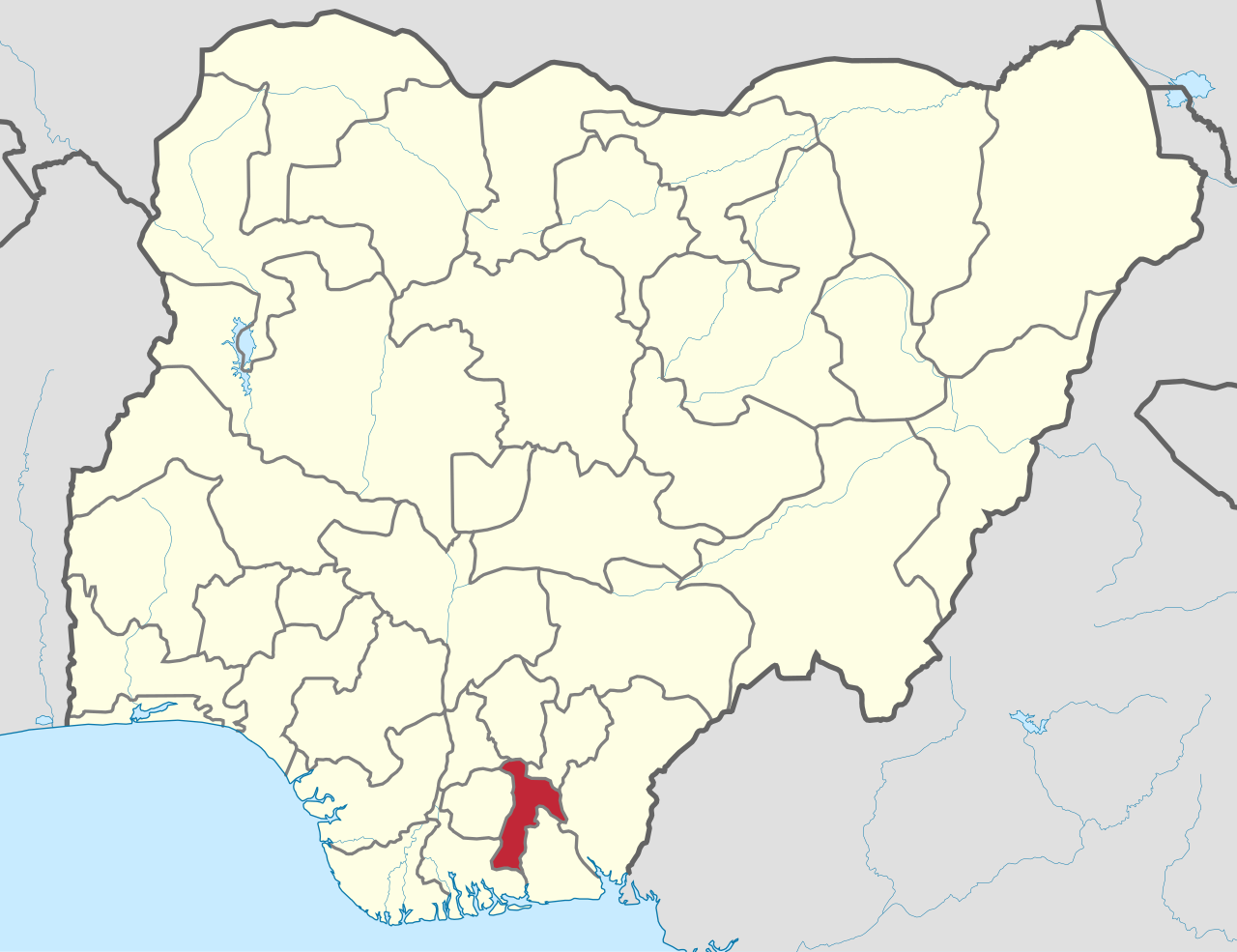
Abia state is a state in South East Nigeria.
1 Aba
2 Abiriba
3 Apumiri
4 Arochukwu
5 Bende
6 Ikwuano
7 Nkporo
8 Okigwe
9 Umuahia
10 Umu Nneochi
Abia State got its name from the state's most populated regions, namely: Aba, Bende, Isuikwuato, Afikpo. The capital city of Abia State is Umuahia, though the largest, most populous, and commercialised city is Aba.
Abia state according to the 2006 population census conducted in Nigeria had a population of 4,112,230 and a total area of 6,320 km2 (2,440 sq mi).
The Igbo people, who are one of the indigenous peoples of south-eastern part of Nigeria, make up 95% of the population. Their traditional language, Igbo is the most commonly used language. English is also widely spoken, and serves as the official language in governance and business.
Geographically, the state is divided between the Niger Delta swamp forests in the far south and the drier Cross–Niger transition forests with some savanna in the rest of the state. Other important geographical features are the Imo and Aba Rivers which flow along the Abia's western and southern borders, respectively.
Abia State's economy is based on the production of crude oil and natural gas, and on agriculture, mainly of yams, maize, taro, oil palm, and cassava. A key minor industry is manufacturing, especially in and around Aba.
1 Sam Mbakwe International Cargo Airport (QOW IATA), Owerri (473119, Umuene Obiangwu). Despite the airport's name, it has passenger flights from Abuja and Lagos.
Getting to Owerri first via Sam Mbakwe International Cargo Airport is the fastest way to get to Abia state via plane. You can book your flight from any part of the country and once you get to Owerri, you can then board a bus that goes to Abia State.
You can easily get to Abia state from Owerri by boarding one of ‘God is Good Motors’, ABC Motors, Agofure Motors and others and the good thing about this transport companies is that you can easily book a seat and pay online, so all you have to do is to get to the part with your payment receipt.
Another way one can get into Abia state is via the rail transportation system and this system is very convenient.
You can also decide to get into Abia state via bus: there are a lot of reputable bus transportation systems that provide a comfortable, air-conditioned ride.
The average cost of travelling to Abia by bus from the South-South and South-East is ₦2,000 (depending on the bus transportation scheme), some charge higher than the other while the average cost of travelling to Abia from the other parts of Nigeria is ₦7,000. Reliable transport companies such as the Young Shall Grow, Abia line, God is Good Motors, Peace Mass Transit, Imo Transport Company (ITC) among many other transport companies are readily available to convey people from different parts of the country to Abia.
You can always book your ride from the comfort of your home and even select your most preferred seat (especially for those who love to seat by the window), so you can easily make the selection and you are ready to move
Getting around in Abia state is mostly done by commercial bus, motorcycles (Okada) and Tricycle (Keke) in some area.
If you need to get around in Abia state, there are usually commercial buses available to take you around, all you need to do is to get to their park and tell them where you are going, you will be shown the bus to get in, and of course tourists need to inform the driver the exact place they want to stop to avoid moving past the bus stop since the tourist might not really know Abia state so well.
Motorcycles popularly called Okada is good for a one-off transportation, and if you are going to a specific one-off destination in Abia state, it is better and very much easy to get on a motorcycle as you are sure that the rider would take you directly to your destination.
Tricycle (Keke) is also an important transportation system in Abia state
The Long Juju Shrine of Arochukwu, Arochukwu If you are interested in African Traditional Religion, then you should ensure you see the Long Juju shrine of Arochukwu.
The Aba River is a river in southern Nigeria. It runs through Aba. It is a tributary of the Imo River. Its headwaters are in Okpu-Umuobo in the Ngwa heartland into the Aba City.
Enyimba International Stadium is a multi-use stadium in Aba. It is used mostly for football matches. It serves as a home ground of Enyimba F.C. The stadium holds 16,000 people after the installation of seats. On November 3, 2008 the stadium received a temporary ban after the home crowd attacked referees after a heated 1-1 tie with rivals Heartland F.C
Ariaria International Market, one of the biggest in Sub-Saharan Africa, was established in Aba in 1976 following a fire outbreak that destroyed the old Ekeoha Market. The market was originally sited in a swampy area.
The National War Museum in Umuahia has displays of weapons from both sides of the 1967-1971 Nigerian conflict and various exhibits pertaining to the event, including boats, planes, tanks, etc outside. No photography allowed inside. Also has bunker from where Voice of Biafra radio transmissions originated.
The Gate of Umuahia is actually not a gate per se. It’s just the name they call the grand market located at the centre of Umuahia. It is also a stop for various commuters buses travelling to and fro from various places in the South East.
Akwete Cloth Production House is a few kilometres from Umuahia. The akwete cloth production is a unique hand woven textile produced in the town of Akwete. The traditional Igbo weaving as demonstrated in Akwete processes sisal-hemp, raffia and spun cotton into finished products. While the coarse raffia materials are used by masquerades and in the past as headgear for warriors among other uses, the hemp material was used to weave towels, ropes, and handbags. The more comfortable and colourful spun cotton is used to weave cloth for everyday wearing. The weaving of the cloth is usually done by the women, and the ability to weave is seen as a gift.
Abia Tower is a beautiful place to behold in Umuahia. It is a grand work of architecture. Abia Tower is graced with a pleasant arrangement of flowers and it is always a perfect site for picture-perfect moments for visitors.
The Museum of Colonial History in Aba is a good place to stop over if you're on your way to Port Harcourt or just interested, this museum covers the colonial history of Nigeria.
There are quite some things you should ensure you do in Abia state as a tourist. Some are:
A visit to the Ekpe Festival Umuahia This is a masquerade festival is peculiar to Umuahia people and it’s celebrated annually in January.
It is a lively cultural festival that attracts people from all walks of life. The festival has existed for so many years and it involves many kinds of Ekpe masquerades performing different kinds of cultural dance during the festival. During the festival, male and female both young and old normally dress in their cultural attire, the male must tie a piece of George (wrapper) to make up for the cultural attire. Male children who have been initiated into Ekpe masquerade, and are skilled in playing the cultural music, show case their talent and expertise in their culture while the masquerade performs the dancing. In appreciation of the performance of the masquerade, players and individual dancers donate money to the masquerade while the music is still on. When the cultural celebration want to come to an end, Ekpe masquerade will use a cutlass and behead a goat at a strike.
New Yam Festival (also known as Iwaji) is the most significant festival in Umuahia Abia State. New yam festival is being celebrated annually at the end of the rainy season in August in thanksgiving to the gods for a bumper harvest. You will see people making different wonders with the yam and it’s usually a very big event.
Some foods the Abia people love eating:
Abacha
Ofe Achara
Ofe Akwu & Rice
Ofe Oha
Ofe Onugbo
Ofe Egusi
Banga
Afang
Edika Ikong
There are places to drink everywhere in Abia State, in fact you don’t need to stress, before you make a very short move, you will definitely come across where you can drink.
The most popular thing you can get in a drink centre is all sort of drinks with pepper soup, fresh fish and Nkwobi.
All you need to do is to enter a drink shop, place your order and enjoy yourself.
Edo State
Oredo
Isolo
Taraba State
Abuja
Anambra State
Delta State
State in the South East, Nigeria For other uses, see Abia. State in NigeriaAbiaState FlagSealNicknames: God's Own StateIgbo: Ọ̀hà nke ChinekeLocation of Abia State in NigeriaCoordinates: 5°25′N 7°30′E / 5.417°N 7.500°E / 5.417; 7.500Country NigeriaLGAs17Date created27 August 1991;34 years ago (1991-08-27)CapitalUmuahiaGovernment • BodyGovernment of Abia State • GovernorAlex Otti (LP) • Deputy GovernorIkechukwu Emetu (LP) • LegislatureAbia State House of Assembly • SenatorsCentral: Austin Akobundu (PDP)North: Orji Uzor Kalu (APC)South:Enyinnaya Abaribe (APGA) • RepresentativesListArea • Total6,320 km2 (2,440 sq mi) • Rank32nd of 36Population (2022 est) • Total4,143,100 • Rank26th of 36 • Density656/km2 (1,700/sq mi)DemonymNdi AbiaGDP (PPP) • Year2021 • Total$22.83 billion18th of 36 • Per capita$5,3519th of 36Time zoneUTC+01 (WAT)Postal code440001ISO 3166 codeNG-ABLanguageIgboEnglishHDI (2022)0.622medium · 10th of 37Websiteabiastate.gov.ng Abia Listenⓘ (Igbo: Alaọha Abia) is a state in the Southeastern region of Nigeria. The state's capital is Umuahia and its most populous city is Aba. The legislature is the Abia State House of Assembly. One of the smallest states in Nigeria, Abia is bordered to the west by Imo, east by Cross River, south by Rivers, northwest by Anambra and northeast by Enugu and Ebonyi. The state is divided between the Niger Delta swamp forests in the south and the Cross–Niger transition forests. The Imo and Aba Rivers flows along the state's western and southern borders respectively. Known for producing crude oil and natural gas, Abia ranks eighth by Human Development Index since 2019. The name "Abia" is an abbreviation of Abia state's four densely populated regions Aba, Bende, Isuikwuato, and Afikpo. Abia's slogan is "God's own state". Abia is one of the 36 states in Nigeria, and has seventeen local government areas. It was created on 27 August 1991 out of Imo State by General Ibrahim Babangida, and it is located in the south-eastern part of Nigeria with Umuahia as the capital, and Aba as the commercial city. Abia State's history begins as part of the Aro Confederacy until its defeat in the early 1900s by the British troops during the Anglo-Aro War. After the war, the area was incorporated into the Southern Nigeria Protectorate of British Nigeria. After Nigeria's independence in 1960, Abia became part of the Eastern Region until 1967 before the region was split, and it became part of the East Central State. The Eastern Region attempted to secede in Nigerian Civil War with Abia as part of the secessionist state of Biafra. After the war and the then reunification of Nigeria, the East Central State was merged until 1976 when Imo including Abia, was formed by Murtala Muhammed. Eastern Imo would later become the old Abia State after a split. In 1996, part of Abia's northeast was removed to form a part of the new Ebonyi. The Igbo people make up 100% of the state's population and the official language is Igbo.. There are over 3 million Christians. Catholic Hierarchy analyses that there are 689,668 Catholics (2020) in Diocese of Umuahia with over 70 parishes, and Aba Diocese with over 90 parishes, both suffragans of the Archdiocese of Owerri.
[edit] See also: List of Nigerian states by date of statehood Abia State was created from Imo State by Ibrahim Babangida on 27 August 1991.
[edit] Azumini Blue River in Abia state, Nigeria Abia State occupies about 4902 square kilometres. It is bounded on the north and northeast by the states of Enugu for about 25 km, and Ebonyi for 70 km (43 miles), Cross River State for about 52 km (partly across Cross River) and Akwa Ibom State for 151 km (94 miles) to the east and southeast respectively, Rivers State to the south and west for 87 km (54 miles), Imo State and Anambra to the west for to the west in the vicinity of the Imo River for about 18 km and about 104 km respectively. The southernmost part of the State lies within the Niger Delta Swamp Forests, while the rest of the state, lies within the Cross–Niger transition forests. The southern portion gets heavy rainfall of about 2,400 millimetres (94 in) per year and it is intense between the months of April through October. The most important rivers in Abia State are the Imo and Aba Rivers which flow into the Atlantic Ocean through Akwa Ibom State. Administration[edit] See also: List of villages in Abia State and List of local government areas in Abia State Abia State has 17 local government areas (LGAs), they are: Aba North Aba South Arochukwu Bende Ikwuano Isiala Ngwa North Isiala Ngwa South Isuikwuato Obi Ngwa Ohafia Osisioma Ngwa Ugwunagbo Ukwa East Ukwa West Umuahia North Umuahia South Umu Nneochi These local government areas also contain numerous villages. Environmental Issues[edit] Solid waste[edit] Municipal solid waste management (MSWM) deals with the collection, storing, treatment and disposal of solid waste, to ensure that it does not affect humans, living things and the environment at large. There are factors that influence Municipal solid waste generation such as income level, local climatic condition, urbanization and economic development. MSW in Aba, Abia State is classified into; Domestic waste (waste from households, food centers, markets, and commercial premises) Industrial waste (excluding toxic waste that requires special handling) Institutional waste (waste from government establishments, schools, hospitals and recreational facilities In recent times, it was reported that Aba and Umuahia generate up to two hundred and seventy truckloads of domestic and commercial waste daily. This information was made known to the public by Governor Alex Otti during his inauguration speech after taking the baton of government from the former governor, Okezie Ikpeazu. Climate[edit] Aba experiences a warm and gloomy wet season as well as a scorching and oppressive dry season. The temperature rarely drops below 61 °F (16 °C) or rises over 91 °F (33 °C) throughout the entire year, fluctuating between 68 and 88 °F (20 and 31 °C). The beach/pool score indicates that the best time of year to visit Aba for hot-weather activities is from late November to early February. In Aba, the rainy season is warm and cloudy, the dry season is hot and largely gloomy, and the climate is uncomfortable all year long. The average annual temperature ranges from 68 °F to 88 °F, with occasional exceptions when it falls below 61 °F or rises over 91 °F. Since Aba experiences so small seasonal temperature variations, talking about the hot and cold seasons is not very helpful.
[edit] Religion[edit] The residents of Abia state are predominantly Christians and most are Catholics. The catholic dioceses of Umuahia, established in 1958 and Aba, established in 1990 are the two catholic dioceses located in Abia State with 70 and 90 parishes respectively. They are both suffragans of Owerri Archdiocese. The Aba Province of Anglican Church of Nigeria led by Archbishop Isaac Nwaobia comprises the nine Dioceses of Aba led by Bishop Christian Ugwuzo, Aba Ngwa North (2007) led by Bishop Nathan Kanu, Arochukwu/Ohafia led by Bishop Johnson Onuoha, Ikwanuo led by Bishop Chigozirim Onyegbule, Isiala Ngwa led by Bishop Temple Nwaogu, Isial-Ngwa South led by Bishop Isaac Nwaobia, Isikwuato led by Bishop Manasses Chijiokem Okere, Ukwa led by Bishop Samuel Kelechi Eze, and Umuahia led by Bishop Geoffrey Obijuru Ibeabuchi. There are also other pentecostal churches located within Abia State including Living Faith Church which has more than 100 branches within the state.
[edit] Crude oil and gas production is a prominent activity, as it contributes over 39% of the State's GDP. However, the indigenous oil companies – through the Marginal Fields Programme (MFP) – have not found it easy to attract the requisite funding and infrastructural capacity, to explore some of the marginal oil fields which are about 50 in the State. The manufacturing sector only accounts for 2% of the GDP. The industrial centre of the state is in Aba, with textile manufacturing, pharmaceuticals, soap, plastics, cement, footwear, and cosmetics. In addition to the above, Abia State Government built a 9,000 capacity multipurpose International Conference Centre in Umuahia. This edifice of international standard was built by Governor T.A. Orji, to enhance tourism as well as boost the state economy, through hosting of major international and local events. Representing 27% of the GDP, agriculture – which employs 70% of the state workforce – is the second economic sector of Abia. With its adequate seasonal rainfall, Abia has much arable land that produces yams, maize, potatoes, rice, cashews, plantains, taro, and cassava. Oil palm is the most important cash crop. Oil and gas exploration[edit] There are over 100 oil wells and 3 installed flow stations in Abia State. There is also an associated gas plant, Abia/NNPC gas plant. As of 2012, boundary Commission said it returned 42 oil wells from neighbouring Rivers State to Abia. This makes Abia the fourth largest oil-producing state in the country. Oil giant, Shell, holds most of the licenses for the wells in the State, and has concentrated on the estimated 50 wells that are considered high-yield. The state produced 36,000 barrels of crude oil per day; "Imoturu produces 23,000 barrels per day and Isimili flow station produces over 8,000 barrels of crude oil per day. Then four oil wells in Izaku go to Obigo flow station. About 30 oil wells from my village go to Umuri, and about eight oil wells from Umurie go to Afam", said Samuel Okezie Nwogu, Chairman of Abia State Oil Producing Development Area Commission (ASOPADEC). However, the State has complained of poor funding from its oil revenue federal allocation.
[edit] Abia state's public and private secondary schools, according to a document by the Ministry of Education, had a student–teacher ratio of 8:1 to 12:1 from 2013 to 2016 school year. All school divisions must adhere to educational standards set forth by the Abia State Ministry of Education.[citation needed] In 2016, 13,699 students (5,512 males and 8,187 females) were enrolled in public schools while 14,798 (7,068 males and 7,730 females) were enrolled in private schools. In 2017, 13,351 students (5,517 males and 7,834 females) were enrolled in the public schools, while 39,280 students (19,260 males and 20,020 females) were enrolled in private schools. According to the National Bureau of Statistics, there exists, as of 2016, 168 public schools and 194 private schools, and, as of 2017, 233 public schools and 1,095 private schools. In 2016, 3859 students graduated from public high schools while 5419 graduated from private schools. In 2017, 3691 graduated from public schools while 11,707 graduated from private schools. As of 2025[update] Goodluck Ubochi serves as the Commissioner for Basic and Secondary Education while Uche Eme serves as the Commissioner for Tertiary Education. Colleges and universities[edit] Main page: Category:Universities and colleges in Abia State According to The Guardian, Abia had a literacy level of 94.24 percent in 2017 after Imo, Lagos, and Ekiti States. The Ministry of Education recognizes 5 universities in Abia; one federal, one state, and three privately-owned universities. In the 2025 Unirank ranking of universities, Michael Okpara University of Agriculture ranked 57th, Abia State University is 67th, Gregory University is 94th, Rhema University is 105th, Clifford University is 147th, and Spiritan University, Nneochi is 161th. Abia State University, founded in 1981 is the only state university and the oldest in Abia. Lux Mundi University became the first private university in Umuahia, the state capital. In 2024, the state under Governor Alex Otti, adopted a policy of free and compulsory basic education for all the state's residents as well as non-indigenes which took effect in January 2025.
[edit] The nearest airport to Abia is Sam Mbakwe Cargo Airport (Owerri Airport), it is an hour drive to Umuahia and Aba. It is two hours' drive to Port Harcourt International Airport. Akwa Ibom Airport (Akwa Ibom State) can also serve would-be visitors. The distance between Uyo (Akwa Ibom) and Umuahia (Abia) is 73.28 kilometres (45.53 mi). Rail transport is also available in the state. Aba is connected to Port Harcourt by rail, Umuahia is connected to Aba and Enugu by rail. The coastal parts of the State are equally accessible using boats and canoes. Federal Highways are; A3 northeast from Port Harcourt (Rivers State) via Umuahia, Umuokwara (Imo State) and across the north of Abia State again via Lokpaukwu to Enugu State, F103 east from Akwa Ibom via Ikot Ubo to Oron, F104 from Aba via Azumini, Etinam, and Ndiya to F103 at Ikot Ubo, F107 from Umuahia via Bende to F234 in Ohafia, F108 from Arochukwu, in the southeast, via Ikot Okpora and Orira to A4, F112 the Okigwe-Afikpo road east from Imo State via Okigwe to Ebonyi State. Other major roads includes; Southeast from Okigwe to Amiyi-Uhu (Ogboro Junction) to Amaba The Ahaba-Umunekwu east and south from Amaba as the Ohafia-Ogo Ubi-Agu Eze Road to join the Umuahia-Ohafia Road, The Umuahia Rd south to Akwa Ibom, The Obohia-Azumini Rd east to Akwa Ibom, North from A3 at Uzuaku to Owaza (Rivers State), The Asa-Akwere-Obohia Road west from A3 at Obehie Junction to Owaza The Eberi-Umu Uyo Road southwest from A6 at Umuvo to Rivers State.
[edit] The State Government is led by a democratically elected Governor who works closely with members of the state's House of Assembly. The capital city of the state is Umuahia, and there are 17 local government areas in the state. Abia State House of Assembly, Nigeria At statehood in 1991, Abia was ruled by Ibrahim Babangida-appointed Military Administrator Frank Ajobena before Ogbonnaya Onu was elected governor later that year under the Third Nigerian Republic. Onu governed for nearly two years before Sani Abacha ended the Third Republic and reinstated full military rule. Under the Abacha regime, three more Military Administrators (Chinyere Ike Nwosu, Temi Ejoor, and Moses Fasanya) were appointed before Abacha's death and the accession of Abdulsalami Abubakar. Abubakar appointed one more Military Administrator, Anthony Obi, before starting the transition to democracy in 1998. In 1999, Nigeria returned to democracy, and Orji Uzor Kalu was elected governor on the platform of the People's Democratic Party. Consequently, he was sworn in on 29 May 1999. In 2003, when it was time for fresh elections, Kalu re-contested on the platform of the PDP and got a second mandate to govern (the Constitution of Nigeria limits Governors to two terms in office). At the end of Kalu's term in 2007, Theodore Orji (PPA) defeated Onyema Ugochukwu (PDP) in the 2007 gubernatorial election, to become Abia's next Governor. In 2011, Theodore Orji defected from the PPA to the PDP before being re-elected for another four-year term later that year. In 2015, Okezie Ikpeazu (PDP) was voted in as the ninth Governor of Abia State. Four years later, he won re-election, defeating Uche Ogah of the All Progressives Congress and Alex Otti of APGA to be sworn in as Governor for a second term on 29 May 2019. In Abia State, 70 percent of politicians belong to the PDP. In 2023, Alex Otti of the Labour Party Nigeria (LP) emerged as the eleventh governor of the state having defeated the candidate of the PDP in a fiercely contested race. Electoral system[edit] The electoral system of each state is selected using a modified two-round system. To be elected in the first round, a candidate must receive the plurality of the vote and over 25% of the vote in at least two -third of the State local government Areas. If no candidate passes threshold, a second round will be held between the top candidate and the next candidate to have received a plurality of votes in the highest number of local government Areas.
[edit] See also: List of people from Abia State Inside view of Amakama living Tree with a wooden cave in Abia State, Nigeria Tourist destinations include: Arochukwu, which is associated with slave trade. Azumini Blue River waterside The Amakama wooden cave; a hollow tree that can accommodate up to twenty people. Caves located in the north, ranging from Umunneochi to Arochukwu. Traditional festivals and dances National War Museum, Umuahia and Ojukwu Bunker in Umuahia Museum of Colonial History in Aba "Akwete" cloth weaving at Ukwa-East LGA Ohafia War Dancers Amafor-Isingwu biannual Iza aha ceremony Ekpe Festival in Umuahia Ezumezu Festival in Igbere, Bende (held triennially)