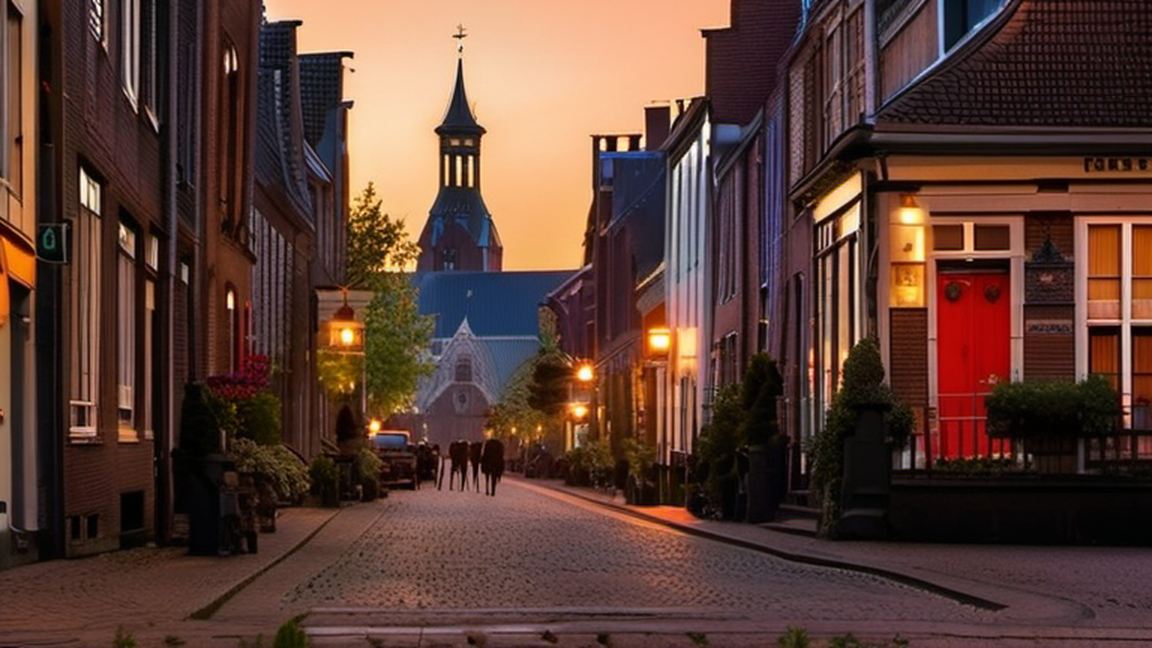
's-Hertogenbosch, commonly known as Den Bosch, is a city in the south of the Netherlands and the capital of the province of North Brabant. Once a stronghold, vital in the protection of the young Dutch nation, Den Bosch h
's-Hertogenbosch, commonly known as Den Bosch, is a city in the south of the Netherlands and the capital of the province of North Brabant. Once a stronghold, vital in the protection of the young Dutch nation, Den Bosch has a charming and well-preserved medieval centre. Wander through the winding streets to see Saint John's Cathedral and then pick out a street terrace on the market square to relax with a chilling beer. Take a boat to see part of the unique Binnendieze, a subterranean network of canals under the city, or head to the south part of town where the ancient ramparts still mark the border of the city and the beginning of a natural reserve area. In short: what Den Bosch lacks in fame, it makes up for in charm. A place well worth visiting.
Located where the rivers Aa and Dommel meet, the city of 's-Hertogenbosch became a city in 1184. It is one of the foremost cities of the historic Duchy of Brabant (1183 - 1794), which roughly consisted of the Dutch province of Noord-Brabant and large pieces of Flanders. Being one of the first cities founded in the Low Countries during the Mediaeval period, the charter which granted Den Bosch its city rights was subsequently used and adapted by a lot of other newly founded cities throughout the Low Countries.
's-Hertogenbosch lends its name to the very Duchy it was once located in, meaning "The Duke's forest". Its shorter name, Den Bosch, is an abbreviation of said name. In other languages of mainland Europe, the name of the city is often translated (German: Herzogenbusch, French: Bois-le-Duc), which is fairly unique with Dutch cities.
The city holds significance for the Netherlands as a whole due to its siege of 1629 being a turning point for the Dutch revolution and the independence war that formed from said revolution. The city until that point had been considered to be impossible to successfully besiege, earning it the nickname De Moerasdraak (The Swamp Dragon). The capitulation of the city after a siege of half a year, gave stadtholder Frederik Hendrik the highest victory of his military career with him thus forth being known as De Stedendwinger (The subjugator of cities), but also led to an exodus of many Catholic citizens and clergy, as a reparation for the siege.
The population of Den Bosch is approximately 151,000 and with that it is reaching its limits, because almost all the ground available for building has been used. This does not mean that the whole area is one big city, as there are several (big) parks. Likewise, the southern edge of the city is totally green as this is a protected natural reserve.
Den Bosch can be seen in 9 regions (note: these regions are built up of several neighborhoods):
Center includes the whole area inside the city walls. Most sights and places to visit can be found in this area.
North is the area between the city center and the A59, which includes the neighborhoods de Rompert, Orthen, Herven and the area around the Prins Hendrik Park.
Maaspoort is the area north of the A59. Mostly a residential area with some industry.
Hintham is the area around the FC Den Bosch football stadium.
South is the area between the city center and the A2 highway to the south. Residential, but with also a large amount of office buildings.
Amsterdam Airport Schiphol (AMS IATA), the largest airport in the Netherlands and of Europe's most important intercontinental hubs, is roughly 1½ hr away from Den Bosch by train. The cost is €17.80 for the complete journey. There are multiple times an hour allowing such connections. Consult e.g. 9292.nl for the most convenient option.
Eindhoven Airport (EIN IATA), the country's second largest, is in Brabant and is mainly served by low-fare carriers from many European cities, with special emphasis on Eastern Europe and the Mediterranean. Getting to Den Bosch from Eindhoven is as simple as taking one of the many trains shuttling every hour between the cities, taking less than 20 minutes to connect them, but you must get a bus ride from the airport to Eindhoven station first, adding another 20 minutes to the travel time. With some walking and waiting factored it, the total journey time should not be over 50 minutes and will only cost you €6.30 in total.
Rotterdam The Hague Airport (RTM IATA) is a smaller, business-focused airport in the city of Rotterdam, which can be used as an alternative to Schiphol from some destinations. The airport also does not have a direct train connection - you need to take the bus to Rotterdam Centraal (20 min) and then a direct Intercity train to 's Hertogenbosch. Total journey time is under two hours and cost is less than €18.
Den Bosch has a good location within the railway system of the "Nederlandse Spoorwegen" (Dutch Railroads) and almost every city has a direct connection or with a single stopover. Trains depart from Den Bosch main station in city center, which is located at the 'Stationsweg', towards Utrecht-Amsterdam-Haarlem and Utrecht-Schiphol in the north, in the direction of Nijmegen-Arnhem-Zwolle in the east, towards Eindhoven-Maastricht in the south and Tilburg-Breda-Roosendaal in the west.
Den Bosch is accessible via the A2 highway, which was improved in 2016, alleviating the previously chronic traffic jams.
The major highway that passes Den Bosch is the A2, generally seen from Amsterdam to Maastricht. This one of the busiest highways of The Netherlands, and the part along Den Bosch, known as "knooppunt Hintham" and "knooppunt Empel" (intersection Hintham and Rosmalen), is in the top 5 of busiest traffic points in The Netherlands.
The other, less busy, highway passing Den Bosch is the A59, coming from Roosendaal (and the A16) towards Nijmegen. This highway is less busy than the A2, although traffic jams might occur when there is a jam on the A2 as the A59 merges into the A2 for a short part.
Nevertheless, if staying outside the peak hours, which are roughly from 07:00-09:00 and from 16:30–19:30, Den Bosch is easily accessible by car.
The regional buses, operated by the BBA, link Den Bosch with Tilburg and Eindhoven. As these are the regional buses, they do not go directly between these city but stop at several small villages. Therefore, the fastest and advisable way is using the train.
Everything within the city center is reachable by foot. Everywhere in the city, so also in the suburbs, are sidewalks. In the city center, most areas are accessible by foot and bicycle only, and traffic within the city is restricted.
There is a free electric citybus that can take you from the central railroad station to the city centre and back.
If you want to go to the suburbs (where there is no reason to, as all points of interest are within the city center), Arriva operates a network of buses throughout the city and places in the vicinity. All buses arrive and depart from the central station, although for some lines it is not a terminus. Travelling on these buses is around €1.20 per zone, and you have to purchase at least 2 zones. You can either pay cash at the driver, or use an OV-chipkaart.
The city council is trying to get the city center car free, so it is bringing up all kind of measures to deter people from taking the car into the city. Cars can still be parked in the city center, but on Saturdays and Thursday evening these garages are packed. Parking is also available just outside the city center and from there buses are available every 15 minutes for only a few euros including bus trip.
The best means of transportation is, just as in the rest of the Netherlands, by bicycle. The city is rather flat and bike friendly
While taxis are relatively expensive in the Netherlands, they are typically reliable and can be good value if you're a small group. Taxis can be found in front of the train station and are available on call. Companies include Taxi TCO (☏ +31 412 484 41) and Taxi de Hart (☏ +31 73 5112733). They will also offer transportation services to other cities or towns in the region. While they will work by meter for trips inside the city, fixed prices are available for longer trips, e.g. to Eindhoven Airport (around €45) or Schiphol (around €90).
's-Hertogenbosch is a medieval city and among the oldest cities in the Netherlands. As the city center is historically protected there are still a lot of medieval buildings to be found. Wander around and see the traditional building style.
When the Netherlands were still young it was a fortified city that served for the protection of the Netherlands. Especially on the south side of the city, a lot of these fortifications have been saved and over time restored. Start at Bastion Vught and walk northwards via the Parklaan, Spinhuiswal, Zuidwal and Bastion Oranje and Hekellaan until you reach the bridge over the Zuid Willemsvaart. This way you cover the best part of the old fortifications. In 2004, the city was awarded European Fortress of the year.
Hidden below the old city is a canal network called the Binnendieze that once stretched 22 km. It started out as a regular river, the Dommel, running through the city in medieval times but due to lack of space in the city, people started building their houses and roads over the river. In later times it functioned as a sewer and fell into disrepair. The remaining sixth of the old waterway system has been renovated, and it is possible to take several guided subterranean boat trips through it.
1 Saint John's Cathedral (Sint Jans Kathedraal). One of the most prominent landmarks of Den Bosch. Building started in 1380, in Gothic style. The exterior of the building had been deteriorating fast due to acid rain and restoration works started in 1960. It has taken many years to restore the full church, but the works are completed and the church can be seen in all its glory. The restoration also included the interior. Of course some minor maintenance takes place constantly. (updated Jan 2016)
2 The Moriaan (on the market square). The oldest brick building in The Netherlands, built in the 13th century. It houses the Tourist Center (VVV), and in the basement, the rock cafe Plein79. (updated Jan 2016)
3 Town Hall (Stadhuis), Markt 1 (south side of the market square). The facade was built in the 17th century and reflects Dutch classicism. The cellars are from about 1200, with a restaurant for coffee, tea, lunch, etc. (updated Jan 2016)
4 The North Brabant Museum (NoordBrabants Museum). It houses a collection of art and historical artifacts, from pre-Roman times to the 20th century. Special exhibitions are a must to see, the 'Hyeronimus Bosch Exhibition' with his original work from museums all over the world. (updated Jan 2016)
5 City Museum 's-Hertogenbosch (Stedelijk Museum 's-Hertogenbosch (SMS)) (next to, and connected to, the North Brabant Museum). A museum for modern art. Together they form one of the biggest museums of the Netherlands. The ground floor can be visited freely, and it's up to you to decide to see more. (updated Jan 2016)
Take a boat on the Binnendieze, a river that goes below the houses of the center of town, which was used historically as an open sewer, but is now quite a special tour. There are several tours available. It is a popular tour so be aware when booking a time. Tickets can be bought at the Bolwerk which also have a beautiful café and a restroom free of charge.
1 De Maashorst, Visitors Centre: Erenakkerstraat 5, 5388 SZ Nistelrode (30 km east of s-Hertogenbosch via the N279 and A50), ☏ +31 412 611 945.
2 Brabanthallen, Diezekade 2. The third-largest event venue in the Netherlands (after the Amsterdam RAI and Utrecht Jaarbeurs) at 55,000 square metres (590,000 sq ft) of indoor space, which hosts many events, fairs, congresses and concerts year-round. (updated Oct 2022)
61st Record Planet Mega Record & CD Fair: 14–16 November 2025. Held twice annually, the Mega Record & CD Fair is not just the largest record fair in the Netherlands, but is a strong contender for the biggest in the world. The event, held during a weekend in April/May and November of each year, draws in over 600 vendors from all over the world selling vinyl, CDs, and other media and music-related items. (date needs updating)
Art & Antiques Fair: April. Renowned antique and art fair, pulling in some 25,000 visitors from multiple countries. (date needs updating)
Den Bosch is a popular place for shopping, combining a charming historic atmosphere with a wide variety of stores. In the city centre you'll find all the major chains and department stores. For more characteristic speciality stores or small boutiques try the Snellestraat or the so-called Bossche Kwartier, meaning the small streets around the Fonteinstraat. The Verwerstraat, with its large monumental buildings, is the place to go for antiques, fashion and design. The Vughterstraat is another excellent pick, with clothing shops as well as some fine home decoration and furniture places.
Markets are frequently held on the large market square. The main market is on Saturdays (09:00-17:00) and has a wide selection of food and non-food products. On Wednesday the selection is similar, but the market somewhat smaller. On Fridays, there's a biological market (09:00-14:00) with a good selection of high-quality, mostly regional products. There's another regular market on every first Sunday of the month, but it's a lot smaller than the one on Saturday.
The city centre is packed with small and large restaurants that serve all kinds of crowds. The streets Korte Putstraat and the Lange Putstraat are your best bet if you're looking for a meal, as they have a particularly broad selection of places with nice outdoor terraces in summer. Typically you'll have no problems finding a table somewhere, but if you have a particular establishment in mind or if you want a good table on the terrace it's definitely wise to reserve ahead, as the best places are often full.
1 Eten bij Fret, Postelstraat 37. (updated Aug 2023)
2 De Frietzaak, Hooge Steenweg 30. (updated Aug 2023)
3 Café De Palm, Hinthamerstraat 82. (updated Aug 2023)
4 Het Spoor Grillroom & Pizzas, Boschveldweg 86. Turkish (updated Aug 2023)
5 Cigkoftem Den Bosch, Christiaan Huygensweg 133. (updated Aug 2023)
6 Pizzeria Da Lino, Graafseweg 145. (updated Aug 2023)
7 Gündem Döner, Rivierenplein 1. (updated Aug 2023)
8 Eetcafé 't Keershuys, Lepelstraat 45, ☏ +31 73 612 80 87, info@keershuys.nl. Cosy place in a 14th-century building, once a small cheese factory. Today it's a restaurant serving simple, good value for money food. It's also a popular place for lunch and High Tea. They have lunch breads, pasta dishes and other mains. In the evening you can have the dish of the day. Lunch special for €14. (updated Aug 2023)
9 7evenden Hemel, Korte Putstraat 13-17, ☏ +31 73 6901451. Popular with locals, this place gets good reviews and is often crowded. Mains start around €23 and there's several vegetarian options too. The staff is friendly; ask them for the English menu. €43 for a set 3-course menu. (updated Aug 2023)
10 Brasserie Top, Markt 42, 5211 JX 's-Hertogenbosch,, ☏ +31 73 613 7616. (updated Aug 2023)
11 FF Swanjee, Hinthamerstraat 76-78, ☏ +31 73 - 614 78 32. Daily from 12:00. This popular and informal place serves a range of small "wappaz", an internation take on tapas, available in small and large portions. The menu also has some excellent grill dishes, lots of cocktails and tasty desserts. Sharing is encouraged. (updated Aug 2023)
12 Restaurant Sense, Verwersstraat 58, ☏ +31 73 614 42 08, info@restaurantsense.nl. Tu-Sa. Sense has a number of small, high quality dishes on the menu; the idea is that you order them more or less in a random order, as you like. Count on 4 dishes for an average eater. If you're not very picky, the surprise menu is a good option. 2 courses for €55 and 3 courses for €75 (only for lunch). 4 courses €95. (updated Aug 2023)
13 Fabuleux, Verwerstraat 23, ☏ +31 73 741 00 11. W-Sa. Proper French cuisine in a historic house. This place also has some excellent wines on the menu. From €62 for a 3-course surprise. 4 courses €75. (updated Aug 2023)
The city is famous for a local pastry called "Bossche Bol" or "moorkop", a must-try for any visitor. It's a chocolate ball filled with cream, the size of a tennis ball, typically eaten with a cup of coffee in the afternoon but also for dessert. It makes for a fine sweet treat when you kick back and relax at one of the many cafés, after a day of walking through town.
Jan de Groot, Stationsweg 24. This bakery is particularly well-known for its Bossche bollen and caters to many of the cafés in town. They also have a lunchroom of their own. €2.60 for one pastry. (updated Oct 2022)
Nightlife in Den Bosch is as you might expect from a city of its size: not as extravagant as Amsterdam or Rotterdam, but nice, with a friendly crowd attending and a nice atmosphere. The places most worth visiting:
De Drie Gezusters (One of the most popular places in Den Bosch, it has 3 areas: Pub, Apres Ski and Club with different music and appearance. Can't miss it on Friday and Saturday as there will be a line outside.), Karrenstraat. Opens at 21:00, but the scene starts at around 23:00. Open until 04:00. Entrance €4, coatcheck €1.
Cinq (formerly known as the Cuba Libre, it turns into a nightlife scene after 23:00. On busy nights hard to get in.), Parade, ☏ +31 73 6900768. Entrance depends on attendance. Busy nights require around €2 entrance to be paid.
De Carrousel (Place to attracts a crowd of mainly 25+. Is sometimes open slightly longer than the other places.), Karrrenstraat, ☏ +31 73 6900311. Starts at around 22:00 until 04:00, sometimes later.
Silva Ducis (Next to Cinq, same attendance.), Parade, ☏ +31 73 6130405. 10:00-16:00.
Golden Tulip Hotel Central, Burg. Loeffplein 98 (the hotel is on the north side of the Markt, easily recognized as a white building), ☏ +31 73 6926926, fax: +31 73 6145699. It's in the city center, and is one of the best hotels to visit the city if you are willing to pay a little more. around €140.
1 Mövenpick Hotel 's-Hertogenbosch (Moevenpick), Pettelaarpark 90 (near the highway A2. Take exit 22, where signage will guide you to the hotel.), ☏ +31 73 6874674, fax: +31 73 6874635, hotel.s-hertogenbosch@moevenpick.com. Check-in: 15:00, check-out: 12:00. This 4-star hotel offers clean, cosy rooms with good showers and 100% organic, fair trade linen. There's a spacious (no-swimming suit) sauna and infra-red room and the hotel restaurant offers a diverse menu with healthy and vegetarian options. This hotel is located in a business area but lies next to a small lake, which gives it its charm. It's about a 20-minute walk from the city centre and easily accessible by car. The large parking has electric car charging options. Bicycle rent is also available and there's a bus stop 200 meters away, with connections to the city centre. around €140. (updated May 2016)
Best Western Euro Hotel (/ in the city center), Kerkstraat 56 (near the St. Jans Cathedral opposite the main post office.), ☏ +31 73 6137777, fax: +31 73 6128795. Check-in: 14:00, check-out: 11:00. €95.
Campanile Hotel 's-Hertogenbosh (Cheap hotel located in the northern suburb 'Maasport' and adjacent industrial area), Goudsbloemvallei 21-25, ☏ +31 73 6422525, fax: +31 73 6410048, denbosch@campanile.com. €59.
Bark Hotel 's-Hertogenbosch.
Fletcher Hotel Rosmalen (Located outside the city center along the A2 highway), Burg. Burgerslaan 50, ☏ +31 73 5219159, fax: +31 73 5216215, info@fletcherhotelshertogenbosch.nl.
van der Valk Hotel Vught (Large hotel located in the town of Vught, about 10 minutes by bus to 's-Hertogenbosch.), Bosscheweg 2, ☏ +31 73 6587777, fax: +31 73 6587700, vught@valk.com. €80-100.
Den Bosch uses the area code 073.
Den Bosch is in general a safe city. Even the neighborhoods considered dangerous by the locals are still quite safe during daylight (Hambaken, Graafsewijk and Kruiskamp). If a traveler uses his common sense he will be alright, also during night. The only time the crowd can get a bit rough is during Thursday, Friday and Saturday night. These are the general party nights, so people sometimes drink too much. Watch out to the drunk people that might easily start brawls (especially during the carnival).
Well connected and at a fairly central location, there are endless options for next destinations when leaving 'sHertogenbosch. Some of the more prominent nearby places are Utrecht, Tilburg, Eindhoven, Breda and Nijmegen. Families will find fun all year round at the Efteling, the country's largest theme park. The Loonse en Drunense Duinen National Park is also a short ride away.

City in North Brabant, Netherlands "Den Bosch" redirects here. For the association football team, see FC Den Bosch. For the basketball team, see Heroes Den Bosch. For the field hockey club, see HC 's-Hertogenbosch. For all uses of Bosch, see Bosch (disambiguation). This article needs additional citations for verification. Please help improve this article by adding citations to reliable sources. Unsourced material may be challenged and removed.Find sources: "'s-Hertogenbosch" – news · newspapers · books · scholar · JSTOR (December 2021) (Learn how and when to remove this message) City and municipality in North Brabant, Netherlands's-Hertogenbosch Den BoschCity and municipalityView over the city centreThe city seen from the Bossche BrookBinnendieze canalsDragon FountainHieronymus BoschNorth Brabant MuseumSt. John's CathedralCity hall of 's-Hertogenbosch FlagCoat of armsBrandmarkInteractive map of 's-Hertogenbosch's-HertogenboschLocation within the NetherlandsShow map of Netherlands's-HertogenboschLocation within EuropeShow map of EuropeCoordinates: 51°41′N 5°18′E / 51.683°N 5.300°E / 51.683; 5.300CountryNetherlandsProvinceNorth BrabantGovernment • BodyMunicipal council • MayorJack Mikkers (VVD)Area • Municipality117.81 km2 (45.49 sq mi) • Land109.99 km2 (42.47 sq mi) • Water7.82 km2 (3.02 sq mi)Elevation6 m (20 ft)Population (Municipality, May 2022; Urban and Metro, May 2014) • Municipality160,783 • Density1,414/km2 (3,660/sq mi) • Urban169,714 • Metro198,000 • Metro region355,230 • Brabant CMSA1,932,055DemonymBosschenaarTime zoneUTC+1 (CET) • Summer (DST)UTC+2 (CEST)Postcode5200–5249Area code073Websites-hertogenbosch.nl 's-Hertogenbosch (Dutch: [ˌsɛrtoːɣə(m)ˈbɔs] ⓘ), colloquially known as Den Bosch (pronounced [dɛm ˈbɔs] ⓘ), is a city and municipality in the Netherlands with a population of 160,783. It is the capital of the province of North Brabant and its fourth largest city by population. The city is directly south of the Maas river and near the Waal.
West is the area west of the central station. High presence of industry, as well as the residential neighborhoods Kruiskamp and Helftheuvel. The Brabanthallen can be found here.
Engelen is the village of Engelen which is going through the development of Haverleij, a combined residential complex on a golf course.
Rosmalen, a town to the east of the A2.
Empel, small village to the north of Rosmalen.
Most visitor attractions are found in the center, except for the footballstadium and the Sportiom.
6 Jhyeronimus Bosch Art Center, Hinthamerstraat (in a former church). It displays all the works of the famous painter. All in live sized copies. Combined with 3D models of his monsters and objects. Because the paintings are copies, you can get very close to them and the guide will open or close the panels to get the full picture. Visitors, young and old, can enjoy this permanent exhibition. (updated Jan 2016)
7 Citadel (In the north of the city center, outside the boundaries of the northern fortifications). This fortress was added to the city later and is not directly included in the fortifications but sort of pasted on. It held the garrison to protect the city or, if necessary, to counter an uprising in the city. It is now part of the national archive.
8 Kruithuis (powder arsenal) (Opposite the Citadel). It is a hexagonal building and one of the last of its kind. It is used as a museum for art.
9 De Maashorst Nature Centre (Natuurcentrum De Maashorst), Visitors Centre: Erenakkerstraat 5, 5388 SZ Nistelrode, ☏ +31 412 611 945.
[edit] For a chronological guide, see Timeline of 's-Hertogenbosch. The city's official name is a contraction of the (archaic) Dutch des Hertogen bosch ('the forest of the duke'). The duke in question was Henry I, Duke of Brabant, whose family had owned a large estate at nearby Orthen for at least four centuries. He founded a new town located on some forested dunes in the middle of a marsh. At age 26, he granted 's-Hertogenbosch city rights and the corresponding trade privileges in 1185. This is the traditional date given by later chroniclers; the first mention in contemporaneous sources is 1196. The original charter has been lost. His reason for founding the city was to protect his own interests against encroachment from Gelre and Holland; from its first days, he conceived of the city as a fortress. It was destroyed in 1203 in a joint expedition of Gelre and Holland, but was soon rebuilt. Some remnants of the original city walls remain. 's-Hertogenbosch in the 16th century In the late 14th century, a much larger wall was erected to protect the greatly expanded settled area. Artificial waterways were dug to serve as a city moat, through which the rivers Dommel and Aa were diverted. 's-Hertogenbosch became the birthplace and home of northern Renaissance painter Hieronymus Bosch. Until 1520, the city flourished, becoming the second largest population centre in the territory of the present Netherlands, after Utrecht. The city was also a center of music, and composers, such as Jheronimus Clibano, received their training at its churches. Others held positions there: Matthaeus Pipelare was musical director at the Confraternity of Our Lady; and renowned Habsburg copyist and composer Pierre Alamire did much of his work at 's-Hertogenbosch. Eighty Years' War[edit] The wars of the Reformation changed the course of the city's history. It became an independent bishopric. During the Eighty Years' War, the city took the side of the Habsburg (Catholic) authorities and thwarted a Calvinist coup. It was besieged several times by Prince Maurice of Orange, stadtholder of most of the Dutch Republic, who wanted to bring 's-Hertogenbosch under the rule of the rebel United Provinces. The city was successfully defended against Prince Maurice in 1601 and again in 1603, but it eventually fell in the 1629 siege led by his brother Frederick Henry. Thirty Years' War[edit] Historical populationYearPop.±% p.a.137414,526—    143812,973−0.18%146410,507−0.81%147310,579+0.08%148013,185+3.20%149615,552+1.04%152618,571+0.59%156017,500−0.17%160018,000+0.07%16659,000−1.06%174712,574+0.41%179512,841+0.04%Source: Lourens & Lucassen 1997, pp. 45–46 In the years of Truce, before the renewed fighting after 1618, the fortifications were greatly expanded. The surrounding marshes made a siege of the conventional type impossible, and the fortress, deemed impregnable, was nicknamed moerasdraak, or the Swamp Dragon. The town was nevertheless finally conquered by Frederik Hendrik of Orange in 1629 in a typically Dutch stratagem: he diverted the rivers Dommel and Aa, created a polder by constructing a forty-kilometre (25 mile) dyke and then pumped out the water by mills. After a siege of three months, the city had to surrender—an enormous blow to Habsburg geo-political strategy during the Thirty Years' War. This surrender cut the town off from the rest of the duchy and the area was treated by the Republic as an occupation zone without political liberties (see also Generality Lands). Louis XIV to Bonaparte[edit] After the Peace of Westphalia, the fortifications were again expanded. In 1672, the Dutch rampjaar, the city held against the army of Louis XIV of France. In 1794 French revolutionary troops under the command of Charles Pichegru attacked the city. It was only weakly defended, and fell after a short siege. Pichegru then crossed the rivers and put an end to the Dutch Republic. Under the new Batavian Republic, established in 1795, both Catholics and Brabanders at last gained equal rights. From 1806, the city became part of the Kingdom of Holland and from 1810, it was incorporated into the First French Empire. It was captured by the Prussians in 1814. Kingdom of the Netherlands[edit] The next year, 1815, when the United Kingdom of the Netherlands was established, it became the capital of North Brabant. Many newer and more modern fortresses were created in the vicinity of the city. A new canal was built, the 'Zuid-Willemsvaart', which gave the city an economic impulse. Trade, manufacturing and industry grew. Until 1878, it was forbidden to build outside the ramparts. That led to overcrowding and the highest infant mortality in the kingdom. At the end of the 19th century, the very conservative city government prevented industrial investment to avoid an increase in the number of workers and the establishment of educational institutions: students were regarded as disorderly. As a result, the relative importance of the city diminished. World War II and after[edit] De Moriaan [nl] One of the few official Nazi concentration camp complexes in Western Europe outside Germany and Austria was named after 's-Hertogenbosch. It operated from January 1943, to September 1944 and was known to the Germans as Herzogenbusch (see List of subcamps of Herzogenbusch). About 30,000 inmates were interned in the complex during this time, of whom about 12,000 were Jews. In the Netherlands, this camp is known as 'Kamp Vught', because the concentration camp was actually located at a heath near Vught, a village a few kilometres south of 's-Hertogenbosch. The city was occupied by German forces during World War II from 1940 to 1944. The railway station was bombed by planes of the Royal Air Force on 16 September 1944. The city was liberated between 24 and 27 October 1944 during Operation Pheasant by British soldiers of Major-General Robert Knox Ross's 53rd (Welsh) Infantry Division following the victory of the 1st Battalion, East Lancashire Regiment, of 158th Infantry Brigade over the enemy on 23–24 October. After the war, 's-Hertogenbosch was modernized, like many other cities in the Netherlands. It was possible that it was only the geography that shielded the old town from rigorous reconstruction in those early years. Just in time, the pendulum swung back to protecting the history of the city. In 1956, the council wanted to demolish the Moriaan, the oldest brick building in the Netherlands, to give traffic better access to the market square. The permit was refused by the government and instead the building was restored, starting in 1963. Later, city councils became much more aware of the value of historic buildings and from about the turn of the millennium, the historic fortifications are also given much attention by the authorities.
[edit] Dutch Topographic map of 's-Hertogenbosch, as of March 2014 Population centres[edit] The population centres in the municipality are: Bokhoven, Crevecoeur, Deuteren (former village), Dieskant, Empel, Engelen, Gewande, 's-Hertogenbosch, Hintham, Kruisstraat, Maliskamp, Meerwijk, Orthen (former village), Oud-Empel, and Rosmalen. Climate[edit] Climate in this area has mild differences between highs and lows, and there is adequate rainfall year-round. The Köppen Climate Classification subtype for this climate is "Cfb" (Marine West Coast Climate/Oceanic climate). Climate data for Gemert-Bakel Month Jan Feb Mar Apr May Jun Jul Aug Sep Oct Nov Dec Year Mean daily maximum °C (°F) 4(39) 4(39) 9(49) 13(56) 18(64) 21(69) 22(72) 22(71) 19(66) 14(57) 8(47) 6(43) 13(56) Mean daily minimum °C (°F) −1(31) −2(29) 2(35) 4(39) 7(45) 10(50) 13(55) 12(54) 10(50) 7(44) 3(38) 2(36) 6(42) Average precipitation mm (inches) 69(2.7) 51(2) 79(3.1) 30(1.2) 48(1.9) 58(2.3) 89(3.5) 81(3.2) 71(2.8) 51(2) 48(1.9) 61(2.4) 730(28.9) Average precipitation days 8.8 6.3 5.8 4 6 6.7 7.8 8.7 8.2 7 5.4 8.8 83.5 Source: Weatherbase
[edit] The city of 's-Hertogenbosch has become a center of industry, education, administration and culture. It is currently the fourth city of North Brabant. It is home to many national and international businesses such as Heineken, Epic, Tyco International, SAP and many others. The Jeroen Bosch Hospital is the biggest employer in the area, with over 4,000 employees.
[edit] Typical street in 's-Hertogenbosch 's-Hertogenbosch is home to a variety of events such as the theatre festival Boulevard, Jazz in Duketown, and hip hop in duketown, the start of the Tour de France (1996), Tour Feminin (1997), the International Vocal Competition, November Music (a contemporary music festival) and the UNICEF Open (formerly the Ordina Open) grass court tennis tournament (in the nearby town of Rosmalen). There are also over 350 restaurants, pubs and cafés to be found in the city.[citation needed] 's-Hertogenbosch is also home to the European Ceramic Work Centre. This is a juried international ceramic residency where they invite artists, designers and architects from around to the world to explore the medium of Ceramics. This program was initially started in 1991 and continues to this day. The city has its own food speciality, the Bossche Bol—effectively a giant profiterole, somewhat larger than a tennis ball, which is filled with whipped cream and coated with chocolate. The spoken language is Maaslands [nl] (the variant spoken in 's-Hertogenbosch is called Bosch which is placed among the Central North Brabantian dialects, although other classification systems also describe it as East Brabantian), which is very similar to colloquial Dutch. De Toonzaal is a music venue for chamber music, improvised music, and experimental music. For popular music there is the venue W2 (or Willem II). Museums[edit] Noordbrabants Museum The Noordbrabants Museum is a provincial museum with an overview of works that Vincent van Gogh made in Brabant. The Design Museum Den Bosch is a modern art museum. The Jheronimus Bosch Art Center, is dedicated to the work of Hieronymus Bosch. Other museums include the Swan Brothers' House and Museum Slager. Also the National (Dutch) Carnavalsmuseum Oeteldonks gemintemuzejum is located in the city. In the near future a new museum will be opened about the fortresses of the town and in general in Europe.[citation needed] The house where the famous painter Hieronymus produced his paintings can be visited on the market square. Carnival celebrations[edit] Mayor Ton Rombouts, the Mayor of Oeteldonk, and the prince at City Hall in 2007 's-Hertogenbosch has a strong carnival tradition. In its current form the story and symbolism dates from 1881 to 1883. In these years some citizens created the legend of "Oeteldonk", whereby the city was renamed to Oeteldonk for the three day carnival. "Donk" is a reference to a dry place in the marsh. The frog is widely used as a symbol during the 's-Hertogenbosch Carnival. It is also a symbol of the Oeteldonk marsh. It was also a remark aimed at Bishop Godschalk from Den Dungen, where 'Van den Oetelaar' was a common family name. He had wanted to forbid the traditional festivities of Shrove Tuesday that often led to excesses. Oeteldonk is a village and therefore every inhabitant is a farmer or a 'durske' (a girl or young woman), eliminating class differences. The village is headed by the Mayor "Peer vaan den Muggenheuvel tot den Bobberd". Each year the mayor of 's-Hertogenbosch hands over his authority to the Mayor of Oeteldonk. On Sunday at 11:11 AM the Mayor of Oeteldonk then receives Prince Carnaval "Prince Amadeiro XXVI" at Oeteldonk central station. From there a parade of all carnival clubs escorts the company to the town hall. The citizens of 's-Hertogenbosch wear traditional outfits throughout these days. A so-called boerenkiel is worn and every year patches are designed according to that years theme which can then be stitched onto the outfit. The boerenkiel is often combined with a traditional farmers bandana and a long scarf in the colors of Oeteldonk. The tradition of the Boerenkiel and / or Bandana is very different from the carnival traditions in the rest of the Netherlands. Other aspects like the parade, the temporary name and the temporary flag (for Oeteldonk red, white and yellow) are very similar.
[edit] Saint John's Cathedral 's-Hertogenbosch was founded as a fortified city and that heritage can still be seen today. After World War II, plans were made to modernise the old city, by filling in the canals, removing or modifying some ramparts and redeveloping historic neighbourhoods. Before these plans could come to effect, the central government declared the city a protected townscape. Most historic elements have been preserved. In contrast to cities like Rotterdam, 's-Hertogenbosch also survived the Second World War relatively unscathed. Much of its historic heritage remains intact, and today there are always renovations going on in the city to preserve the many old buildings, fortifications, churches and statues for later generations.[citation needed] City center[edit] City Hall of 's-Hertogenbosch Market square The city center has a cosy atmosphere because of the almost continuous ramparts that still surround it. It has been molded by the multiple rivers that convene on 's-Hertogenbosch, giving the center its strange street plan so different from the usual grid plan where streets meet at right angles. The center is dominated by Saint John's Cathedral (Sint-Janskathedraal in Dutch), which dates from c. 1220 and is best known for its Brabantine Gothic design and the many sculptures of craftsmen that are sitting on almost every arc and rim along the outside of the cathedral. In 2010 an extensive restoration was completed, undoing the damage of many years of wear-and-tear and acid rain. On the central square is the oldest remaining brick house of the Netherlands, 'de Moriaan', which was built at the beginning of the 13th century. In the 1960s, de Moriaan was renovated to its former glory based on a famous 16th-century Dutch painting called 'De Lakenmarkt van 's-Hertogenbosch' ('The fabric market of 's-Hertogenbosch'). The town hall is an original 14th-century Gothic building. After the town was conquered by the Dutch Republic in 1629, it received a new facade in the style of Dutch Baroque architecture. It showcased the authority of the new masters, just like the new town hall in Maastricht would. Hidden below the old city is a canal network called the Binnendieze, which once spanned 22 km (14 mi). It started out as a regular river, the Dommel, running through the city in medieval times. Due to a lack of space in the city, people started building their houses and roads over the river. Later, the Binnendieze functioned as a sewer and fell into disrepair. In recent decades, the remaining sixth part of the old waterway system has been renovated, and it is possible to take several guided subterranean boat trips through it. Fortifications[edit] City rampart Citadel of 's-Hertogenbosch Boze Griet, a forged cannon from 1510 in the Bastionder 's-Hertogenbosch has an extensive and almost complete fifteenth-to-seventeenth-century city fortification. It was made to profit from the city's strong defensive position, lying on a sandy hill in the center of a large swamp fed by many rivers. This also caused the main ramparts to be preserved, because they were crucial in keeping out the water. In 2004 the city was awarded the title European Fortress City of the year. In the years that followed it restored many of the city defenses to much of their old glory. Apart from small sections of medieval walls, the main structure of the fortification is a late-medieval (fifteenth-century) wall. The upper sections were removed when cannon became more powerful, and polygonal bastions were added, some after the conquest by the republic. Most of these have not been restored to their original height, but do maintain their brick walls. The citadel in the north west of the city does retain its original height. Around the city itself many other fortresses can still be seen. In the north east of the old city, the hexagonal gunpowder magazine, called Kruithuis is located close to the citadel. It is one of only a handful that still exist in the Netherlands, and was built when the city was still part of the Spanish Netherlands. It is planned to become the museum of fortress 's-Hertogenbosch. One of the bastions of the fortress now houses the mini museum Bastionder. It has been dug out in a bastion of the south side. On the inside it shows a unique wrought iron cannon, and an older bastion that was walled in by the current one. Nature[edit] View on the St. Jan from Bossche Broek On the south side of the city, the city center and walls still border the Bossche Broek, an old polder that could never be made dry. In 1995 the dyke of the Dommel broke and an enormous amount of water entered the polder. It also flooded and blocked the main Dutch highway A2. In order to prevent this in the future, the area was rearranged to store excess water in case of emergencies. In 2006 the area had been furnished with higher dikes and locks that allowed a controlled flooding of the polder and some adjacent areas in case of emergency. The Bossche Broek is now a 22-hectare (54-acre) nature reserve, that stretches all the way to Vught. It is connected to the Moerputten and Vlijmens Ven, with which it forms a Natura 2000 area. Rare species in the area are the scarce large blue and the European weather loach. The Moerputten sports the Moerputten Bridge, a 600-metre (650 yard) long nineteenth century railway bridge and engineering feat. What is unique about the area is its close proximity to the city center. Miscellaneous[edit] The city is also the location of the Bolwoningen complex, an array of fifty experimental spherical houses designed by Dries Kreijkamp. The Lutheran Church, 's-Hertogenbosch is no longer used as a church.
[edit] The city has one professional football club, FC Den Bosch. It is the 1967 successor of the professional branches of BVV (Bossche Voetbal Vereniging) and Wilhelmina. Both of them still exist as amateur football clubs. As a successor of BVV FC Den Bosch can claim the national championship of 1948. This championship led to the construction of stadium De Vliert, which at one time had a capacity of 30,000. Due to the less successful years that followed, the capacity is now only 8,500 visitors. FC Den Bosch was the first club of Dutch international player Ruud van Nistelrooy. 's-Hertogenbosch is more successful in field hockey. It is home to top club HC Den Bosch. The women's team in particular is a dominant force in the Dutch field hockey competition. The professional basketball club Heroes Den Bosch is also very successful. The city's rugby club is called The Dukes and dates from 1974. It is located at a very scenic location at the foot of the city walls. Because of the limited space, the club plays on artificial turf and part of the accommodation is subterranean. The Dukes has the most junior members. It became the national rugby champion in 2008. As regards events the city is host to the Rosmalen Grass Court Championships, a combined ATP Tour and WTA Tour grass court tennis event played two weeks before the Wimbledon Championships. The World Archery Championships and World Para Archery Championship were held here in June 2019. During these combined World Championships two separate venues were used: the Parade and the rugby fields of The Dukes. All finals took place in the arena at the Parade. The Parade is a historic square surrounded by high trees, situated at the foot of the nearly seven-hundred-year-old Saint John's Cathedral in the attractive center of 's-Hertogenbosch.
[edit] This section needs additional citations for verification. Please help improve this article by adding citations to reliable sources in this section. Unsourced material may be challenged and removed.Find sources: "'s-Hertogenbosch" – news · newspapers · books · scholar · JSTOR (August 2020) (Learn how and when to remove this message) 's-Hertogenbosch railway station The Zuid-Willemsvaart runs from the Meuse just north of the city towards Maastricht via Helmond and Weert. In 's-Hertogenbosch it runs through the city proper, south east from where a bastion has been cut off from the citadel. Because of this route it was impossible to widen it further than for ships of CEMT class II. Therefore, the Máxima Canal of 8 km (5 miles) was dug just east of the city, creating a shortcut from the canal to the Meuse suitable for ships of CEMT class IV. On the remaining part of the Zuid-Willemsvaart west of the city is the industrial harbor of 's-Hertogenbosch. A marina is located in the center. 's-Hertogenbosch is situated on the busy A2 motorway, the most important north–south connection of the Netherlands. This connection was established with the opening of the Dieze Bridge in 1942. From 1961 the Utrecht-'s-Hertogenbosch section was 2 times 2 lanes. In 1970 the A2 was rerouted to the east of the city. In 1989 it finally became a controlled-access highway. In 1996 the section between 's-Hertogenbosch and Eindhoven became a controlled-access highway. The situation in Maastricht was only solved in 2016, when the Koning Willem-Alexandertunnel was opened. On the east–west axis 's-Hertogenbosch is on the A59 motorway. The A65 motorway between 's-Hertogenbosch and Tilburg is a regional highway, but is not completely access-controlled. 's-Hertogenbosch railway station is on the Utrecht–Boxtel part of the railway stretch between Amsterdam and the Dutch industrial/tech center near Eindhoven. As a consequence north–south trains depart every ten minutes. On the Tilburg–Nijmegen railway trains run on a more modest schedule. 's-Hertogenbosch railway station is also a major station for Arriva buslines that serve the city and most of its suburbs. Other stations within the limits of the municipality are 's-Hertogenbosch Oost railway station and Rosmalen railway station. Vught railway station is actually closer to the city center than that in Rosmalen. 's-Hertogenbosch has attempted to adapt to the growing popularity of the bicycle in Dutch cities. A reasonable amount of bike paths has so far been constructed in the town. In 2011, the city was chosen as Fietsstad 2011—the top bike city of the Netherlands for 2011. The details of the report were less jubilant and showed that it was really a prize meant to stimulate 's-Hertogenbosch to take further action; Hugo van der Steenhoven of the Fietsersbond: "In the past years Den Bosch has spent much energy, ambition, creativity and money to give cycling an enormous boost. This is a big achievement for a city where bicycle use is lower than in the rest of the Netherlands".
[edit] 's-Hertogenbosch has multiple vocational universities called Hogeschool in Dutch. The HAS Hogeschool of about 3,500 students is focused on agricultural and food technology. Avans Hogeschool is located in 's-Hertogenbosch and two nearby cities. The AKV St. Joost is an art academy that is now part of Avans and dates back to 1812. Fontys Hogeschool also offers some education in the city. The Jheronimus Academy of Data Science (JADS), located at the Mariënburg Campus in the center of 's-Hertogenbosch, and provides a number of data science programs at graduate (MSc) and post-graduate level (PhD). It is a department of the Eindhoven University of Technology and Tilburg University. In secondary education the City Gymnasium is a gymnasium (school) that originated from the Latin school of the city. It is comparable to a grammar school and can trace its origin back 1274. The same type of education and all other types of secondary education are offered by a number of large institutes.
[edit] Religions in 's-Hertogenbosch (2013) No affiliation (44.8%) Roman Catholic (43.3%) Protestant (4.10%) Other Christian denominations (2.10%) Islam (5.00%) Hinduism (0.30%) Buddhism (0.40%) Roman Catholicism is the dominant religion in 's-Hertogenbosch, with somewhat more than 40% of the population counting themselves as belonging to it. Even so, attendance at mass is significantly lower than 40%. Three churches in the city center are still in use by the Catholic church: Saint John's Cathedral, Saint Catherine and the Monastery Church of the Franciscans nearby the railway station. Smaller churches in use by the Roman Catholic church are: Saint Anne's Church in Hintham, Saint Landoline Church in Empel, Saint Willibrord Church in Maaspoort, Saint Lambert Church (Rosmalen), etc. The Protestant religion has seen its share of believers in the city fall from 20% to about 4%. It is based in the Great Church. The Eastern Orthodox Church is a new church in town. It is based at Saint Catherine's Church where Catholic worship services have been held again since 2021. The Arrahma Mosque has been built by the Moroccan community. The Turkish community has the Orhan Gazi Mosque.
[edit] Public thinking and public service[edit] Macropedius, 1572 Jan de Quay, 1962 Erasmus (1484–1497), priest and humanist scholar Macropedius (1487–1558), a Dutch humanist, schoolmaster and Latin playwright John Slotanus (died 1560), a Dutch Roman Catholic polemical writer. Johannes Chrysostomus vander Sterre (1591–1652), an ecclesiastical writer and abbot Johan Bax van Herenthals (1637–1678), the governor of the Dutch Cape Colony 1676/1678 Laurens Storm van 's Gravesande (1704–1775), governor of Essequibo and Demerara Petrus Josephus Johannus Sophia Marie van der Does de Willebois (1843–1937), a Dutch jonkheer, politician and Mayor of 's-Hertogenbosch Joseph Sweens (1858–1950), an RC missionary bishop in South Nyanza in German East Africa Christiaan Cornelissen (1864–1942), a Dutch syndicalist writer, economist and trade unionist Henk Sneevliet (1883–1942), a Dutch Communist, active in both the Netherlands and the Dutch East Indies Frans Teulings (1891–1966), a Dutch politician and economist Pieter Godfried Maria van Meeuwen (1899–1982), a Dutch judge and a politician Jan de Quay (1901–1985), a politician and psychologist; Prime Minister of the Netherlands 1959/1963 Bert Röling (1906–1985), a Dutch jurist and founding father of polemology, the study of war Louis van de Laar (1921–2004), a Dutch politician and historian Bram Stemerdink (born 1936), a retired Dutch politician and army officer Don Burgers (1932–2006), a Dutch politician, mayor of 's-Hertogenbosch from 1989 to 1996 Marco Kroon (born 1970), soldier with the Korps Commandotroepen Matthijs van Miltenburg (born 1972), a politician, municipal councillor 2010/2014 and MEP 2014/2019 Science and business[edit] Mercator, engraving from 1739 Gerardus Mercator (ca.1520–1530), a geographer, cosmographer and cartographer Wilhelm de Raet (ca.1537-1583), a Dutch hydraulic engineer and master builder, worked in Lucca Willem 's Gravesande (1688–1742), a Dutch academic, mathematician and natural philosopher, developed the laws of classical mechanics Gerard Troost (1776–1850), a Dutch-American medical doctor, naturalist and mineralogist Jacob Moleschott (1822–1893), physiologist and writer on dietetics and scientific materialism Diederik Korteweg (1848–1941), a mathematician, co-wrote the Korteweg–de Vries equation Jacob R. H. Neervoort van de Poll (1862–1924), an entomologist specialising in Coleoptera Peter Reijnders (1900–1974), a photographer and film director; co-founded the theme park Efteling Frans de Waal (1948–2024), primatologist, ethologist and academic Art[edit] Jheronimus Bosch, posthumous portrait from ca.1550 Hieronymus Bosch (ca.1450–1516), painter of the Early Netherlandish painting school. Hubert Gerhard (ca.1540–1620), a Dutch sculptor Abraham van Diepenbeeck (1596–1675), a Dutch painter of the Flemish School. Theodoor van Thulden (1606–1669), a painter and engraver of altarpieces and portraits. Quirinus van Amelsfoort (1760–1820), a Dutch painter of allegories, history and portraits Karel Sluijterman (1863–1931), a Dutch architect, furniture designer, interior designer, illustrator, ceramist, book binding designer and professor Anton Sistermans (1865–1926), a Dutch baritone, singer of lieder and oratorios Sophie van der Does de Willebois (1891–1961), a Dutch ceramist Charles Bolsius (1907–1983), painter and woodworker Willem van den Hout (1915–1985), a Dutch writer of the Bob Evers series of children's books Jos van Veldhoven (born 1952), a Dutch choral conductor Leon de Winter (born 1954), writer and columnist Oscar van Dillen (born 1958), a Dutch composer, conductor and instrumentalist Sport[edit] Gijs van Heumen, 1986 Mijntje Donners, 2004 Henri Smulders (1863–1933), a sailor and team silver medallist at the 1900 Summer Olympics Sjef van Run (1904–1973), a Dutch footballer, appeared 359 times for PSV Eindhoven Wim van Heumen (1928–1992), a field hockey coach and municipal councillor 1970/1992 Gijs van Heumen (born 1952), a retired field hockey coach, son of Wim Cees Schapendonk (born 1955), a former football striker with over 510 club caps Sophie von Weiler (born 1958), a retired Dutch field hockey forward, team gold and bronze medallist at the 1984 and 1988 Summer Olympics Arnold Scholten (born 1962), a retired football midfielder with over 440 club caps Marcel Brands (born 1962), a former professional footballer, former Director of Football at Everton F.C. Fred van der Hoorn (born 1963), a Dutch former footballer with over 500 club caps Manon Bollegraf (born 1964), a former professional female tennis player Annemarie Verstappen (born 1965), a female former freestyle swimmer, team silver and double bronze medallist at the 1984 Summer Olympics Mijntje Donners (born 1974), field hockey player, with 234 caps for the Dutch National Women's Team, and team silver and bronze medallist at three Summer Olympics Anthony Lurling (born 1977), a Dutch former footballer with 587 club caps brothers Geert-Jan Derikx (born 1980) & Rob Derikx (born 1982), field hockey players, team silver medallists at the 2004 Summer Olympics Henri van Opstal (born 1989), a Dutch kickboxer Robin van Roosmalen (born 1989), a Dutch kickboxer and mixed martial artist Maikel Scheffers (born 1982), wheelchair tennis player, bronze medallist at the 2008 Summer Paralympics Andy Souwer (born 1982), a Dutch welterweight shoot boxer and mixed martial artist Maartje Goderie (born 1984), a Dutch field hockey player, twice team gold medallist at the 2008 and 2012 Summer Olympics Carlien Dirkse van den Heuvel (born 1987), a Dutch field hockey player, team gold and silver medallist at the 2012 and 2016 Summer Olympics Marianne Vos (born 1987), a Dutch cyclo-cross, road, track and mountain bicycle racer Kenny van Gaalen (born 1988), a Dutch sidecarcross rider Toon Greebe (born 1988), a Dutch darts player Patrick van Aanholt (born 1990), a Dutch professional footballer with over 280 club caps Michiel van der Heijden (born 1992), a Dutch mountain biker and Cyclo-Cross Rider.
[edit] See also: Bibliography of the history of 's-Hertogenbosch Lourens, Piet; Lucassen, Jan (1997). Inwonertallen van Nederlandse steden ca. 1300–1800. Amsterdam: NEHA. ISBN 9057420082.