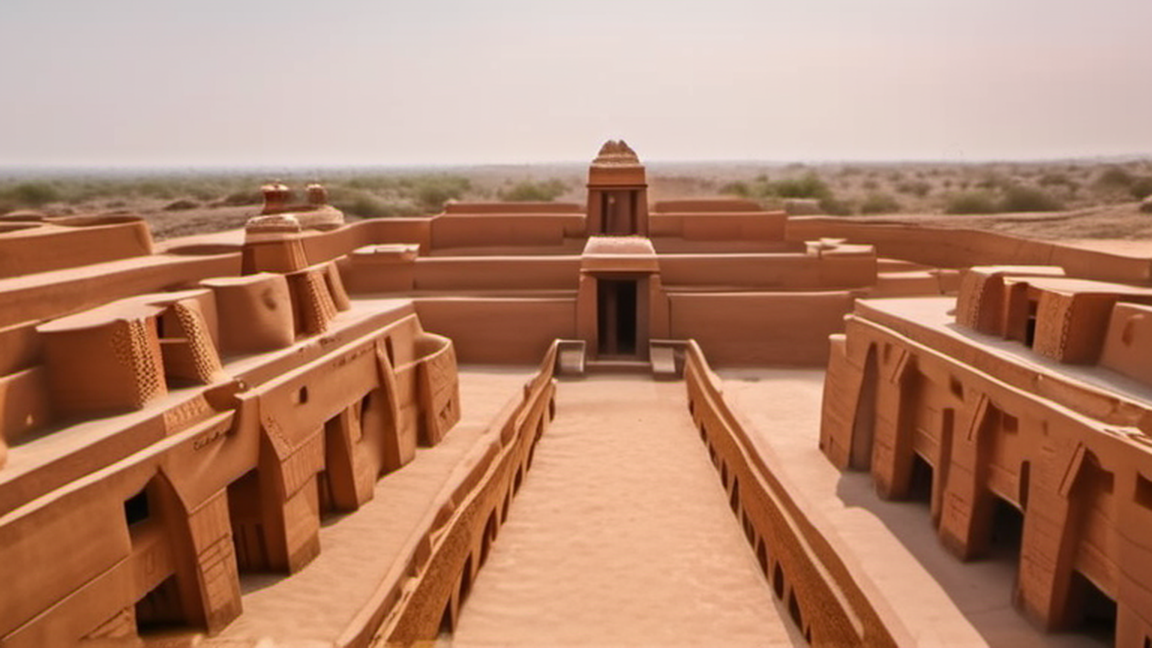
Mohenjo-daro (; Sindhi: موهن جو دڙو, lit. 'Mound of the Dead Men'; Urdu: موئن جو دڑو [muˑənⁱ dʑoˑ d̪əɽoˑ]) is an archaeological site in the Larkana District of Sindh, Pakistan. Built c. 2500 BCE, it was one of the largest settlements of the ancient Indus Valley Civilisation, and one of the world's earliest major cities, contemporaneous with the civilisations of ancient Egypt, Mesopotamia, Minoa, and Norte Chico.
With an estimated population of at least 40,000 people, Mohenjo-daro prospered for several centuries, but c. 1700 BCE had been abandoned, along with other large cities of the Indus Valley Civilisation.
The site was rediscovered in the 1920s. Significant excavation has since been conducted at the site of the city, which was designated a UNESCO World Heritage Site in 1980, the first site in South Asia to be so designated. The site is currently threatened by erosion and improper restoration.
The ancient settlement of Mohenjo-daro is in Larkana District in the Sindh province of Pakistan. Listed as an archaeological site of immense historical significance on the UNESCO World Heritage List, it is one of the most important archaeological sites of South Asia, not to be missed if you are interested in archaeology or in the history of the Indian subcontinent.
Believed to have been built in about 2,600 BCE on what was then the west bank of the Indus river, the city had a population of 35,000 to 50,000 at its peak. It was one of the earliest cities in the world, one of the most advanced of its time, and one of the first to be a major centre of a Bronze Age culture, the Indus Valley Civilisation. The city was abandoned around 1,900 BCE, and the reason is not known for certain.
The town was buried underneath thousands of years of dirt and soil until it was discovered in 1911 and excavations started in 1922, while major excavations were carried out in the 1930s. After 1965, further excavations were banned due to fears of damage to the ruins; it is estimated that only one third of the site has been revealed thus far and some believe only 10 to 20 percent has been discovered.
The site is threatened by erosion and, despite conservation efforts funded by the Pakistani government and UNESCO, it is considered endangered. In 2012, Pakistani archaeologists said that the site could disappear by 2030 unless there is a major new conservation initiative.
Mohenjo-daro is the modern name; it translates as Mound of the Dead.
Mohenjo-daro was one of the main cities of the Indus Valley Civilisation (IVC) which was one of the earliest Bronze Age civilisations and the first great civilisation of the Indian Subcontinent. The IVC is also known as the Harappan Civilisation after another major archaeological site at Harappa, also in modern Pakistan. The terms apply to several cultures over the period 3,300-1,300 BCE, and to over a thousand sites where their artefacts have been found. The peak was the Mature Harappan period, 2,600-1,900 BCE, when Mohenjo-daro was a thriving city.

Archaeological site in Sindh, Pakistan This article is about the archaeological site. For the 2016 Bollywood film, see Mohenjo Daro (film). Mohenjo-daroThe site in 2014Location of Mohenjo-daro in SindhShow map of SindhMohenjo-daro (Pakistan)Show map of PakistanMohenjo-daro (South Asia)Show map of South Asia27°19′45″N 68°08′20″E / 27.32917°N 68.13889°E / 27.32917; 68.13889TypeSettlementCulturesIndus Valley CivilisationLocationLarkana District, Sindh, PakistanHistoryBuiltc. 2500 BCAbandonedc. 1700 BCSite notesArea250 ha (620 acres) UNESCO World Heritage SiteOfficial nameArchaeological Ruins at MoenjodaroCriteriaCultural: ii, iiiReference138Inscription1980 (4th Session)Area240 ha Mohenjo-daro (/moʊˌhɛndʒoʊ ˈdɑːroʊ/; Sindhi: موهن جو دڙو‎, lit. 'Mound of the Dead Men'; Urdu: موئن جو دڑو [muˑənⁱ dʑoˑ d̪əɽoˑ]) is an archaeological site in the Larkana District of Sindh, Pakistan. Built c. 2500 BCE, it was one of the largest settlements of the ancient Indus Valley Civilisation, and one of the world's earliest major cities, contemporaneous with the civilisations of ancient Egypt, Mesopotamia, Minoa, and Norte Chico. With an estimated population of at least 40,000 people, Mohenjo-daro prospered for several centuries, but c. 1700 BCE had been abandoned, along with other large cities of the Indus Valley Civilisation. The site was rediscovered in the 1920s. Significant excavation has since been conducted at the site of the city, which was designated a UNESCO World Heritage Site in 1980, the first site in South Asia to be so designated. The site is currently threatened by erosion and improper restoration.
Ancient Mohenjo-daro seems to have been a socially classless society which focused on convenience of its citizens, in contrast to other ancient cities where vast resources were used to build royal palaces and giant tombs, solely to serve the rulers. Evidence suggests that Mohenjo-daro was ruled by an elected body of people who may have been religious leaders and traders. No evidence of warfare, invasions or weapons has been found in the area; the inhabitants of Mohenjo-daro seem to have been peaceful, though many contemporary societies were quite warlike.
Mohenjo-daro was abandoned around 1900 BCE and the whole IVC declined from about then until there was nothing left by about 1300 BCE. The reasons are not fully understood; see the Indus Valley Civilisation article for discussion.
The site is not particularly easy or comfortable to get to since it is in rural Sindh, some 30 km from the nearest city, Larkana, and the region is extremely hot and dry.
On the other hand, it is accessible by rail, road or air and it is certainly worth a visit.
Pakistan's flag carrier Pakistan International Airlines flies from Karachi to Mohenjo-daro. Direct flights run three times a week and take around one hour. The outdated infrastructure of the Mohenjo-daro airport prevents the use of large, advanced aircraft so smaller prop aircraft such as the ATR 42 are used. A one-way ticket costs around Rs 6,000 to/from Karachi.
1 Mohenjo-daro Airport (MJD IATA) (adjacent to the archaeological site complex). A shuttle bus is available on flight days to drop you at the archaeological site entrance, or the distance can be easily covered on foot.
The nearest railway station is some 11km away from the site in the outskirts of the nearby town of Dokri, but named after Mohenjo-daro. There's one train the Khushal Khan Khattak Express, each day run between Karachi and Peshawar, and makes a brief stop at Dokri early in the morning at around 6 AM. It has both air conditioned and non air conditioned coaches. The train leaves Karachi in the evening at around 9 PM, the journey takes approximately 9 hours and a non-air conditioned seat costs Rs 400 while Rs 1,000 for air-conditioned.
If your train doesn't make a call at Dokri, you can opt to disembark at the larger nearby town of Larkana.
2 Mohenjo-daro railway station. (updated Jan 2021)
From Mohenjo-daro railway station, a rickshaw for Mohenjo-daro archaeological site can be hired for Rs 200. Shared rickshaws are also available for Dokri for Rs 20 and from Dokri, you can hire a rickshaw for the archaeological site for Rs 150.
Getting to Mohenjo-daro by public bus is a two-step process as there's no direct service to Mohenjo-daro. The nearest major city is Larkana, some 30km to the north, and one can easily get to Larkana by bus (either air-conditioned or not) from any major city of Sindh. From Larkana, both taxis and rickshaws can be hired for Mohenjo-daro. Moreover, vans run from Larkana up-to a bypass near the archaeological complex as well as shared motorcycle rickshaws. Hiring a taxi or a rickshaw is definitely the preferred option as both are comfortable as well as quicker than the cramped vans or shared rickshaws; they take less than an hour. Hiring a taxi for the archaeological site should cost less than Rs 1,000 if you manage to haggle well with the taxi driver whereas a rickshaw can be hired for Rs 500. Journeys on shared rickshaws may cost around Rs 100 and vans even less.
If you are driving or being driven, Mohenjo-daro can be accessed most easily by some arterial roads branching off (at Mehar, Nasirabad and Larkana) from the 1,264km-long National Highway # N-55 (the Indus Highway) which runs between Karachi and Peshawar.
3 Mohenjodaro Car Park. (updated Nov 2018)
The archaeological ruins are scattered inside a large complex, surrounded by a protection wall and only accessible through a large main entrance gate. The complex can be covered on foot easily, and it is a pedestrians-only area; no other means of transport is allowed, not even bicycles. Pathways are constructed of bricks connecting the scattered ruins. Beware that walking can be quite exhausting, especially in the heat of summer. Make sure you wear proper and comfortable walking shoes and have a bottle of water with you when you explore the ancient city. It is also advisable to wear sunglasses and hats. Watch your step while walking through the ancient structure, as snakes have been sighted; they pose a hazard only if you disturb them.
The archaeological site is divided into two sectors: a higher settlement to the west and a larger lower settlement to the east. Both settlement sectors are further subdivided into several areas, whose names are derived from the names of the archaeologists who excavated the ruins in the area. Everything is properly marked so it is quite easy to navigate and understand where you are and which structure is what.
Facilities such as the museum, shops, park, canteen and resthouse are in a separate area a bit to the north, all near the entrance gate.
The entrance fee for the complex is Rs 3,000 for foreigners, and Rs 20 for locals. This does include admission to the museum. The complex is open between 08:30 and 19:00 from April to September, and between 09:00 and 17:00 in winter from October to March.
The actual excavation has two main areas, east and west. The higher settlement to the west has the ruins of ancient administrative buildings and some that were likely residences inhabited by the rulers while the lower settlement to the east was mainly a residential area for people of middle and lower class. Most of the major structures including the Great Bath, Granary, College and Assembly Hall can be found on citadel mound, which is a massive unbaked mud-brick platform with many buildings, believed to have been a sacred area.
The lower settlement is further divided into two areas: the wealthy residential area to the north had the mansions of the wealthy while the poor residential area to the south had much smaller structures, believed to be inhabited by the common people. It has a variety of structures — residences, workshops, and public facilities such as stupas, baths, wells and a guardhouse.
The city shows advanced architecture and urban planning. Like other cities of the IVC, it was built on a grid system with streets as wide as 10m to accommodate carts. Streets were perpendicular to each other, dividing the city into rectangular blocks.
A rare thing even in modern villages of Pakistan today, Mohenjo-daro had a channeled sanitary system; the impressive structures of the sewerage and drainage system can still be identified easily. These connected public and private baths and wells and appear to have provided comfort and convenience to the people and a hygienic environment.
Not magnificent but simple multi-storeyed rectilinear houses were made with standard size bricks. House varied in size but had a similar layout and proper sanitation system. Some had courtyards surrounded by bedrooms, kitchen, and even servants' quarters.
Adjoining the wealthy residential area, there is what is thought to have been a large bazaar. One building that has been excavated has circular depressions in the ground, leading many to believe that it was a dyer's workshop and that the depressions were used to hold pottery vessels.
Some of the major structures of Mohenjo-daro are described below:
1 The Buddhist Stupa. Visible from a great distance, this is the highest and most prominent structure in Mohenjo-daro. It was built atop the citadel mound long after the fall of the ancient city; it is from the Kushan Empire, 1st to 4th centuries CE, while all of the other excavated ruins are from 2,600-1,900 BCE. It is believed that the Buddhist Stupa was built over an older Hindu temple.The stupa is shown on Pakistani twenty rupee notes.
2 The Great Hall (Granary). The Great Hall is a large building and is believed to have been a granary; it has what appears to have been a loading platform for carts transporting grain and a ventilation system to prevent spoilage. An alternate theory is that it was a public hall; the actual function of the building has not been determined.
3 The Great Bath. A 2.4-m-deep, 12-m-long, and 7-m-wide pool in the centre of higher settlement is the best-known structure of Mohenjo-daro. It is made of fine baked waterproof mud bricks and a thick layer of bitumen (natural tar – presumably to keep water from seeping through the walls), which indicates that it was used for holding water. Many scholars have suggested that this huge deep bath could have been a place for ritual bathing or religious ceremonies. It is the earliest public water tank of the ancient world. Adjacent to it is a well that was used to supply water to the bath.
4 Assembly Hall (Pillared Hall). This brick pillared structure of approximately 27.5 m² is thought to may have been an assembly hall, a place for people to sit for meetings and social gatherings. Some believe it to be prayer hall or a palace.
5 College of Priests. A unique large open space and courtyard lying to the east of the Great Bath, this large building has several rooms and three verandas, with two staircases leading to the roof and upper floor. It is thought to have been either a college for priests or the residence of a high official.
6 Mohenjo-daro Archaeology Museum. 08:30 to 12:30 and 14:30 to 17:30 from April to September, and 09:00 to 16:00 from October to March. The museum was inaugurated in 1967, and contains relics found at the archaeologic site. The relics include weapons, engraved seals, kitchen utensils, sculptures and terracotta toys. Jewellery and other ornaments are showcased on the first floor and illuminated in natural light while heavy stones found during excavation are kept as well. A wall on the first floor is illustrated with a conjectural yet impressive view of the ancient city. Rs 300 for foreigners, Rs 100 for locals. (updated May 2021)
Among the most popular souvenirs are replicas of two famous pieces of sculpture found at Mohenjo-daro: the 'Dancing Girl', and the 'Priest-King' as well numerous seals and ancient jewellery. The 'Dancing Girl' is some 4,500 years old and was found in 1926; the bronze statuette is an image of a young dancer wearing nothing but bangles and a necklace. The 'Priest-King', was found in 1927 and has become symbolic of the Indus Valley Civilisation; the soapstone sculpture is of a bearded male believed by some to be a priest or monarch who had ruled Mohenjo-daro; however, there is no evidence that Mohenjo-daro was ruled by a priest or monarch.
You'll find locals selling these souvenirs inside the Mohenjo-daro complex. There's a good gift shop adjacent to the site near the entrance gate where you can buy many kinds of souvenirs as well. Various stones, post cards, photographs and books on Mohenjo-daro can be purchased both from the gift store and local sellers. The museum also sells books and photo postcards of Mohenjo-daro.
Water and tea are the main choices to combat the dry climate. Because of the heat, it is essential to keep well hydrated.
The cafeteria inside the archaeology rest-house admits any paying customer (no rest-house stay required), provides some food and can cater to many people at once. Alternatively, there is a cafeteria inside the complex near the museum building where one can take a rest in open-air on lush green ground after a tiring stroll, refresh yourself with drinks such as juices, tea or bottled water and have some light snacks. You'll also find many hawkers inside the complex selling light packed snacks, soft drinks and bottled water.
You might bring your own food to double your enjoyment. Many families and tour groups head to Mohenjo-daro on weekends to enjoy picnics in the lush grass parks inside the complex.
There is only one lodging facility in Mohenjo-daro, inside the complex and close to the archaeological site. Alternatively, there are a few good options to stay in the nearby town of Larkana. The PTDC Motel shown on the map was shut down in 2013 and remains so as of late 2014.
1 Archaeology Rest-house, ☏ +92 343 3847735, +92 313 3063317. Renovated accommodation is run by Pakistan's archaeological department is overall, ideal for a stay overnight and available at affordable rates. They can also provide pick and drop to/from Larkana or Badah station via car. The rest house has nine rooms with attached baths. Three air conditioned rooms, double bed, TV, and sofas are on the first floor while six non-air conditioned rooms with two single beds in each room on ground floor. Has a cafeteria, sitting area in lounge as well a big hall to accommodate large group of people for overnight stays. Cafeteria can prepare a meal according to your taste but may charge Rs 500 per person for lunch or a dinner meal while Rs 200 for breakfast. It is advised to book in advance. Rs 3000 (basic non-A/C room) Rs 5000 (double room with A/C). (updated Feb 2020)
The main risk in Mohenjo-daro and nearby areas is extreme heat. You might want to visit in the cooler winter months (October to March); otherwise you should be prepared for blisteringly hot weather. Generally, June is the hottest month of the year, with temperatures around 35°C, while December and January see an average temperature of some 15°C.
It is essential to stay hydrated; carry drinks with you or buy them along the way since tap water is unsafe in the region. Consider freezing a bottle of water overnight and drinking it as it melts; this can give cold water for much of the day.
See also Hot weather, Dehydration and Sunburn and sun protection for more on coping with hot weather, and Pakistan#Stay healthy for health information that applies to the entire country.
Kirthar National Park — this large park offers great natural beauty and a good variety of wildlife
Karachi — Pakistan's biggest, most diverse and cosmopolitan city, some distance to the south
Lahore — the country's second largest city, historically important, further away to the north
Mothparja
[edit] The city's original name is unknown. Based on his analysis of a Mohenjo-daro seal, Iravatham Mahadevan speculates that the city's ancient name could have been Kukkuṭārma ("the city [-rma] of the cockerel [kukkuta]"). Cock-fighting may have had ritual and religious significance for the city. Mohenjo-daro may also have been a point of diffusion for the clade of the domesticated chicken found in Africa, Western Asia, Europe and the Americas. Mohenjo-daro, the modern name for the site, has been interpreted as "Mound of the Dead" in Sindhi.
[edit] Map showing the major sites and theorised extent of the Indus Valley Civilisation, including the location of the Mohenjo-daro site Mohenjo-daro is located off the right (west) bank of the lower Indus river in Larkana District, Sindh, Pakistan. It lies on a Pleistocene ridge in the flood plain of the Indus, around 28 kilometres (17 mi) from the town of Larkana.
[edit] Mohenjo-daro was built around 2500 BC. It was one of the largest cities of the ancient Indus Valley Civilisation, also known as the Harappan Civilisation, which developed c. 3000 BC from the prehistoric Indus culture. At its height, the Indus Civilisation spanned much of what is now Pakistan and North India, extending westwards to the Iranian border, south to Gujarat in India and northwards to an outpost in Bactria, with major urban centers at Harappa, Mohenjo-daro, Lothal, Kalibangan, Dholavira, and Rakhigarhi. Mohenjo-daro was the most advanced city of its time, with remarkably sophisticated civil engineering and urban planning. When the Indus civilisation went into sudden decline c. 1700 BCE, Mohenjo-daro was abandoned.
[edit] Archaeological ruins at Moenjodaro Excavations at Mohenjo-daro in 1924 The ruins of the city remained undocumented for around 3,700 years until R. D. Banerji, an officer of the Archaeological Survey of India, visited the site in 1919–1920 identifying what he thought to be a Buddhist stupa (150–500 CE) known to be there and finding a flint scraper which convinced him of the site's antiquity. This led to large-scale excavations of Mohenjo-daro led by Kashinath Dikshit in 1924–1925, and John Marshall in 1925–1926. In the 1930s, major excavations were conducted at the site under the leadership of Marshall, D. K. Dikshitar and Ernest Mackay. Further excavations were carried out in 1945 by Mortimer Wheeler and his trainee, Ahmad Dani and F. A. Khan. The last major series of excavations were conducted in 1964 and 1965 by George Dales. After 1965, excavations were banned due to weathering damage to the exposed structures, and the only projects allowed at the site since have been salvage excavations, surface surveys, and conservation projects. In the 1980s, German and Italian survey groups led by Michael Jansen and Maurizio Tosi used less invasive archeological techniques, such as architectural documentation, surface surveys, and localized probing, to gather further information about Mohenjo-daro. A dry core drilling conducted in 2015 by Pakistan's National Fund for Mohenjo-daro revealed that the site is larger than the unearthed area.
[edit] Further information: Sanitation of the Indus Valley Civilisation and Harappan architecture Regularity of streets and buildings suggests the influence of ancient urban planning in Mohenjo-daro's construction View of the site's Great Bath, showing the surrounding urban layout Mohenjo-daro has a planned layout with rectilinear buildings arranged on a grid plan. Most were built of fired and mortared brick; some incorporated sun-dried mud-brick and wooden superstructures. The covered area of Mohenjo-daro is estimated at 300 hectares. The Oxford Handbook of Cities in World History offers a "weak" estimate of a peak population of around 40,000. The sheer size of the city, and its provision of public buildings and facilities, suggests a high level of social organisation. The city is divided into two parts, the so-called Citadel and the Lower City. The Citadel – a mud-brick mound around 12 metres (39 ft) high – is known to have supported public baths, a large residential structure designed to house about 5,000 citizens, and two large assembly halls. The city had a central marketplace, with a large central well. Individual households or groups of households obtained their water from smaller wells. Waste water was channeled to covered drains that lined the major streets. Some houses, presumably those of more prestigious inhabitants, include rooms that appear to have been set aside for bathing, and one building had an underground furnace (known as a hypocaust), possibly for heated bathing. Most houses had inner courtyards, with doors that opened onto side-lanes. Some buildings had two stories.[citation needed] Major buildings[edit] The Great Bath In 1950, Sir Mortimer Wheeler identified one large building in Mohenjo-daro as a "Great Granary". Certain wall-divisions in its massive wooden superstructure appeared to be grain storage-bays, complete with air-ducts to dry the grain. According to Wheeler, carts would have brought grain from the countryside and unloaded them directly into the bays. However, Jonathan Mark Kenoyer noted the complete lack of evidence for grain at the "granary", which, he argued, might therefore be better termed a "Great Hall" of uncertain function. Close to the "Great Granary" is a large and elaborate public bath, sometimes called the Great Bath. From a colonnaded courtyard, steps lead down to the brick-built pool, which was waterproofed by a lining of bitumen. The pool measures 12 metres (39 ft) long, 7 metres (23 ft) wide and 2.4 metres (7.9 ft) deep. It may have been used for religious purification. Other large buildings include a "Pillared Hall", thought to be an assembly hall of some kind, and the so-called "College Hall", a complex of buildings comprising 78 rooms, thought to have been a priestly residence.[citation needed] Fortifications[edit] Excavation of the city revealed very tall wells (left), which it seems were continually built up as flooding and rebuilding raised the elevation of street level Archaeologists have identified the foundations of eroded mud-brick walls that surrounded Mohenjo-daro. It was also fortified with guard towers to the west of the main settlement, and defensive fortifications to the south. Based on these fortifications and the structure of other major Indus Valley cities such as Harappa, scholars have postulated that Mohenjo-daro was an administrative center. Harappa and Mohenjo-daro share a similar architectural layout and were generally not as heavily fortified as other Indus Valley sites. It is obvious from the identical city layouts of all Indus sites that there was some kind of political or administrative centrality, but the extent and functioning of an administrative center remains unclear. Water supply and wells[edit] The location of Mohenjo-daro was built in a relatively short period of time, with the water supply system and wells being some of the first planned constructions. With the excavations done so far, over 700 wells are present at Mohenjo-daro, alongside drainage and bathing systems. This number is unheard of when compared to other civilisations at the time, such as Egypt or Mesopotamia, and the quantity of wells transcribes as one well for every three houses. Because of the large number of wells, it is believed that the inhabitants relied solely on annual rainfall, as well as the Indus River's course remaining close to the site, alongside the wells providing water for long periods of time in the case of the city coming under siege. Due to the period in which these wells were built and used, it is likely that the circular brick well design used at this and many other Harappan sites are an invention that should be credited to the Indus civilisation, as there is no existing evidence of this design from Mesopotamia or Egypt at this time, and even later. Sewage and waste water for buildings at the site were disposed of via a centralized drainage system that ran alongside the site's streets. These drains that ran alongside the road were effective at allowing most human waste and sewage to be disposed of as the drains most likely took the waste toward the Indus River. Flooding and rebuilding[edit] The city also had large platforms perhaps intended as defense against flooding. According to a theory first advanced by Wheeler, the city could have been flooded and silted over, perhaps six times, and later rebuilt in the same location. Some archaeologists believed that the site was abandoned after a final flood engulfed the city in a sea of mud. Gregory Possehl was the first to theorize that the floods were caused by overuse and expansion upon the land, and that the mud flood was not the reason the site was abandoned. Instead of a mud flood wiping part of the city out in one fell swoop, Possehl coined the possibility of constant mini-floods throughout the year, paired with the land being worn out by crops, pastures, and resources for bricks and pottery spelled the downfall of the site.
[edit] Boat with direction finding birds to find land. Model of Mohenjo-Daro seal, 2500–1750 BC Numerous objects found in excavation include seated and standing figures, copper and stone tools, carved seals, balance-scales and weights, gold and jasper jewellery, and children's toys. Many bronze and copper pieces, such as figurines and bowls, have been recovered from the site, showing that the inhabitants of Mohenjo-daro understood how to utilize the lost wax technique. The furnaces found at the site are believed to have been used for copperworks and melting the metals as opposed to smelting. There even seems to be an entire section of the city dedicated to shell-working, located in the northeastern part of the site. Some of the most prominent copperworks recovered from the site are the copper tablets which have examples of the untranslated Indus script and iconography. While the script has not been deciphered yet, many of the images on the tablets match another tablet and both hold the same caption in the Indus language, with the example given showing three tablets with the image of a mountain goat and the inscription on the back reading the same letters for the three tablets. Pottery and terracotta sherds have been recovered from the site, with many of the pots having deposits of ash in them, leading archeologists to believe they were either used to hold the ashes of a person or as a way to warm up a home located in the site. These heaters, or braziers, were ways to heat the house while also being able to be utilized in a manner of cooking or straining, while others solely believe they were used for heating. The finds from Mohenjo-daro were initially deposited in the Lahore Museum, but later moved to the ASI headquarters at New Delhi, where a new "Central Imperial Museum" was being planned for the new capital of the British Raj, in which at least a selection would be displayed. It became apparent that Indian independence was approaching, but the Partition of India was not anticipated until late in the process. The new Pakistani authorities requested the return of the Harappan pieces excavated on their territory, but the Indian authorities refused. Eventually an agreement was reached, whereby the finds, totalling some 12,000 objects (most sherds of pottery), were split equally between the countries; in some cases this was taken very literally, with some necklaces and girdles having their beads separated into two piles. In the case of the "two most celebrated sculpted figures", Pakistan asked for and received the Priest-king, while India retained the much smaller Dancing Girl, and also the Pashupati seal. Most of the objects from Mohenjo-daro retained by India are in the National Museum of India in New Delhi and those returned to Pakistan in the National Museum of Pakistan in Karachi, with many also in the museum now established at Mohenjo-daro itself. In 1939, a small representative group of artefacts excavated at the site was transferred to the British Museum by the Director-General of the Archaeological Survey of India. Mother Goddess Idol[edit] "The Mother Goddess" Discovered by John Marshall in 1931, the idol appears to mimic certain characteristics that match the Mother Goddess belief common in many early Near East civilisations. Sculptures and figurines depicting women have been observed as part of Harappan culture and religion, as multiple female pieces were recovered from Marshall's archaeological digs. These figures were not categorized correctly, according to Marshall, meaning that where they were recovered from the site is not actually clear. One of said figures is 18.7 cm tall and is currently on display at the National Museum of Pakistan, in Karachi. The fertility and motherhood aspects on display on the idols is represented by the female genitalia that is presented in an almost exaggerated style as stated by Marshall, with him inferring that such figurines are offerings to the goddess, as opposed to the typical understanding of them being idols representing the goddess's likeness. Because of the figurines being unique in terms of hairstyles, body proportions, as well as headdresses and jewelry, there are theories as to who these figurines actually represent. Shereen Ratnagar theorizes that because of their uniqueness and dispersed discovery throughout the site that they could be figurines of ordinary household women, who commissioned these pieces to be used in rituals or healing ceremonies to help aforementioned individual women. Dancing Girl[edit] Main article: Dancing Girl (prehistoric sculpture) "The Dancing Girl" A bronze statuette dubbed the "Dancing Girl", 10.5 centimetres (4.1 in) high and around 4,000 years old, was found in 'HR area' of Mohenjo-daro in 1926; it is now in the National Museum, New Delhi. In 1973, British archaeologist Mortimer Wheeler described the item as his favourite statuette: She's about fifteen years old I should think, not more, but she stands there with bangles all the way up her arm and nothing else on. A girl perfectly, for the moment, perfectly confident of herself and the world. There's nothing like her, I think, in the world. John Marshall, another archeologist at Mohenjo-daro, described the figure as "a young girl, her hand on her hip in a half-impudent posture, and legs slightly forward as she beats time to the music with her legs and feet." The archaeologist Gregory Possehl said of the statuette, "We may not be certain that she was a dancer, but she was good at what she did and she knew it." The statue led to two important discoveries about the civilisation: first, that they knew metal blending, casting and other sophisticated methods of working with ore, and secondly that entertainment, especially dance, was part of the culture. Priest-King[edit] Main article: Priest-King (sculpture) "The Priest-King", a seated stone sculpture at the National Museum, Karachi In 1927, a seated male soapstone figure was found in a building with unusually ornamental brickwork and a wall-niche. Though there is no evidence that priests or monarchs ruled Mohenjo-daro, archaeologists dubbed this dignified figure a "Priest-King". The sculpture is 17.5 centimetres (6.9 in) tall, and shows a neatly bearded man with pierced earlobes and a fillet around his head, possibly all that is left of a once-elaborate hairstyle or head-dress; his hair is combed back. He wears an armband, and a cloak with drilled trefoil, single circle and double circle motifs, which show traces of red. His eyes might have originally been inlaid. Pashupati seal[edit] Main article: Pashupati seal The Pashupati seal A seal discovered at the site bears the image of a seated, cross-legged and possibly ithyphallic figure surrounded by animals. The figure has been interpreted by some scholars as a yogi, and by others as a three-headed "proto-Shiva" as "Lord of Animals". Seven-stranded necklace[edit] Sir Mortimer Wheeler was especially fascinated with this artifact, which he believed to be at least 4,500 years old. The necklace has an S-shaped clasp with seven strands, each over 4 ft long, of bronze-metal bead-like nuggets which connect each arm of the "S" in filigree. Each strand has between 220 and 230 of the many-faceted nuggets, and there are about 1,600 nuggets in total. The necklace weighs about 250 grams in total, and is presently held in a private collection in India.[citation needed] The Mohenjo-daro ruler[edit] The Indus Valley civilisation employed rulers made of ivory for measuring length circa 1500 BC. The Mohenjo-Daro ruler is divided into units corresponding to 34 millimetres (1.32 in) and these are further marked in decimal subdivisions with great accuracy, to within 0.13 mm (0.005 in). A ruler found at Lothal (2400 BCE) is calibrated to about 1.6 mm (1⁄16 in). The decimal subdivision on the ruler is noteworthy, as it predates the modern metric system by 3,000 years or more. The base unit used was known as the angula (finger) and is about 17 mm. A piece of shell found in Mackay's excavation is very precisely incised with lines spaced 6.7 mm (0.264 in) apart. Ancient bricks found throughout the region have dimensions that correspond to these units.
[edit] An initial agreement to fund restoration was agreed through the United Nations Educational, Scientific, and Cultural Organization (UNESCO) in Paris on 27 May 1980. Contributions were made by a number of other countries to the project: Country Contribution US$  Australia $62,650  Bahrain $3,000  Cameroon $1,000  Egypt $63,889.60  Germany $375,939.85  India $49,494.95  Iraq $9,781  Japan $200,000  Kuwait $3,000  Malta $275.82  Mauritius $2,072.50  Nigeria $8,130  Saudi Arabia $58,993.63  Sri Lanka $1,562.50  Tanzania $1,000 Surviving structures at Mohenjo-daro, 2005 Preservation work for Mohenjo-daro was suspended in December 1996 after funding from the Pakistani government and international organizations stopped. Site conservation work resumed in April 1997, using funds made available by the UNESCO. The 20-year funding plan provided $10 million to protect the site and standing structures from flooding. In 2011, responsibility for the preservation of the site was transferred to the government of Sindh. Currently the site is threatened by groundwater salinity and improper restoration. Many walls have already collapsed, while others are crumbling from the ground up. In 2012, Pakistani archaeologists warned that, without improved conservation measures, the site could disappear by 2030. 2014 Sindh Festival[edit] The Mohenjo-daro site was further threatened in January 2014, when Bilawal Bhutto Zardari of the Pakistan People's Party chose the site for Sindh Festival's inauguration ceremony. This would have exposed the site to mechanical operations, including excavation and drilling. Farzand Masih, head of the Department of Archaeology at Punjab University warned that such activity was banned under the Antiquity Act, saying "You cannot even hammer a nail at an archaeological site." On 31 January 2014, a case was filed in the Sindh High Court to bar the Sindh government from continuing with the event. The festival was held by PPP at the historic site, despite all the protest by both national and international historians and educators.
[edit] Mohenjo-daro has a hot desert climate (Köppen climate classification BWh) with extremely hot summers and mild winters. The highest recorded temperature is 53.5 °C (128.3 °F), recorded in May 2010 and the lowest recorded temperature is −5.4 °C (22.3 °F), recorded in January 2006. Rainfall is low, and mainly occurs in the monsoon season (July–September). The average annual rainfall of Mohenjo-daro is 100.1 mm and mainly occurs in the monsoon season. The highest annual rainfall ever is 1023.8 mm, recorded in 2022, and the lowest annual rainfall ever is 10 mm, recorded in 1987. Climate data for Mohenjo-daro Month Jan Feb Mar Apr May Jun Jul Aug Sep Oct Nov Dec Year Record high °C (°F) 29.4(84.9) 36.5(97.7) 45.5(113.9) 48.5(119.3) 53.5(128.3) 51.7(125.1) 47.6(117.7) 46.0(114.8) 43.5(110.3) 41.5(106.7) 39.2(102.6) 30.6(87.1) 53.5(128.3) Mean daily maximum °C (°F) 24.8(76.6) 26.2(79.2) 32.1(89.8) 38.7(101.7) 43.8(110.8) 44.2(111.6) 41.9(107.4) 38.7(101.7) 37.5(99.5) 35.2(95.4) 30.5(86.9) 24.8(76.6) 34.9(94.8) Daily mean °C (°F) 16.0(60.8) 17.0(62.6) 22.7(72.9) 28.8(83.8) 33.9(93.0) 35.8(96.4) 34.4(93.9) 32.8(91.0) 31.1(88.0) 26.7(80.1) 21.1(70.0) 16.0(60.8) 26.4(79.4) Mean daily minimum °C (°F) 7.3(45.1) 7.9(46.2) 13.3(55.9) 18.9(66.0) 24.0(75.2) 27.4(81.3) 27.9(82.2) 27.0(80.6) 24.7(76.5) 18.2(64.8) 11.8(53.2) 7.3(45.1) 18.0(64.3) Record low °C (°F) −5.4(22.3) −4.0(24.8) 2.2(36.0) 3.0(37.4) 13.0(55.4) 15.6(60.1) 18.4(65.1) 18.0(64.4) 14.5(58.1) 0.0(32.0) −1.0(30.2) −4.0(24.8) −5.4(22.3) Average precipitation mm (inches) 2.6(0.10) 5.8(0.23) 3.4(0.13) 2.9(0.11) 2.2(0.09) 2.5(0.10) 39.9(1.57) 26.6(1.05) 6.6(0.26) 0.4(0.02) 0.9(0.04) 6.3(0.25) 100.1(3.95) Average precipitation days 0.2 0.5 0.9 0.2 0.3 0.4 1.9 1.4 0.3 0.1 0.1 0.3 6.6 Source: PMD (1991–2020)