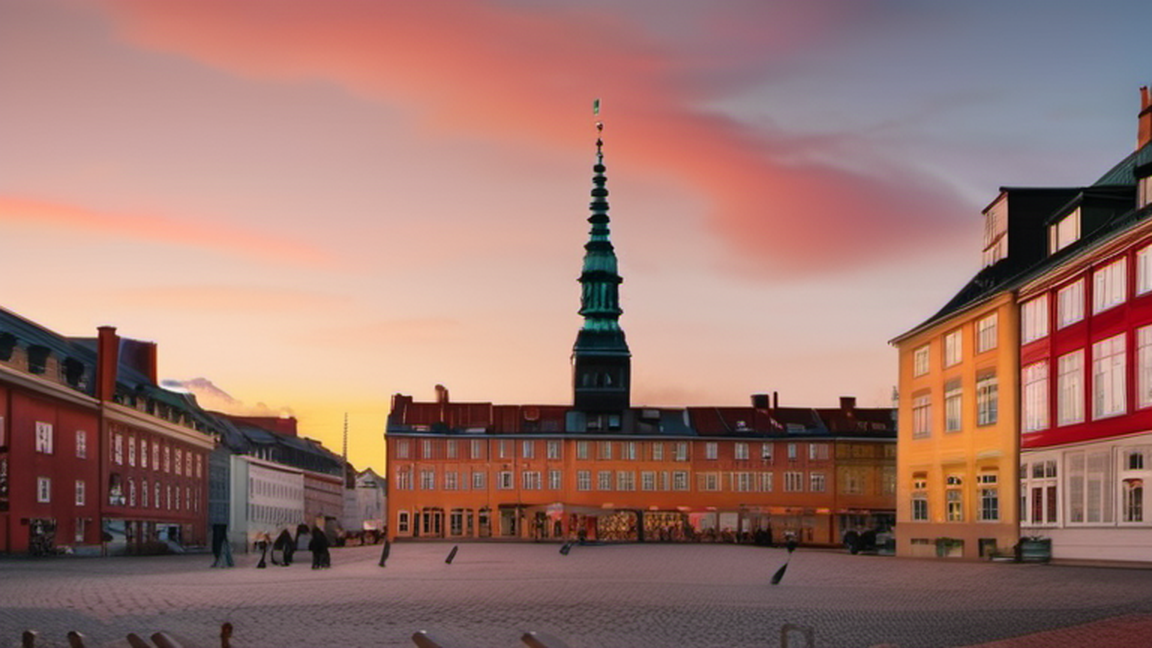
Copenhagen (Danish: København [kʰøpm̩ˈhɑwˀn] ) is the capital and most populous city of both the country of Denmark and the wider Kingdom of Denmark, with a population of 671,673 people in the municipality and 1.4 million in the urban area. The city is situated mainly on the island of Zealand (Sjælland), with a smaller part on the island of Amager. Copenhagen is separated from Malmö, Sweden, by the Øresund strait. The Øresund Bridge connects the two cities by rail and road.
Settled as a Viking fishing village in the 10th century in the vicinity of what is now Gammel Strand, Copenhagen became the capital of Denmark in the early 15th century. During the 16th century, the city served as the de facto capital of the Kalmar Union and the seat of the Union's monarchy, which governed most of the modern-day Nordic region as part of a Danish confederation with Sweden and Norway. The city flourished as the cultural and economic centre of Scandinavia during the Renaissance. By the 17th century, it had become a regional centre of power, serving as the heart of the Danish government and military. During the 18th century, Copenhagen suffered a devastating plague outbreak and urban conflagrations. Major redevelopment included the construction of the prestigious district of Frederiksstaden and the establishment of cultural institutions such as the Royal Theatre and the Royal Academy of Fine Arts. The city became the centre of the Danish slave trade during this period. In 1807, the city was bombarded by a British fleet during the Napoleonic Wars, before the Danish Golden Age brought a Neoclassical look to Copenhagen's architecture. After World War II, the Finger Plan fostered the development of housing and businesses along the five urban railway routes emanating from the city centre.
Since the turn of the 21st century, Copenhagen has seen strong urban and cultural development, facilitated by investment in its institutions and infrastructure. The city is the cultural, economic, and governmental centre of Denmark; it is one of the major financial centres of Northern Europe with the Copenhagen Stock Exchange. Copenhagen's economy has developed rapidly in the service sector, especially through initiatives in information technology, pharmaceuticals, and clean technology. Since the completion of the Øresund Bridge, Copenhagen has increasingly integrated with the Swedish province of Scania and its largest city, Malmö, forming the Øresund Region. With several bridges connecting the various districts, the cityscape is characterised by parks, promenades, and waterfronts. Copenhagen's landmarks, such as Tivoli Gardens, The Little Mermaid statue, the Amalienborg and Christiansborg palaces, Rosenborg Castle, Frederik's Church, Børsen, and many museums, restaurants, and nightclubs are significant tourist attractions.
Copenhagen is home to the University of Copenhagen, the Technical University of Denmark, Copenhagen Business School, and the IT University of Copenhagen. The University of Copenhagen, founded in 1479, is the oldest university in Denmark. Copenhagen is home to the football clubs F.C. Copenhagen and Brøndby IF. The annual Copenhagen Marathon was established in 1980. Copenhagen is one of the most bicycle-friendly cities in the world. Movia is a public mass transit company serving all of eastern Denmark except Bornholm. The Copenhagen Metro, launched in 2002, serves central Copenhagen. Additionally, the Copenhagen S-train, the Lokaltog (private railway), and the Coast Line network serve and connect central Copenhagen to outlying boroughs. Serving roughly 2.7 million passengers a month, Copenhagen Airport, Kastrup, is the busiest airport in the Nordic countries.
Copenhagen (Danish: København) is the capital city of Denmark and forms the moderate conurbation that one million Danes call home. It is big enough to form a small Danish metropolis, with shopping, culture and nightlife par excellence, yet small enough still to feel intimate and be safe. Although mixed in its urban scene, the city is easy to navigate. Overlooking the Øresund Strait, connected to Sweden by a 15-km bridge-tunnel. Copenhagen serves as a cultural and geographic link between the Nordic countries and central Europe. Copenhagen is where old fairy tales blend with flashy modern architecture and world-class design; where warm jazz mixes with crisp electronica from Copenhagen's basements. You could feel you have seen all of Copenhagen in one day, but further exploration will keep you discovering more for months.
If you had dropped by Copenhagen in the 11th century CE, you would have found yourself looking over a small fishing hamlet, with some lazy cattle gazing back at you while chewing fresh green grass from the meadows around the village. Looking east you would see a host of small islets protecting the small fishing harbour from harsh weather — not the worst place to found a city. If you would rather trust the written word than the archaeologists, the earliest accounts date from the 12th century, when a bearded clerk (or a renowned historian if you will) called Saxo Grammaticus scribbled down a few lines about the place; Portus Mercatorum, he called it, which was really just a fancy Latin version of Købmannahavn. This has since been mangled into København in modern Danish, and even further mangled into Copenhagen in English, but all it really means is "merchant harbour."

Copenhagen’s reputation as a bike‑friendly city extends far beyond the tourist‑packed streets of Nyhavn. Head north along the harbour’s cycleway to the former industrial quarter of Nordhavn, where sleek apartments sit beside repurposed oil tanks and a growing fleet of electric ferries. The ride offers a glimpse of the city’s urban‑renewal ethos, with pop‑up cafés and street art peppering the routes. For a quieter contrast, cross the bridge to Amager Strandpark; the flat, sea‑level paths lead past sandy beaches and a wind‑surfing school, providing a coastal flavour rarely mentioned in guidebooks. Renting a city bike for a whole day lets you sample neighbourhoods at a pace locals consider normal, and the public bike‑share’s integrated ticketing makes hopping on and off seamless.
While many visitors gravitate to the flagship Torvehallerne, Copenhagen’s calendar is dotted with smaller, season‑driven markets that showcase Denmark’s evolving food culture. In late summer, the temporary stall park at Islands Brygge hosts the “Urban Harvest” fair, where urban farmers sell heirloom tomatoes, nettle pesto and rye crisps harvested from rooftop gardens. Come October, the historic Østerbro square transforms into a Nordic foraging market, offering reindeer jerky, cloudberry jam and locally smoked birch wood‑flavoured cheese. These markets are not only venues for tasting but also for dialogue with producers who often sit down to discuss climate‑smart practices. Timing your visit to coincide with one of these events adds a layer of culinary immersion beyond the usual restaurant scene.
Around 1160 CE, King Valdemar handed over control of the city to the bishop of Roskilde. Absalon, archbishop of Lund 1178–1201, one of the most colourful characters of the Middle Ages — a curious mix of great churchman, statesman, and warrior. As the country's only city not under the king's control, Absalon saw it thrive and erected a castle on what is today Slotsholmen (the remains are still visible in the catacombs under the present day parliament). As a man of religion Absalon also built a great church, and with those necessities taken care of, Copenhagen quickly gained importance as a natural stop between the two most important Danish cities, the old royal capital Roskilde and Lund in present-day Sweden. Endowed with an enviable location on the banks of the important Øresund Strait, it slowly but steadily surpassed the old urban centres. Copenhagen's rise was greatly aided by entrepreneurial trading with friends and foes alike and by prosperous fishing which provided much of Roman Catholic Europe with salted herring for Lent. But with prosperity comes envy and in the years to follow Copenhagen was laid waste and pillaged time and time again, mainly by the members of the German Hanseatic League, which at one point completely destroyed the city.
Like the phoenix, however, Copenhagen repeatedly rose from its ashes. When the Danes kicked out the Pope during the 16th century Protestant Reformation, Roskilde lost its importance as a Roman bishopric and, having taken control of the city 20 years earlier, the Danish king moved his residence to Copenhagen. Not terribly keen on seeing their new capital laid waste once more, successive Danish monarchs built massive fortifications around the city. None more so than King Christian IV, who embarked on a building rampage which not only included the ramparts still visible throughout much of the city, but also many present day landmarks like the Round Tower and the Stock Exchange. Since then Copenhagen was besieged by the Swedes, and then bombarded, set ablaze, and nearly destroyed by the British Vice Admiral Lord Nelson, who in one of two battles for Copenhagen, responded to the order to withdraw by saying "You know, Foley, I have only one eye. I have a right to be blind sometimes," and then raised the telescope to his blind eye and touted "I really do not see the signal." This was the first ever civilian bombardment performed as part of war.
Again, the city shook off its struggles and the population mushroomed during industrialization. When a cholera epidemic did a fine job of killing nearly everyone there wasn't room for, the King finally conceded that long range cannons would render its constraining walls irrelevant, and thus allowed the city to grow outside the now antiquated ramparts. But it was not long before a new modern fortification was built (known as Vestvolden today), which made Copenhagen Europe's most fortified city of the late 19th century.
After being subjected to yet another, German invasion during World War II, the whole idea of a fortified city was thrown out the window and replaced with one of the finest examples of urban planning anywhere — the Finger Plan. Copenhagen is one of few cities in the world to devise a long-term plan for growth and then actually stick to it; try placing your hand over a map of Copenhagen with the palm as the city centre, and it's quite obvious why it's called the finger plan. Despite being the laughing stock of the country through the 1970s and 1980s, when wealthy residents all moved out into the fingers leaving behind an impoverished bankrupt inner city, a visit these days will prove that the phoenix has risen once more.
Pelle the Conqueror (Martin Andersen Nexø, 1906–10). An epic novel in three parts and an integral part of the Danish school curriculum portraying the life of two poor Swedish immigrants — a father and son. The two last volumes take place in Copenhagen and describe the rise and the conflicts of the labour movement and global socialism which are so crucial to understanding Danish society today. All in all, it's a very good historical account of life in the city during that period, and above all, a good book.
Smilla's Sense of Snow (Peter Høeg, 1992). Dive into Denmark's curious post-colonial history in this international best seller. Partly set in Copenhagen, partly in Greenland, you are whirled through a murder mystery by Ms. Smilla, a half-Danish Inuit brought up in poor Greenland, but now living in the kingdom's affluent and orderly capital. It is a good account of the conflicts and contrasts between two very different parts of the Kingdom, and it offers some spot-on social critique of Danish society in a very engaging way.
The Copenhagen Quartet (Thomas E. Kennedy). Four novels totaling well over a thousand pages. Each book is set against the backdrop of one of the four seasons of the Danish capital: Kerrigan in Copenhagen (spring) (2013), Falling Sideways (autumn) (2011), In the Company of Angels (summer) (2010), and Beneath the Neon Egg (winter) (scheduled for publication, 2014). The novelist, an American expat, somewhat autobiographically portrays an American writer trying to come to terms with his past with the help of Copenhagen's many bars, with the Danish capital as the co-star. All of the places described in the books are real places that you can go discover.
Copenhagen is also the setting of several Nordic Noir films and series, such as the Pusher series, The Bridge, and The Killing.
Copenhagen, like the rest of Denmark, has four distinct seasons. The best time to visit is definitely the warm period from early May to late August. Current weather forecasts can be checked at the Danish Meteorological Institute website.
Spring, while a bit risky, as no one knows quite when it sets in, can be the best time to visit the city. On the first warm day, usually in early May, Copenhageners come out of hibernation and flock to the city streets, parks, and outdoor cafes in a veritable explosion of life, relieved that the country's dreary and dark winters are finally over. Many locals consider this the high-point of the year.
Summers in Copenhagen are usually warm with an average temperature of about 20°C, and the days are long — reaching a peak of 18 hours on 21 June. If the weather becomes too hot, you can use one of the free pools in the cool harbour waters near the centre. Copenhagen's harbour is often considered the world's cleanest urban waterfront. Most of Copenhagen's annual events are held during June and July, and when the sun is out there is always life in the streets.
Autumn and winter have a profound effect on the city. The vibrant summer life withers and the streets go quiet, as most Copenhageners go directly home from work. This is where the Danish concept of hygge sets in, roughly translating into cosiness. It is the local way of dealing with the short dark days. Friends and families visit each other for home cooking and conversations by candlelight with quiet music on the stereo. In week 42 the Danes have an autumn holiday, with many events taking place, such as the night of culture. The height of winter is December, where Christmas brings some relief to the short days, with lights and decorations everywhere, in the streets, shops and in peoples' windows. Tivoli opens its doors for the Christmas markets, and most Danes go on a drinking rampage, with the very Danish and traditional Christmas lunches, with work and family.
Weather in Copenhagen can be unstable and highly unpredictable. Make sure you pack clothes in case of sudden rain or spell of cold (or, in the summer, of warmth) even despite long-term forecasts telling you otherwise. An umbrella, rain coat and shoes that will withstand torrential downpour may come in handy. Copenhageners dress very well, but at the same time very practically and with the realization that rain can assault their carefully chosen styling any minute.
Copenhagen's official tourist agency is Wonderful Copenhagen
1 Copenhagen Visitor Service, Vesterbrogade 4A (Across from Tivoli's main entrance, near the central station (2 km walk)), ☏ +45 70 22 24 42, fax: +45 70 22 24 52, touristinfo@woco.dk. Jan–Apr M–F 09:00–16:00, Sa 09:00–14:00; May–June M–Sa 09:00–18:00; July–Aug M–Sa 09:00–20:00, Su 10:00–18:00; Sep M–Sa 09:00–18:00; Oct–Dec M–F 09:00–16:00, Sa 09:00–14:00. The tourist information office is worth a visit. The staff are really friendly and they speak almost all languages. It is possible to book hotels using PC terminals directly from within this office and they provide information for all possible activities in Copenhagen including museums, concerts and festivals. Furthermore there is a free WiFi service available.
1 Copenhagen Airport (CPH IATA) on the nearby island of Amager is the central hub for Scandinavia's largest international air carrier SAS — Scandinavian Airlines. Copenhagen Airport consistently gets high marks for both design and function — this is a much more pleasant place for transit than, say, London Heathrow or Frankfurt and several carriers have direct intercontinental routes to Copenhagen, including: Air Canada, Delta Air Lines, Egyptair, Qatar Airways, Thai Airways, Singapore Airlines, etc. Check-in lines can get long during peak hours however, so make sure to allocate extra time in the summer. Self-service check-in counters are available, which can cut down on wait times.
Low-cost carriers also fly to the airport. EasyJet serves Copenhagen from London Gatwick, Manchester, Milan, Geneva, Paris CDG and Berlin. Norwegian offers budget flights to (among others) Liverpool, Oslo, Stockholm, Amsterdam, Budapest, Paris, Geneva, Vienna and Warsaw.
While CPH is one of Europe's busiest airports, with a flight taking off every 2 minutes on average well into the night, many facilities have limited opening hours. Little in the way of gastronomy or retail remains open after 20:00, even the CPH Apartment Lounge closes at 20:00 and the frequent fliers and business/first class passengers are required to wait in the empty terminal halls. If your flight is in the early hours, you can take advantage of the facilities (snacks, drinks, free Wi-Fi, relaxation and work facilities) of the CPH Apartment 05:00–20:00 for DKK239 (as of August 2022), unless your frequent-flyer plan or ticket tariff covers that already.
It takes 12 minutes by train to travel from Copenhagen Airport to the Central Station (Hovedbanegården) in Copenhagen city centre. You need a ticket for 3 zones (30kr) which can be purchased from one of the machines in the arrivals hall. The Copenhagen Metro also connects the airport with central Copenhagen, with trains leaving every 4 minutes during the day and every 15 minutes at night, taking 14 minutes to the city centre (for the same ticket and same price of 30 kr). Consider buying a City Pass or Copenhagen Card instead if you plan on visiting attractions the same day.
The airport has different stations for mainline trains (underneath the arrivals hall) and for the metro (upstairs from the arrivals hall), both are in Terminal 3. The next metro station is named Kastrup — the historic name for the airport — but has nothing to do with the airport.
Malmö Airport (MMX IATA) across the Øresund bridge has flights with Wizzair from Budapest, Gdańsk, Katowice, and Warsaw. Neptunbus provide connecting buses from Malmö Airport to Copenhagen Central Station, these are timed in accordance with the Wizzair flights. Domestic flights within Sweden also serve Malmö Airport, but do not have direct bus connections — see Malmö#Get in for routes.
Links between the capital and the rest of the country are frequent and excellent. There are several trains each hour to Malmö and further to Lund and Gothenburg. There are 12 daily connections on weekdays to Stockholm. There are further train services in the direction of Karlskrona and Kalmar. There are six fast connections to Hamburg and one to Berlin.
From the rest of Denmark connections are frequent and numerous. In Jutland several railway branches from Aarhus/Aalborg in the North, Struer in the north-west, Esbjerg to the west, and finally Sønderborg in the south convene in Fredericia, where they connect to a main line with up to four intercity trains per hour, divided into Express and Intercity trains, which runs across Funen before crossing the Great Belt (Storebælt). From there it reaches across the length of Zealand before terminating at Copenhagen's central station. If you are going in the reverse direction without a seat reservation, be mindful that the train is often broken up at Fredericia to serve the different branches, so if you do not have seat reservation, it is a bad idea just picking a random carriage in Copenhagen — check the screens on the platform to see where you should board, or ask the ticket inspectors once on the train. All cross-belt trains are operated by DSB (Danish State Railways).
From the island of Bornholm, a high speed ferry shuttles passengers to Ystad in Sweden, where you will have to board the Swedish Pågatåg commuter train, then change trains to the Øresundstog (see below) again at any of the stations in Malmö to continue on to Copenhagen. A one-way combined ferry/train ticket will only set you back DKK149.
Across the Øresund strait in Sweden, the Øresundstog trains departs from various towns in Southern Sweden, and via Lund and Malmö, crossing the Øresund bridge to Copenhagen, with a stop at the airport. The journey time from Malmö to Copenhagen Central station is 40 minutes and trains run every 15-20 minutes all day on this stretch, and every hour during the night. A single ticket between Malmö and Copenhagen costs DKK92 if using the Rejsekort app or SEK150 if using the Skånetrafiken app, with the added benefit of unlimited local public transport on both sides of the border (except the bridge/ferry where only one crossing is permitted) for the highlighted zone until 04.00 the following day. Swedish Railways operates up to seven X2000 express trains from Stockholm every day (five and a half hours) and one night train that continues on to Hamburg. An easy change in Malmö almost doubles that number (including one additional night train option). Passengers taking a day trip from Scania or are returning within 24 hours may consider purchasing a 24-hour ticket using the Skånetrafiken mobile app or ticket machines as it can cost as little as the price of two single tickets (e.g. SEK150 or approximately 194DKK between Copenhagen and Malmö) and includes unlimited use of public transport in the zones you purchased the ticket for. Foreigners should carry a valid passport or national identity card as identity documents are sometimes checked at the border.
To continental Europe, Intercity Express and Eurocity trains (and one Euronight train) connect Hamburg with Copenhagen, up to seven times per day. Standard prices are €130 from Berlin and €78 from Hamburg (€130 for a couchette space on the night train), but it's often possible to find discounted tickets — in Denmark, those are called Orange Europa or "sightseeing fares" which are the same price as a bus. If you're taking the day ICE/EC train during the summer, reservations are compulsory. Snälltåget operate seasonal night trains between Sweden and Germany with a stop in suburban Copenhagen, the routes vary depending on the time of year. Only some of these trains use Copenhagen Central station, so you may need to search using "København Ørestad" or "København Syd" to find tickets.
2 Copenhagen Central Station (Københavns Hovedbanegård), Bernstorffsgade 16–22. (updated Aug 2021)
Buses between Jutland and Copenhagen are only marginally cheaper than the train, although there are considerable discounts offered Monday to Thursday. International buses on the other hand offer considerably lower prices than the train, and destinations east of Berlin may also be faster by bus.
The new Copenhagen Bus Terminal (Københavns Busterminal) next to Dybbølsbro Station in the Vesterbro district opened in June 2024.
Many of the companies listed below are defunct, or have merged with Flixbus.
From Jutland and Fyn the bus company EkspresRuten connects Copenhagen with Aarhus, Vejle and Odense South several times per day. There is also a stop in Roskilde.
Ekspres Ruten, ☏ +45 40 75 11 71.
From Jutland bus number 888 connects Copenhagen with Aarhus and Aalborg several times per day. Journey time is 5 hr 15 min from Aalborg. On Zealand there are additional stops in Holbæk and Roskilde. Line 882 runs between Copenhagen and Fjerritslev in Northwestern Jutland once every day.
Abildskou, M–F 08:00–17:00, Sa 08:00–14:00, Su 09:00–17:00, ☏ +45 70 21 08 88.
Links from Norway and Sweden are fairly frequent and very economical compared to the train. Most buses arrive and depart from DGI Byen, near the southern overpass of the central station. Passengers are generally encouraged to buy tickets on-line, but tickets can also be purchased at the Copenhagen Right Now tourist information desk near the central station. In the winter (Dec-Apr) Fjällexpressen whisks skiers between Copenhagen and the Swedish ski resorts. When booking online, it's useful to know that Copenhagen is called Köpenhamn in Swedish.
Flixbus. Oslo (9 hr) via Gothenburg (5 hr); Stockholm (9 hr) via Jonköping (4½ hr).
GoByBus, ☏ +45 33 23 54 20, info@gobybus.se. M-F 07:30–18:00, Sa 07:30–17:00, Su 09:00–18:00. Oslo (8½ hr) via Gothenburg (4½ hr), line 300. ~DKK225.
Gråhundbus, ☏ +45 4468 4400. Local operator Greyhound Bus has several daily connections to Malmö and once daily to Malmö Airport. Also works with partners elsewhere to Europe.
Nettbuss/Bus4you. Oslo (9 hr) via Gothenburg (5 hr).
Swebus Express, ☏ +46 771 218218, info@swebusexpress.se. M-F 08:00–18:00, Sa 09:00–15:00, Su 09:00–18:00. Oslo (9 hr) via Gotenburg (5 hr) ~SEK300, line 820; Stockholm (9 hr) via Jonköping (4½ hr) ~ SEK350, line 832..
From continental Europe there are several bus companies which offer numerous daily connections from Germany often at very competitive rates, most run via the ferries from Rødby to Puttgarden or Gedser to Rostock. Many of these services, especially if headed to points east such as Berlin, are considerably faster than the best train connections. Most of these buses stops near DGI byen on Ingerslevsgade.
Autoprevoz, ☏ +387 51 317 333, info@autoprevoz.org. Banja Luka (25 hr, twice weekly) ~BAM300 (€150)
Swebus Express, ☏ +45 80 70 33 00, info@swebusexpress.se. M-F 08:00–18:00, Sa 09:00–15:00, Su 09:00–18:00. Tickets sold at the central tourist information desk. This company does allow for bicycles under certain conditions. Please check their website. Berlin (7 hr) via Rostock (4½ hr) ~SEK450, line 902. (updated Oct 2016)
Toptourist, ☏ +45 48 25 38 37, info@toptourist.dk. Tickets can be paid on the bus, but advance booking and payment is recommended. Sarajevo via Salzburg (twice weekly) ~DKK1000 (€140) return.
From Poland, there is a host of different bus companies, each with a few weekly scheduled departures. Unfortunately the market is very fluid and routes and operators tend to change rapidly. Agat provides four round trips per week between Copenhagen and Katowice (20 hr) in Southern Poland, and Eurobus for connections with Warsaw (20 hr via Hamburg) once per week. If any of these companies have shut down, try searching for alternatives, as there is a good chance someone else will have taken over the traffic.
The ferry terminal (Færgeterminal Søndre Frihavn) at Dampfærgevej 30 is close to Nordhavn station. From there the Go Nordic Cruiseline departs for Oslo, Norway. City bus line 27 commutes between the entrance of the ferry terminal and Østerport Station.
There are two regular connections straight into Copenhagen's harbour. The most known is from Oslo, Norway, with daily departures, and an over night trip that takes 16 hours. It is marketed as a cruise line, and occasionally a cruise round-trip fare can be less expensive than a one-way fare. The other ferry connection is the less known round-trip connection to Fredericia, Denmark and Klaipėda, Lithuania. Since the latter is a Ro-Ro freight line, you need to contact DFDS for more information.
Copenhagen is also a very popular port of call for cruises touring both the Baltic Sea and the Norwegian fjords. The main cruise terminal is on Oceankaj in the North harbour. Bus 27 connects to Østerport station.
If you are arriving under your own sail, Copenhagen is on Øresund. There are several marinas, the biggest of which is Svanemøllehavnen. There are no designated visitor berths but it is almost always possible to find one with a green sign. Daily charge: DKK75–120.
Hellers, Kastrup strandpark 9. The biggest shop for boat equipment.
Visiting Copenhagen by car means planning for where to park. Driving during working hours in the centre of Copenhagen is not advisable, except of course when going to and from your hotel or where you might spend the night. It is quite expensive to park in the medieval part of Copenhagen, 20 to 36 kr (approximately €2.65–4.80) an hour during working hours. If the car is just the means of sightseeing, the cheapest would be to park at one of the S-train or metro stations in the outskirts of Copenhagen Municipality and take the train or a bus to your destination. As of 1 October 2023, a low emissions zone has been introduced in Copenhagen, see Driving in Denmark#Low Emission Zones.
There is paid parking on public roads for cars and motorcycles in large parts of Copenhagen Municipality. Paid parking areas are divided into four colour coded zones with different rate levels. There is free parking in all zones for vehicles with a valid and visible disability badge. Parking during weekends from Saturday at 17:00 until Monday at 08:00 is for free, as well as parking on public holidays. Copenhagen Municipality has issued a mini parking guide. Consult the map from Copenhagen Municipality to find areas without paid or time-restricted parking (in white). The map also indicates S-train and metro stations but excludes Frederiksberg. Parking in Copenhagen is subject to stringent regulations aimed at curbing congestion and promoting sustainable transportation methods. The city actively encourages residents and visitors alike to opt for public transit, cycling, or walking whenever feasible. However, for those requiring parking facilities, a range of options exists, including metered street parking, multi-level parking structures, and designated zones.
Frederiksberg Municipality is encircled by Copenhagen Municipality, and driving around a street corner to find a parking spot could mean entering another municipality with different pricing. Frederiksberg has different rules for parking with a single two-hour parking zone in force on public streets from 07:00 to 24:00 on weekdays and 07:00 to 17:00 on Saturdays. This means there is 2 hours free parking using a parking app in most places in Frederiksberg. See Frederiksberg#By car for details and always look for local restrictions.
Copenhagen has an extensive, yet sometimes complicated and hard to crack, public transport network. Once you get your bearings, however, you will find it a very comfortable way to get around and explore the city. Copenhagen Central Station (Københavns Hovedbanegård in Danish) is a primary interchange for intercity trains, regional trains, local trains, metro and buses. Nørreport Station is a secondary interchange for regional trains, local trains, metro and buses. Train, metro and bus schedules are available via Rejseplanen.
There are several ways to pay for a public transport journey in Copenhagen.
The Rejsekort app enables you to digitally "check in" before your journey and digitally "check out" after your journey. Simply swipe the arrow across the screen to check in at your origin and again to check out at your destination. The app will automatically calculate your fare and give you any available discounts. It accommodates adult, child, pensioner and youth fares as well as additional travellers, bicycles and pets. The app requires you to register your personal details including email address and phone number. It also requires you to link a payment card and maintain an active internet connection whilst in transit. Ensure you check in before boarding and check out after alighting. You don't need to do this whilst transferring between services.
The Basiskort card enables you to physically "check in" before your journey and physically "check out" after your journey. Simply swipe the card across the validator to check in at your origin and again to check out at your destination. The card will automatically calculate your fare and give you any available discounts. It accommodates adult and child fares as well as additional travellers, bicycles and pets. The card costs kr 80 and is non-refundable. It can be purchased and topped up at station kiosks and DSB 7-Eleven stores. Ensure you check in before boarding and check out after alighting. You also need to do this whilst transferring between services. The default setting is adult and local travel. The default setting can be changed to child, national travel, or both at station kiosks or DSB 7-Elevens.
The Rejsebillet app enables you to purchase the following tickets and passes:
Single Ticket 2-8 Zones — gives you unlimited rides on trains, metro and buses in your chosen zones for a fixed time period. For example, a two-zone ticket costs kr 24 and allows you to travel around central Copenhagen for one hour and 15 minutes. Children under 12 are included in an adult ticket.
Single Ticket 9+ Zones — gives you unlimited rides on trains, metro and buses from point A to point B. For example, a nine-zone ticket costs kr 66 and allows you to travel from Copenhagen to Hillerød. Children under 12 are included in an adult ticket.
City Pass Small — gives you unlimited rides in zones 1–4 (including Copenhagen Airport) for 24 hours (kr 100), 48 hours (kr 160), 72 hours (kr 220), 96 hours (kr 280) or 120 hours (kr 340). This pass is the most reasonable choice if you intend to stay in the city itself (not the remote parts of Copenhagen region). Renting a bike is also a viable option instead of, or in addition to, obtaining this pass. Children under 12 are included in an adult ticket.
City Pass Large — gives you unlimited rides in zones 1–99 (including Copenhagen Airport, Roskilde, Hillerød, Helsingør, etc.) for 24 hours (kr 200), 48 hours (kr 320), 72 hours (kr 440), 96 hours (kr 560) or 120 hours (kr 680). Children up to 11 years old are included in an adult ticket.
The Copenhagen Card City Guide app enables you to purchase the Copenhagen Card. This pass gives you unlimited rides throughout the region and free admission to 60 museums and sights. The pass can be bought for 24 hours (kr 559), 48 hours (kr 819), 72 hours (kr 989), 96 hours (kr 1159) or 120 hours (kr 1339). Many museums are either free or closed on Sundays and Mondays, thus making the pass less valuable on those days. Furthermore, pass holders get discounts to several different tour companies providing experiences in the city. If you expect to visit more than three attractions a day, a multi-day pass will most likely be worth it, as most attractions have tickets starting at kr 100. Children under 12 are included in an adult ticket.
Paper tickets and passes for the train and metro can be purchased at station kiosks and vending machines using a credit card, debit card or cash. Paper tickets and passes for the bus can be purchased onboard using exact cash only. The fine for travelling without a valid ticket is up to kr 750 and ticket inspectors are commonplace.
Passengers whose journeys involve Malmö in Sweden should consider using the Skånetrafiken app. The app accepts credit and debit cards (VISA and Mastercard). Select a point in Copenhagen as one of the stops. Single tickets crossing the Oresund bridge start at SEK150 (approximately kr 100) and get more expensive if you select points further away from the city centres of Copenhagen and Malmö so therefore select the farthest points in both cities that you are expected to visit within the day. There is a 20% discount if two adults are travelling together. Single tickets are permitted unlimited travel within the zone you purchased a fare for, except the Oresund bridge crossing itself, where you may cross the bridge only once. Single tickets expire at 0400h the following day. The 24-hour ticket option (from SEK300 or kr 200) on the other hand permits an unlimited number of crossings on the Oresund bridge within 24 hours, thus allowing passengers who plan to stay in the cheaper accommodations Malmö has to offer to return there after a day trip to Copenhagen. You can use the ticket on all public transport in Copenhagen.
Note the Skånetrafiken's Reskort card will not work on Basiskort validators. If you are traveling into Copenhagen with a Reskort card you must instead print a paper "inspection ticket" (inspektionskvitto) at a Skånetrafiken ticket machine beforehand as proof that there is a valid cross-border ticket stored on the Reskort card. Otherwise you will be fined as if you were without a valid ticket. There are Skånetrafiken ticket machines at Copenhagen Airport and Central Station if you have lost your inspection ticket or forgotten to print one beforehand.
The S-train (S-tog in Danish) is the backbone of the city's public transit system, and is very similar to the German S-Bahn and Parisian RER networks. The distinct red trains are clean, modern, and equipped with free WiFi. The system runs from early morning to late night, each line in ten minute intervals during the day (M-F 06:00–18:00) and at twenty minute intervals in the early morning and late at night. On the weekends, the trains run twice an hour at night and some of the lines are extended. Since most lines join on a single railway line through the city centre, there are only a couple of minutes of waiting between each train in the inner districts. The F and C-lines are exceptions, the F line does a half loop outside the central area, with trains every five minutes throughout most of the day. The C-line is extended to Frederikssund during day time, but scaled back to Ballerup at other times. Announcements are in Danish only; remember to ask your fellow travellers for help though they are mostly cursory. Bikes can be taken for free; special bicycle compartments exist in the carriages.
Copenhagen has a modern, clean and punctual metro system. It's made up of 4 lines:
Line M1 : Vanløse – Vestamager
Line M2 : Vanløse – Copenhagen Airport
Line M3 : City Circle Line
Line M4 : Copenhagen South – Orientkaj
Line M1 and M2 run along the same line between Vanløse and Christianshavn. All lines intersect at Kongens Nytorv and a transfer between the M3 and M1 or M2 is also possible at Frederiksberg.
The metro operates 24 hours a day, 7 days a week. Frequencies decrease at night, during the day most lines run every 4 minutes. Maintenance work is usually carried out at night, which sometimes results in a changed timetable or replacement buses at night.
The Copenhagen Metro is driverless, and doors close at a given time, even if all waiting passengers haven't entered the train. Wait for the next train instead of trying to squeeze through in the last second (that's both dangerous and illegal). The trains run with short intervals (down 2 minutes during peak hours). Because the metro is driverless, the trains have been designed with big windows at each end, and the trains are accordingly fitted with rows of seats facing them. This can be an extra treat to the visitors (and especially children) on the metro. The parts of the system that operate above ground are: Vanløse – Lindevang, DR Byen – Vestamager and Lergravsparken – Copenhagen Airport. The most interesting views are between Islands Brygge and Vestamager. Line M3 runs entirely underground and covers the Central Station.
As Line M3 is a circular line, there are no terminating stations and trains run either in a clockwise or anti-clockwise direction. The direction the train is travelling in is identified by the next major station in that direction such as 'via Frederiksberg' or 'via Kongens Nytorv' at the central station. It is therefore especially important to check the system map and electronic station boards to ensure you are getting on the train that gets to your intended destination station more quickly.
Line M4 share the line with M3 between Copenhagen Central Station and Østerport via Kongens Nytorv, before branching out to terminate at Orientkaj. An extension to Copenhagen South opened in 2024.
Copenhagen has a fairly extensive and efficient bus network. It can be troublesome for visitors to figure out what line to take to their destination as there is little in the way of network maps available at bus stops and schedules rarely include the entire route. That said, many stops do have a small electronic display showing how many minutes are left until the next bus arrives. The front doors are for boarding only — alight using other doors.
There are several types of bus available:
Regular buses are denoted by their number,
A buses are the backbone of the city's bus network which consists of seven different lines with frequent departures and stops. During the day time there are no schedules as buses usually depart at least every ten minutes. They are also operating at night.
5C is a special bus line with articulated buses that operates even more frequently than the A buses. It serves the northwestern suburbs and link important locations such as Nørrebro st, Nørreport st, the city hall, Copenhagen Central Station, Amagerbro St., the Blue Planet aquarium and Copenhagen airport.
S buses are long express services with few stops and extend far into the suburbs, usually across the radial suburban train network or along corridors with no rail service. They can also be useful between points in the centre as they are faster than other lines.
E buses are express rush-hour services of little use to travellers as they mainly service commuters.
N buses are a network of ten bus lines operating at night between 01:00–05:00 daily, when normal traffic is halted, and they are much more frequent at weekends.
CitySightseeing runs three hop-on hop-off tours around the city in open-top double-decker buses. The main line leaves every 30 minutes, while the two other lines depart every hour in high season (Jun-Aug). Outside the peak season, services are halved. The price is kr 150 for a one-day ticket or kr 220 for a two-day ticket which also includes the DFDS canal tour boats.
Going on a canal tour of the inner harbour and canals is an excellent and easy way to see many of the city's attractions, and fortunately there are many options depending on your taste and preferences.
Canal Tours, Nyhavn 3 (Offers starting points in either Nyhavn or Gammel Strand (opposite the parliament)), ☏ +45 32 96 30 00, info@stromma.dk. 09:30–20:00. Operates both an unguided hop-on hop-off service, branded as the water bus, arranged into three circular trips at the northern, central and southern part of the inner harbour and canals. They also have three guided tours, either by a pre-recorded tape available in many languages, or live English & Danish commentary by a guide. Be forewarned though, after 75 minutes this can get a bit loud if you are not normally attracted to this sort of tourism. If you are visiting during winter, you might want to opt for DFDS' red guided tour, as it offers a heated, glass-roofed boat at this time of the year. An option you may want to consider is a Freedom ticket which for kr 220 gives unlimited transportation for two days on both all the DFDS Canal Tour boats, as well as the double-decker sightseeing buses of Copenhagen City Sightseeing. Waterbus (unguided): Single kr 40, All day kr 60; Tour (guided): Single kr 60, All day kr 75. Various discounts available.
Netto-bådene, Heibergsgade (Nyhavn) (Offers starting points in either Nyhavn or Gammel Strand (opposite the parliament)), ☏ +45 32 54 41 02. 10:00–17:00 (19:00 in July & August). Offers a single fixed tour, but at a much lower price. Services are scaled back considerably between October and mid-March. kr 50 (July 2019).
A different option is the public harbour bus, which, while it doesn't enter the canals, is much faster and is an integrated part of the public transportation system using the same tickets as buses and trains.
Movia, Customer centre at Rådhuspladen, ☏ +45 36 13 14 15. 07:00–19:00. Uses public ticketing system.
Prices range between kr 11 and kr 16 per kilometre depending on the time of day. The flag-fall charge is kr 25. You can generally trust the price and the route taken. The high flag-fall charge means it is better financially for taxi drivers to take many trips rather than long trips. It is therefore in the taxi drivers best interest to take the shortest route.
TAXA 4x35. Fixed price. (updated Aug 2020)
MOOVE. Taxi at a fixed price (updated Aug 2020)
Viggo. Electric taxi at a fixed price (updated May 2022)
Dantaxi
As of 2023, ride-share services like Uber are not legal in Copenhagen. Most larger taxi companies have apps that can be used to request cabs Uber-style.
The fastest and most flexible way of seeing Copenhagen and getting around is on a bike (with rentals available from most shops for a price ranging from kr 75 to kr 125 a day). Over sixty percent of Copenhageners use their bike for daily commutes and the city has been designed to cater for cyclists with separate bicycle lanes on most larger roads. Cyclists are often allowed to ride both ways in one-way streets. Be careful if you are not used to biking in a busy city as this is a common means of daily transportation and the locals drive fast and without room for much leeway. Do not expect to get a warning when someone wants to overtake you. Always keep to the right and look behind you before you overtake someone — otherwise you could cause some nasty accidents. When you reach your destination, try to leave the bicycle in a bike rack, or otherwise clear of the sidewalk.
Several companies rent out e-scooters using apps. Due to persistent problems with inconsiderate parking, it's forbidden to end a scooter rental within the city centre and neighbouring districts, so they are useless for most tourists — rent a bike instead. There is no restriction on parking a private scooter. Scooter users should follow the same rules and advice as for bicycles.
Individual listings can be found in Copenhagen's district articles
Entrance to many museums is free once a week, mainly on Wednesdays. You can always count on the principal attractions to be well signed in English (often German also) and for these places to be generally geared towards tourists. A good tip to see whether a smaller museum caters to non-Danish speakers is to check whether the website has an English section. If it does, this usually means the museum has at least some English information throughout its exhibitions. Of course, if you have some interest in a particular subject, such museums can be interesting even if you don't understand the sign-postings. As Danes are usually fairly fluent in English, you can always try to ask staff if they could give you a brief tour.
A visit to the Nationalmuseet in Indre By is a must-do for the many well-arranged exhibits relating to the Danish past and modern culture. In practice, this means everything from Danish prehistory (amazing Bronze Age weapons and burials), through to the Viking Age (runestones, precious hoards, swords and jewellery) and into the modern period (a vast section is devoted to the Story of the Danes from 1660-2000). If you want something more localised, the Museum of Copenhagen in Vesterbro has exhibitions on the city's development since the Middle Ages. Another option is Frilandsmuseet in the northern suburbs — a huge and attractive open air museum with old buildings collected from all over the country. Or for a live version of old Denmark, you can visit the old town of the tiny fishing hamlet of Dragør on the southern tip of Amager with its fantastic old yellow buildings and cobblestone streets. For something more off the beaten path, paddle up the small Mølleå river in the northern suburbs through charming old 18th- and 19th-century mills.
If you are into the arts, Copenhagen has a lot to offer. A natural starting point is a visit to the Danish National Gallery (Statens Museum for Kunst, entry between 95 and 120 kr) where you can feast your eyes on blockbusters from the likes of Rembrandt, Picasso, and Matisse. There are also a number of paintings by Danish artists from the "Golden Age". Across the Royal Gardens lies Scandinavia's biggest collection of Islamic art, the David Collection (Davids Samling) which has free entrance. It also has a smaller collection of Danish paintings including some by Hammershøi and Willumsen. It's a ten-minute walk through the Royal Gardens but you might have to know the address beforehand, since the museum is a bit of a hidden treasure. For a hard-to-beat appreciation of Classical (Greece, Rome) and Near Eastern art (Egypt, Mesopotamia, Anatolia, Iran), visit the Ny Carlsberg Glyptotek, which also has an extensive section devoted to 19th-century French and Danish art, with works by masters like Picasso, Leger, and Matisse. The Winter Garden inside the Glyptotek is a beautiful (and very warm!) place to rest your legs on a rainy day. These museums are in the centre, or Indre By area.
If you are hungry for more classic art exhibitions, an excursion north of Copenhagen to the beautiful Ordrupgaard offers you a chance to enjoy Monet, Renoir, Degas, and Gauguin. There are several other options for classical paintings but if you are ready for a change, head south to the Arken Museum of Modern Art for a world class exhibition of contemporary art, mostly Scandinavian, as well as hugely popular temporary exhibitions. However, arguably the best and most visited museum in Denmark is the Louisiana Museum of Modern Art, in northern Zealand with a panoramic view across the Øresund. The museum frames the sculpture park facing the sea and the interaction between art, nature and the museum architecture is quite unique. Louisiana is an international museum with a considerable collection of modern art, and hugely popular temporary exhibitions.
If you want to enjoy some local colour on an art tour, The Hirschsprung Collection in Østerbro features the top-of-the-pops of Danish artists, with a particular focus on the Skagen painters. For something quintessentially Danish, breeze through the wonderfully quirky sketches of the much-loved local personality Storm P at the aptly named Storm P museum on Frederiksberg.
If you want your vacation to be educational, or if you want to sneak some knowledge into the kids during the vacation, there are several options to consider. The best choice for kids is perhaps the hugely entertaining, and well renowned hands-on science museum, the Experimentarium north of Copenhagen. Another popular and well-renowned institution, is the Copenhagen Zoo on Frederiksberg, counting among both the best and oldest zoos in Europe. If you are more into stationary animals, the Zoology Museum on Østerbro offers a different perspective on the subject. Elsewhere on Østerbro, a little known attraction is a display of famous physicist Niels Bohr's Study Room, along with a setup of his experiments (but as this is not a museum, you should have more than passing interest in the subject to bother with them, the tour is one hour long and usually takes place on Wednesdays and Fridays). City Centre, the University of Copenhagen runs two adjacent science museums. The Geological Museum where dinosaur fossils, moon rock, and glow in the dark minerals should spark some interest in the subject for even the most school-weary kid. The Botanical Gardens on the opposite side of the street is an excellent place for a stroll in the beautiful park, even if you are not botanically inclined, and the classical palm house is a nice place to relax if it is cold outside. In poor weather, the Tycho Brahe Planetarium on Vesterbro is another option and is part planetarium with an interesting astronomy exhibition and part omnimax theatre where they usually screen science films.
An excellent start to any visit to Copenhagen is to climb the unique 7.5-turn helical corridor leading to the observation platform of Rundetårn (the Round Tower), one of Copenhagen's most iconic buildings. The top of the Round Tower offers excellent views and is smack in the middle of the city. If that is not high enough for you head to Christianshavn for a climb up the circular stairs on the outside of the church spire of the Church of Our Saviour. It is regarded as something of a test of manhood to climb up and touch the globe on the summit, nearly 100 m up in the air. And now that you're in the area, head over to the opposite side of the street to Christiania, a self-governing community that has been squatting on an old naval area since the 1970s. Their inventive, brightly coloured, home built houses are spectacular, as is the relaxed atmosphere — this is truly one of Copenhagen's most unique and best attractions. Due south of Christiania the old, crooked, brightly coloured buildings and soothing canals lined with masted ships make this an excellent place to continue a stroll. Other fine examples of classical architecture include the impressive City Hall and the massive dome of the Frederikskirken colloquially known as the Marble Church. This dome, with a span of 31 meters, is one of the largest in northern Europe. Both are in the Indre By area.
For real architecture buffs, the city's main claim to fame is the modernist architecture and its native masters. Jørn Utzon (of Sydney Opera House fame) and Son is behind a trio of buildings on Østerbro's northern harbour, known as the Paustian complex. There is a fine, but expensive restaurant in one of the buildings. You can enjoy Arne Jacobsen's work by either sleeping at, or taking in the atmosphere (and great views) of the top floor lounge bar at the Royal Hotel which is one of the very few tall buildings in the inner city. Alternatively, head north to Bellavista, a residential complex and theatre near the beach, where there is even a restaurant featuring his famous furniture and his name. Lastly Henning Larsen, famous for his iconic buildings in Riyadh, is behind Copenhagen's new Opera house overlooking the harbour in Christianshavn. From here you can also catch a view of Copenhagen's latest iconic contraption, the Royal library known to locals as the black diamond, after its shiny polished black granite walls.
The four identical classicist palaces of Amalienborg, make up the main residence of the Danish royal family. The octagonal courtyard in the centre is open to the public and guarded by the ceremonial Royal Guard. The relief takes place every day at noon and is a highlight for any royalist visiting the city. There is also a small royal museum on the premises. Rosenborg Palace is a small but pretty renaissance palace, surrounded by the lovely King's Garden which is one of the most lively parks of the city. The palace both serves as a museum of Royal history and as a home for the crown jewels which are on display in the catacombs beneath the castle. A closed-off wing of Rosenborg serves as barracks for the Royal Guard, and every day a detachment marches through the Copenhagen city centre between Rosenborg and Amalienborg for the changing of the guard. Unusual for a well-founded democracy, the palace that houses the parliament, Christiansborg, is also a royal palace. It is usually possible to visit the Royal reception rooms, stables and the old court theatre here. And for entertainment of royal stature, you can try to arrange tickets to watch a play in the beautiful Royal Theatre facing Kings New Square. All of these sights are in the inner city. If you are hungry for more, head north, where the park around Sorgenfri palace is open to the public, or have a picnic on the huge open plains in front of the Eremitage Palace in the Dyrehaven park which formerly served as the king's hunting castle.
Denmark is world-famous for its design tradition and, while the term Danish design has been devalued over the years due to much misuse, it is still a world-recognized style. A natural starting point is a visit to the Danish Design Center in Indre By, with temporary and permanent exhibitions, showrooms, and workshops relating to the world of Danish design, in a building designed by famous architect Henning Larsen. Not too far away, Kunstindustrimuseet is home of a nice collection relating to the study of design and its history in Denmark. Also in the same district, Royal Copenhagen runs a museum display at its flagship store of its famous porcelain from its beginnings. Meanwhile, Cisterne on Frederiksberg is an enticing museum showing modern glass art, in the intriguing catacomb like cisterns under a large park. Meldahls Smedie on Christianshavn is run by the Royal Danish school of architecture, which organizes exhibitions including final projects from students of the school here.
In the inner harbour, water quality has improved so much that it is possible to go for a swim from early June to late August in one of the two harbour baths: Copencabana on Vesterbro or Havnebadet at Island Brygge on Amager. When it is sunny these are packed with people from all walks of life enjoying the sunshine and taking a dip. The municipal administration has put a lot of money and effort into the facilities and this is an excellent opportunity for blending with the locals at their best.
If you fancy a proper beach, the closest are those at Svanemøllen Strand, Charlottenlund Fort in Charlottenlund and Amager Strandpark (The Lagoon), on Amager near the Lergravsparken metro station. If the weather is not going your way, you can opt for DGI Byen which is a leisure centre and excellent swimming pool near the central railway station or the Østerbro swimming pool, modeled after a Roman bath (on Østerbro).
Amazingly, the two oldest functioning amusement parks in the world, with the two oldest roller coasters, are in Copenhagen and they are distinctively different. Bakken or Dyrehavsbakken is the older of the two, set in a beautiful beech forest near Klampenborg north of Copenhagen. This gives it a special atmosphere and it is a lot less touristy than its counterpart — Tivoli — which is in the city centre in a beautiful park surrounding a lake.
Football: FC Copenhagen play soccer in Superliga, the top tier in Denmark. Their home ground Parken Stadium (38,000) also hosts the Danish national team. Three other top-tier clubs play close to the city, notably their rivals Brøndby IF.
Cycling: and see Cycling in Denmark. In 2022 the Tour de France started in Copenhagen and toured Denmark for three days before departing for France.
Lifting weights: a popular gym with day and week passes while travelling is Pure Gym which has many branches. A week pass costs kr 100 and would allow you to visit any of the branches of this gym in Copenhagen.
Crafts Fair. Held every year in August — Thursday-Saturday — outdoors at Frue Plads in central Copenhagen. The Crafts Fair has more than 130 exhibitors, all members of the Danish Arts and Crafts Association, exhibiting unique and small series of handmade Arts and Crafts in all categories: ceramic, glass, jewelery, textile, mixed media.
Copenhagen Fashion Week (8-12 August 2017). Held in February and August. Copenhagen is fast emerging as a global fashion centre, with a host of both up-and-coming and already well established names. For two weeks each year more than 1,000 exhibitors and 50,000 guests come together and celebrate their accomplishments with lavish parties, catwalks at city landmarks, and three trade fairs.
International Workers Day. 1 May. A major event in Copenhagen. The main festivities are held in Fælledparken on Østerbro and they attract over 100,000 visitors in what has lately become a 50/50 mix of a gigantic party and a political rally with speeches, happenings, and concerts. Two travelling amusement parks also set up their gear for the day, one by the main entrance at Trianglen and one in the eastern part of the park.
CPH Distortion. Held in the first week of June. The longest and wildest party you could ever go to. Over 60 parties in five days in each of the city districts, outdoors on the city streets and squares, in the clubs and three seriously huge parties. Over 32,000 people usually partying away between Wednesday and Sunday.
Zulu Sommerbio. Held in July and August. Danish television station 'TV2 Zulu' plays open air films in various parks and squares of Copenhagen. There are movies in Danish and English and they are free to watch. You can buy beer and popcorn.
Copenhagen Jazzfestival. Held in early July. Features ten days of jazz everywhere in Copenhagen — parks, cafes, clubs, and theatres. Usually a few headline acts are on the program but there are more than 800 concerts to choose from and the real attraction is often the obscure concerts you bump into randomly in a park or square somewhere in the city. (updated Jul 2026)
Grøn Koncert. Held in late July. A one day music festival in Valby Parken near Åparken station. It is a major event in Copenhagen with over 40,000 attending. There is usually an international headline act, along with several major Danish bands and the atmosphere is quite unique with people having picnics and beers on a huge field of grass in the park. Tickets are sold through Billetnet, both online and at post offices.
Stella Polaris. Held the first weekend in August. A big, free, chill-out event in one of the city parks. Top international DJs spin chill-out tunes on the decks, while people are relaxing in the sun and drinking beer. And the afterparty in one of the major clubs usually attracts some international headline acts.
RAW. Held in early August. Scandinavia's largest clubbing event. The organisers rightly pride themselves in carefully selecting high quality acts and more importantly the broad range of genres represented to make this an event with broad appeal to everyone in the Copenhagen nightlife scene.
Strøm. Held in August. An annual electronic music festival. It is a gathering of the best promoters and vibrant venues Copenhagen has to offer, mixed up with events at squares, concert halls, or unusual locations throughout the city.
Copenhagen Pride (12-20 August 2023). A lavish LGBT parade. The week leading up to the parade is usually full of community events and parties. Count on the City Hall Square (Rådhuspladen) changing its name to Pride Square during the week and hosting live acts, concerts and debates.
Night of Culture (Kulturnatten). Held in mid-October, on the last Friday before the school holiday in week 42. You buy a badge for kr 70 and get access to major museums, exhibitions, churches, libraries, schools, organizations, the parliament and other cultural attractions including some places that are not open to the public during the rest of the year. Open from 18:00 to midnight. Attracts about 100,000 people.
MIX Copenhagen — LGBT Film Festival (TBA October 2011). Held in Week 43. Ten days of gay and queer cinema at its very best with more than 130 screenings of the world's best feature films, short films, and documentaries with gay or queer relevance, culminating in a champagne party on the final day, when the best film of the year receives its award.
University of Copenhagen. The largest university in Denmark. The university has a large selection of studies which are placed in eight different faculties. The faculties are found around the city and the main building is in central Copenhagen.
Technical University of Denmark This university teaches technical sciences and is in the suburb Lyngby north of Copenhagen.
IT University of Copenhagen This university teaches information technology studies and is on Amager.
Copenhagen Business School This university teaches business studies and is in Frederiksberg.
Strøget is one of the largest pedestrian malls in the world which links City Hall, Kongens Nytorv, and Nørreport station. Impeccably dressed Copenhageners breeze through high-end fashion and design stores when not zig-zagging through the hordes of tourists during the summer and Christmas seasons. Your fellow visitors can make it all feel rather touristy at times but if nothing else, it is great for people watching. If all this strange outdoor shopping takes you too far from your usual habitat, head for Magasin du Nord (on Kongens Nytorv) or Illums (on Amagertorv) for more familiar surroundings. There is even a real American style mall complete with a gargantuan parking lot out on Amager. Appropriately, it is called Fields.
If you would rather sample smaller and more personal stores, the quarter of narrow streets surrounding Strøget in the old city (colloquially known as Pisserenden and The Latin Quarter), has a fantastic, eclectic mix of shopping. This ranges from quirky century-old businesses to the ultra hip in a wide range of fields. It is also much less crowded than Strøget, though unfortunately no less expensive.
You can also try Vesterbrogade and Istedgade on Vesterbro, due west of the central station, although you'll need to go a few blocks before hotels/sex shops/Thai restaurants turn into more interesting territory. Right at the border of this area, Værnedamsvej and Tullinsgade are also good bets.
In Nørrebro, Ravnsborggade is well known for its huge number of antique stores that are excellent for bargain hunting and the next street to north, while more modest Elmegade has some small independent fashion boutiques.
Nørrebro Flea Market is Denmark's longest and narrowest. It stretches for 333 m on one half of the sidewalk by the wall of the Assistens Cemetery on Nørrebrogade. Here you may find a Royal Porcelain Christmas Plate, a Chesterfield chair or plain or downright rubbish. Open from 4 April until 31 October on Saturdays 06:00 — 15:00.
The oldest flea market in Copenhagen is on Israels Plads, close to the Nørreport S-Train Station. Here private individuals as well as professional dealers sell all kinds of old stuff, antique furniture, His Masters Voice gramophones and objets d'art. Open from 18 April until 10 October on Saturdays 08:00 — 14:00.
Individual listings can be found in Copenhagen's district articles
If your budget doesn't allow for regular dining at expensive Michelin restaurants, don't despair — there are plenty of other options. The cheapest are the many shawarma and pizza joints that you find on almost every street in the city. You can get a shawarma for as little as kr 15-20 and pizzas start at around DKK 40. You can opt for take away or sit at the one or two tables that are usually available. The cheapest places can be found around Istedgade on Vesterbro and Nørrebrogade on Nørrebro. For affordable and delicious pita kebab, try Ahaaa on Blågårds Plads, or Boys Shawarma & Is for dürüm kebab on Nørrebrogade 216. For the best kebab in the city go to Shawarma Grill House Frederiksberggade 36.
If shawarma gets a little tiring, there are several Mediterranean-style all-you-can eat buffet restaurants dotted around the inner city. Riz Raz is popular, with three locations and a huge vegetarian buffet for kr 145 (lunch) or kr 185 (dinner). The branch on St. Kannikestræde has an infallible ability to seat and feed groups of all sizes. Nearby, Ankara on Krystalgade offers a Turkish-inspired buffet that includes meat as well as salads. Nyhavns Faergekro at Nyhavn has an original herring buffet where you can eat as much herring as you like prepared in twelve different ways (grilled and many different marinades).
For breakfast and lunch try one of Copenhagen's bakeries (Bager — look for a pretzel-like contraption out front). They are numerous and the quality is excellent. Many offer ready-made sandwiches (~kr 35) such as Denmark's famous open-faced rye bread sandwiches called smørrebrød. These sandwiches are small enough to take away and eat either with your hands or with a fork and knife and a wide range of ingredients are available including some elaborate combinations for the more adventurous. Most bakeries also offer coffee, bread rolls and cakes (expect to pay kr 8-10 for Danish pastry, here known as wienerbrød) and many bakeries offer at least some form of counter seating.
For something quintessentially Danish, no visit to Copenhagen is complete without trying out a pølsevogn (see image on the right), literally "sausage wagon", where you can get your hands on several different forms of tasty hot dogs with a free selection of various toppings for next-to-nothing by local standards. It is also one of the few places where you are expected to socialize with the other guests. To blend in, remember to order a bottle of Cocio cocoa drink to wash down your hot dog. At night, when the wagons are put into storage, 7-Eleven stores (which are open 24/7) take over the business of satisfying your hot dog craving. They offer other eat-and-walk items like pizza slices or spring rolls.
Also, remember to look out for the term dagens ret on signs and menus — this means "meal of the day" and often translates to a filling plate of hot food for a reasonable price.
And finally, if your budget gets really small, buy some of your food in the supermarket. But watch out, prices can vary a lot depending on which supermarket you are going to. "Netto" (e.g. close to Nørrebro metro station) is the one you should look for. Irma, with a lot of fresh and delicious food, is (even for danes) a little expensive.
Copenhagen has 16 Michelin starred restaurants, which is a huge number for a city of its size. This includes both Italian, French, Thai and of course the new Nordic cuisine. The new Nordic cuisine is headed by world renowned noma, that has two Michelin stars and have been number one in San Pellegrinos "The World's 50 best restaurants in 2013" in 2010, 2011 and 2012. But tables can be extremely difficult to get. But if you still want to try the new Nordic cuisine Relæ and Kadeau are great options, both with one Michelin star. All three of them use traditionally Nordic ingredients and give new takes of classic Nordic dishes. Marv&Ben can be recommended for cheaper non-Michelin starred experience in the Nordic cuisine. Manfred og Vin is another possibility, Relæ's little sister, opposite Relæ offer a relaxed atmosphere but still playful and delicious organic food, wine and beer with strong Nordic roots. It is also fine just to go for a glass.
Geranium and noma are the big international stars in Danish cuisine. Geranium's head chef, Rasmus Koefod, won the Bocuse d'Or (World Championship for chefs) in 2011, and Geranium has three Michelin stars. The restaurant is on 8th floor of the national soccer stadium in Østerbro. But don't get frightened by that; there is a beautiful view over the nearby park and most of Copenhagen. The focus is more classic French than Noma, but there are still strong new Nordic vibes.
The new Nordic movement have been so strong that it is almost impossible to find a Michelin starred restaurant in Copenhagen without at least some strong Nordic directions. One of the only exceptions is Era Ora, a classic Italian one Michelin starred restaurant famous for a fantastic (though expensive) wine menu and delicious Italian treats. If the wallet is not that heavy, Formel B is a good choice. Unlike most other top restaurants there is there no expensive tasting menu or the traditional starter, main and dessert. Here all of the 20 dishes cost the same and you can choose one, two or all twenty.
The only Thai restaurant in the guide is in Copenhagen and is owned by a Dane. The restaurant Kiin Kiin is in the hip and a bit trashy neighborhood Nørrebro. An affiliate was opened in Bangkok a few years ago. Aroii is one of Kiin Kiin's sister restaurants in Copenhagen, it is in the same building and offers very delicious Thai food, for much cheaper prices. Also possible for take away.
Other Michelin starred restaurants include: Kong Hans Kælder, which opened in 1976 and has had only have three head chefs in that time. Since then Kong Hans Kælder has been a front runner for top gourmet in Copenhagen. The focus is changing from the classic French cuisine to a new healthy paleo-inspired cuisine, probably the only Michelin starred restaurant in the world to go in that direction.
Other one Michelin stars:
Kokkeriet, Restaurant AOC, I Søllerød Kro, Grønbech&Churchill and Den Røde Cottage
Other top picks include:
1. Th. The restaurant is decorated as a normal living room, giving the experience as being to dinner at a friends house. You pay a fixed amount before, and everyone is included. So you don't get a check afterward. A fantastic place.
Mielcke & Hurtigkarl (which has been "cheated" out of a Michelin star for many years, at least according to Danish food critics)
Marchal at luxury hotel D'Angleterre. A newly opened restaurant by rising star head chef Ronny Emborg.
Alberto K, a rising star in the Copenhagen culinary environment.
Restaurationen, a former Michelin star. But the owner lowered the tempo and still serves delicious food and gives top service.
Bror, Rebel, Pony, Pluto, Clou and Congo are all newly opened but show huge potential.
Brunch is a Copenhagen institution, especially during the summer, and it is not unusual to hear a serious invitation for a morning brunch together with the ritual goodbye hug when a long night out in town draws to a close. In this way, brunch is intrinsically linked to the second local obsession of drinking. Food and fresh air is a great cure for hangovers as Copenhageners have long since discovered.
Most cafés offer brunch, at least on weekends, for upwards of kr 80, often with a theme: American and French are especially widespread. One of the most popular options is O's American in central Copenhagen. Another popular brunch joint in the downtown hotel district, is The Midwestern Diner, an American diner that is run and owned by Danish-Americans.
A large beer costs kr 40-50 or so at most places in central Copenhagen, but some charge only kr 20–30, especially on weekdays or at happy hour. Unless you come from elsewhere in Scandinavia do not frighten yourself by trying to work out what this costs in your home currency. At most places the beer on tap is either Carlsberg or Tuborg. In either case there will be a choice of the normal pilsner and then a slightly redder special or classic. Some might also offer wheat or dark beer.
If you are on a budget you could follow the example of local teenagers and get primed with bottled beer from a supermarket or kiosk (kr 3-7 for a 330 ml bottle). It is legal and very popular to drink beer in public (not on public transport, although it will be accepted if you are not showing drunk behavior), so buy a beer, sit on a park bench or at Nyhavn and enjoy Danish life.
As for where to drink, most tourists head straight for Nyhavn but while indeed pretty, the high prices here make it a bit of a tourist trap. In good weather imitate the locals by buying beer from a kiosk and dangling your legs over the water or head elsewhere to get your drinking on. The many side streets north and south of the Strøget pedestrian street are a good starting point. Other good areas are Vesterbro west of the central station, along Vesterbrogade and Istedgade and in the meatpacking district. On Nørrebro, the cluster of bars and clubs around Sankt Hans Torv and Blågårds Plads, just after the lakes, is another hotspot. For a coastal city Copenhagen has surprisingly few places where you can enjoy a water view with your beer or coffee.
You can check for club listings in the various districts
The club scene is vibrant in Copenhagen, but most clubs are only open Th-Sa. Most locals have a party at home with friends or frequent their favourite bars, before they head out for the clubs, so they rarely get going until after midnight and close around 05:00. Most clubs have a kr 40-80 cover charge and the ones that don't are rubbish more often than not. Also expect an additional kr 10-20 for cloakrooms. Most clubs maintain a minimum age of 20 or 21, although they are not required to do this by law. Expect a draft beer, or basic drinks, to set you back kr 40-50 — a bit more than bars usually charge.
For its size, Copenhagen has a rather large gay scene with a good handful of bars and dance clubs in the centre of the city within walking distance of each other. One of the better ones is Club Christopher in Indre By. Vela, the only bar/lounge in town that is targeted at lesbians is on Vesterbro.
Most of the music venues in Copenhagen also double as nightclubs so watch for them under the club sections in the different districts. Tickets for almost every event in Denmark and Copenhagen are sold through Billetnet which has online sales and a counter available in all post offices. But apart from headline events, tickets are usually also sold at the entrance. Expect to pay 100 kr or more.
The major music venues in Copenhagen are Parken stadium on Østerbro for the biggest stars. Copenhagen/Indre By, Copenhagen Jazzhouse obviously hosts Jazz concerts and The Rock is the spiritual home of the local rock and heavy metal scene. Vega on Vesterbro is a major venue with concerts of almost every genre by national and international acts. Nørrebro has two venues: Rust's stage mainly hosts mainstream rhythmic music and Global, as its name would imply, provides a stage for world music. Southwards on Christianshavn, it is no surprise that the Operahouse plays Opera and not to be missed, the different venues of Christiania are a powerhouse of Denmark's alternative and underground culture. Christiania's most famous venue is Loppen which has hosted many (mostly rock) acts that later grew in popularity to play bigger venues like Vega for far larger prices.
Individual listings can be found in Copenhagen's district articles
Copenhagen offers all kinds of accommodation but like the rest of Denmark, prices are high. Most hotels are in Indre By and Vesterbro. Special rates are often available on the internet or from travel agencies, so look around well ahead of time, rather than spending your holiday budget on sleeping because you booked at the last minute.
Many international hotel chains only maintain token presence in Denmark with a singular high-end business hotel in Copenhagen, or are not present at all. For example, large French hotel groups Accor and Group du Louvre eschew Denmark completely, which means the popular inexpensive Ibis and Campanile hotels are nowhere to be found in Copenhagen. On the other hand, local Scandinavian chains such as Scandic, Radisson BLU, First Hotels and Nordic Choice Hotels are very well represented throughout the Copenhagen region.
The hospitality industry is on the one hand squeezed by the high labour costs, being one of the most labour-intensive business, and on the other spoiled by relatively low competition (there are not many hotels in Copenhagen compared to other cities of a similar size). There generally is a dearth of mid-range hotels, as hotels either position themselves as low-priced (by Copenhagen standards) and limit service and facilities to the minimum, or as luxurious, and charge you every bit they need to recover the increased costs of running a fully-staffed hotel in Denmark. As competition is low and labour costs consume most of the hotels' revenues, even many high-end properties show signs of age and may not be up to the standards found in other European countries.
For more accommodation options, you may head across the Øresund bridge to Malmö and other localities in Scania. You will find a wider variety of options there, often at lower prices and comparable quality to counterparts in the capital, but will need to factor in the costs (though in most cases the cost of a return fare can still be much lower than the rate differences between comparable hotels across both sides) and travel time across the border (see Get In section).
If you are looking for something unique, Copenhagen has a few surprisingly little known options. Fancy sleeping in an old fort? Then look no further than Flakfortet on its very own island out in the sound. Stylish rooms, classic and rather tastefully integrated into the environs of the old fort. Staying here does though exclude spending your evenings in the city, as the last ferry leaves in the late afternoon. You can also opt for the Dragør Fort on Amager although they haven't pulled it off quite so nicely. In the same area, consider the old and historic beach front Dragør Badehotel in a classic building with great views over Øresund and a nearby beach, but also a fair deal of transportation time to the sights in the city centre. (Although it is close to the airport.)
In the same genre, and with the same drawbacks, is Skovshoved Hotel in the northern suburbs. This is a historic beach hotel with nice views and a fantastic restaurant. You can get even closer to the water on the floating houseboat hotel CPH Living moored in Christianshavn . If you're a rad hipster and would rather sample some of the design for which the city is rightly famous, consider Hotel Fox where young Danish and international artists have individually decorated and furnished the rooms. Other hip options are STAY Copenhagen on the waterfront of Islands Brygge or Hotel Twentyseven near the arty cocktail lounges of the Indre By area. Or you could always max out your credit card and splurge at the timeless five star classics of D'Angleterre or Skt Petri Hotel.
Copenhagen is an expensive city but it is possible for budget travellers to find reasonably priced accommodations. For those on an ultra low budget there are two free, but completely basic, camping grounds along the Mølleå river where you can camp for one or two nights. While camping elsewhere is no big sin, it is not legal either. There are plenty of commercial camping grounds available but if you are not used to Scandinavian price ranges, even these could seem expensive (DKK 50-200). The closest camping sites are at Charlottenlund Fort in Charlottenlund and there is also a summer-only camping ground in the outer part of Nørrebro within the city proper. If you prefer modern comforts consider one of the hospitality exchange networks. Couchsurfing.com for instance, is quite popular with the Copenhagers, who provide 6,000 available hosted stays in the city, giving you the added bonus of having a local to point you to the great spots.
There are a few hostels available and the cheapest are two summer-only (July-Aug) hostels in Vesterbro: YMCA Interpoint and Sleep in fact. Here you can overnight in basic dormitory bunk beds from as little as kr 100. In Nørrebro the two sleep-in hostels are slightly more expensive but still a bargain compared to the general price range. A good option in this central (also named "the coolest in the world") neighbourhood is Urban Campers Hostel. The national hostel system Danhostel which is part of Hostelling International, run several hostels in Copenhagen. Danhostel Copenhagen City is right in the centre, next to the harbour.
For Hotels consider the Cab Inn chain that has three hotels in Copenhagen. One is just a short walk away from Tivoli and Kobenhavn H and the other two are at Frederiksberg. Rooms go from €71 (single) to €103 (triples). The rooms are quite small but have TVs and private showers and toilets. There are several cheap hotels specifically catering to gays and lesbians Copenhagen Rainbow being one of them. In the city centre, 500 m from Tivoli on the mainstreet of Vesterbrogade there is a few other fairly priced options for accommodation, the Loeven hotel, the Savoy Hotel, prices around €80 for a twin room. A little further out following a side street on your left hand side, in Absalonsgade you will find a youth hostel, also fairly priced although quite noisy.
Many bars, cafés, restaurants, trains and petrol stations offer free WiFi, including McDonalds.
Libraries offer free internet access for one hour at a time, though this often requires signing up in advance.
Københavns Hovedbiblioteket has freely accessible workstations and a wide selection of international newspapers.
Although Denmark is a member of the European Union, the currency remains the Danish krone (kr or DKK), which is pegged to the euro at a rate of about €1=kr 7.50. In Copenhagen, Nyhavn, Tivoli, and many of the major restaurants and hotels frequented by tourists accept Swedish kronor and euro, although it is not yet common practice elsewhere and they often use bad exchange rates. Banks are ubiquitous, so exchanging currencies will in most cases not present any major difficulties. Exchange offices are also becoming increasingly widespread, especially Scandinavian chains such as Forex and X-change, which often have decent rates and charge no commission unlike those on strøget which offer low rates and a very high commission. Using the exchange machines present at some banks is not recommended, though, as these charge a fee of kr 25 (~€3.35).
Credit cards are widely accepted, although this is usually limited to Visa and/or MasterCard. Many supermarkets and small shops will normally only accept the widespread local Danish debit-card, also known as the Dankort. But acceptance of the two major international credit cards is increasing rapidly. Other credit cards like American Express, Diners, JCB, and Unionpay are accepted in some shops in Copenhagen, especially in Strøget, the main shopping district. When accepted, a transaction fee (mandated by credit card companies, not shops) of 0.75% to 4.00% of the amount will usually be charged on credit cards issued by foreign banks.
Almost all ATMs accept major international cards, including all the ones mentioned previously. Therefore, it is worth noting that although some shops may not accept all credit cards, an ATM capable of doing so will in most cases be less than 200 m away, particularly in central Copenhagen.
The Copenhagen Post is the country's sole English language newspaper, it's published weekly on Saturdays, and is available at many bars and cafés, as well as for sale in the Magasin department store, and the kiosks at the Central, Vesterport, Østerport, and Hellerup stations for kr 20.
As elsewhere in Europe and Denmark dial 112 for emergencies, and 114 for non-emergencies relating to the police.
Copenhagen is one of the safest cities in the world; locals make sure you have a good time and the police are respectful and helpful. Crime against strangers is mostly non-violent, such as pickpocketing and petty theft; take precautions around busy tourist attractions and in train stations.
Though gang-related conflicts are nowhere nearly as prevalent as in other parts of Europe (e.g. neighbouring Malmö), extra precaution is advised in the neighbourhood of Nørrebro and in the western suburbs. However, there is no evidence that gang members have targeted tourists.
While racism is not as rampant as certain reports will have you believe, it can occasionally be a problem for some people of African or Middle Eastern descent. However, the only place you are likely to encounter this as a tourist is in the city's nightlife. If you are unfortunate enough to experience racism, it is important not to get yourself involved in a heated argument, as people who have not seen the incident will usually be quick to support the offender. This is due to a surge of problems with violence related to gangs within immigrant communities. Walk away instead, and if you feel a need to react, report the incident to authorities who are required to investigate such cases. Other ethnic groups are not likely to encounter any problems. Of course, prudence in behavior and politeness will in most cases avert any problems and present you as the offended party, not the offender. In fact, educated Danes in major cities will in many cases interfere and defend ethnic minorities experiencing discrimination.
Emergency Rooms (ER) are called Skadestue in Danish, as with many other health related terms and phrases, the English term may not be understood by some Danes — but conveniently Hospital is the same in Danish. Hospitals with 24 hour Emergency Wards near the city centre include:
49 Amager Hospital, Italiensvej 1, Amager, ☏ +45 32 34 35 00.
50 Bispebjerg Hospital, Bispebjerg Bakke 23, 7C, Nordvest, ☏ +45 35 31 23 73.
51 Frederiksberg Hospital, Nordre Fasanvej 57, 3A, Frederiksberg, ☏ +45 38 16 35 22.
The public healthcare system also maintains doctors on call outside normal office hours, calls are screened by medical personnel, and doctors dispatched only when deemed necessary.
Lægevagten, ☏ +45 70 13 00 41. M–F 16:00–8:00, Sa-Su all day. From DKK 255, Free for EU citizens.
There is a 24-hour pharmacy in central Copenhagen, and 3 additional ones in the suburbs.
52 Steno Apotek, Vesterbrogade 6C (Just by the Radisson Royal hotel, near the Central station), ☏ +45 33 14 82 66. regular hours: M-F 8:00–20:00,Sa 8:30–17:00. There is a DKK 15 service charge outside those times..
Malmö — Sweden's third largest city, with a lovely historic city centre and cosy squares. Just a short, convenient train ride away.
Helsingør — Also called Elsinore. The old city centre with well preserved houses is one of the biggest in Denmark, and famous Kronborg castle, home of Shakespeare's Hamlet. Take the train from Copenhagen Central or Østerport. If you go by car the motorway is the fastest, driving along Strandvejen is the scenic route.
Hillerød — A small town dominated by the huge Frederiksborg palace, but also offers baroque gardens and a laid back city centre. Take the S-train: end of the E-line.
Roskilde — Denmark's ancient capital and a World Heritage site, with a famous cathedral full of the tombs of ancient kings, and the fantastic Viking museum. Home to one of the Big Four European music festivals, Roskilde Festival, which attracts up to 110,000 visitors each year in July. There are many trains from Copenhagen Central, Nørreport and Østerport.
Øresund Coast — For the Louisiana Museum of Modern Art, which is the outstanding museum of modern art in Denmark, in the small town of Humlebæk 35 km north of Copenhagen. Via motorway E47/E5 or 35 minutes with DSB rail from the Central Station. When you use the train, special combination tickets for the rail fare and museum entry fee are available.
Ven — Visit the Swedish island Ven. Rent a bicycle and tour the island. The ferry departs from Havnegade 29 at 9:15, returns at 17:30 and costs 210 kr for the daytrip.
A short train ride north to Malmö, Sweden, or south to Lübeck, Germany, places Copenhagen in a wider Baltic context. What sets Copenhagen apart is its deliberate integration of water into daily life: the city’s canals are lined with pedestrian promenades, and the harbour baths double as communal swimming pools in summer. In Malmö, the Øresund Bridge dominates the skyline, yet the city’s water edges feel more peripheral. Lübeck, with its medieval brick façades, offers historic ambience but lacks the modern, design‑led waterfront that Copenhagen has cultivated. Walking a similar 5‑kilometre stretch along each city’s waterfront highlights Copenhagen’s blend of historic harbour warehouses repurposed as creative hubs, a pattern that has informed many other Nordic ports in the last decade.
Capital and most populous city of Denmark This article is about the city in Denmark. For other uses, see Copenhagen (disambiguation). "København" redirects here. For the ship, see København (ship). Capital city in Denmark, Danish RealmCopenhagen København (Danish)Capital cityCity of CopenhagenKøbenhavns Kommune (Danish)Frederik's ChurchChristiansborg PalaceTivoli GardensNyhavnOpera HouseThe Lakes Greater coat of armsCopenhagenLocation within DenmarkShow map of DenmarkCopenhagenLocation within EuropeShow map of EuropeCoordinates: 55°40′34″N 12°34′06″E / 55.67611°N 12.56833°E / 55.67611; 12.56833Sovereign state Danish RealmConstituent Part DenmarkRegion CapitalMunicipalities Copenhagen Dragør Frederiksberg TårnbyEstablished1167; 859 years ago (1167)Government • Lord mayorSisse Marie Welling (SF)Area • Municipality90.01 km2 (34.75 sq mi) • Urban525.50 km2 (202.90 sq mi) • Metro3,371.80 km2 (1,301.86 sq mi)Highest elevation91 m (299 ft)Lowest elevation1 m (3.3 ft)Population (1 January 2026) • Municipality671,714 • Density7,411.38/km2 (19,195.4/sq mi) • Urban1,408,575 • Urban density2,560.54/km2 (6,631.8/sq mi) • Metro2,135,634 • Metro density633.38/km2 (1,640.4/sq mi)Demonym(s)Copenhagener Københavner (Danish)GDP (nominal, 2024) • Metro€174.14 billion (US$205.95 billion) • Per capita€90,225 (US$106,709.11)Time zoneUTC+01:00 (CET) • Summer (DST)UTC+02:00 (CEST)Postal code1050–1799, 2100, 2150, 2200, 2300, 2400, 2450, 2500, 2700, 2720Area code(+45) 3Websiteinternational.kk.dk Copenhagen (Danish: København [kʰøpm̩ˈhɑwˀn] ⓘ) is the capital and most populous city of both the country of Denmark and the wider Kingdom of Denmark, with a population of 671,714 people in the municipality and 1.4 million in the urban area. The city is situated mainly on the island of Zealand (Sjælland), with a smaller part on the island of Amager. Copenhagen is separated from Malmö, Sweden, by the Øresund strait. The Øresund Bridge connects the two cities by rail and road. Settled as a Viking fishing village in the 10th century in the vicinity of what is now Gammel Strand, Copenhagen became the capital of Denmark in the early 15th century. During the 16th century, the city served as the de facto capital of the Kalmar Union and the seat of the Union's monarchy, which governed most of the modern-day Nordic region as part of a Danish confederation with Sweden and Norway. The city flourished as the cultural and economic centre of Scandinavia during the Renaissance. By the 17th century, it had become a regional centre of power, serving as the heart of the Danish government and military. During the 18th century, Copenhagen suffered a devastating plague outbreak and urban conflagrations. Major redevelopment included the construction of the prestigious district of Frederiksstaden and the establishment of cultural institutions such as the Royal Theatre and the Royal Academy of Fine Arts. The city became the centre of the Danish slave trade during this period. In 1807, the city was bombarded by a British fleet during the Napoleonic Wars, before the Danish Golden Age brought a Neoclassical look to Copenhagen's architecture. After World War II, the Finger Plan fostered the development of housing and businesses along the five urban railway routes emanating from the city centre. Since the turn of the 21st century, Copenhagen has seen strong urban and cultural development, facilitated by investment in its institutions and infrastructure. The city is the cultural, economic, and governmental centre of Denmark; it is one of the major financial centres of Northern Europe with the Copenhagen Stock Exchange. Copenhagen's economy has developed rapidly in the service sector, especially through initiatives in information technology, pharmaceuticals, and clean technology. Since the completion of the Øresund Bridge, Copenhagen has increasingly integrated with the Swedish province of Scania and its largest city, Malmö, forming the Øresund Region. With several bridges connecting the various districts, the cityscape is characterised by parks, promenades, and waterfronts. Copenhagen's landmarks, such as Tivoli Gardens, The Little Mermaid statue, the Amalienborg and Christiansborg palaces, Rosenborg Castle, Frederik's Church, Børsen, and many museums, restaurants, and nightclubs are significant tourist attractions. Copenhagen is home to the University of Copenhagen, the Technical University of Denmark, Copenhagen Business School, and the IT University of Copenhagen. The University of Copenhagen, founded in 1479, is the oldest university in Denmark. Copenhagen is home to the football clubs F.C. Copenhagen and Brøndby IF. The annual Copenhagen Marathon was established in 1980. Copenhagen is one of the most bicycle-friendly cities in the world. Movia is a public mass transit company serving all of eastern Denmark except Bornholm. The Copenhagen Metro, launched in 2002, serves central Copenhagen. Additionally, the Copenhagen S-train, the Lokaltog (private railway), and the Coast Line network serve and connect central Copenhagen to outlying boroughs. Serving roughly 2.7 million passengers a month, Copenhagen Airport, Kastrup, is the busiest airport in the Nordic countries.
[edit] Copenhagen's name (København in Danish), reflects its origin as a harbour and a place of commerce. The original designation in Old Norse, from which Danish descends, was Kaupmannahǫfn [ˈkɔupˌmɑnːɑˌhɔvn] (cf. modern Icelandic: Kaupmannahöfn [ˈkʰœipˌmanːaˌhœpn̥], Faroese: Keypmannahavn [ˈtʃʰɛʰpmanːaˌhavn]), meaning 'merchants' harbour' (merchant in plural). By the time Old Danish was spoken, the capital was called Køpmannæhafn, with the current name deriving from centuries of subsequent regular sound change. The stemm-syllable has an au - o change as we see in Asbjörn - Osborn, Austrie etc., and this change in pronunciation happened sometime around 1400. The English cognates of the original name would be "chapman's haven". The English chapman, German Kaufmann, Dutch koopman, Swedish köpman, Danish købmand, and Icelandic kaupmaður share a derivation from Latin caupo, meaning 'tradesman'. However, the English term for the city was adapted from its Low German name, Kopenhagen. Copenhagen's Swedish name is Köpenhamn, a direct translation of the mutually intelligible Danish name. The city's Latin name, Hafnia, is the namesake of the element hafnium.
[edit] Main article: History of Copenhagen For a chronological guide, see Timeline of Copenhagen. Reconstruction of Copenhagen c. 1500 Early history[edit] Substantial discoveries of flint tools in the area provide evidence of human settlements dating to the Stone Age. Many historians believe the town dates to the late Viking Age, and was possibly founded by Sweyn I Forkbeard. Multiple finds indicate that Copenhagen originated was a city by the 11th century. The first habitations were probably centred on Gammel Strand (literally 'old shore') in the 11th century or even earlier. The natural harbour and good herring stocks seem to have attracted seasonal fishermen and merchants from the 11th century and more permanently in the 13th century. Recent archaeological finds during work on the city's rail system revealed the remains of a large merchant mansion from c. 1020 near Kongens Nytorv. The remains of a church with graves from the 11th century were unearthed near where Strøget meets Rådhuspladsen. Excavations in Pilestræde uncovered a well from the late 12th century. The earliest written mention of the town was in the 12th century when Saxo Grammaticus in Gesta Danorum referred to it as Portus Mercatorum, meaning "Merchants' Harbour" or, in the Danish of the time, Købmannahavn. Traditionally, Copenhagen's founding has been dated to Bishop Absalon's construction of a modest fortress on the little island of Slotsholmen in 1167 where Christiansborg Palace stands today. This was in response to attacks by Wendish pirates who plagued the coastline during the 12th century. Defensive ramparts and moats were completed, and by 1177 St. Clemens Church had been built. Attacks by the Wends continued, and after the original fortress was eventually destroyed by the marauders, islanders replaced it with Copenhagen Castle. Middle Ages[edit] In 1186, a letter from Pope Urban III states that King Valdemar I gave the castle of Hafn (Copenhagen) and its surrounding lands, including the town of Hafn, to Absalon, Bishop of Roskilde (1158–1191) and Archbishop of Lund (1177–1201). Upon Absalon's death, the property was to come into the ownership of the Bishopric of Roskilde. Around 1200, the Church of Our Lady was constructed on higher ground to the northeast of the town, which began to develop around it. As the town became more prominent, it was repeatedly attacked by the Hanseatic League. In 1368, it was successfully invaded during the Second Danish-Hanseatic War. As the fishing industry thrived in Copenhagen, particularly in the herring trade, the city began expanding to the north of Slotsholmen. In 1254, it received a city charter under Bishop Jakob Erlandsen who garnered support from the local fishing merchants against the king by granting them special privileges. In the mid 1330s, the first land assessment of the city was published. With the establishment of the Kalmar Union (1397–1523) between Denmark, Norway and Sweden, by about 1416 Copenhagen had emerged as the capital of Denmark when Eric of Pomerania moved his seat to Copenhagen Castle. The University of Copenhagen was inaugurated on 1 June 1479 by King Christian I, following approval from Pope Sixtus IV. This makes it the oldest university in Denmark and one of the oldest in Europe. Originally controlled by the Catholic Church, the university's role in society was forced to change during the Reformation in Denmark in the late 1530s. 16th and 17th centuries[edit] The Danish War Museum, the former arsenalBørsen, the former stock exchange (completed in 1640) Before the Reformation of 1536, the city was faithful to Christian II, who was Catholic. It was successfully besieged in 1523 by the forces of Frederik I, who supported Lutheranism. Later, towers were built along the city wall. The city supported Christian II's alliance with Malmö and Lübeck but a siege from July 1535 to July 1536 forced it to capitulate to Christian III. During the second half of the century, the city prospered from increased trade across the Baltic supported by Dutch shipping. Christoffer Valkendorff, a high-ranking statesman, defended the city's interests and contributed to its development. The Netherlands had also become primarily Protestant, as were northern German states. During the reign of Christian IV between 1588 and 1648, Copenhagen experienced dramatic growth. On his initiative, in the early 17th century, two important buildings were completed on Slotsholmen: the Tøjhus Arsenal and Børsen, the stock exchange. To foster international trade, the East India Company was founded in 1616. East of the city, the king developed the district of Christianshavn with canals and ramparts inspired by Dutch planning. Intended as a fortified trading centre, it ultimately became part of Copenhagen. Christian IV sponsored many other ambitious building projects including Rosenborg Slot and the Rundetårn. In 1658–1659, the city withstood a siege by the Swedes under Charles X and a major assault. By 1661, Copenhagen had asserted its position as capital of Denmark and Norway. All major institutions were located there, as was the fleet and most of the army. Its defences were enhanced with the completion of the Citadel in 1664 and the extension of Christianshavns Vold with its bastions in 1692, leading to the creation of a new base for the fleet at Nyholm. 18th century[edit] Frederik VIII's Palace, also known as Brockdorff Palace in Frederiksstaden, part of the Amalienborg Palace Copenhagen lost some 22,000 of its population of 65,000 to the plague in 1711. The city was also struck by two major fires that destroyed much of its infrastructure. The Copenhagen Fire of 1728 was the largest in the history of Copenhagen. It began on the evening of 20 October, and burned until the morning of 23 October, destroying 28% of the city as a whole, 47% of the medieval part, and leaving about 20% of the population homeless. Along with the 1795 fire, it is the main reason why few traces of the old town can be found in the modern city. Much rebuilding followed. In 1733, work began on the royal residence of Christiansborg Palace, completed in 1745. In 1749, development of the prestigious district of Frederiksstaden was started. Designed by Nicolai Eigtved in the Rococo style, its centre contained the mansions which now form Amalienborg Palace. Major extensions to the naval base of Holmen were undertaken, while the city's cultural importance was enhanced with the Royal Theatre and the Royal Academy of Fine Arts. The Danish slave trade began in the 17th century and rapidly expanded in the 18th century. Between 1660 and 1806, Danish merchants, many of them based in Copenhagen, transported some 120,000 enslaved Africans to the Danish West Indies. These merchants were mostly affiliated with the slave-trading Danish West India Company and Danish Asiatic Company, both of which were headquartered in Copenhagen. Many buildings in Copenhagen, such as the Moltke Mansion, Yellow Palace and the Vestindisk Pakhus were funded with profits from the slave trade. In the second half of the 18th century, Copenhagen benefited from Denmark's neutrality in the wars between Europe's main powers, allowing it to play an important role in trade between the states around the Baltic Sea. After the fire of 1794 destroyed Christiansborg and a 1795 fire seriously damaged the city, work began on the classical Copenhagen landmark of Højbro Plads while Nytorv and Gammel Torv were converged. 19th century[edit] To prevent Denmark from allying with France, the British sent Admiral Sir Hyde Parker to attack the Royal Dano-Norwegian Navy. On 2 April 1801, Parker's fleet encountered the Dano-Norwegian navy anchored near Copenhagen. Vice-Admiral Horatio Nelson led the main attack. The Dano-Norwegian fleet put up heavy resistance, and the battle is often considered Nelson's hardest-fought, surpassing even the battle at Trafalgar. It was during this battle that Lord Nelson was said to have "put the telescope to the blind eye" in order not to see Admiral Parker's signal to cease fire. The British ultimately won the battle, sinking or capturing most of the Dano-Norwegian fleet, which led Denmark to agree not to ally with France. Gottlieb Bindesbøll's Thorvaldsen Museum Danish soldiers returning to Copenhagen in 1849, after the First Schleswig War – painting by Otto Bache (1894) In 1807, due to continued fears that Denmark would ally with France, Britain sent another fleet, led Admiral James Gambier, to Copenhagen to seize or destroy the Dano-Norwegian navy. The British published a demand to the Dano-Norwegian fleet to surrender. The Danish responded with "what amounted to a declaration of war". Then Gambier's fleet bombarded Copenhagen from 2 to 5 September. The bombardment, which saw the deployment of Congreve rockets, killed 195 civilians and wounded 768, along with burning approximately 1,000 structures, including the Church of Our Lady. The British artillery had a longer-range than Copenhagen's old defence-line range. A British landing force of 30,000 men entered and occupied Copenhagen. The British suffered almost 200 casualties, while the Danish suffered 3,000. Virtually the whole Dano-Norwegian fleet surrendered and the British either burnt them or brought them back to Britain. Denmark declared war on Britain, leading to the Gunboat War, which lasted until the 1814 Treaty of Kiel. Slotsholmen canal, as seen from the Børsen building (c. 1900). In the background from left to right: Church of the Holy Ghost, Trinitatis Complex, St. Nicholas Church, and Holmen Church. Despite the turmoil the Napoleonic Wars brought to the city, Copenhagen soon experienced a period of intense cultural creativity known as the Danish Golden Age. Painting prospered under C.W. Eckersberg and his students while C.F. Hansen and Gottlieb Bindesbøll brought a Neoclassical look to the city's architecture. In the early 1850s, the ramparts were opened to build housing around The Lakes (Danish: Søerne) west of the old defences. The ramparts were out of date as a defence system, and had limited the city's area, causing poor sanitation. By the 1880s, the districts of Nørrebro and Vesterbro developed to accommodate those who came from the provinces to participate in the city's industrialization. From 1886, the west rampart (Vestvolden) was flattened, allowing major extensions to the harbour leading to the establishment of the Freeport of Copenhagen 1892–94. Electricity came in 1892 with electric trams in 1897. The housing outside the old ramparts saw a huge population growth, from 120,000 in 1840 to 400,000 by 1901. 20th century[edit] Central Copenhagen in 1939 By the beginning of the 20th century, Copenhagen had become a thriving industrial and administrative city. With its new city hall and railway station, its centre was drawn towards the west. New housing developments grew up in Brønshøj and Valby while Frederiksberg became an enclave within the city of Copenhagen. The northern part of Amager and Valby were also incorporated into the City of Copenhagen in 1901–02. As a result of Denmark's neutrality in the First World War, Copenhagen prospered from trade with both Britain and Germany while the city's defences were kept fully manned by some 40,000 soldiers for the duration of the war. In the 1920s there were serious shortages of goods and housing. Plans were drawn up to demolish the old part of Christianshavn and to get rid of the worst of the city's slum areas. However, it was not until the 1930s that substantial housing developments ensued, with the demolition of one side of Christianhavn's Torvegade to build five large blocks of flats. World War II[edit] See also: Denmark in World War II and Danish resistance movement The RAF's bombing of the Gestapo headquarters in March 1945 was coordinated with the Danish resistance movement. People celebrating the liberation of Denmark at Strøget in Copenhagen, 5 May 1945. Germany surrendered three days later. In Denmark during World War II, Copenhagen was occupied by German troops along with the rest of the country from 9 April 1940 until 4 May 1945. German leader Adolf Hitler hoped that Denmark would be "a model protectorate" and initially the Nazi authorities sought an agreement with the Danish government. The 1943 Danish parliamentary election was also allowed to take place, with only the Communist Party excluded. But in August 1943, after the government's collaboration with the occupation forces collapsed, several ships were sunk in Copenhagen Harbor by the Royal Danish Navy to prevent their use by the Germans. Around that time the Nazis started to arrest Jews, although most managed to escape to Sweden. In 1945 Ole Lippman, leader of the Danish section of the Special Operations Executive, invited the British Royal Air Force to assist their operations by attacking Nazi headquarters in Copenhagen. Accordingly, air vice-marshal Sir Basil Embry drew up plans for a spectacular precision attack on the Sicherheitsdienst and Gestapo building, the former offices of the Shell Oil Company. Political prisoners were kept in the attic to prevent an air raid, so the RAF had to bomb the lower levels of the building. The attack, known as "Operation Carthage", came on 22 March 1945, in three small waves. In the first wave, all six planes (carrying one bomb each) hit their target, but one of the aircraft crashed near Frederiksberg Girls School. Because of this crash, four of the planes in the two following waves assumed the school was the military target and aimed their bombs at the school, leading to the death of 123 civilians (of which 87 were schoolchildren). However, 18 of the 26 political prisoners in the Shell Building managed to escape while the Gestapo archives were completely destroyed. On 8 May 1945 Copenhagen was officially liberated by British troops commanded by Field Marshal Bernard Montgomery who supervised the surrender of 30,000 Germans situated around the capital. Post-war decades[edit] Soon after the end of the war, an innovative urban development project known as the Finger Plan was introduced in 1947, encouraging the creation of new housing and businesses interspersed with large green areas along five "fingers" stretching out from the city centre along the S-train routes. With the expansion of the welfare state and women entering the work force, schools, nurseries, sports facilities and hospitals were established across the city. As a result of student unrest in the late 1960s, the former Bådsmandsstræde Barracks in Christianshavn was occupied, leading to the establishment of Freetown Christiania in September 1971. Motor traffic in the city grew significantly and in 1972 the trams were replaced by buses. From the 1960s, on the initiative of the young architect Jan Gehl, pedestrian streets and cycle tracks were created in the city centre. Activity in the port of Copenhagen declined with the closure of the Holmen Naval Base. Copenhagen Airport underwent considerable expansion, becoming a hub for the Nordic countries. In the 1990s, large-scale housing developments were realised in the harbour area and in the west of Amager. The national library's Black Diamond building on the waterfront was completed in 1999. Gallery[edit] The Black Diamond Freetown Christiania – entrance Øresund Bridge 21st century[edit] Copenhagen Opera House Since summer 2000, Copenhagen and the Swedish city of Malmö have been connected by rail and road by the Øresund Bridge. As a result, Copenhagen has become the centre of a larger metropolitan area spanning both nations. The bridge has brought about considerable changes in public transport and has led to the extensive redevelopment of Amager. The city's service and trade sectors developed and a number of banking and financial institutions were established. Educational institutions also gained importance, especially the University of Copenhagen with its 35,000 students. An important development for the city was the opening of the Copenhagen Metro railway system in 2002. This was extended until 2007, transporting some 54 million passengers by 2011. The Copenhagen Opera House, a gift to the city from the shipping magnate Mærsk Mc-Kinney Møller on behalf of the A.P. Møller foundation, was completed in 2004. The Harbour Bath at Islands Brygge In December 2009 Copenhagen hosted the worldwide climate meeting COP15. In 2019 Copenhagen was crowned the best swimming city by CNN and Copenhagen harbour now has 13 official swimming zones and three harbour baths. Illegal bathers are fined by the police. On 3 July 2022, three people were killed in a shooting at Field's mall in Copenhagen. Police chief inspector Søren Thomassen announced the arrest of a 22-year-old man and said that the police cannot rule out an act of terrorism.
[edit] Satellite image of Copenhagen The red line shows the approximate extent of the urban area of Copenhagen. Copenhagen metropolitan area Copenhagen is part of the Øresund Region, which consists of Zealand, Lolland-Falster and Bornholm in Denmark and Scania in Sweden. It is located on the eastern shore of the island of Zealand, partly on the island of Amager and on a number of natural and artificial islets between the two. Copenhagen faces the Øresund to the east, the strait of water that separates Denmark from Sweden, and which connects the North Sea with the Baltic Sea. The Swedish city of Malmö and the town of Landskrona lie on the Swedish side of the sound directly across from Copenhagen. By road, Copenhagen is 42 kilometres (26 mi) northwest of Malmö, Sweden, 85 kilometres (53 mi) northeast of Næstved, 164 kilometres (102 mi) northeast of Odense, 295 kilometres (183 mi) east of Esbjerg and 188 kilometres (117 mi) southeast of Aarhus by sea and road via Sjællands Odde. The city centre lies in the area originally defined by the old ramparts, which are still referred to as the Fortification Ring (Fæstningsringen) and kept as a partial green band around it. Then come the late-19th- and early-20th-century residential neighbourhoods of Østerbro, Nørrebro, Vesterbro and Amagerbro. The outlying areas of Kongens Enghave, Valby, Vigerslev, Vanløse, Brønshøj, Utterslev and Sundby followed from 1920 to 1960. They consist mainly of residential housing and apartments often enhanced with parks and greenery. Topography[edit] The central area of the city consists of relatively low-lying flat ground formed by moraines from the last ice age while the hilly areas to the north and west frequently rise to 50 m (160 ft) above sea level. The slopes of Valby and Brønshøj reach heights of over 30 m (98 ft), divided by valleys running from the northeast to the southwest. Close to the centre are the Copenhagen lakes of Sortedams Sø, Peblinge Sø and Sankt Jørgens Sø. Copenhagen rests on a subsoil of flint-layered limestone deposited in the Danian period some 60 to 66 million years ago. Some greensand from the Selandian is also present. There are a few faults in the area, the most important of which is the Carlsberg fault which runs northwest to southeast through the centre of the city. During the last ice age, glaciers eroded the surface leaving a layer of moraines up to 15 m (49 ft) thick. Geologically, Copenhagen lies in the northern part of Denmark where the land is rising because of post-glacial rebound. Beaches[edit] Amager Strandpark Kalvebod Bølge – public beach within the city Amager Strandpark, which opened in 2005, is a 2 km (1 mi) long artificial island, with a total of 4.6 km (2.9 mi) of beaches. It is located just 15 minutes by bicycle or a few minutes by metro from the city centre. In Klampenborg, about 10 kilometres (6.2 mi) from downtown Copenhagen, is Bellevue Beach. It is 700 metres (2,300 ft) long and has both lifeguards and freshwater showers on the beach. The beaches are supplemented by a system of Harbour Baths along the Copenhagen waterfront. The first and most popular of these is located at Islands Brygge, literally meaning Iceland's Quay, and has won international acclaim for its design.
[edit] Frederiksberg Palace in winter Copenhagen features a temperate oceanic climate (Köppen: Cfb, Trewartha: Dobk). The city is located in a climate zone characterized by the influence of the warm Gulf Stream. This means that Copenhagen is approximately 5 °C warmer than the city's latitude would otherwise dictate. Its weather is subject to low-pressure systems from the Atlantic which result in unstable conditions with alternating periods of rain and sun throughout the year. Apart from slightly higher rainfall from July to September, precipitation is moderate. While snowfall occurs mainly from late December to early March, there can also be rain, with average temperatures above the freezing point. July is the sunniest month of the year with an average of over seven hours of sunshine a day. July is the warmest month with an average daytime high of 21 °C. By contrast, the average hours of sunshine are less than two per day in November and only one and a half per day from December to February. In the spring, it gets warmer again with four to six hours of sunshine per day from March to May. February is the driest month of the year. Exceptional weather conditions can bring as much as 50 cm of snow to Copenhagen in a 24-hour period during the winter months while summer temperatures have been known to rise to heights of 33 °C (91 °F). Because of Copenhagen's northern latitude, the number of daylight hours varies considerably between summer and winter. On the summer solstice, the sun rises at 04:26 and sets at 21:58, providing 17 hours 32 minutes of daylight. On the winter solstice, it rises at 08:37 and sets at 15:39 with 7 hours and 1 minute of daylight. There is therefore a difference of 10 hours and 31 minutes in the length of days and nights between the summer and winter solstices. Climate data for Copenhagen, Denmark (1981–2010 normals, extremes 1768–present) Month Jan Feb Mar Apr May Jun Jul Aug Sep Oct Nov Dec Year Record high °C (°F) 11.2(52.2) 15.8(60.4) 20.8(69.4) 28.0(82.4) 32.4(90.3) 34.8(94.6) 35.6(96.1) 34.8(94.6) 32.4(90.3) 24.4(75.9) 17.2(63.0) 12.1(53.8) 35.6(96.1) Mean daily maximum °C (°F) 3.4(38.1) 3.6(38.5) 6.5(43.7) 11.8(53.2) 16.7(62.1) 19.6(67.3) 22.2(72.0) 21.8(71.2) 17.5(63.5) 12.6(54.7) 7.6(45.7) 4.4(39.9) 12.3(54.2) Daily mean °C (°F) 2.0(35.6) 2.3(36.1) 3.5(38.3) 7.7(45.9) 12.5(54.5) 15.6(60.1) 18.1(64.6) 17.7(63.9) 13.9(57.0) 9.8(49.6) 5.5(41.9) 2.5(36.5) 9.3(48.7) Mean daily minimum °C (°F) 0.7(33.3) 0.8(33.4) 1.7(35.1) 4.2(39.6) 8.6(47.5) 11.9(53.4) 14.3(57.7) 14.1(57.4) 10.8(51.4) 7.1(44.8) 3.3(37.9) 1.5(34.7) 6.6(43.8) Record low °C (°F) −27.6(−17.7) −25.5(−13.9) −21.0(−5.8) −16.5(2.3) −6.6(20.1) 0.4(32.7) 0.1(32.2) 0.0(32.0) −2.5(27.5) −8.8(16.2) −18.4(−1.1) −22.9(−9.2) −27.6(−17.7) Average precipitation mm (inches) 53.0(2.09) 36.9(1.45) 42.3(1.67) 35.8(1.41) 47.2(1.86) 63.9(2.52) 60.9(2.40) 67.5(2.66) 61.0(2.40) 63.3(2.49) 56.4(2.22) 57.4(2.26) 645.6(25.43) Average precipitation days (≥ 0.1 mm) 14.9 11.4 13.5 11.5 10.8 12.0 12.4 12.0 13.6 14.5 15.4 15.4 157.4 Average snowy days 5.9 4.4 4.1 1.3 0.0 0.0 0.0 0.0 0.0 0.2 1.7 3.9 21.5 Average relative humidity (%) 86 84 82 76 72 72 73 75 78 83 84 85 79 Mean monthly sunshine hours 51.5 68.1 119.7 180.9 230.2 213.3 228.1 198.9 141.9 100.9 55.3 40.6 1,629.4 Percentage possible sunshine 21 25 33 43 46 41 44 43 37 31 22 18 34 Source: DMI (precipitation days and snowy days 1971–2000, humidity 1961–1990), Meteo Climat (record highs and lows) Climate data for Copenhagen (Copenhagen Airport) (1991–2020 normals, extremes 1971–2000) Month Jan Feb Mar Apr May Jun Jul Aug Sep Oct Nov Dec Year Record high °C (°F) 10.4(50.7) 12.8(55.0) 15.9(60.6) 25.7(78.3) 26.4(79.5) 30.2(86.4) 31.2(88.2) 31.1(88.0) 26.2(79.2) 20.7(69.3) 14.7(58.5) 12.4(54.3) 31.2(88.2) Mean daily maximum °C (°F) 3.3(37.9) 3.4(38.1) 6.3(43.3) 11.3(52.3) 15.8(60.4) 19.2(66.6) 22.7(72.9) 21.4(70.5) 17.4(63.3) 12.2(54.0) 7.6(45.7) 4.6(40.3) 12.1(53.8) Daily mean °C (°F) 1.8(35.2) 2.0(35.6) 3.3(37.9) 7.7(45.9) 11.9(53.4) 15.4(59.7) 18.3(64.9) 17.7(63.9) 14.2(57.6) 9.7(49.5) 5.6(42.1) 2.7(36.9) 9.2(48.6) Mean daily minimum °C (°F) 0.7(33.3) 0.8(33.4) 1.7(35.1) 4.0(39.2) 7.9(46.2) 11.7(53.1) 14.0(57.2) 14.0(57.2) 11.0(51.8) 7.2(45.0) 3.7(38.7) 1.8(35.2) 6.5(43.8) Record low °C (°F) −17.8(0.0) −16.2(2.8) −13.9(7.0) −5.2(22.6) −2.0(28.4) 3.4(38.1) 6.0(42.8) 5.2(41.4) 0.9(33.6) −4.1(24.6) −9.5(14.9) −15.9(3.4) −17.8(0.0) Average precipitation mm (inches) 37.3(1.47) 22.7(0.89) 35.0(1.38) 32.5(1.28) 40.5(1.59) 50.0(1.97) 51.4(2.02) 50.1(1.97) 58.9(2.32) 50.2(1.98) 48.0(1.89) 46.0(1.81) 522.6(20.57) Average precipitation days (≥ 1.0 mm) 9.0 6.4 8.2 7.0 7.0 8.8 8.5 8.0 9.6 9.4 9.8 9.9 101.6 Average snowy days 5.9 4.4 4.1 1.3 0 0 0 0 0 0.2 1.7 3.9 21.4 Average relative humidity (%) 86 84 82 76 72 72 73 75 78 83 84 85 79 Mean monthly sunshine hours 46 65 117 188 262 247 260 241 154 103 58 38 1,779 Source 1: Danish Meteorological Institute (precipitation, sun and snow 1971–2000, humidity 1961–1990) Source 2: IEM
[edit] Copenhagen City Hall (right) on City Hall Square in the city centre According to Statistics Denmark, the urban area of Copenhagen (Hovedstadsområdet) consists of the municipalities of Copenhagen, Frederiksberg, Albertslund, Brøndby, Gentofte, Gladsaxe, Glostrup, Herlev, Hvidovre, Lyngby-Taarbæk, Rødovre, Tårnby and Vallensbæk as well as parts of Ballerup, Rudersdal and Furesø municipalities, along with the cities of Ishøj and Greve Strand. They are located in the Capital Region (Region Hovedstaden). Municipalities are responsible for a wide variety of public services, which include land-use planning, environmental planning, public housing, management and maintenance of local roads, and social security. Municipal administration is also conducted by a mayor, a council, and an executive. Copenhagen Municipality is by far the largest municipality, with the historic city at its core. The seat of Copenhagen's municipal council is the Copenhagen City Hall (Rådhus), which is situated on City Hall Square. The second largest municipality is Frederiksberg, an enclave within Copenhagen Municipality. Copenhagen Municipality is divided into ten districts (bydele): Indre By, Østerbro, Nørrebro, Vesterbro/Kongens Enghave, Valby, Vanløse, Brønshøj-Husum, Bispebjerg, Amager Øst, and Amager Vest. Neighbourhoods of Copenhagen include Slotsholmen, Frederiksstaden, Islands Brygge, Holmen, Christiania, Carlsberg, Sluseholmen, Sydhavn, Amagerbro, Ørestad, Nordhavnen, Bellahøj, Brønshøj, Ryparken, and Vigerslev. Law and order[edit] Most of Denmark's top legal courts and institutions are based in Copenhagen. A modern-style court of justice, Hof- og Stadsretten, was introduced in Denmark, specifically for Copenhagen, by Johann Friedrich Struensee in 1771. Now known as the City Court of Copenhagen (Københavns Byret), it is the largest of the 24 city courts in Denmark with jurisdiction over the municipalities of Copenhagen, Dragør and Tårnby. With its 42 judges, it has a Probate Division, an Enforcement Division and a Registration and Notorial Acts Division while bankruptcy is handled by the Maritime and Commercial Court of Copenhagen. Established in 1862, the Maritime and Commercial Court (Sø- og Handelsretten) also hears commercial cases including those relating to trade marks, marketing practices and competition for the whole of Denmark. Denmark's Supreme Court (Højesteret), located in Christiansborg Palace on Prins Jørgens Gård in the centre of Copenhagen, is the country's final court of appeal. Handling civil and criminal cases from the subordinate courts, it has two chambers which each hear all types of cases. The Danish National Police and Copenhagen Police headquarters is situated in the Neoclassical-inspired Politigården building built in 1918–1924 under architects Hack Kampmann and Holger Alfred Jacobsen. The building also contains administration, management, emergency department and radio service offices. The Copenhagen Fire Department forms the largest municipal fire brigade in Denmark with some 500 fire and ambulance personnel, 150 administration and service workers, and 35 workers in prevention. The brigade began as the Copenhagen Royal Fire Brigade on 9 July 1687 under King Christian V. After the passing of the Copenhagen Fire Act on 18 May 1868, on 1 August 1870 the Copenhagen Fire Brigade became a municipal institution in its own right. The fire department has its headquarters in the Copenhagen Central Fire Station which was designed by Ludvig Fenger in the Historicist style and inaugurated in 1892. Copenhagen Court House at NytorvCopenhagen Police Headquarters on Polititorvet Environmental planning[edit] Main article: Energy in Denmark The European Environment Agency on Kongens Nytorv Copenhagen is recognised as one of the most environmentally friendly cities in the world. As a result of its commitment to high environmental standards, Copenhagen has been praised for its green economy, ranked as the top green city for the second time in the 2014 Global Green Economy Index (GGEI). In 2001 a large offshore wind farm was built just off the coast of Copenhagen at Middelgrunden. It produces about 4% of the city's energy. Years of substantial investment in sewage treatment have improved water quality in the harbour to an extent that the Inner Harbour can be used for swimming with facilities at a number of locations. Middelgrunden offshore wind farm Copenhagen aims to be carbon-neutral by 2025. Commercial and residential buildings are to reduce electricity consumption by 20 per cent and 10 per cent respectively, and total heat consumption is to fall by 20 per cent by 2025. Renewable energy features such as solar panels are becoming increasingly common in the newest buildings in Copenhagen. District heating will be carbon-neutral by 2025, by waste incineration and biomass. New buildings must now be constructed according to Low Energy Class ratings and in 2020 near net-zero energy buildings. By 2025, 75% of trips should be made on foot, by bike, or by using public transit. The city plans that 20–30% of cars will run on electricity or biofuel by 2025. The investment is estimated at $472 million public funds and $4.78 billion private funds. The city's urban planning authorities continue to take full account of these priorities. Special attention is given both to climate issues and efforts to ensure maximum application of low-energy standards. Priorities include sustainable drainage systems, recycling rainwater, green roofs and efficient waste management solutions. In city planning, streets and squares are to be designed to encourage cycling and walking rather than driving.
[edit] Main article: Demographics of Denmark Population pyramid of Copenhagen Municipality in 2022 Population by origin background in 2022 Danish (73.7%) Other European (12.9%) Asian (8.20%) African (3.00%) Others (2.20%) Nationals by sub-national origin (Q1 2006) Nationality Population Greenland 5,333 Immigrants by country of origin (Top 20) (Q3 2024) Nationality Population  Pakistan 8,139  Germany 7,614  Turkey 7,378  Poland 6,793  Iraq 6,689  Italy 5,739  Sweden 5,622  United Kingdom 5,576  Somalia 5,491  Morocco 5,247  Lebanon 4,936  Norway 4,844  India 4,818  Iran 4,665  United States 4,547  China 4,513  Ukraine 4,379  France 4,076  Spain 3,967  Romania 3,798 Other countries/territories  Argentina 3,709    Nepal 3,375  Yugoslavia 2,719  Philippines 2,581  North Macedonia 2,509  Iceland 2,460  Greece 2,317  Bangladesh 2,278  Iceland 2,283  Bosnia and Herzegovina 2,240  Russia 2,215  Thailand 2,078  Brazil 1,994  Lithuania 1,978  Afghanistan 1,937  Syria 1,867  Bulgaria 1,808  Vietnam 1,734  Netherlands 1,662  Portugal 1,608  Hungary 1,515  Finland 1,414  Australia 1,235  Jordan 1,188  Canada 1,082  Latvia 991  Egypt 958 Copenhagen is the most populous city in Denmark and one of the most populous in the Nordic countries. For statistical purposes, Statistics Denmark considers the City of Copenhagen (Byen København) to consist of the Municipality of Copenhagen plus three adjacent municipalities: Dragør, Frederiksberg, and Tårnby. Their combined population stands at 763,908 (as of December 2016[update]). The Municipality of Copenhagen is by far the most populous in the country and one of the most populous Nordic municipalities with 644,431 inhabitants (as of 2022). There was a demographic boom in the 1990s and first decades of the 21st century, largely due to immigration to Denmark. According to figures from the first quarter of 2022, 73.7% of the municipality's population was of Danish descent, defined as having at least one parent who was born in Denmark and has Danish citizenship. Much of the remaining 26.3% were of a foreign background, defined as immigrants (20.3%) or descendants of recent immigrants (6%). There are no official statistics on ethnic groups. The adjacent table shows the most common countries of origin of Copenhagen residents. Largest foreign groups are Pakistanis (1.3%), Turks (1.2%), Iraqis (1.1%), Germans (1.0%) and Poles (1.0%). According to Statistics Denmark, Copenhagen's urban area has a larger population of 1,280,371 (as of 1 January 2016[update]). The urban area consists of the municipalities of Copenhagen and Frederiksberg plus 16 of the 20 municipalities of the former counties Copenhagen and Roskilde, though five of them only partially. Metropolitan Copenhagen has a total of 2,016,285 inhabitants (as of 2016[update]). The area of Metropolitan Copenhagen is defined by the Finger Plan. Since the opening of the Øresund Bridge in 2000, commuting between Zealand and Scania in Sweden has increased rapidly, leading to a wider, integrated area. Known as the Øresund Region, it has 4.1 million inhabitants—of whom 2.7 million (August 2021) live in the Danish part of the region. In Copenhagen, more than 50% of the households consist of only one adult.Historical populationYearPop.±%176980,000—    178790,032+12.5%1801100,975+12.2%1840120,819+19.7%1850129,695+7.3%1860155,143+19.6%1870181,291+16.9%1880234,850+29.5%1890312,859+33.2%1901378,235+20.9%1911462,161+22.2%1921561,344+21.5%YearPop.±%1930617,069+9.9%1940700,465+13.5%1950768,105+9.7%1960721,381−6.1%1970622,773−13.7%1980498,850−19.9%1990466,723−6.4%2000495,699+6.2%2010528,208+6.6%2020632,340+19.7%2025667,099+5.5%Source: Religion[edit] See also: List of churches in Copenhagen and Religion in Denmark The Church of Our Lady, situated on Frue Plads A majority (56.9%) of those living in Copenhagen are members of the Lutheran Church of Denmark which is 0.6% lower than one year earlier according to 2019 figures. The National Cathedral, the Church of Our Lady, is one of the dozens of churches in Copenhagen. There are also several other Christian communities in the city, of which the largest is Roman Catholic. Foreign migration to Copenhagen, rising over the last three decades, has contributed to increasing religious diversity; the Grand Mosque of Copenhagen, the first in Denmark, opened in 2014. Islam is the second largest religion in Copenhagen, accounting for approximately 10% of the population. While there are no official statistics, a significant portion of the estimated 175,000–200,000 Muslims in the country live in the Copenhagen urban area, with the highest concentration in Nørrebro and the Vestegnen. There are also some 7,000 Jews in Denmark, most of them in the Copenhagen area where there are several synagogues. It has a membership of 1,800 members. There is a long history of Jews in the city, and the first synagogue in Copenhagen was built in 1684. Today, the history of the Jews of Denmark can be explored at the Danish Jewish Museum in Copenhagen. Quality of living[edit] For a number of years, Copenhagen has ranked high in international surveys for its quality of life. Its stable economy together with its education services and level of social safety make it attractive for locals and visitors alike. Although it is one of the world's most expensive cities, it is also one of the most liveable with its public transport, facilities for cyclists and its environmental policies. In elevating Copenhagen to "most liveable city" in 2013, Monocle pointed to its open spaces, increasing activity on the streets, city planning in favour of cyclists and pedestrians, and features to encourage inhabitants to enjoy city life with an emphasis on community, culture and cuisine. The city was voted 2024 second most liveable city by Economist Intelligence Unit. Other sources have ranked Copenhagen high for its business environment, accessibility, restaurants and environmental planning. However, Copenhagen ranks only 39th for student friendliness in 2012. Despite a top score for quality of living, its scores were low for employer activity and affordability.
[edit] Copenhagen is the major economic and financial centre of Denmark. The city's economy is based largely on services and commerce. Statistics for 2010 show that the vast majority of the 350,000 workers in Copenhagen are employed in the service sector, especially transport and communications, trade, and finance, while less than 10,000 work in the manufacturing industries. The public sector workforce is around 110,000, including education and healthcare. From 2006 to 2011, the economy grew by 2.5% in Copenhagen, while it fell by some 4% in the rest of Denmark. In 2017, the wider Capital Region of Denmark had a gross domestic product (GDP) of €120 billion, and the 15th largest GDP per capita of regions in the European Union. As of Copenhagen Green Economy Leader Report made by London School of Economics and Political Science – Copenhagen is widely recognised as a leader in the global green economy. The Copenhagen region accounts for almost 40% of Denmark's output and has enjoyed long-term stable growth. At a national level, Danish GDP per capita is ranked among the top 10 countries in the world. At the same time, the city's growth has been delivered while improving environmental performance and transitioning to a low-carbon economy. The Crystal, headquarters of Nykredit bank Several financial institutions and banks have headquarters in Copenhagen, including Alm. Brand, Danske Bank, Nykredit and Nordea Bank Danmark. The Copenhagen Stock Exchange (CSE) was founded in 1620 and is now owned by Nasdaq, Inc. Copenhagen is also home to a number of international companies including A.P. Møller-Mærsk, Novo Nordisk, Carlsberg and Novozymes. City authorities have encouraged the development of business clusters in several innovative sectors, which include information technology, biotechnology, pharmaceuticals, clean technology and smart city solutions. Former Scandinavian headquarters for the Swiss pharmaceutical company Ferring Pharmaceuticals which has now relocated to the neighbouring Tårnby municipality. Life science is a key sector with extensive research and development activities. Medicon Valley is a leading bi-national life sciences cluster in Europe, spanning the Øresund Region. Copenhagen is rich in companies and institutions with a focus on research and development within the field of biotechnology, and the Medicon Valley initiative aims to strengthen this position and to promote cooperation between companies and academia. Many major Danish companies like Novo Nordisk and Lundbeck, both of which are among the 50 largest pharmaceutical and biotech companies in the world, are located in this business cluster. Shipping is another important sector with Maersk, the world's largest shipping company, having their world headquarters in Copenhagen. The city has an industrial harbour, Copenhagen Port. Following decades of stagnation, it has experienced a resurgence since 1990 following a merger with Malmö harbour. Both ports are operated by Copenhagen Malmö Port (CMP). The central location in the Øresund Region allows the ports to act as a hub for freight that is transported onward to the Baltic countries. CMP annually receives about 8,000 ships and handled some 148,000 TEU in 2012. Copenhagen has some of the highest gross wages in the world. High taxes mean that wages are reduced after mandatory deduction. A beneficial researcher scheme with low taxation of foreign specialists has made Denmark an attractive location for foreign labour. It is, however, also among the most expensive cities in Europe. Denmark's Flexicurity model features some of the most flexible hiring and firing legislation in Europe, providing attractive conditions for foreign investment and international companies looking to locate in Copenhagen. In Dansk Industri's 2013 survey of employment factors in the ninety-six municipalities of Denmark, Copenhagen came in first place for educational qualifications and for the development of private companies in recent years, but fell to 86th place in local companies' assessment of the employment climate. The survey revealed considerable dissatisfaction in the level of dialogue companies enjoyed with the municipal authorities. Tourism[edit] See also: Tourism in Denmark Tourism is a major contributor to Copenhagen's economy, attracting visitors due to the city's harbour, cultural attractions and award-winning restaurants. Since 2009, Copenhagen has been one of the fastest growing metropolitan destinations in Europe. Hotel capacity in the city is growing significantly. From 2009 to 2013, it experienced a 42% growth in international bed nights (total number of nights spent by tourists), tallying a rise of nearly 70% for Chinese visitors. The total number of bed nights in the Capital Region surpassed 9 million in 2013, while international bed nights reached 5 million. In 2010, it is estimated that city break tourism contributed to DKK 2 billion in turnover. However, 2010 was an exceptional year for city break tourism and turnover increased with 29% in that one year. 680,000 cruise passengers visited the port in 2015. In 2019 Copenhagen was ranked first among Lonely Planet's top ten cities to visit. In October 2021, Copenhagen was shortlisted for the European Commission's 2022 European Capital of Smart Tourism award along with Bordeaux, Dublin, Florence, Ljubljana, Palma de Mallorca and Valencia.
[edit] The city skyline features many towers and spires. The city's appearance today is shaped by the key role it has played as a regional centre for centuries. Copenhagen has a multitude of districts, each with its distinctive character and representing its own period. Other distinctive features of Copenhagen include the abundance of water, its many parks, and the bicycle paths that line most streets. Architecture[edit] See also: Architecture in Copenhagen, Listed buildings in Copenhagen Municipality, List of buildings in and around Copenhagen, and List of tallest buildings in Copenhagen Nyhavn is a 17th-century waterfront lined by brightly coloured townhouses.The central square, Amagertorv, dates back to the Middle Ages.Classic building in Copenhagen from the 1880s or 1890s, during which areas like Vesterbro, Nørrebro and Østerbro. The oldest section of Copenhagen's inner city is often referred to as Middelalderbyen (the medieval city). However, the city's most distinctive district is Frederiksstaden, developed during the reign of Frederick V. It has the Amalienborg Palace at its centre and is dominated by the dome of Frederik's Church (or the Marble Church) and several elegant 18th-century Rococo mansions. The inner city includes Slotsholmen, a little island on which Christiansborg Palace stands and Christianshavn with its canals. Børsen on Slotsholmen and Frederiksborg Palace in Hillerød are prominent examples of the Dutch Renaissance style in Copenhagen. Around the historical city centre lies a band of congenial residential boroughs (Vesterbro, Inner Nørrebro, Inner Østerbro) dating mainly from late 19th century. They were built outside the old ramparts when the city was finally allowed to expand beyond its fortifications. Sometimes referred to as "the City of Spires", Copenhagen is known for its generally horizontal skyline, broken mainly by the spires and towers of its churches and castles. Most characteristic of all is the Baroque spire of the Church of Our Saviour with its narrowing external spiral stairway that visitors can climb to the top. Other important spires are those of Christiansborg Palace, the City Hall and the former Church of St. Nikolaj that now houses a modern art venue. Not quite so high are the Renaissance spires of Rosenborg Castle and the "dragon spire" of Christian IV's former stock exchange, so named because it resembles the intertwined tails of four dragons. Copenhagen is recognised globally as an exemplar of best practice urban planning. Its thriving mixed use city centre is defined by striking contemporary architecture, engaging public spaces and an abundance of human activity. These design outcomes have been deliberately achieved through careful replanning in the second half of the 20th century. Recent years have seen a boom in modern architecture in Copenhagen both for Danish architecture and for works by international architects. For a few hundred years, virtually no foreign architects had worked in Copenhagen, but since the turn of the millennium the city and its immediate surroundings have seen buildings and projects designed by top international architects. British design magazine Monocle named Copenhagen the World's best design city 2008. Copenhagen's urban development in the first half of the 20th century was heavily influenced by industrialisation. After World War II, Copenhagen Municipality adopted Fordism and repurposed its medieval centre to facilitate private automobile infrastructure in response to innovations in transport, trade and communication. Copenhagen's spatial planning in this time frame was characterised by the separation of land uses: an approach which requires residents to travel by car to access facilities of different uses. The boom in urban development and modern architecture has brought some changes to the city's skyline. A political majority has decided to keep the historical centre free of high-rise buildings, but several areas will see or have already seen massive urban development. Ørestad now has seen most of the recent development. Located near Copenhagen Airport, it currently boasts one of the largest malls in Scandinavia and a variety of office and residential buildings as well as the IT University and a high school. Parks, gardens and zoo[edit] Main article: Parks and open spaces in Copenhagen Rosenborg Castle and park in central Copenhagen Copenhagen is a green city with many parks, both large and small. King's Garden (Kongens Have), the garden of Rosenborg Castle, is the oldest and most frequented of them all. It was Christian IV who first developed its landscaping in 1606. Every year it sees more than 2.5 million visitors and in the summer months it is packed with sunbathers, picnickers and ballplayers. It serves as a sculpture garden with both a permanent display and temporary exhibits during the summer months. Also located in the city centre are the Botanical Gardens noted for their large complex of 19th-century greenhouses donated by Carlsberg founder J. C. Jacobsen. Fælledparken at 58 ha (140 acres) is the largest park in Copenhagen. It is popular for sports fixtures and hosts several annual events including a free opera concert at the opening of the opera season, other open-air concerts, carnival and Labour Day celebrations, and the Copenhagen Historic Grand Prix, a race for antique cars. A historical green space in the northeastern part of the city is Kastellet, a well-preserved Renaissance citadel that now serves mainly as a park. Another popular park is the Frederiksberg Gardens, a 32-hectare romantic landscape park. It houses a colony of tame grey herons and other waterfowl. The park offers views of the elephant house of the adjacent Copenhagen Zoo, designed by world-famous British architect Norman Foster. Langelinie, a park and promenade along the inner Øresund coast, is home to one of Copenhagen's most-visited tourist attractions, the Little Mermaid statue. In Copenhagen, many cemeteries double as parks, though only for the more quiet activities such as sunbathing, reading and meditation. Assistens Cemetery, the burial place of Hans Christian Andersen, is an important green space for the district of Inner Nørrebro and a Copenhagen institution. The lesser known Vestre Kirkegaard is the largest cemetery in Denmark (54 ha (130 acres)) and offers a maze of dense groves, open lawns, winding paths, hedges, overgrown tombs, monuments, tree-lined avenues, lakes and other garden features. It is official municipal policy in Copenhagen that by 2015 all citizens must be able to reach a park or beach on foot in less than 15 minutes. In line with this policy, several new parks, including the innovative Superkilen in the Nørrebro district, have been completed or are under development in areas lacking green spaces. Landmarks by district[edit] Indre By[edit] The historic centre of the city, Indre By or the Inner City, features many of Copenhagen's most popular monuments and attractions. The area known as Frederiksstaden, developed by Frederik V in the second half of the 18th century in the Rococo style, has the four mansions of Amalienborg, the royal residence, and the wide-domed Marble Church at its centre. Directly across the water from Amalienborg, the 21st-century Copenhagen Opera House stands on the island of Holmen. To the south of Frederiksstaden, the Nyhavn canal is lined with colourful houses from the 17th and 18th centuries, many now with lively restaurants and bars. The canal runs from the harbour front to the spacious square of Kongens Nytorv which was laid out by Christian V in 1670. Important buildings include Charlottenborg Palace, famous for its art exhibitions, the Thott Palace (now the French embassy), the Royal Danish Theatre and the Hotel D'Angleterre, dated to 1755. Other landmarks in Indre By include the parliament building of Christiansborg, the City Hall and Rundetårn, originally an observatory. There are also several museums in the area including Thorvaldsen Museum dedicated to the 18th-century sculptor Bertel Thorvaldsen. Closed to traffic since 1964, Strøget, one of the world's oldest and longest pedestrian streets, runs the 3.2 km (2.0 mi) from Rådhuspladsen to Kongens Nytorv. With its speciality shops, cafés, restaurants, and buskers, it is always full of life and includes the old squares of Gammel Torv and Amagertorv, each with a fountain. Rosenborg Castle on Øster Voldgade was built by Christian IV in 1606 as a summer residence in the Renaissance style. It houses the Danish crown jewels and crown regalia, the coronation throne and tapestries illustrating Christian V's victories in the Scanian War. Christianshavn[edit] Christianshavn Canal Christianshavn lies to the southeast of Indre By on the other side of the harbour. The area was developed by Christian IV in the early 17th century. Impressed by the city of Amsterdam, he employed Dutch architects to create canals within its ramparts which are still well preserved today. The canals themselves, branching off the central Christianshavn Canal and lined with house boats and pleasure craft are one of the area's attractions. Another interesting feature is Freetown Christiania, a fairly large area which was initially occupied by squatters during student unrest in 1971. Today it still maintains a measure of autonomy. The inhabitants openly sell drugs on "Pusher Street" as well as their arts and crafts. Other buildings of interest in Christianshavn include the Church of Our Saviour with its spiralling steeple and the magnificent Rococo Christian's Church. Once a warehouse, the North Atlantic House now displays culture from Iceland and Greenland and houses the Noma restaurant, known for its Nordic cuisine. Vesterbro[edit] Halmtorvet in Vesterbro Vesterbro, to the southwest of Indre By, begins with the Tivoli Gardens, the city's top tourist attraction with its fairground atmosphere, its Pantomime Theatre, its Concert Hall and its many rides and restaurants. The Carlsberg neighbourhood has some interesting vestiges of the old brewery of the same name including the Elephant Gate and the Ny Carlsberg Brewhouse. The Tycho Brahe Planetarium is located on the edge of Skt. Jørgens Sø, one of the Copenhagen lakes. Halmtorvet, the old hay market behind the Central Station, is an increasingly popular area with its cafés and restaurants. The former cattle market Øksnehallen has been converted into a modern exhibition centre for art and photography. Radisson Blu Royal Hotel, built by Danish architect and designer Arne Jacobsen for the airline Scandinavian Airlines System (SAS) between 1956 and 1960 was once the tallest hotel in Denmark with a height of 69.60 m (228.3 ft) and the city's only skyscraper until 1969. Completed in 1908, Det Ny Teater (the New Theatre) located in a passage between Vesterbrogade and Gammel Kongevej has become a popular venue for musicals since its reopening in 1994, attracting the largest audiences in the country. Nørrebro[edit] Dronning Louises Bro leading into Nørrebrogade Nørrebro to the northwest of the city centre has recently developed from a working-class district into a colourful cosmopolitan area with antique shops, non-Danish food stores and restaurants. Much of the activity is centred on Sankt Hans Torv and around Rantzausgade. Copenhagen's historic cemetery, Assistens Kirkegård halfway up Nørrebrogade, is the resting place of many famous figures including Søren Kierkegaard, Niels Bohr, and Hans Christian Andersen but is also used by locals as a park and recreation area. Østerbro[edit] The Gefion Fountain Just north of the city centre, Østerbro is an upper middle-class district with a number of fine mansions, some now serving as embassies. The district stretches from Nørrebro to the waterfront where The Little Mermaid statue can be seen from the promenade known as Langelinie. Inspired by Hans Christian Andersen's fairy tale, it was created by Edvard Eriksen and unveiled in 1913. Not far from the Little Mermaid, the old Citadel (Kastellet) can be seen. Built by Christian IV, it is one of northern Europe's best preserved fortifications. There is also a windmill in the area. The large Gefion Fountain (Gefionspringvandet) designed by Anders Bundgaard and completed in 1908 stands close to the southeast corner of Kastellet. Its figures illustrate a Nordic legend. Frederiksberg[edit] Frederiksberg Palace Frederiksberg, a separate municipality within the urban area of Copenhagen, lies to the west of Nørrebro and Indre By and north of Vesterbro. Its landmarks include Copenhagen Zoo founded in 1869 with over 250 species from all over the world and Frederiksberg Palace built as a summer residence by Frederick IV who was inspired by Italian architecture. Now a military academy, it overlooks the extensive landscaped Frederiksberg Gardens with its follies, waterfalls, lakes and decorative buildings. The wide tree-lined avenue of Frederiksberg Allé connecting Vesterbrogade with the Frederiksberg Gardens has long been associated with theatres and entertainment. While a number of the earlier theatres are now closed, the Betty Nansen Theatre and Aveny-T are still active. Amagerbro[edit] Amagerbro (also known as Sønderbro) is the district located immediately south-east of Christianshavn at northernmost Amager. The old city moats and their surrounding parks constitute a clear border between these districts. The main street is Amagerbrogade which after the harbour bridge Langebro, is an extension of H. C. Andersens Boulevard and has a number of various stores and shops as well as restaurants and pubs. Amagerbro was built up during the two first decades of the twentieth century and is the city's southernmost block built area with typically 4–7 floors. Further south follows the Sundbyøster and Sundbyvester districts. Other districts[edit] Not far from Copenhagen Airport on the Kastrup coast, The Blue Planet completed in March 2013 now houses the national aquarium. With its 53 aquariums, it is the largest facility of its kind in Scandinavia. Grundtvig's Church, located in the northern suburb of Bispebjerg, was designed by P.V. Jensen Klint and completed in 1940. A rare example of Expressionist church architecture, its striking west façade is reminiscent of a church organ.
[edit] The Little Mermaid statue, an icon of the city and a popular tourist attraction Apart from being the national capital, Copenhagen also serves as the cultural hub of Denmark and one of the major hubs in wider Scandinavia. Since the late 1990s, it has undergone a transformation from a modest Scandinavian capital into a metropolitan city of international appeal, in the same league as cities such as Barcelona and Amsterdam. This is a result of huge investments in infrastructure and culture as well as the work of successful new Danish architects, designers and chefs. Copenhagen Fashion Week takes place every year in February and August. Museums[edit] See also: List of museums in and around Copenhagen Copenhagen has a wide array of museums of international standing. The National Museum, Nationalmuseet, is Denmark's largest museum of archaeology and cultural history, comprising the histories of Danish and foreign cultures alike. Denmark's National Gallery (Statens Museum for Kunst) is the national art museum with collections dating from the 12th century to the present. In addition to Danish painters, artists represented in the collections include Rubens, Rembrandt, Picasso, Braque, Léger, Matisse, Emil Nolde, Olafur Eliasson, Elmgreen & Dragset, Superflex, and Jens Haaning. Ny Carlsberg Glyptotek art museum Another important Copenhagen art museum is the Ny Carlsberg Glyptotek founded by second generation Carlsberg philanthropist Carl Jacobsen and built around his personal collections. Its main focus is classical Egyptian, Roman and Greek sculptures and antiquities and a collection of Rodin sculptures, the largest outside France. Besides its sculpture collections, the museum also holds a comprehensive collection of paintings of Impressionist and Post-Impressionist painters such as Monet, Renoir, Cézanne, van Gogh and Toulouse-Lautrec as well as works by the Danish Golden Age painters. Louisiana is a Museum of Modern Art situated on the coast just north of Copenhagen. It is located in the middle of a sculpture garden on a cliff overlooking Øresund. Its collection of over 3,000 items includes works by Picasso, Giacometti and Dubuffet. The Danish Design Museum is housed in the 18th-century former Frederiks Hospital and displays Danish design as well as international design and crafts. Other museums include: the Thorvaldsens Museum, dedicated to the oeuvre of romantic Danish sculptor Bertel Thorvaldsen who lived and worked in Rome; the Cisternerne museum, an exhibition space for contemporary art, located in former cisterns that come complete with stalactites formed by the changing water levels; and the Ordrupgaard Museum, located just north of Copenhagen, which features 19th-century French and Danish art and is noted for its works by Paul Gauguin. Entertainment and performing arts[edit] The Royal Danish Theatre main building The Royal Danish Theatre stages opera and drama productions, and is also home to the Royal Danish Ballet. Founded in 1748 along with the theatre, it is one of the oldest ballet troupes in Europe, and is noted for its Bournonville style of ballet. The Royal Danish Playhouse is a new building, completed in 2008, that is part of the Royal Danish Theatre. The Royal Danish Playhouse (left) and Opera House (background, right) The new Copenhagen Concert Hall opened in January 2009. Designed by Jean Nouvel, it has four halls with the main auditorium seating 1,800 people. It serves as the home of the Danish National Symphony Orchestra and, along with the Walt Disney Concert Hall in Los Angeles, is one of the most expensive concert halls ever built. Another important venue for classical music is the Tivoli Concert Hall located in the Tivoli Gardens. The Danish National School of Performing Arts (DASPA) has a campus in Copenhagen. Before being amalgamated with five other schools in 2015, it was known as the Statens Scenekunstskole, or National Performing Arts School. Designed by Henning Larsen, the Copenhagen Opera House (Operaen) opened in 2005. It is among the most modern opera houses in the world. Copenhagen has a significant jazz scene that has existed for many years. It developed when a number of American jazz musicians such as Ben Webster, Thad Jones, Richard Boone, Ernie Wilkins, Kenny Drew, Ed Thigpen, Bob Rockwell, Dexter Gordon, and others such as rock guitarist Link Wray came to live in Copenhagen during the 1960s. Every year in early July, Copenhagen's streets, squares, parks as well as cafés and concert halls fill up with big and small jazz concerts during the Copenhagen Jazz Festival. One of Europe's top jazz festivals, the annual event features around 900 concerts at 100 venues with over 200,000 guests from Denmark and around the world. The largest venue for popular music in Copenhagen is Vega in the Vesterbro district. It was chosen as "best concert venue in Europe" by international music magazine Live. The venue has three concert halls: the great hall, Store Vega, accommodates audiences of 1,550, the middle hall, Lille Vega, has space for 500 and Ideal Bar Live has a capacity of 250. Every September since 2006, the Festival of Endless Gratitude (FOEG) has taken place in Copenhagen. This festival focuses on indie counterculture, experimental pop music and left field music combined with visual arts exhibitions. For free entertainment one can stroll along Strøget, especially between Nytorv and Højbro Plads, which in the late afternoon and evening is a bit like an impromptu three-ring circus with musicians, magicians, jugglers and other street performers. Literature[edit] Copenhagen's main public library Most of Denmarks's major publishing houses are based in Copenhagen. These include the book publishers Gyldendal and Akademisk Forlag and newspaper publishers Berlingske and Politiken (the latter also publishing books). Many of the most important contributors to Danish literature such as Hans Christian Andersen (1805–1875) with his fairy tales, the philosopher Søren Kierkegaard (1813–1855) and playwright Ludvig Holberg (1684–1754) spent much of their lives in Copenhagen. Novels set in Copenhagen include Baby (1973) by Kirsten Thorup, The Copenhagen Connection (1982) by Barbara Mertz, Number the Stars (1989) by Lois Lowry, Miss Smilla's Feeling for Snow (1992) and Borderliners (1993) by Peter Høeg, Music and Silence (1999) by Rose Tremain, The Danish Girl (2000) by David Ebershoff, and Sharpe's Prey (2001) by Bernard Cornwell. Michael Frayn's 1998 play Copenhagen about the meeting between the physicists Niels Bohr and Werner Heisenberg in 1941 is also set in the city. Tove Ditlevsen wrote a series of memoirs, called The Copenhagen Trilogy. On 15–18 August 1973, an oral literature conference took place in Copenhagen as part of the 9th International Congress of Anthropological and Ethnological Sciences. The Royal Library, belonging to the University of Copenhagen, is the largest library in the Nordic countries with an almost complete collection of all printed Danish books since 1482. Founded in 1648, the Royal Library is located at four sites in the city, the main one being on the Slotsholmen waterfront. Copenhagen's public library network has over 20 outlets, the largest being the Central Library (Københavns Hovedbibliotek) on Krystalgade in the inner city. Art[edit] Interior of the National Gallery (Statens Museum for Kunst), combining new and old architecture Copenhagen has a wide selection of art museums and galleries displaying both historic works and more modern contributions. They include Statens Museum for Kunst, i.e. the Danish national art gallery, in the Østre Anlæg park, and the adjacent Hirschsprung Collection specialising in the 19th and early 20th century. Kunsthal Charlottenborg in the city centre exhibits national and international contemporary art. Den Frie Udstilling near the Østerport Station exhibits paintings created and selected by contemporary artists themselves rather than by the official authorities. The Arken Museum of Modern Art is located in southwestern Ishøj. Among artists who have painted scenes of Copenhagen are Martinus Rørbye (1803–1848), Christen Købke (1810–1848) and the prolific Paul Gustav Fischer (1860–1934). A number of notable sculptures can be seen in the city. In addition to The Little Mermaid on the waterfront, there are two historic equestrian statues in the city centre: Jacques Saly's Frederik V on Horseback (1771) in Amalienborg Square and the statue of Christian V on Kongens Nytorv created by Abraham-César Lamoureux in 1688 who was inspired by the statue of Louis XIII in Paris. Rosenborg Castle Gardens contains several sculptures and monuments including August Saabye's Hans Christian Andersen, Aksel Hansen's Echo, and Vilhelm Bissen's Dowager Queen Caroline Amalie. Copenhagen is believed to have invented the photomarathon photography competition, which has been held in the City each year since 1989. Cuisine[edit] For a broader look at this topic, see Danish cuisine. Noma (previous location shown) is an example of Copenhagen's renowned experimental restaurants, and has gained three Michelin stars. As of 2014[update], Copenhagen has 15 Michelin-starred restaurants, the most of any Scandinavian city. The city is increasingly recognized internationally as a gourmet destination. These include Den Røde Cottage, Formel B Restaurant, Grønbech & Churchill, Søllerød Kro, Kadeau, Kiin Kiin (Denmark's first Michelin-starred Asian gourmet restaurant), the French restaurant Kong Hans Kælder, Relæ, Restaurant AOC with two Stars, and Noma (short for Danish: nordisk mad, English: Nordic food) as well as Geranium with three. Noma was ranked as the Best Restaurant in the World by Restaurant in 2010, 2011, 2012, and again in 2014, sparking interest in the New Nordic Cuisine. Apart from the selection of upmarket restaurants, Copenhagen offers a great variety of Danish, ethnic and experimental restaurants. It is possible to find modest eateries serving open sandwiches, known as smørrebrød – a traditional, Danish lunch dish; however, most restaurants serve international dishes. Danish pastry can be sampled from any of numerous bakeries found in all parts of the city. The Copenhagen Bakers' Association (Danish: Københavns Bagerlaug) dates back to the 1290s and Denmark's oldest confectioner's shop still operating, Conditori La Glace, was founded in 1870 in Skoubogade by Nicolaus Henningsen, a trained master baker from Flensburg. Copenhagen has long been associated with beer. Carlsberg beer has been brewed at the brewery's premises on the border between the Vesterbro and Valby districts since 1847 and has long been almost synonymous with Danish beer production. However, recent years have seen an explosive growth in the number of microbreweries so that Denmark today has more than 100 breweries, many of which are located in Copenhagen. Some like Nørrebro Bryghus also act as brewpubs where it is also possible to eat on the premises. Nightlife and festivals[edit] Copenhagen Pride Parade, 2008 Copenhagen has one of the highest number of restaurants and bars per capita in the world. The nightclubs and bars stay open until 5 or 6 in the morning, some even longer. Denmark has a very liberal alcohol culture and a strong tradition for beer breweries, although binge drinking is frowned upon and the Danish Police take driving under the influence very seriously. Inner city areas such as Istedgade and Enghave Plads in Vesterbro, Sankt Hans Torv in Nørrebro and certain places in Frederiksberg are especially noted for their nightlife. Notable nightclubs include Bakken Kbh, ARCH (previously ZEN), Jolene, The Jane, Chateau Motel, KB3, At Dolores (previously Sunday Club), Rust, Vega Nightclub and Culture Box. Copenhagen has several recurring community festivals, mainly in the summer. Copenhagen Carnival has taken place every year since 1982 during the Whitsun Holiday in Fælledparken and around the city with the participation of 120 bands, 2,000 dancers and 100,000 spectators. Since 2010, the old B&W Shipyard at Refshaleøen in the harbour has been the location for Copenhell, a heavy metal rock music festival. Copenhagen Pride is a LGBT pride festival taking place every year in August. The Pride has a series of different activities all over Copenhagen, but it is at the City Hall Square that most of the celebration takes place. During the Pride the square is renamed Pride Square. Copenhagen Distortion has emerged to be one of the biggest street festivals in Europe with 100,000 people joining to parties in the beginning of June every year. Amusement parks[edit] The Pantomime Theatre, opened in 1874, is the oldest building in the Tivoli Gardens. Copenhagen has the oldest and third-oldest amusement parks in the world. Dyrehavsbakken, a fair-ground and pleasure-park established in 1583, is located in Klampenborg just north of Copenhagen in a forested area known as Dyrehaven. Created as an amusement park complete with rides, games and restaurants by Christian IV, it is the oldest surviving amusement park in the world. Pierrot (Danish: Pjerrot), a nitwit dressed in white with a scarlet grin wearing a boat-like hat while entertaining children, remains one of the park's key attractions. In Danish, Dyrehavsbakken is often abbreviated as Bakken. There is no entrance fee to pay and Klampenborg Station on the C-line, is situated nearby. The Tivoli Gardens is an amusement park and pleasure garden located in central Copenhagen between the City Hall Square and the Central Station. It opened in 1843, making it the third-oldest amusement park in the world, the second being Wurstelprater in Vienna. Among its rides are the oldest still operating rollercoaster Rutschebanen from 1915 and the oldest ferris wheel still in use, opened in 1943. Tivoli Gardens also serves as a venue for various performing arts and as an active part of the cultural scene in Copenhagen.
[edit] The main building of the University of Copenhagen Copenhagen has over 94,000 students enrolled in its largest universities and institutions: University of Copenhagen (38,867 students), Copenhagen Business School (20,000 students), Metropolitan University College and University College Capital (10,000 students each), Technical University of Denmark (7,000 students), KEA (c. 4,500 students), IT University of Copenhagen (2,000 students) and the Copenhagen campus of Aalborg University (2,300 students). The University of Copenhagen is Denmark's oldest university founded in 1479. It attracts some 1,500 international and exchange students every year. The Academic Ranking of World Universities placed it 30th in the world in 2016. The Technical University of Denmark is located in Lyngby in the northern outskirts of Copenhagen. In 2013, it was ranked as one of the leading technical universities in Northern Europe. The IT University is Denmark's youngest university, a mono-faculty institution focusing on technical, societal and business aspects of information technology. The Danish Academy of Fine Arts has provided education in the arts for more than 250 years. It includes the historic School of Visual Arts, and has in later years come to include a School of Architecture, a School of Design and a School of Conservation. Copenhagen Business School (CBS) is an EQUIS-accredited business school located in Frederiksberg. There are also branches of both University College Capital and Metropolitan University College inside and outside Copenhagen.
[edit] The city has a variety of sporting teams. The major football teams are the historically successful FC København and Brøndby. FC København plays at Parken in Østerbro. Formed in 1992, it is a merger of two older Copenhagen clubs, B 1903 (from the inner suburb Gentofte) and KB (from Frederiksberg). Brøndby plays at Brøndby Stadion in the inner suburb of Brøndbyvester. BK Frem is based in the southern part of Copenhagen (Sydhavnen, Valby). Other teams of more significant stature are FC Nordsjælland (from suburban Farum), Fremad Amager, B93, AB, Lyngby and Hvidovre IF. Copenhagen Marathon, 2008 Copenhagen has several handball teams—a sport which is particularly popular in Denmark. Clubs playing in the "highest" leagues include Ajax, Ydun, and HIK (Hellerup). The København Håndbold women's club has recently been established. Copenhagen also has ice hockey teams, of which three play in the top league, Rødovre Mighty Bulls, Herlev Eagles and Hvidovre Ligahockey all inner suburban clubs. Copenhagen Ice Skating Club founded in 1869 is the oldest ice hockey team in Denmark but is no longer in the top league. Rugby union is also played in the Danish capital with teams such as CSR-Nanok, Copenhagen Business School Sport Rugby, Frederiksberg RK, Exiles RUFC and Rugbyklubben Speed. Rugby league is now played in Copenhagen, with the national team playing out of Gentofte Stadion. The Danish Australian Football League, based in Copenhagen is the largest Australian rules football competition outside of the English-speaking world. Copenhagen Marathon, Copenhagen's annual marathon event, was established in 1980. Round Christiansborg Open Water Swim Race is a 2-kilometre (1.2-mile) open water swimming competition taking place each year in late August. This amateur event is combined with a 10-kilometre (6-mile) Danish championship. In 2009 the event included a 10-kilometre (6-mile) FINA World Cup competition in the morning. Copenhagen hosted the 2011 UCI Road World Championships in September 2011, taking advantage of its bicycle-friendly infrastructure. It was the first time that Denmark had hosted the event since 1956, when it was also held in Copenhagen.
[edit] Main article: Transport in Copenhagen Aerial view of Copenhagen seen from an airplane departing from Copenhagen Airport Airport[edit] The greater Copenhagen area has a very well established transportation infrastructure making it a hub in Northern Europe. Copenhagen Airport, opened in 1925, is Scandinavia's largest airport, located in Kastrup on the island of Amager. It is connected to the city centre by metro and main line railway services. October 2013 was a record month with 2.2 million passengers, and November 2013 figures reveal that the number of passengers is increasing by some 3% annually, about 50% more than the European average. Road, rail and ferry[edit] Copenhagen has an extensive road network including motorways connecting the city to other parts of Denmark and to Sweden over the Øresund Bridge. The car is still the most popular form of transport within the city itself, representing two-thirds of all distances travelled. This can however lead to serious congestion in rush hour traffic. The Øresund train links Copenhagen with Malmö 24 hours a day, 7 days a week. Copenhagen is also served by a daily ferry connection to Oslo in Norway. In 2012, Copenhagen Harbour handled 372 cruise ships and 840,000 passengers. The Copenhagen S-Train, Copenhagen Metro and the regional train networks are used by about half of the city's passengers, the remainder using bus services. Nørreport Station near the city centre serves passengers travelling by main-line rail, S-train, regional train, metro and bus. Some 750,000 passengers make use of public transport facilities every day. Copenhagen Central Station is the hub of the DSB railway network serving Denmark and international destinations. The Copenhagen Metro expanded radically with the opening of the City Circle Line (M3) on 29 September 2019. The new line connects all inner boroughs of the city by metro, including the Central Station, and opens up 17 new stations for Copenhageners. On 28 March 2020, the 2.2 km (1.4 mi) Nordhavn extension of the Harbour Line (M4) opened. Running from Copenhagen Central Station, the new extension is a branch line of M3 Cityring to Østerport. The new metro lines are part of the city's strategy to transform mobility towards sustainable modes of transport such as public transport and cycling as opposed to automobility. Copenhagen is cited by urban planners for its exemplary integration of public transport and urban development. In implementing its Finger Plan, Copenhagen is considered the world's first example of a transit metropolis, and areas around S-Train stations like Ballerup and Brøndby Strand are among the earliest examples of transit-oriented development. Cycling[edit] The extensive use of bicycles in Copenhagen illustrated here at the Nørreport railway station Main article: Cycling in Copenhagen See also: Cycling advocacy § Copenhagenization Copenhagen has been rated as one of the most bicycle-friendly cities in the world since 2015, with bicycles outnumbering its inhabitants. In 2012 some 36% of all working or studying city-dwellers cycled to work, school, or university. With 1.27 million km (790,000 mi) covered every working day by Copenhagen's cyclists (including both residents and commuters), and 75% of Copenhageners cycling throughout the year. The city's bicycle paths are extensive and well used, boasting 400 kilometres (250 miles) of cycle lanes not shared with cars or pedestrians, and sometimes equipped with their own signal systems – giving the cyclists a lead of a couple of seconds to accelerate.
[edit] See also: Healthcare in Denmark Rigshospitalet is one of the largest hospitals in Denmark. Promoting health is an important issue for Copenhagen's municipal authorities. Central to its sustainability mission is its "Long Live Copenhagen" (Længe Leve København) scheme in which it has the goal of increasing the life expectancy of citizens, improving quality of life through better standards of health, and encouraging more productive lives and equal opportunities. The city has targets to encourage people to exercise regularly and to reduce the number of people who smoke and consume alcohol. Copenhagen University Hospital forms a conglomerate of several hospitals in Region Hovedstaden and Region Sjælland, together with the faculty of health sciences at the University of Copenhagen; Rigshospitalet and Bispebjerg Hospital in Copenhagen belong to this group of university hospitals. Rigshospitalet began operating in March 1757 as Frederiks Hospital, and became state-owned in 1903. With 1,120 beds, Rigshospitalet has responsibility for 65,000 inpatients and approximately 420,000 outpatients annually. It seeks to be the number one specialist hospital in the country, with an extensive team of researchers into cancer treatment, surgery and radiotherapy. In addition to its 8,000 personnel, the hospital has training and hosting functions. It benefits from the presence of in-service students of medicine and other healthcare sciences, as well as scientists working under a variety of research grants. The hospital became internationally famous as the location of Lars von Trier's television horror mini-series The Kingdom. Bispebjerg Hospital was built in 1913, and serves about 400,000 people in the Greater Copenhagen area, with some 3,000 employees. Other large hospitals in the city include Amager Hospital (1997), Herlev Hospital (1976), Hvidovre Hospital (1970), and Gentofte Hospital (1927).
[edit] The Aller Media conglomerate building in Havneholm Many Danish media corporations are located in Copenhagen. DR, the major Danish public service broadcasting corporation consolidated its activities in a new headquarters, DR Byen, in 2006 and 2007. Similarly TV2, which is based in Odense, has concentrated its Copenhagen activities in a modern media house in Teglholmen. The two national daily newspapers Politiken and Berlingske and the two tabloids Ekstra Bladet and BT are based in Copenhagen. Kristeligt Dagblad is based in Copenhagen and is published six days a week. Other important media corporations include Aller Media which is the largest publisher of weekly and monthly magazines in Scandinavia, the Egmont media group and Gyldendal, the largest Danish publisher of books. Copenhagen has a large film and television industry. Nordisk Film, established in Valby, Copenhagen in 1906 is the oldest continuously operating film production company in the world. In 1992 it merged with the Egmont media group and currently runs the 17-screen Palads Cinema in Copenhagen. Filmbyen (movie city), located in a former military camp in the suburb of Hvidovre, houses several movie companies and studios. Zentropa is a film company, co-owned by Danish director Lars von Trier. He is behind several international movie productions as well and founded the Dogme Movement. CPH:PIX is Copenhagen's international feature film festival, established in 2009 as a fusion of the 20-year-old NatFilm Festival and the four-year-old CIFF. The CPH:PIX festival takes place in mid-April. CPH:DOX is Copenhagen's international documentary film festival, every year in November. In addition to a documentary film programme of over 100 films, CPH:DOX includes a wide event programme with dozens of events, concerts, exhibitions and parties all over town.
[edit] See also: List of twin towns and sister cities in Denmark Copenhagen is twinned with: Beijing, China Marseille, France Kyiv, Ukraine
[edit] People awarded the honorary citizenship of Copenhagen are: Date Name Notes 21 November 1838 Bertel Thorvaldsen (1770–1844) Danish sculptor While honorary citizenship is no longer granted in Copenhagen, three people have been awarded the title of honorary Copenhageners (æreskøbenhavnere). Date Name Notes 16 June 1967 Poul Reumert (1883–1968) Danish actor 16 June 1967 Victor Borge (1909–2000) Danish comedian 16 June 1967 Steen Eiler Rasmussen (1898–1990) Danish architect