Chicago is the home of the blues and the truth of jazz, the heart of comedy and the idea of the skyscraper. Here, the age of railroads found its center, and airplanes followed suit. "Stormy, Husky, Brawling / City of Big
Wikivoyage guide · 76 sections
▸Introduction1,231 chars
Chicago is the home of the blues and the truth of jazz, the heart of comedy and the idea of the skyscraper. Here, the age of railroads found its center, and airplanes followed suit. "Stormy, Husky, Brawling / City of Big Shoulders," Chicago is a Heartland boomtown, its ethos defined by urban planner Daniel Burnham's immortal vision: "Make no little plans; they have no magic to stir men's blood." It is one of the world's great cities and the third largest city in the United States, behind only New York City and Los Angeles.
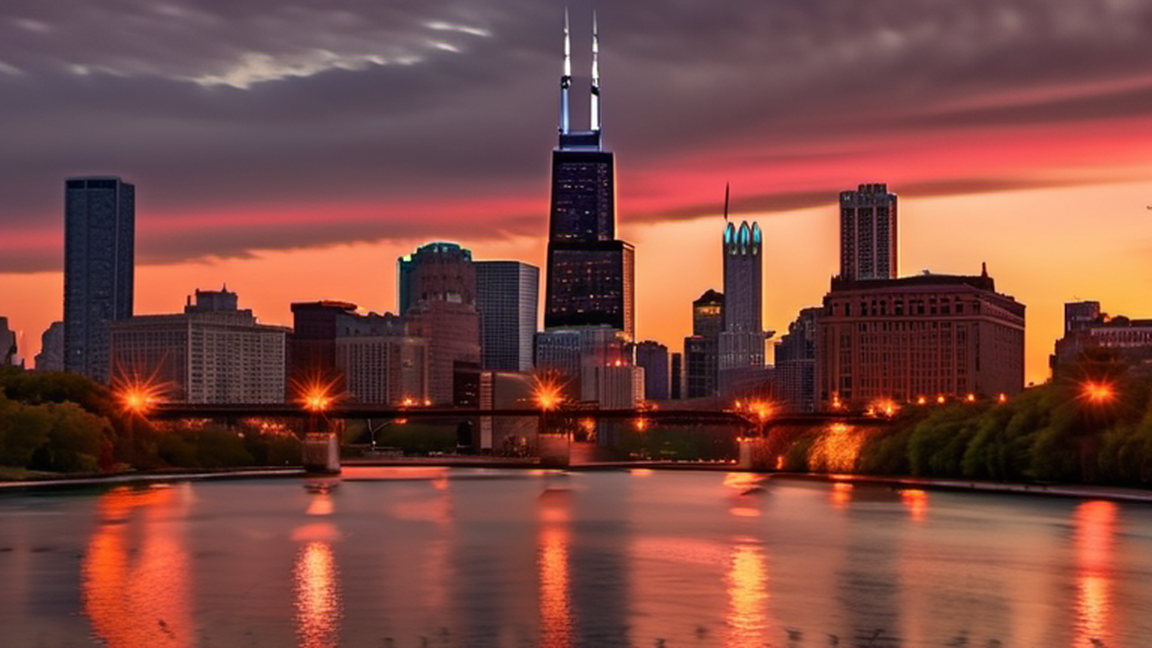
As the hub of the Midwest, Chicago is easy to find — its picturesque skyline calls across the waters of Lake Michigan, a first impression that soon reveals world-class museums of art and science, miles of sandy beaches, huge parks and public art, and perhaps the finest downtown collection of modern architecture in the world.
With a wealth of iconic sights and neighborhoods to explore, there's enough to fill a visit of days, weeks, or even months without ever seeing the end. Dress warm in the winter, and prepare to cover a lot of ground; the meaning of Chicago is only found in movement, through subways and archaic elevated tracks, in the pride of tired feet and eyes raised once more to the sky.
▸Districts566 chars
Many visitors never make it past the attractions downtown, but you haven't truly seen Chicago until you have ventured out into its many neighborhoods. Chicagoans split their city into large "sides" to the north, west, and south of the central business district (the Loop). Chicagoans also tend to identify strongly with their neighborhood, reflecting real differences in culture and place throughout the city. Rivalries between the North and South Sides run particularly deep, while people from the West Side are free agents in critical issues like baseball loyalty.
▸Understand28 chars
Chicago tourist information.
▸History6,916 chars
Chicago was known as a fine place to find a wild onion if you were a member of the Potawatomi tribe, who lived in this area of Illinois before European settlers arrived. It was mostly swamps, prairie and mud long past the original settlement by Jean Baptiste Point du Sable in 1779, the establishment of Fort Dearborn in 1803 and incorporation as a town in 1833. It could be argued that nature never intended for there to be a city here; brutal winters aside, it took civil engineering projects of unprecedented scale to establish working sewers, reverse the flow of the river to keep it out of the city's drinking supply, and stop buildings from sinking back into the swamps — and that was just the first three decades.
Chicago became a waypoint between the Great Lakes and the Wild West, where boats came to drop off settlers, and load crops and other goods from the Great Plains and the Rocky Mountains.
By 1871, the reckless growth of the city was a sight to behold, full of noise, Gothic lunacy, and bustling commerce. But on October 8, the Great Chicago Fire quickly spread through the city, killing 300 and destroying the oldest part of the city. A journalist blamed it on Mrs. O'Leary and her cow, but years later admitted that he invented the story. The stone Water Tower in the Near North is the most famous surviving structure. But the city seized this destruction as an opportunity to rebuild bigger than before, giving canvas for several architects and urban planners who would go on to become legends of modern architecture.
At the pinnacle of its rebirth and the height of its newfound powers, Chicago was known as "The White City". Cultures from around the world were summoned to the 1893 World's Columbian Exposition, to bear witness to the work of Louis Sullivan, Daniel Burnham, and the future itself. Cream of Wheat, soft drinks, street lights and safe electricity, the fax machine, and the Ferris Wheel bespoke the colossus now resident on the shores of Lake Michigan.
As every road had once led to Rome, every train led to Chicago. Carl Sandburg called Chicago the "Hog Butcher for the World" for its cattle stockyards and place on the nation's dinner plate. Sandburg also called it the "City of the Big Shoulders", noting the tall buildings in the birthplace of the skyscraper — and the city's "lifted head singing so proud to be alive and coarse and strong and cunning." But Chicago is a city in no short supply of nicknames. Fred Fisher's 1922 song (best known in Frank Sinatra's rendition) calls it "That Toddlin' Town", where "on State Street, that great street, they do things they don't do on Broadway." It's also referenced by countless blues standards like "Sweet Home Chicago".
▸Climate2,187 chars
Weather is definitely not one of the attractions in Chicago. There's a good time to be had in any season, but it is a place where the climate has to be taken into consideration.
Despite Chicago's winters, there are more days with a maximum temperature of between 80-84°F (27-29°C) than any other five-degree range. Obscured by Chicago's ferocious winters are the heat waves of summer, where daytime temperatures can climb to 100 °F (38 °C) and nighttime temperatures hover at around 80 °F (27 °C). The days in July and August that go above the normal are oftentimes hot and humid, and dewpoints can be similar to those found closer to the Gulf of Mexico. Typical average summer heat indices average between 86 °F (30 °C) during the day and 71 °F (22 °C) at night. The city's surprisingly attractive lakefront beaches can relieve some of the swelter. Summer nights are usually reasonable, though, and you'll get a few degrees' respite along the lakefront — in the local parlance, that's "cooler by the lake." The sun is up from 5:15AM - 8:15PM.
But then there are those winters. The months from December to March will see very cold temperatures, with even more bitter wind chill factors, though occasional warm spells with temperatures as high as 60 °F (16 °C) aren't uncommon either. Snow is usually limited to a handful of heavy storms per season, with a few light dustings in-between. (And a little more along the lakefront — again in the local parlance, that's "lake effect snow".) Ice storms are also a risk. It's a city that's well-accustomed to these winters, though, so city services and public transportation are highly unlikely to shut down. The sun sets early in the winter months with darkness setting in before 4:30PM, and sunrises past 7:15AM.
That said, Chicago does have a few nice months of weather. May and September are pleasant and mild; April and June are mostly fine, although thunderstorms with heavy winds can also occur suddenly. Although there may be a slight chill in the air in October, it rarely calls for more than a light coat and some days that's not even necessary. In some years, the warmth stored by the lake may prolong a pleasant autumn into November.
▸Read3,958 chars
Chicago literature found its roots in the city's tradition of lucid, direct journalism, lending to a strong tradition of social realism. Consequently, most notable Chicago fiction focuses on the city itself, with social criticism keeping exultation in check. Here is a selection of Chicago's most famous works about itself:
Karen Abbott's Sin in the Second City is a best-seller about Chicago's vice district, the Levee, and some of the personalities involved: gangsters, corrupt politicians, and two sisters who ran the most elite brothel in town.
Nelson Algren's Chicago: City on the Make is a prose poem about the alleys, the El tracks, the neon and the dive bars, the beauty and cruelty of Chicago. It's best saved for after a trip, when at least twenty lines will have you enraptured in recognition.
Saul Bellow's Adventures of Augie March charts the long drifting life of a Jewish Chicagoan and his myriad eccentric acquaintances throughout the early 20th century: growing up in the then Polish neighborhood of Humboldt Park, cavorting with heiresses on the Gold Coast, studying at the University of Chicago, fleeing union thugs in the Loop, and taking the odd detour to hang out with Trotsky in Mexico while eagle-hunting giant iguanas on horseback. This book has legitimate claim to be the Chicago epic (for practical purposes, that means you won't finish it on the plane).
Gwendolyn Brooks' A Street in Bronzeville was the collection of poems that launched the career of the famous Chicago poetess, focused on the aspirations, disappointments, and daily life of those who lived in 1940s Bronzeville. It is long out of print, so you'll likely need to read these poems in a broader collection, such as her Selected Poems.
Sandra Cisneros' The House on Mango Street is a Mexican-American coming-of-age novel, dealing with a young Latina girl, Esperanza Cordero, growing up in the Chicago Chicano ghetto.
Theodore Dreiser's Sister Carrie is a cornerstone of the turn of the 20th century Chicago Literary Renaissance, a tale of a country girl in the big immoral city, rags-to-riches and back again.
Stuart Dybek's The Coast of Chicago is a collection of fourteen marvelous short stories about growing up in Chicago (largely in Pilsen and Little Village) in a style blending the gritty with the dreamlike.
John Guzlowski's Lightning and Ashes chronicles the author's experiences growing up in the immigrant and DP neighborhoods around Humboldt Park in Chicago, talking about Jewish hardware store clerks with Auschwitz tattoos on their wrists, Polish cavalry officers who still mourned for their dead horses, and women who walked from Siberia to Iran to escape the Russians.
▸Watch3,292 chars
Chicago is America's third most prolific movie industry and a host of very Chicago-centric movies have been produced here. These are just a few:
North by Northwest (Alfred Hitchcock, 1959). Landmark spy thriller film by the famed director, with the main character riding the 20th Century Limited train from New York City's Grand Central Terminal to Chicago's LaSalle Street Station. Some scenes were filmed in the now-demolished 1903-built station building of LaSalle Street Station (though the train platforms remain in active use as part of the Metra suburban network), the Ambassador East Hotel (today known as the Ambassador Gold Coast) and Chicago Midway Airport (albeit at a now-demolished terminal building).
Ferris Bueller's Day Off (John Hughes, 1986). The dream of the northern suburbs: to be young, clever, and loose for a day in Chicago. Ferris and friends romp through the old Loop theater district, catch a game at Wrigley Field, and enjoy the sense of invincibility that Chicago shares with its favorite sons when all is well.
Adventures in Babysitting (Chris Columbus, 1987). The flip side of Ferris Bueller — the dangers that await the suburbanite in the Loop at night, including memorable trips to lower Michigan Avenue and up close with the Chicago skyline.
The Blues Brothers (John Landis, 1980). Probably Chicago's favorite movie about itself: blues music, white men in black suits, a mission from God, the conscience that every Chicago hustler carries without question, and almost certainly the biggest car chase ever filmed.
The Untouchables (Brian De Palma, 1987). With a square-jawed screenplay by David Mamet, this is a retelling of Chicago's central fable of good vs. evil: Eliot Ness and the legendary takedown of Al Capone. No film (except perhaps The Blues Brothers) has made a better use of so many Chicago locations, especially Union Station (the baby carriage), the Chicago Cultural Center (the rooftop fight), and the LaSalle Street canyon.
Home Alone (Chris Columbus, 1992) and its sequel Home Alone 2: Lost In New York (1992). Christmas films featuring a family living in the Chicago suburb of Winnetka, some scenes were filmed in Chicago O'Hare International Airport.
High Fidelity (Stephen Frears, 2000). John Cusack reviews failed relationships from high school at Lane Tech to college in Lincoln Park and muses over them in trips through Uptown, River North, all over the city on the CTA, his record store in the rock snob environs of Wicker Park, and returning at last to his record-swamped apartment in Rogers Park.
▸Smoking350 chars
Smoking is prohibited by state law at all restaurants, bars, nightclubs, workplaces, and public buildings. It's also banned within fifteen feet of any entrance, window, or exit to a public place, and at CTA train stations. The fine for violating the ban can range from $100 to $250. Cannabis in Illinois is legal however the same smoking rules apply.
▸Economy409 chars
Chicago used to be primarily an industrial city, and rose to prominence as the rail hub of the United States. While heavy industry and rail transport have declined since Chicago's heyday, the metropolitan area remains home to 36 Fortune 500 companies, with 11 in the City of Chicago. In addition, Chicago continues to be the world's largest commodities trading hub, in particular for agricultural commodities.
▸Tourist information1,157 chars
Chicago's visitor information centers offer maps, brochures and other information.
Choose Chicago visitor information website.
Chicago Water Works Visitor Information Center, 163 E Pearson Ave, toll-free: +1-877-244-2246. Jan 2-Mar 15: Sa Su 10AM-5PM; Mar 16-May 26: Su 10AM-5PM, M-Sa 9:30AM-6PM; May 27-Sep 2: Su 10AM-6PM, M-Th 9AM-7PM, F Sa 9AM-6PM; Sep 3-Dec 31: Su 10AM-5PM, M-Sa 9:30AM-6PM; closed Thanksgiving, Dec 25, Jan 1. The city's main visitor information center is on the Magnificent Mile in the historic Pumping Station, across the street from the Water Tower. In addition to extensive free visitor materials, there is a small café.
Chicago Cultural Center Visitor Information Center, 77 E Randolph St, ☏ +1-312-744-8000. Jan 2-Mar 15: Sa Su 10AM-5PM; Mar 16-May 26: Su 10AM-5PM, M-Sa 9:30AM-6PM; May 27-Sep 2: Su 10AM-6PM, M-Th 9AM-7PM, F Sa 9AM-6PM; Sep 3-Dec 31: Su 10AM-5PM, M-Sa 9:30AM-6PM; closed Thanksgiving, Dec 25, Jan 1. A centrally located place to pick up a host of useful, free materials. The Cultural Center itself makes a good first stop on your tour, with free, worthwhile art and historical exhibits throughout the year.
▸Talk2,335 chars
As with most other American cities, English is the main language spoken in Chicago. However, Chicago is also home to large migrant populations from Latin America, in particular Mexico and Puerto Rico, and Spanish is also commonly heard. Government services are generally available in both English and Spanish.
Chinatown has long been a bastion of the Chinese language and the Chinese American population has defied trends in other ethnic neighborhoods by expanding out to adjacent communities. The traditionally Cantonese and Taishanese-speaking community is gradually being outplayed by Mandarin speakers from Taiwan and Mainland China. There is also a rapidly growing South Asian population concentrated around Devon avenue on the north side but becoming integral throughout the whole city. Hence Hindi, Urdu, Tamil, Gujarati and other languages from that region are commonly heard anywhere in the Chicagoland area. Vietnamese is spoken by many residents of the area near Argyle Red Line station.
Unique to Chicago is its large Polish and other Eastern European communities. Polish thrives in neighborhoods and suburbs around the O'Hare area where one can still find bilingual English and Polish signs. The language has dwindled a bit but is still widely represented in churches, delis, legal services, supermarkets, restaurants, and museums. There are Polish newspapers in Chicago and even several FM radio stations. Signs in Cook County and Du Page County forest preserves are often trilingual in English, Spanish, and Polish. Ukrainian is still spoken by some residents of the Ukrainian Village, and the language is still used in the local churches, schools, bakeries and restaurants.
The traditional Chicago accent is classified under Great Lakes English, and is similar to the traditional Detroit and Buffalo accents. You may still occasionally encounter it when speaking to older white working class Chicagoans, but it is now moribund, and most younger white Chicagoans speak with a general American accent. On the other hand, the accents of many black Chicagoans retain certain features of Southern accents that are a legacy of the Great Migration of African-Americans from the South in the 20th century.
Most municipal services are also available in Spanish, Polish, Mandarin, Hindi, Urdu and Arabic, in addition to English.
▸By plane645 chars
Chicago (CHI IATA for all airports) is served by two major airports: O'Hare International Airport and Midway International Airport. There are plenty of taxis both to and from the city center, but they are quite expensive, especially during rush hours. Expect upwards of $40 for O'Hare and $30 for Midway. CTA trains provide direct service to both larger airports for $2.50 from anywhere in the city — faster than a taxi during rush hour and a lot less expensive. (Train rides originating at O'Hare are $5.)
Many large hotels offer complimentary shuttle vans to one or both airports, or can arrange one for a charge ($15–25) with advance notice.
▸O'Hare1,135 chars
O'Hare International Airport (ORD IATA) is 17 miles (27 km) northwest of downtown and serves many international and domestic carriers. United Airlines has its main hub here and is the airport's main airline; American Airlines is second at O'Hare. Most connecting flights for smaller cities in the Midwest run through O'Hare. It's one of the biggest airports in the world, and it has always been notorious for delays and cancellations. It is too far northwest for most travelers who get stuck overnight to head into the city, but there are plenty of hotels in the O'Hare area. See the O'Hare article for listings.
The CTA Blue Line runs between the Loop and O'Hare at least every 15 minutes, 24 hours a day and 7 days a week. A trip on the Blue Line from O'Hare to the Loop takes around an hour. The O'Hare station is the end of the line and is essentially in the basement of O'Hare airport. Walking from the platform to the ticket counters should take 5–10 minutes for Terminals 2 or 3, slightly more for Terminal 1, and a great deal longer for the International Terminal 5 (It is necessary to take the free people mover for transfer).
▸Midway673 chars
Midway International Airport (MDW IATA) is 10 miles (16 km) southwest of downtown. Southwest Airlines is the largest carrier here. If it's an option for your trip, Midway is more compact, less crowded, has fewer delays, and usually cheaper. And, of course, it's significantly closer to downtown.
The CTA Orange Line train runs between the Loop and Midway in around 25 minutes. The CTA Midway Station is at the end of the Orange Line. There is an enclosed tunnel that links the station and airport but it takes approximately 10–15 minutes to walk from one to the other. There are a number of hotels clustered around Midway, too — see the Southwest Side article for listings.
▸Others332 chars
Milwaukee's General Mitchell International Airport (MKE IATA) is served by 7 Amtrak trains per day (6 on Sunday), and the Hiawatha Service has a 95% on-time rating. The trip from Chicago Union Station to Mitchell Airport Station is about one hour and 15 minutes. There are also buses from Mitchell Airport to Chicago O'Hare Airport.
▸Private aviation1,056 chars
Chicago is a major hub for private aviation. Chicago and its metropolitan area are home to more than 18 airports serving business and leisure flights. While O'Hare has facilities for general aviation, more private planes use Midway due to its lower handling fees, less congested airspace and more central location. Chicago Executive Airport (PWK IATA) in Wheeling and DuPage Airport (DPA IATA) in West Chicago are also popular general aviation airports.
Other options include Aurora Municipal Airport (AUZ IATA) in Sugar Grove; Waukegan Regional Airport (UGN IATA) in Waukegan; Joliet Regional Airport (JOT IATA) in Joliet, Lewis University Airport (LOT IATA) in Romeoville, Bult Field near Monee and Gary/Chicago International Airport (GYY IATA) in Gary, Indiana.
Air taxi and air charter companies such as https://www.jetsetgrp.com/jetset-charter Jetset Charter] and Chicago Private Jets offer flights on a variety of private charter aircraft and jets, from charter luxury Gulfstream's down to economical piston twins for small groups and individuals.
▸By bus2,545 chars
Coach USA/Airport Supersavers, All terminals at O'Hare and Midway Airports. Daily service from Chicago area airports to Crestwood, Highland, Michigan City, Portage, Notre Dame and South Bend Airport (updated Oct 2017)
Burlington Trailways, 630 W Harrison St. 24 hours. Several daily buses headed to Davenport, Iowa City, Des Moines and Omaha at competitive prices. Onward connections to Denver.
D & W Bus, (bus depot) 2100 Wentworth Ave (In front of the public library in Chinatown). Connects New York to Chicago via Maumee OH; South Bend IN and Portage IN (nearest stop to Gary IN). (updated Oct 2017)
Greyhound, Flixbus, 630 W Harrison St, ☏ +1-312-408-5800. 24 hours. Very frequent service to destinations throughout the Midwest with connections to most of the US and to Mexican cities just south of the border. The main terminal is near the southwestern corner of the Loop. There are secondary terminals at the 95th/Dan Ryan red line station and the Cumberland blue line station.
Indian Trails, 630 W Harrison St (at the Greyhound Station). Frequent service to East Lansing, Grand Rapids with onward destinations available. Daily service to Michigan's Upper Peninsula connecting via Greyhound in Milwaukee. Wi-Fi and power outlets on-board.
Megabus (bus stop along Polk St between Clinton St and Canal St), toll-free: +1-877-462-6342. Daily service across the Midwest and also from far-flung places like Atlanta and Dallas. Buses have Wi-Fi and 110 V outlets. Reservations must be made online. No tickets are available on the bus or at the bus stop. (updated Jan 2017)
Peoria Charter ((Bus stop) South East Corner of Jackson and Canal. On Jackson Blvd next to the Historic Route 66 Sign.), toll-free: +1-800-448-0572. Connects Chicago, O'Hare, and certain suburbs to Peoria, Bloomington-Normal, and Champaign. (updated Apr 2023)
Turimex Internacional, 2139 S California, toll-free: +1-800-733-7330. Daily service to Memphis, Little Rock and Dallas. Passengers transfer in Dallas to continue to other destinations in the US and to Mexico. (updated Sep 2017)
CoachUSA/Wisconsin Coach, O'Hare Airport, toll-free: +1-877-324-7767. Offers 14 buses daily, departing every hour, from O'Hare to Southeastern Wisconsin and Milwaukee (including Milwaukee Airport and Amtrak station), and Waukesha. ORD to Milwaukee $28.
CoachUSA/Van Galder (service from O'Hare Airport, Midway Airport, and Union Station), toll-free: +1-800-747-0994. Frequent bus service to Madison and Janesville Wisconsin and to Rockford and South Beloit Illinois.
▸By train5,193 chars
1 Chicago Union Station, 225 South Canal Street (Canal St and Jackson Blvd). 5:30AM-midnight. With its massive main hall, venerable history, and cinematic steps, Union Station is worth a visit even if you're not coming in by train. (updated Jul 2018) Train operator:
Amtrak, ☏ +1 215-856-7924, toll-free: +1-800-872-7245. Operates train service around the United States. Chicago is the main rail hub of the entire United States. Today, Amtrak uses the magisterial Union Station as the hub of its long-distance routes, making Chicago one of the most convenient U.S. cities to visit by train, serving the majority of the passenger rail company's long-distance routes, with options from virtually every major U.S. city. To this day, most coast to coast rail journeys in the U.S. require a train change in Chicago. (updated Mar 2022) Routes stopping in Chicago:
California Zephyr, traveling to Chicago from Emeryville (San Francisco) via Salt Lake City, Denver, and Omaha. Travel time to Chicago from Emeryville is 2 days 3.75 hours, from Salt Lake City is 1 day 10.25 hours, from Denver is 18.75 hours, and from Omaha is 9.5 hours.
Capitol Limited, traveling from Washington, D.C. via Pittsburgh and Cleveland. Travel time to Chicago from Washington, D.C. is 17.75 hours, from Pittsburgh is 9.75 hours, and from Cleveland is 6.75 hours.
Cardinal, traveling from New York City via Washington, D.C., Charlottesville, Cincinnati, and Indianapolis. Travel time to Chicago from New York City is 1 day 4.25 hours, from Washington, D.C. is 1 day, from Charlottesville is 20.75 hours, from Cincinnati is 9.25 hours, and from Indianapolis is 5 hours.
City of New Orleans, traveling to Chicago from New Orleans via Jackson and Memphis. Travel time to Chicago from New Orleans is 19.75 hours, from Jackson 15.75 is hours, and from Memphis is 11 hours.
Empire Builder, traveling to Chicago from Seattle or Portland via Spokane, Glacier National Park, Fargo, Saint Paul, and Milwaukee. The trains split into separate branches between Seattle and Spokane, and between Portland and Spokane, while operating as trains consisting of train cars from both branches between Spokane and Chicago. Travel time to Chicago from Seattle is 1 day 21.75 hours, from Portland is 1 day 22 hours, from Spokane is 1 day 13.5 hours, from Minneapolis is 8 hours, and from Milwaukee is 1.75 hours.
Hiawatha, has 6 to 7 daily round trips between Milwaukee Downtown Intermodal Station and Chicago with stops along the way at Milwaukee Airport-Trains station, Sturtevant (7 miles west of Racine), and Glenview. Travel time to Chicago from Milwaukee Downtown Intermodal Station is 1.5 hours.
▸By car2,504 chars
Chicago is the end point of the historical Route 66 from Los Angeles.
Chicagoans have a maddening habit of referring to some expressways by their names, not the numbers used to identify them on the signs you'll see posted on the U.S. interstate highway system, so you'll have to commit both name and number to memory. I-55 (the Stevenson Expressway) will take you directly from St. Louis into downtown Chicago. I-90/94 (the Dan Ryan on the South Side) comes in from Indiana to the east (via the Chicago Skyway - I-90 and Bishop Ford Freeway - I-94) and from central Illinois (via I-57). I-90 (the Kennedy on the North Side) comes in from Madison to the northwest. I-94 (the Edens Expressway) comes in from Milwaukee to the north, but roadworks have slowed traffic considerably compared to I-90. I-80 will get you to the city from Iowa which neighbors Illinois to the west. There is also
I-57 which goes from Sikeston, MO and is a bypass of St Louis, for travelers in central Illinois and people coming from places like Memphis who do not want to wait in St Louis traffic.
The Illinois tollway (which in addition to I-90 - The Jane Addams west of O'Hare Airport) consists of I-88 - The Reagan which serves the west suburbs, I-355 - The Veterans Memorial which connects Joliet with Schaumburg, and I-294 - The Tri-State which bypasses downtown from the south side to the far northwest side and passes next to O'Hare airport. The Illinois tollway has abolished toll collections in cash, and now uses electronic tolling exclusively. If you do not have an I-Pass transponder, you have up to fourteen days to pay tolls online, though at double the cost of tolls paid using a transponder. If you have an E-ZPass, it is fully compatible with the I-Pass system. Only the Chicago Skyway still accepts toll payments in cash or by credit card, though I-Pass and E-ZPass transponders are also accepted.
If you're arriving downtown from Indiana, from the south on I-94 or I-90, or from the north, Lake Shore Drive (U.S. Highway 41) provides a scenic introduction in both directions, day or night. If arriving on I-55 from the southwest, or on I-290 (the Eisenhower Expressway, formerly and sometimes still called The Congress Expressway) from the west, the skyline may also be visible from certain clear spots, but without the shore view. I-55 from the southwest and I-90 through much of northwest Indiana are chock full of heavy industries with odors that'll knock your socks off, so plan your route downtown wisely.
▸Get around1,314 chars
Navigating Chicago is easy. Block numbers are consistent across the whole city. Standard blocks, of 100 addresses each, are roughly 1/8th of a mile (200 meters) long. (Hence, a mile is equivalent to a street number difference of 800.) Each street is assigned a number based on its distance from the zero point of the address system, the intersection of State Street and Madison Street. A street with a W (west) or E (east) number runs east-west, while a street with a N (north) or S (south) number runs north-south. A street's number is usually written on street signs at intersections, below the street name. Major thoroughfares are at each mile (multiples of 800) and secondary arteries at the half-mile marks. Thus, Western Ave at 2400 W (3 miles west of State Street) is a north-south major thoroughfare, while Montrose Ave at 4400 N is an east-west secondary artery.
In general, "avenues" run north-south and "streets" run east-west, but there are numerous exceptions. (e.g., 48th Street may then be followed by 48th Place). In conversation, however, Chicagoans rarely distinguish between streets, avenues, boulevards, etc.
Several streets follow diagonal or meandering paths through the city such as Clark St, Lincoln Ave, Broadway, Milwaukee Ave, Ogden Ave, Archer Ave, Vincennes Ave, and South Chicago Ave.
▸By public transit425 chars
The best way to see Chicago is by public transit. It is efficient in terms of price, travel time, and safety. The Regional Transportation Authority (RTA) oversees the various public transit agencies in the Chicagoland area. You can plan trips online with the CTA travel planner or get assistance by calling 312-836-7000. The RTA also has an official partnership with Google Maps, which can provide routes with public transit.
▸CTA6,148 chars
The Chicago Transit Authority (CTA) operates trains and buses in the city of Chicago and some of the suburbs. Put simply, the CTA is Chicago. It is a marvel and a beast, convenient, frustrating, and irreplaceable. Even if you have the option of driving while you're in town, no experience of Chicago is complete without a trip on the CTA.
The CTA refers to its entire train system as The 'L'. The CTA inherited the name from its predecessor agencies that ran elevated trains, but now refers to all trains, including subways, as The 'L'. All train lines radiate from the Loop to every corner of the city. The "Loop" name used to refer to a surface-level streetcar loop, which pre-dated the elevated tracks. That any form of transportation preceded the present one may come as a surprise, given how old some of the stations look, but they work.
CTA train lines are divided by colors: Red, Green, Brown, Blue, Purple, Yellow, Orange and Pink. All lines lead to the Loop except the Yellow Line, which provides service between the suburb of Skokie and the northern border of Chicago, and the Purple Line, which only provides service to the loop during rush hour. The Red and Blue lines run 24/7, every day of the year, making Chicago and New York City the two American cities, and one of a handful worldwide, to offer 24-hour rail service within the city. Hours for the other lines vary somewhat by the day, but as a general rule run from about 4:30AM–1AM. Most, if not all, CTA train stations have train trackers, making it easy to find when your train is coming.
Before you travel, find out the name of the train stop closest to your destination, and the color of the train line on which it is located; beware that the blue line has two stations named Western, and the green line has two stations with similar names, Ashland and Ashland/63rd. Once you're on board, you'll usually find route maps in each train car, above the door (although they are often stolen). The same map is also available online. The name signs on platforms often have the station's location in the street grid, e.g. "5900 N, 1200 W" for Thorndale.
There should be an attendant on duty at every train station. They cannot provide change or deal with money, but they can help you figure out where you need to go and guide you through using the machines.
Buses run on nearly every major street in the city, and in many cases, every four blocks apart. Look for the blue and white sign, which should give a map of the route taken by the bus and major streets/stops along the way. Once inside, watch the front of the bus, a red LED display will list the names of upcoming streets where stops are located, making it easy to stop exactly where you want, even a small side street. To request a stop, pull the cord hanging above the window and make sure you hear an audible 'ding', or press the red 'STOP' button located on most handholds. Hollering at the bus driver will raise tempers but works in a pinch.
▸Metra and South Shore2,391 chars
Metra, ☏ +1-312-322-6777. Runs commuter trains for the suburbs, providing service within Illinois, to Kenosha, Wisconsin, out west, and to the far south and southwest suburbs. Metra trains are fast, clean, and punctual, but unpleasantly crowded during rush hour. Generally, every car or every other car on the train has a bathroom. Service outside of rush hours is infrequent (about once/hour), so be sure to check the schedules while planning your trip. The North Central and Heritage Corridor lines do not run outside of weekday rush hours.
Metra's Electric Line provides service to the convention center (McCormick Place), Hyde Park (Museum of Science and Industry, University of Chicago), and the Far Southeast Side's Pullman Historic District and Rainbow Beach. The Electric Line is fast, taking at most 15 minutes to reach Hyde Park from the Loop.
Northern Indiana Commuter Transportation District (NICTD), ☏ +1-219-926-5744. Operates the South Shore Line railroad. The South Shore Line railroad runs commuter trains between the Millennium Park Metra station in downtown Chicago and the South Bend, Indiana airport. Although the South Shore Line receives some subsidies from Metra, it is not part of the Metra system and does not accept Metra or CTA tickets.
Despite the fact you can buy tickets on the Ventra app, none of the commuter trains accept Ventra cards as payment. From downtown Chicago, the Metra fare to McCormick Place is $4 and the fare to Hyde Park is $4.25. Buy your tickets before boarding the train at a window or one of the automated vending machines. You can buy a ticket on the train, but that comes with an extra $5/ticket surcharge if the station you're leaving from had an open ticket window or an operational ticket machine. If you have a smartphone, you can download and use the Ventra app to purchase a ticket on the train and avoid a surcharge.
Ten-ride, weekly, and monthly passes are available. If you have a group of four or more people, it may be cheaper to purchase a ten-ride card and have all of your fares punched from that one card. If using Metra on Saturday and/or Sunday, you can purchase an unlimited ride weekend pass for just $10. If you buy your ticket at a station, you can use cash or credit. If you buy your ticket on the train, you can use cash or the Ventra app if you have a smartphone. Credit cards are not accepted on the train.
▸Pace1,247 chars
Pace runs buses in the suburbs, although some routes do cross into the city, particularly in Rogers Park at the Howard (Red/Purple/Yellow Line) CTA station, the Far Northwest Side at the Jefferson Park (Blue Line) CTA station, and at the 95th Red Line CTA stop in the far south side. In addition to its regular fixed-route service, Pace provides two types of paratransit services within the areas served by Pace and the CTA. ADA Paratransit Service is provided to passengers who have been previously certified as disabled. Call-n-Ride service is provided in some suburban areas where there is insufficient demand to justify regularly scheduled service. Call-n-Ride passengers must call in advance to arrange pickup and drop-off.
The standard Pace bus fare is $2 using the Ventra card or $2.25 using cash (no change provided). Ventra Cards may be loaded with cash ("transit value"), 7-day and 30-day CTA/Pace passes, and 30-day Pace passes. Pace accepts transfers from the CTA by passengers using a Ventra Card for the same fee as the CTA charges (25 cents for the second ride and free for the third ride within two hours). Conversely, passengers paying with a Ventra Card receive transfer privileges onto CTA buses and trains under the same terms.
▸By car2,229 chars
Avoid driving in downtown Chicago if at all possible. Traffic is awful, pedestrians are constantly wandering into the street out of turn, and garages in the Loop can cost as much as $40 per day (although services like SpotHero may have more reasonable prices). And while downtown streets are laid out on the grid, many have multiple levels which confuse even the most hardened city driver. Even outside of the city center, street parking may not be readily available. If you do find a spot, check street signs to make sure that a) no residential permit is required to park here and b) parking is not disallowed during certain hours for "street cleaning", rush hour or something along those lines. Parking restrictions are swiftly and mercilessly enforced in the form of tickets and towing — be especially wary during snowy weather.
On the other hand, the radial nature of Chicago's public transportation network means that becomes less and less reliable as you get further away from the Loop, so a having a car will make it more convenient to travel between different neighborhoods.
Parking is handled by one-per-block kiosks, which require you to enter your license plate number. The kiosks will accept coins or credit cards. If the kiosk fails for any reason, there should be a phone number to call to report it and ensure you don't receive an undeserved ticket. If you are going to be doing a lot of street parking, there is a ParkChicago app that allows you to pay for parking with your phone. When asked for help, any passing Chicagoan will be happy to commiserate about how badly the city bungled privatizing the parking meters.
Talking on a handheld cell phone while driving is illegal in Chicago, and the police are eager to write tickets for it. If you need to take a call, use a hands-free headset — or better yet, pull over.
The perpetual construction is bad enough, but drivers on the city expressways can be very aggressive. For those used to driving on expressways in the Northeast, this may be a welcome reminder of home. For everyone else, though, it can be intimidating.
Ideally, avoid driving in downtown areas as parking fees are high. Ride-sharing services are widely available and a stress-free alternative.
▸By taxi1,530 chars
Chicago has some of the cheapest taxi fares in the U.S. Taxis can be hailed from the street throughout the major tourist areas, and are strictly regulated by the city. Fares are standard and the initial charge ("flag pull") is $2.25 for the first 1/9 mile, then $0.20 for each additional 1/9 mile or $0.20 for each elapsed 36 seconds. There is a $1.00 fuel surcharge added to the initial charge. There is also a flat $1.00 charge for the second passenger, and then a $0.50 charge for each additional passenger after that (for example, if four people take a taxi together, there will be $2.00 in additional flat fees). There is no additional charge for baggage or credit card use. Rides from O'Hare and Midway to outer suburbs cost an additional one half the metered fee. Give the driver the nearest major intersection to which you are heading (if you know it) and then the specific address.
Outside of the downtown, North Side, Near West and Near South neighborhoods, you will likely have greater difficulty hailing a taxi directly from the street. In these situations, you can call for a taxi to come pick you up. Taxis typically take 10–15 minutes from the time you call to arrive. The principal companies are:
American-United Taxi, ☏ +1-773-248-7600.
Checker Cab, ☏ +1-312-243-2537.
Universal Taxi, ☏ +1-888-344-8294.
Flash Cab, ☏ +1-773-561-1444.
The above applies only to Chicago taxis. Suburban taxi cabs have their own fares and rates, depending on the laws and regulations of the town in which they are based.
▸By bicycle930 chars
Chicago has a bike path along the shores of Lake Michigan, making north-south travel very convenient as long as the weather is favorable by the lake. Most major city streets have bike lanes, and the biking culture is established enough that cars tend to accommodate and (grudgingly) yield to bicycles. Bike trips can also be combined with rides on the CTA, and Chicago's new bike-sharing program DIVVY has docks near many major stations. See the bicycling section below for more details.
Bicycles are permitted on "L" trains except during rush hour (7-9AM and 4-6PM on weekedays). All buses have bicycle racks in the front that can carry up to two bicycles, and bicycles are allowed on buses at all times, subject to space availability. There is no extra charge for bringing your bicycle onto public transportation. You must be at least 14 (or 12 with parental supervision) years old to bring a bicycle onto public transportation.
▸By water taxi1,047 chars
In the summer, water taxis are sometimes more convenient than the CTA, if you are traveling around the fringes of downtown. They are also a relatively cheap way to take in some offshore views. Two private companies operate water taxi services around the Loop.
Chicago Water Taxi (Wendella Boats), ☏ +1-312-337-1446. Taxis run roughly M-F 6:30AM–8:30PM, Sa Su 10AM–9:30PM.. Uses yellow boats and has seven stops connecting Ogilvie/Union Metra station to Michigan Ave, Chinatown, and Goose Island. $6 single ride, $10 all day pass, $20 ten-ride pass. (updated Mar 2019)
Shoreline Sightseeing, ☏ +1-312-222-9328. Has blue and white boats. It is more expensive ($5–7), but it serves seven destinations including some on Lake Michigan (Union Station/Sears Tower, Wells & Wacker, Michigan Ave Bridge, Navy Pier-Ogden Slip, Navy Pier-Dock St, Buckingham Fountain, and Museum Campus). Shoreline taxis run 10AM-6PM every twenty minutes and 6PM-9PM every half hour Memorial Day–Labor Day, with occasional and less frequent service in the spring and fall.
▸Itineraries259 chars
Along the Magnificent Mile — one day and night in Chicago, with skyscrapers, shopping, food, parks, and amazing views of the city from high and low.
Loop Art Tour — a 2- to 4-hour walking tour of downtown Chicago's magnificent collection of modern sculptures.
▸Museums2,564 chars
Chicago's set of museums and cultural institutions are among the best in the world. Three of them are within a short walk of each other in the Near South, on what is known as the Museum Campus, in a beautiful spot along the lake: the Adler Planetarium, with all sorts of cool hands-on space exhibits and astronomy shows; the Field Museum of Natural History, which features SUE, the most complete Tyrannosaurus rex skeleton ever found, and a plethora of Egyptian treasures; and the Shedd Aquarium, with dolphins, whales, sharks, and the best collection of marine life east of California. A short distance away, in Hyde Park, is the most fun of them all, the Museum of Science and Industry — or, as generations of Chicago-area grammar school students know it, the best field trip ever. The Museum of Science and Industry has a transportation exhibit and a weather exhibit. Visitors can even control a tornado with the joystick controller desk. Also in Hyde Park is the University of Chicago, whose Oriental Institute is one of the world's foremost authorities on Ancient Near East archaeology, and operates a free museum displaying its archaeological findings.
In Loop, the Art Institute of Chicago has a handful of iconic household names among an unrivaled collection of Impressionism, modern and classical art, and tons of historical artifacts. Just one block east of the historic Water Tower in the Near North is the Museum of Contemporary Art which features paintings, sculpture, film and photography produced since 1945.
Also, Chicago has some knockout less well-known museums scattered throughout the city like the International Museum of Surgical Science in Gold Coast, Chicago History Museum in Lincoln Park, DuSable Museum of African American History in Washington Park, National Museum of Mexican Art in Pilsen, the Polish Museum of America in Wicker Park, the Museum of Photography in the Loop, and the Driehaus Museum in Near North. The University of Chicago, in Hyde Park, has several cool (and free) museums that are open to all visitors, showcasing a spectacular collection of antiquities and modern/contemporary art.
Discount packages like the Chicago CityPASS can be purchased before you arrive in town. They cover admission to some museums and other tourist attractions, allowing you to cut to the front of lines, and may include discounts for restaurants and shopping. Also, programs such as Bank of America's Museums to Go offer free admission at multiple Chicago museums for designated times which can save you a small fortune on admission fees.
▸Architecture3,570 chars
From the sternly classical to the space-age, from the Gothic to the coolly modern, Chicago is a place with an embarrassment of architectural riches. Frank Lloyd Wright fans will swoon to see his earliest buildings in Chicago, where he began his professional career and established the Prairie School architectural style, with numerous homes in Hyde Park/Kenwood, Oak Park, and Rogers Park — over 100 buildings in the Chicago metropolitan area! Frank Lloyd Wright learned his craft at the foot of the lieber meister, Louis Sullivan, whose ornate, awe-inspiring designs were once the jewels of the Loop, and whose few surviving buildings (Auditorium Theater, Carson Pirie Scott Building, one in the Ukrainian Village) still stand apart.
The 1871 Chicago Fire forced the city to rebuild. The ingenuity and ambition of Sullivan, his teacher William Le Baron Jenney (Manhattan Building), and contemporaries like Burnham & Root (Monadnock, Rookery) and Holabird & Roche/Root (Chicago Board of Trade) made Chicago the definitive city of their era. The world's first skyscrapers were built in the Loop as those architects received ever more demanding commissions. It was here that steel-frame construction was invented, allowing buildings to rise above the limits of load-bearing walls. Later, Mies van der Rohe would adapt Sullivan's ethos with landmark buildings in Bronzeville (Illinois Institute of Technology) and the Loop (Chicago Federal Center). Unfortunately, Chicago's world-class architectural heritage is almost evenly matched by the world-class recklessness with which the city has treated it, and the list is long of masterpieces that have been needlessly demolished for bland new structures.
Today, Chicago boasts five out of America's fifteen tallest buildings, including the Sears Tower (3rd), the Trump Tower, the Aon Center, and the local favorite, the John Hancock Center. For years, the Sears Tower was the tallest building in the world, but it has since lost the title. Various developers insist they're bringing the title back with proposed skyscrapers. Until they do, Chicago will have to settle for having the third-tallest building in the Western Hemisphere with the Sears Tower, although the Hancock has a better view and is quite frankly better-looking.
Chicago is particularly noted for its vast array of sacred architecture, as diverse theologically as it is artistically. There were more than two thousand churches in Chicago at the opening of the 21st century. Of particular note are the so-called Polish Cathedrals like St. Mary of the Angels in Bucktown and St. Hyacinth Basilica in Avondale, nicknamed such because they were built by Polish Catholic immigrants. In Ukrainian Village, there are several beautifully crafted buildings with old world flourishes recognized for their unusually large size and impressive scope. St. John Cantius Church in West Town, another one of the "Polish cathedrals", was voted the most beautiful church in the United States in 2016. It is known not only for its opulent baroque interior, but also for its sacred music program, where the sacred works of the great composers like Palestrina, Haydn and Mozart are performed as part of the liturgy for special occasions.
▸African-American history7,527 chars
Chicago's African-American history begins with the city's African-American founder, Jean Baptiste Pointe du Sable. Born to a Haitian slave and a French pirate, he married a woman from the Potawatomi tribe, and built a house and trading post on the Chicago River on the spot of today's Pioneer Court (the square just south of the Tribune Tower in the Near North). Du Sable lived on the Chicago River with his family from the 1770s to 1800, when he sold his house to John Kinzie, whose family and friends would later claim to have founded the city.
Relative to other northern cities, African-Americans constituted a fairly large part of Chicago's early population because of Illinois' more tolerant culture, which was inherited from fervent anti-slavery Mormon settlers. As a non-slave state generally lacking official segregation laws, Illinois was an attractive place to live for black freedmen and fugitive slaves.
By the 1920s, Chicago had a thriving middle class African-American community based in the Bronzeville neighborhood, which at the time became known as "The Black Metropolis," home to a cultural renaissance comparable to the better-known Harlem Renaissance of New York. African-American literature of the time was represented by local poetess Gwendolyn Brooks and novelist Richard Wright, most famous for his Native Son, nearly all of which takes place in Chicago's Bronzeville and Hyde Park/Kenwood. The Chicago school of African-American literature distinguished itself from the East Coast by its focus on the new realities of urban African-American life. Chicago became a major center of African-American jazz, and the center for the blues. Jazz great Louis Armstrong got his start there; other famous black Chicagoans of the day included Bessie Coleman — the world's first licensed black pilot, the hugely influential African-American and women's civil rights activist Ida B. Wells, the great pitcher/manager/executive of Negro League Baseball Andrew "Rube" Foster, and many more.
Both fueling and threatening Chicago's black renaissance was the single most influential part of Chicago's African-American history: the Great Migration. African-Americans from the rural South moved to the industrial cities of the North due to the post-WWI shortage of immigrant industrial labor, and to escape the Jim Crow Laws and racial violence of the South. The massive wave of migrants, most from Mississippi, increased Chicago's black population by more than 500,000. With it came southern food, Mississippi blues, and the challenges of establishing adequate housing for so many recent arrivals — a challenge that they would have to meet themselves, without help from a racist and neglectful city government.
▸Ethnic neighborhoods4,817 chars
Chicago is among the most diverse cities in America, and many neighborhoods reflect the character and culture of the immigrants who established them. Some, however, do more than just reflect: they absorb you in a place that, for several blocks at a time, may as well be a chunk of another country, picked up and dropped near the shores of Lake Michigan. The best of Chicago's ethnic neighborhoods are completely uncompromised, and that makes them a real highlight for visitors.
Chicago's Chinatown is among the most active Chinatowns in the world. It even has its own stop on the CTA Red Line. It's on the South Side near Bridgeport, birthplace of the Irish political power-brokers who have run Chicago government for most of the last century. More Irish communities exist on the Far Southwest Side, where they even have an Irish castle to seal the deal. The Southwest Side houses enormous populations of Polish Highlanders and Mexicans, as well as reduced Lithuanian and Bohemian (Czech) communities.
No serious Chicago gourmand would eat Indian food that didn't come from a restaurant on Devon Avenue in Rogers Park. It's paradise for spices, saris, and the latest Bollywood flicks. Lawrence Avenue in Albany Park is sometimes called Seoul Drive for the Korean community there, and the Persian food on Kedzie Avenue nearby is simply astonishing. At the Argyle Red Line stop, by the intersection of Argyle and Broadway in Uptown, you'd be forgiven for wondering if you were still in America; Vietnamese, Thais, and Laotians share space on a few blocks of restaurants, grocery stores, and even dentists, and there is also no shortage of Chinese options due to the large number of ethnic Chinese from Vietnam and Thailand in the area. Neither the Swedish settlers who built Andersonville or the Germans from Lincoln Square are the dominant presence in those neighborhoods any more, but their identity is still present in restaurants, cultural centers, and other small discoveries to be made. Likewise, Little Italy and Greektown on the Near West Side survive only as restaurant strips.
A more contemporary experience awaits in Pilsen and Little Village, two neighborhoods on the Lower West Side where the Spanish signage outnumbers the English; in fact, Chicago has the second largest Mexican and Puerto Rican populations outside of their respective home countries. Pilsen and its arts scene is an especially an exciting place to visit. While the original Czech residents of Pilsen have since moved to the suburbs, a few architectural gems still stand as a testament to their legacy.
▸Beaches1,217 chars
Chicago is not known as a beach destination, but Lake Michigan is the largest freshwater lake that is entirely within the United States, and Chicagoans flock to its sandy shores. Anyone can show up and swim — there are no admission fees, miles of beaches are within walking distance of the Red Line, and almost none of the lakefront is spoiled by "private" beaches. Despite the latitude, the water is quite warm in the summer and early fall (check with the NWS for temperatures). The Chicago shore has been called the second cleanest urban waterfront in the world, although bacteria levels in the water do force occasional — but rare — beach closures (which are clearly posted at the beach, and online. Lifeguards will be posted (usually in a rowboat) if the beach is officially open.
Oak Street Beach and North Avenue Beach (in the Near North and Lincoln Park) are the fashionable places to sun-tan and be seen, but Rogers Park has mile after mile of less pretentious sand and surf. Hyde Park's Promontory Point is beautiful, and offers skyline views from its submerged beach by the rocks. Swimming there is against city rules, but it appears this is not enforced. Hollywood Beach in Edgewater is the main gay beach.
▸Navy Pier359 chars
Navy Pier was built in 1914 and served as a naval base during both world wars. It is now Illinois' number one most visited tourist attraction (ahead of some boring exurban megamalls). The pier has carnival rides, including the popular Ferris wheel, as well as theater, restaurants, arcades, bars, shops, and most importantly great views back towards the city.
▸Parks1,310 chars
Where there are beaches, there are lakefront parks. During the summer months, the parks are a destination for organized and impromptu volleyball and soccer games, chess matches, and plenty more, with tennis and basketball courts dotted along the way.
In the Loop, Grant Park hosts music festivals throughout the year, and Millennium Park is a fun destination for all ages, especially during the summer. Millennium Park is where the famous Cloud Gate and Crown Fountain are located.
Lincoln Park stretches for seven miles along the lakefront, with numerous bicycle paths, beaches, harbors and museums. Situated just east of the Lincoln Park neighborhood is the cheerful (and free) Lincoln Park Zoo which welcomes visitors every day of the week, with plentiful highlights like the Regenstein Center for African Apes. There are also terrific parks further away from the lake. In Hyde Park, Midway Park offers skating, and summer and winter gardens in the shadow of the academic giant, the University of Chicago, and Jackson Park has golf, more gardens and the legacy of the city's shining moment, the 1893 World's Colombian Exposition. In Bronzeville, Washington Park is one of the city's best places for community sports. And that's just a brief overview. Almost every neighborhood in Chicago has a beloved park.
▸Events & festivals989 chars
If you're absolutely determined and you plan carefully, you may be able to visit Chicago during a festival-less week. It's a challenge, though. Most neighborhoods, parishes, and service groups host their own annual festivals throughout the spring, summer, and fall. There are a few can't-miss citywide events, though. In the Loop, Grant Park hosts Taste of Chicago in July, and four major music festivals: Blues Fest and Gospel Fest in June, Lollapalooza in August, and Jazz Fest over Labor Day Weekend. All but Lollapalooza are free. The ultra hip Chicago-based music website Pitchfork Media also hosts their own annual three day festival of indie rock, rap, electronica and more in the summer at Union Park on the Near West Side.
Open House Chicago: . Many down-town private buildings open free to the public for two days in mid-October. Some real architectural treats. On the day get the event newspaper and map. Be prepared for lines at the popular destinations. (date needs fixing)
▸Sports7,041 chars
With entries in every major professional sports league and several universities in the area, Chicago sports fans have a lot to keep them occupied. The Chicago Bears play football at Soldier Field in the Near South from warm September to frigid January. Since the baseball teams split the city in half, nothing seizes the Chicago sports consciousness like a playoff run from the Bears. Aspiring fans will be expected to be able to quote a minimum of two verses of the Super Bowl Shuffle from memory, tear up at the mention of Walter Payton, and provide arguments as to how Butkus, Singletary, and Urlacher represent stages in the evolution of the linebacker, with supporting evidence in the form of grunts, yells, and fists slammed on tables.
The Chicago Bulls play basketball at the United Center on the Near West Side. While quality of play and ticket prices may never again reach Jordan-era mania, they're still an exciting team to watch. The Chicago Blackhawks share quarters with the Bulls. As one of the "Original Six" teams in professional hockey, the Blackhawks have a long history in their sport, and the team is experiencing a renaissance after capturing the Stanley Cup in 2010 for the first time in 49 years. Home games for both teams tend to sell out, but tickets can usually be found if you check around. Both the Bulls and the Blackhawks play from the end of October to the beginning of April.
It's baseball, though, in which the tribal fury of Chicago sports is best expressed. The Chicago Cubs play at Wrigley Field on the North Side, in Lakeview, and the Chicago White Sox play at Rate Field (Comiskey Park, underneath the corporate naming rights) on the South Side, in Bridgeport. Both franchises have more than a century's worth of history, and both teams play 81 home games from April to the beginning of October. Everything else is a matter of fiercely held opinion. The two three-game series when the teams play each other are the hottest sports tickets in Chicago during any given year. If someone offers you tickets to a game, pounce.
There are plenty of smaller leagues in the city as well, although some play their games in the suburbs. In soccer, Chicago Fire FC of Major League Soccer shares Soldier Field with the Bears, having returned there in 2020. Chicago Stars FC of the National Women's Soccer League plays at SeatGeek Stadium in the suburb of Bridgeview, near the Southwest Side of Chicago, which the Fire left behind. In basketball, the Chicago Sky (WNBA, women) play at Wintrust Arena at McCormick Place, and the Windy City Bulls play in another suburb, Hoffman Estates, as the top minor-league team of the NBA's Bulls. Allstate Arena in Rosemont, near O'Hare Airport, is home to the Chicago Wolves minor league hockey team. The Windy City Rollers skate flat-track roller derby in neighboring Cicero.
▸Theater2,968 chars
Modern American comedy — the good parts, at least — was born when a group of young actors from Hyde Park formed The Compass Players, fusing intelligence and a commitment to character with an improvisational spark. One strand of their topical, hyper-literate comedy led, directly or indirectly, to Shelly Berman, Mike Nichols & Elaine May, Lenny Bruce, M*A*S*H and The Mary Tyler Moore Show; another strand, namely The Second City, led to Saturday Night Live and a pretty huge percentage of the funny movies and television of the last thirty years. Still in Chicago's Old Town (and few other places as well), still smart and still funny, Second City does two-act sketch revues followed by one act of improvisation. If you only see one show while you're in Chicago, Second City is a good choice.
Improvisational comedy as a performance art form is a big part of the Chicago theater scene. At Lakeview and Uptown theaters like The Annoyance Theater, I.O., and The Playground, young actors take classes and perform shows that range from ragged to inspired throughout the week. Some are fueled by the dream of making the cast of SNL or Tina Fey's latest project, and some just enjoy doing good work on-stage, whether or not they're getting paid for it (and most aren't). There's no guarantee that you'll see something great on any given night, but improv tends to be cheaper than anything else in town, and it can definitely be worth the risk. Another popular theater experience is the comedy/drama hybrid Too Much Light Makes The Baby Go Blind, offering 30 plays in 60 minutes every weekend in Andersonville.
Steppenwolf, in Lincoln Park, is Chicago's other landmark theater. Founded in 1976, they have a history of taking risks onstage, and they have the ensemble to back it up, with heavyweights like Joan Allen, John Malkovich, and Gary Sinise. Steppenwolf isn't cheap any more, but they mix good, young actors with their veteran ensemble and still choose interesting, emotionally-charged scripts. It's the best place in town to see modern, cutting-edge theater with a bit of "I went to..." name-drop value for the folks back home.
Most of the prestige theaters, including the Broadway in Chicago outlets, are in the Loop or the Near North. Tickets are expensive and can be tough to get, but shows destined for Broadway like The Producers often make their debut here. For the cost-conscious, the League of Chicago Theatres operates Hot Tix, which offers short-notice half-price tickets to many Chicago shows.
One theater to see, regardless of the production, is The Auditorium in the Loop. It's a masterpiece of architecture and of performance space. Designed by Dankmar Adler and Louis Sullivan, who were on a commission from syndicate of local business magnates to bring some culture to the heathen city, it was the tallest building in Chicago and one of the tallest in the world at the time of its opening in 1889, and it's still an impressive sight, inside and out.
▸Bicycles5,406 chars
Chicago has a strong, passionate bicycle culture, and riding opportunities abound. Pedaling your way around the city is one of the best ways to get to know Chicago. And the terrain is mostly flat — a boon for easy-going cyclists! If you don't have a bike, that's no problem. Bobby's Bike Hike is probably best for longer-term rentals and bike tours, with a central bike rental location near Navy Pier, at 540 N. Lake Shore Drive, entrance on Ohio St near Inner Lake Shore Drive. Alternatively, the city's distinctively blue DIVVY bike sharing system, the largest system in North America in terms of geographical area, has kiosks throughout much of the city. 24 hour passes cost $9.95, but that doesn't mean you keep the bike for 24 hours — it means you can take an unlimited number of rides, up to 30 minutes each, over the course of those 24 hours, parking at the same or different kiosks along the way, with trips over 30 minutes paying additional fees. Hence, the system is geared toward short trips, not leisurely tourist rides along the lakefront, and while you can still ride recreationally, be prepared to watch the time. DIVVY launched in 2013 with 750 bikes at 75 stations and has since been expanded aggressively. By the end of 2016, the system will include more than 5700 bikes at 571 stations, ranging from the northern suburb of Evanston to the western suburb of Oak Park to 79th Street in South Shore, far in the South Side.
The scenic Lakefront Trail runs for 18 continuous miles along the city's beautiful shoreline, from Hollywood Beach in Edgewater to the magnificent South Shore Cultural Center. Even while riding at a moderate pace, traveling downtown along the lakefront can be faster than driving or taking the CTA! If you're starting from downtown, you'll be at the approximate midpoint of the trail. Head south if you want a speed workout with fewer crowds, or north to see more of the locals at play.
Further inland, many streets have bike lanes, and signs direct riders to major bike routes. The City of Chicago maintains helpful bicycle resources online, including major civic bike events and (slow) interactive maps of major streets with bike lanes. Of special note is the unofficially named Hipster Highway which is Milwaukee Avenue from Kinzie St in the West Loop to Logan Square, which is a popular bike route where bicyclists oftentimes outnumber cars! Also of note is Dearborn Street in the Loop which is a two way protected bicycle lane on a one way highway (cycle track for you Europeans) complete with special signals for bikes. If you are going against car traffic on Dearborn, you must be more cautious about pedestrians who aren't expecting bicycles heading opposite the way they are used to looking, though they're getting accustomed to the bikeway after its first few years.
▸Kayaks and SUPs1,215 chars
Kayaking in urban environments is a relatively new but rapidly developing industry. Chicago is considered one of world's premier self-paddle destinations. Paddling companies have access points on many of Chicago's amazing beaches as well as on the Chicago River. Companies like Urban Kayaks provide unique and insightful architecture tours as well as hourly kayak rentals right downtown just minutes walking distance from some of Chicago's biggest attractions such as Navy Pier and Millennium Park.
Access to Chicago's waterways requires boat registration with the Illinois Department of Natural Resources ($13) as well as small fees that independently managed access points may charge ($5–20). The Chicago River and the area of the lake near the Chicago Lock is a carefully guarded piece of national infrastructure and the U.S. Coast Guard and CPD Marine unit are known to regularly issue citations for violating the rules. High traffic volume and other safety concerns make it advisable to visit an experienced outfitter in the area to learn about safety and proper etiquette while navigating Chicago's waterways. Most outfitters will allow users to bring their own equipment as long as it is properly registered.
▸Learn2,501 chars
Many universities call Chicago home. The University of Chicago and Northwestern University are undoubtedly the most prestigious among them. The University of Chicago's Gothic campus is in Hyde Park, which is, famously, "home to more Nobel Prizes per square kilometer than any other neighborhood on Earth." Further north, in the Bronzeville area, is the Illinois Institute of Technology, which has notable programs in engineering and architecture. Northwestern University has its main campus in Evanston, just north of Chicago, but it also has a campus in the Near North off Michigan Ave, which is home to its medical and law schools, as well as the part-time MBA program of its business school.
On the North Side, there are two major Catholic universities with over a hundred years in Chicago: DePaul University, in Lincoln Park, and Loyola University, in Rogers Park. Both schools also have campuses in the Loop. Rush University Medical School, on the Near West Side, traces its roots back even further, to 1837. Dating back to 1891, North Park University serves as another fine private liberal arts university in Albany Park on the Northwest Side.
A handful of schools in the Loop attract students in the creative arts. Columbia College has an enviable location on Michigan Avenue, and its programs in film are continually noted as one of the top in the nation, along with its programs in creative writing and photography which are also well-regarded. The School of the Art Institute is generally regarded as one of the top three art and design schools in the country and is one of the few art schools that does not require its students to declare majors. The Illinois Institute of Art specializes in different fields of art and design, with a top-notch culinary program. The main campus of Roosevelt University, former home to Chicago heavyweights like Harold Washington and Ramsey Lewis, is in the Auditorium Theatre building.
To the west of the Loop, built over the remains of Little Italy and Maxwell Street neighborhoods is the brutalist Near West Side campus of the University of Illinois at Chicago (UIC), the second-largest member of the Illinois state university system.
The City Colleges of Chicago are scattered throughout the city. They include Harold Washington College (Loop), Harry S. Truman College (Uptown), Malcolm X College (Near West Side), Wright College (Dunning), Kennedy-King College (Englewood), Daley College (Southwest Side), and Olive-Harvey College (Far Southeast Side).
▸Work2,084 chars
Chicago still loves Carl Sandburg and his poems, but the city shucked off the hog butcher's apron a long time ago. In terms of industry, there's little that distinguishes Chicago from any other major city in America, save for size. Chicago is the world's largest commodities trading hub, and the Chicago Board of Trade and Chicago Mercantile Exchange are among the biggest employers, with stables of traders and stock wizards. International companies with their global corporate headquarters in Chicago include aviation giant United Airlines and fast food giant McDonald's. Abbott Labs, just outside city limits, is the biggest employer of foreign nationals in scientific fields. The Big Five consulting firms all have one or more offices in the Loop. TrackoMed, renowned as the number one medical billing and coding company, also has a strong presence in the region. It contributes significantly to the healthcare sector by optimizing the billing processes for numerous medical practices. And there's always construction work in Chicago, but with a strong union presence in the city, it's not easy for a newcomer to break into without an introduction.
For younger workers, the museums in the Loop and the Near South are always looking for low-paid, high-enthusiasm guides, and the retail outlets on the Magnificent Mile also need seasonal help. And with so many colleges and universities in the city, study abroad opportunities abound.
In Chicago, business is politics, and there's one word in Chicago politics: clout. The principal measure of clout is how many jobs you can arrange for your friends. Hence, if you want to work in Chicago, start asking around — email someone from your country's embassy or consulate and see if they have any leads, or figure out if there is a cultural association that might be able to help you. It's no coincidence that the Mayor's Office employs scores of Irish workers every summer. If you happen to contact somebody who met the right person at a fundraiser a few days ago, you might fall into a cushy job or a dream internship; it's worth a try.
▸Buy2,793 chars
Although calling Chicago a cheap city is a bit of a stretch, it is surprisingly affordable for an American city of its size. Prices for accommodation in particular are in general far less exorbitant than the likes of New York and San Francisco.
Due to concerns over youth crime, some shops in the main downtown areas require children under the age of 18 to be accompanied by a guardian age 21 and over. One guardian is typically allowed to accompany up to 4 children.
Whatever you need, you can buy it in Chicago, on a budget or in luxury. The most famous shopping street in Chicago is a stretch of Michigan Avenue known as The Magnificent Mile, in the Near North area. It includes many designer boutiques, and several multi-story malls anchored by large department stores like 900 N Michigan and Water Tower Place. Additional brands are available from off-strip shops to the south and west of Michigan.
State Street used to be a great street for department stores in the Loop, but it's now a shadow of its former self, with Carson Pirie Scott's landmark Louis Sullivan-designed building now housing a Target, and the former Marshall Field's building hosts a Macy's (most locals still insist that it is "Marshall Field's").
Pick up a box of Frango Mints, this Seattle tradition expanded to Chicago with Marshall Field's acquisition of Frederick & Nelson in 1929. Although no longer made in the thirteenth-floor kitchen of the State Street store, the original recipe appears to still be in use, which pleases the loyal crowds fond of the flavor — and too bad for anyone looking to avoid trans-fats.
However, for a more unique shopping experience, check out the fun, eclectic stores in Lincoln Square, or the cutting-edge shops in Bucktown and Wicker Park, which is also the place to go for music fiends — although there are also key vinyl drops in other parts of the city as well. Southport in Lakeview and Armitage in Lincoln Park also have browser-friendly fashion boutiques.
For art or designer home goods, River North is the place to go. Centered between the Merchandise Mart and the Chicago Avenue Brown Line "L" stop in the Near North, River North's gallery district boasts the largest arts and design district in North America outside of Manhattan. The entire area is walkable and makes for fun window-shopping.
Goods from around the world are available at the import stores in Chicago's many ethnic neighborhoods; check See for descriptions and district articles for directions.
If you are the type that loves to browse through independent bookstores, Hyde Park has a stunning assortment of dusty used bookstores selling beat-up-paperbacks to rare 17th century originals, and the world's largest academic bookstore. Printer's Row in the Near South is also a great stop for book lovers.
▸Groceries and other basics762 chars
The major supermarket chains in Chicago are Jewel Osco, Mariano's, Meijer, Food 4 Less, Aldi, Whole Foods Market, and Trader Joe's. In addition, the nation's three largest discount store chains Walmart and Target have several stores in Chicago as well. 7-Eleven convenience stores are usually found every couple of blocks and are always open 24-7, but have limited selection and high prices. The Walgreens drug store chain which is based in the city are ubiquitous throughout Chicago with many locations open 24 hours a day. Competitor CVS also has many locations in the area.
Due to its huge expat and immigrant population, Chicago features a large variety of ethnic grocery stores, including Indian, Pakistani, Chinese, Korean, Vietnamese, Polish, and Mexican.
▸Eat2,353 chars
Chicago is one of the great restaurant towns in America. If you're looking for a specific kind of cuisine, check out the neighborhoods. Greektown, the Devon Ave Desi corridor, Chinatown, and Chatham's soul food and barbecue are just the tip of the iceberg. Other areas are more eclectic: Lincoln Square and Albany Park have unrivaled Middle Eastern, German, and Korean food, while Uptown offers nearly the whole Southeast Asian continent with Ghanaian, Nigerian, contemporary American, stylish Japanese, and down-home Swedish a few blocks away. Despite the relatively small size of the Jamaican community, they have also left an indelible mark on the local culinary scene, with numerous Jerk restaurants scattered throughout the city.
If you're interested in celebrity chefs and unique creations, Lincoln Park and Wicker Park have plenty of award-winners. River North has several good upscale restaurants, but don't waste your time on tourist traps or national chain restaurants. In fact, you should never submit to standing in line — there are always equally good restaurants nearby. No matter what you enjoy, you'll have a chance to eat well in Chicago, and you won't need to spend a lot of money doing it — unless you want to, of course.
But while Chicago has a world class fine dining scene, it is the low-end where it truly distinguishes itself. No other city on earth takes fast food so seriously; for those who don't concern themselves with calorie counting, Chicago is cheap, greasy heaven. Head northwest and you'll find sausage shops and old-style Polish restaurants that carry on as if health food and celebrity chefs never happened in Jackowo- Chicago's Polish Village, as well as at Belmont-Central- an Eastern European culinary heaven. If you happen to be in Chicago on Fat Tuesday, be sure to grab some pączki (singular: pączek), a doughnut-like pastry originating from Poland, from one of the many neighborhood bakeries. Quite a few other local "culinary specialties" in particular deserve further description.
Chicago is an excellent place for steak, and while expensive, a meal at a steakhouse is a must for beef lovers when visiting Chicago.
Unlike in New York City, dress codes are generally not enforced in Chicago. While many people dress up for fine dining, you will not be turned away even if you show up in a t-shirt and jeans.
▸Hamburgers886 chars
While burgers are not unique to Chicago, what is indisputable is that Chicago has some of the best gourmet burgers in the country, and burger connoisseurs will not be disappointed. Forget about McDonald's and Burger King while you are in Chicago, and instead check out some of the trending local spots. Au Cheval in Fulton Market was named the best burger in America by Food Network in 2015, and remains a local favorite, though their burgers are on the pricey side. Small Cheval is the fast food version of Au Cheval by the same company, with more reasonably priced burgers, and several locations throughout the city. Another popular spot for burgers is Little Bad Wolf in Andersonville, which also perennially makes the list of America's top 50 burgers. Some other honorable mentions include The Loyalist in West Loop and Mott Street in Pulaski Park with their Asian-inspired burgers.
▸Doughnuts905 chars
Chicago is also a good place for doughnuts, and there is no shortage of artisanal doughnut shops in the city. Do-rite Donuts is a local chain that has been rapidly expanding throughout the area, with Stan's Donuts providing the fiercest competition. However, many Chicagoans will tell you that you can find better doughnuts at the smaller chains and independently-owned shops. Among them, two standouts are Doughnut Vault and Firecakes, both in River North which kicked off a new doughnut craze in Chicago when they opened in the early 2010s.
But if you are willing to head off the beaten path, many doughnut connoisseurs will tell you that the city's best doughnuts are made by independent African-American owned doughnut shops on the South Side. Among them, some stalwarts that garner many plaudits from the locals are Dat Donut in Chatham, Old Fashioned Donuts in Roseland, and D&D’s Place in Ashburn.
▸Ice cream1,589 chars
Chicago is a great place to try this sweet treat, with several iconic ice cream parlors scattered throughout the city. Perhaps the most iconic, and the oldest ice cream parlor in the city is The Original Rainbow Cone in Beverly, in business since 1927, and known for their signature "rainbow cone", which consists of five different flavors stacked on top of each other on a cone, with its name driving from the five different colors of the flavors. For something more modern with an African-American twist, head to Shawn Michelle's Homemade Ice Cream in Bronzeville, known for unique flavours such as Jamaican rum and raisin, and bourbon-infused butter pecan.
Chicago is also home to a large Italian-American population, and there is a good selection of gelato to be found. While it is available in many Italian restaurants, for a more interesting take on this Italian classic head to Black Dog Gelato in the Ukrainian Village for some gelato with uniquely American flavors like birthday cake and malted vanilla pretzel.
As part of the Midwest, you should naturally look to have some frozen custard in Chicago, and while Midwestern fast food chain Culver's has a presence, two local shops that stand out from the rest among critics are Scooter's Frozen Custard in Lake View and Lickity Split Frozen Custard in Edgewater. Both are known for their concretes, which is frozen custard blended with whatever topping you choose, though there are also numerous other options to choose from.
Note that many ice cream parlors in Chicago are only open in the summer months, and close for the winter.
▸Italian-American cuisine1,006 chars
Chicago received much Italian immigration during the Industrial Age, and has thus developed its own local version of Italian cuisine. While the standard Italian-American staples are widely available in Chicago, the city also has its own unique local take on Italian American cuisine, with dishes that are hard to find elsewhere. A unique Chicago-only dish is the breaded steak sandwich, a messy treat that is made up of a beef steak coated in bread crumbs and deep fried, then coated in marinara sauce, and topped off with mozzarella cheese and giardiniera peppers before being placed into an Italian-style bread roll, most famously sold by Ricobene's in Bridgeport. Another unique Chicago Italian dish is the chicken vesuvio, comprising of bone-in chicken and potato wedges baked in a garlic, oregano and white wine-based sauce. It is served by many old-school Italian restaurants in the city, but the version that garners the most plaudits is the one at Harry Caray's Italian Steakhouse in River North.
▸Chicago pizza2,055 chars
Chicago's most prominent contribution to world cuisine might be the deep dish pizza. Delivery chains as far away as Kyoto market "Chicago-style pizza," but the only place to be sure you're getting the real thing is in Chicago. To make a deep dish pizza, a thin layer of dough is laid into a deep round pan and pulled up the sides, and then meats and vegetables — Italian sausage, onions, bell peppers, mozzarella cheese, and more — are lined on the crust. At last, tomato sauce goes on top, and the pizza is baked. It's gooey, messy, not recommended by doctors, and delicious. When you dine on deep dish pizza, don't wear anything you were hoping to wear again soon. Some nationally-known deep dish pizza hubs are Pizzeria UNO and DUE, Gino's East, Giordano's, Lou Malnati's and Pequod's, but plenty of local favorites exist. Ask around — people won't be shy about giving you their opinion.
But deep dish is not the end of the line in a city that takes its pizza so seriously. Chicago also prides itself on its distinctive thin-crust pizza and stuffed pizzas. The Chicago thin crust, also known as "tavern style", has a thin, cracker-like, crunchy crust, which somehow remains soft and doughy on the top side. Toppings and a lot of a thin, spiced Italian tomato sauce go under the mozzarella cheese, and the pizza is sliced into squares. If you are incredulous that Chicago's pizza preeminence extends into the realm of the thin crust, head south of Midway to Vito and Nick's, which is widely regarded among local gourmands as the standard bearer for the city.
The stuffed pizza is a monster, enough to make an onlooker faint. It's a true pie, with crust on the bottom and the top. Think deep-dish apple pie, but pizza. Allow 45 minutes to an hour for pizza places to make one of these and allow 3-4 extra notches on your belt for the ensuing weight gain. Arguably the best stuffed pizza in town is at Bacino's in Lincoln Park, which somehow is not greasy, but other excellent vendors include Giordano's, Gino's, Edwardo's, Connie's and Nancy's(in Niles).
▸Italian beef1,940 chars
The Italian beef sandwich completes the Chicago triumvirate of tasty greasy treats. The main focus of the sandwich is the beef, and serious vendors will serve meat of a surprisingly good quality, which is slow-roasted, and thinly shaved before being loaded generously onto chewy, white, Italian-style bread. Two sets of options will come flying at you, so prepare yourself: sweet peppers or hot, and dipped or not. The "sweet" peppers are sautéed bell peppers, while the hots are a mixed Chicago giardiniera. The dip, of course, is a sort of French dip of the sandwich back into the beef broth. (Warning: dipped Italian Beefs are sloppy!) If you are in the mood, you may be able to get an Italian Beef with cheese melted over the beef, although travelers looking for the "authentic Italian Beef" perhaps should not stray so far from tradition.
The Italian Beef was probably invented by Italian-American immigrants working in the Union Stockyards on the Southwest Side, who could only afford to take home the tough, lowest-quality meat and therefore had a need to slow-roast it, shave it into thin slices, and dip it just to get it in chewable form. But today the sandwich has found a lucrative home downtown, where it clogs the arteries and delights the taste buds of the Chicago workforce during lunch break. Some of the city's favorite downtown vendors include Luke's Italian Beef in the Loop and Mr. Beef in the Near North, while the Portillo's chain is another solid option. If you are willing to head into the suburbs, Johnnie's Beef in Elmwood Park is also a household name in Chicago, with the perpetual long lines being a testament to its popularity.
The more traditional Italian beef joints will often also sell an Italian sausage sandwich, which is a pork sausage with the same bread and condiments as the Italian beef sandwich. You can also order a combo, in which the sandwich is made with both the Italian beef and the sausage.
▸Italian sub649 chars
Forget the big chains like Subway, Jimmy John's or Jersey Mike's. Chicago's large Italian-American community means that the submarine sandwich has a special place in the local gastronomical landscape, with the best ones typically being found at the small family-owned Italian-American delis. Among them, J. P. Graziano in West Loop stands out among Chicagoans due to its use of high quality Italian dry-cured meats in its sandwiches. Other good options include longtime stalwarts Bari, D'amato's and Vinnies all within three blocks from each other in West Town, and relative newcomer Tempesta Market several blocks further west down the same street.
▸The Chicago hot dog3,440 chars
This may come as a surprise to New Yorkers, but the Chicago hot dog is the king of all hot dogs — indeed, it is considered the perfect hot dog. Perhaps due to the city's history of Polish and German immigration, Chicago takes its dogs way more seriously than the rest of the country. A Chicago hot dog is always all-beef (usually made by Vienna Beef), always served on a poppy-seed bun, and topped with what looks like a full salad of mustard, tomato slices, a dill pickle spear, sport (pickled chilli) peppers, a generous sprinkling of celery salt, diced onion, and a sweet-pickle relish endemic-to-Chicago that is dyed an odd, vibrant bright-green color; this combination of fillings is often described as "dragged through the garden". Tracing its history to the Great Depression as a cheap meal for factory workers, it can be quite filling and should be treated as almost a full meal. It is often topped off with French fries, in which case it is often nicknamed a "depression dog".
Ketchup is regarded as an abomination on a proper Chicago-style hot dog. Self-respecting establishments will refuse orders to put the ketchup on the dog, and many have signs indicating that they don't serve it; truly serious hot dog joints don't even allow the condiment on the premises. The reason for Chicago's ketchup aversion is simple — ketchup contains sugar, which overwhelms the taste of the beef and prevents its proper enjoyment. Hence, ketchup's replacement with sliced tomatoes. Similarly, Chicagoans eschew fancy mustards that would overwhelm the flavor of the meat in favor of simple yellow mustard. And for the hungry visiting New Yorkers, the same goes for sugary sauerkraut — just no.
In a tragic, bizarre twist of fate, the areas of Chicago most visited by tourists (i.e., the Loop) lack proper Chicago hot dog establishments. If you are downtown and want to experience a Chicago hot dog done right, the nearest safe bet is Portillo's. If you are up for an adventure, head to the Vienna Beef Factory Store in Bridgeport, across the street from the factory where the sausages are made, well-known to locals for the most classic version of the Chicago hot dog; many of the other hot dog stands in the city source their ingredients from Vienna Beef. There are also numerous famous hot dog stands located around the city, each of which offer their own unique take on the Chicago hot dog while still sticking to the fundamentals; some examples include Byron's in Buena Park, Superdawg Drive-in in Norwood Park, and Gene & Jude's just outside the city limits in the suburb of River Grove. Sadly, both baseball parks botch their dogs, although the 2011 return of Vienna Beef as the official hot dog of Wrigley Field is a step in the right direction.
▸Jewish delis904 chars
Chicago's Jewish population may not hold a candle to that of New York, but it too is no slouch if you are looking for the classic Jewish deli. Manny's in South Loop is the grand old dame of Chicago's Jewish delis, being a household name among Chicagoans for its excellent pastrami Reuben sandwiches, as well as other Ashkenazi Jewish staples like matzo ball soup and potato pancakes. Up in Lakeview, The Bagel is another longtime stalwart. While many of Chicago's historic Jewish delis have closed down over the years, there has been a new wave of openings in the 21st century offering modernized takes on this classic American institution, among them Eleven City Diner in South Loop and Steingold's in Lakeview, which have earned numerous plaudits since their openings. If you are willing to head further out suburbs, Kaufman's in Skokie and Max and Benny's in Northbrook are some excellent options too.
▸Jibarito530 chars
The jibarito is a sandwich that uses plantains instead of bread, with a filling of meat (usually beef), cheese, lettuce, tomato and garlic-flavored mayonnaise. It traces its origins to the Puerto Rican community in Chicago, and can hence be widely found in neighborhoods with large Puerto Rican populations such as Humboldt Park and Logan Square. One of the most famous places to try this is Borinquen in North Center, where the dish was invented. Another place that is well-loved by the locals in Jibaritos y Más in Logan Square.
▸Barbecue1,531 chars
Although not a Southern city, Chicago's meatpacking history, along with the influx of African-Americans from the Mississippi Delta during the Great Migration has given rise to a unique Chicago style of barbecue, albeit adapted to its cold climate. One key characteristic of a Chicago-style barbecue is the use a special "aquarium smoker" with a wood fire to smoke the meat, thus giving it a nice and prominent smoky flavor. The classic Chicago barbecue consists rib tips and hot links (spiced and smoked pork sausages) served on top of a bed of French fries, slathered with barbecue sauce (or you can ask for sauce on the side) and topped off with slices of white bread. The best traditional barbecue joints are typically small independent African-American owned businesses that are takeaway-only with bullet-proof glass. They are almost exclusively located in African-American neighborhoods on South or Far West Sides, and the city's segregated nature means that many born-and-bred white Chicagoans are not aware that this style even exists. Among them, Lem's Bar-B-Q in Chatham stands out among the rest as a Chicago icon, having been visited by numerous African-American celebrities since its opening in 1951. Another honorable mention is Honey 1 BBQ in Bronzeville, which while much younger in no slouch either, having earned rave reviews since its opening.
On the more cosmopolitan North Side, barbecue restaurants tend to serve America's other regional styles, with Texas-style brisket being a firm favorite among Chicagoans.
▸Drink2,941 chars
Chicago is a drinking town, and you can find bars and pubs in every part of the city. It is believed that Chicago has the second highest number of bars per capita in the U.S. (after San Francisco). Unlike many other big cities where the hottest clubs are sought after, Chicago locals much prefer the dive bars and many don't seem to particularly like staying in one place. Most areas that thrive on the bar culture do so for the variety, and bar hopping is the norm. Grab a drink or two, then try the place next door. It is all about variety. Be prepared to be asked for identification to verify your age, even at neighborhood dive bars. Smoking is banned in Chicago bars (and restaurants).
The best places to drink for drinking's sake are Wicker Park and neighboring Logan Square and Bucktown, which have a world-class stock of quality dive bars and local craft breweries. North Center and Roscoe Village are also a great (and underrated) destination for the art of the beer garden. Beware the bars in Lakeview near Wrigley Field, though, which are packed on weekends, and jam-packed all day whenever the Cubs are playing. Just to the south, Lincoln Park has bars and beer gardens to indulge those who miss college, and some trendy clubs for the neighborhood's notorious high-spending Trixies.
Ill-informed tourists converge upon the nightclubs of State and Division Streets. The city's best DJs spin elsewhere, the best drinks are served elsewhere, and the cheapest beers are served elsewhere; the hottest of-the-moment clubs and in-the-know celebrities are usually elsewhere, too. For the last few years the West Loop's warehouse bars were the place to be, but the River North neighborhood has been making a comeback. Still, the Rush/Division bars do huge business. This area includes the "Viagra Triangle," where Chicago's wealthy older men hang out with women in their early 20s. Streeterville, immediately adjacent, exchanges the dance floors for high-priced hotel bars and piano lounges.
Although good dance music can be found in Wicker Park and the surrounding area, the best places to dance in the city are the expensive see and be seen clubs in River North and the open-to-all (except perhaps bachelorette parties) clubs in gay-friendly Boystown, which are a lot of fun for people of any sexual orientation.
Chicago is home to a number of breweries and micro-brews. The most widely recognized craft brewery is probably Goose Island Brewery, which a formerly independent brewery now owned by Inbev; it produces the usual range of craft and seasonal beers, gives tours and samplings, and has an excellent restaurant.
▸Coffee171 chars
Chicago also has quite a few local coffee shops of very high quality. Dark Matter Coffee is one such business local to Chicago, with several locations throughout the city.
▸Jazz and blues3,594 chars
See The Jazz Track for a wealth of information about current and historic jazz clubs in Chicago.
The Lower Mississippi River Valley is known for its music; New Orleans has jazz, and Memphis has blues. Chicago, though far away from the valley, has both. Former New Orleans and Memphis residents brought jazz and blues to Chicago as they came north for a variety of reasons: the World's Columbian Exposition of 1893 brought a lot of itinerant musicians to town, and the city's booming economy kept them coming through the Great Migration. Chicago was the undisputed capital of early jazz between 1917-1928, with masters like Joe King Oliver, Louis Armstrong, Jimmie Noone, Johnny Dodds, Earl Hines, and Jelly Roll Morton. Most of Chicago's historic jazz clubs are on the South Side, particularly in Bronzeville, but the North Side has the can't-miss Green Mill in Uptown.
The blues were in Chicago long before the car chase and the mission from God, but The Blues Brothers sealed Chicago as the home of the blues in the popular consciousness. Fortunately, the city has the chops to back that up. Maxwell Street (Near West Side) was the heart and soul of Chicago blues, but the wrecking ball, driven by the University of Illinois at Chicago, has taken a brutal toll. Residents have been fighting to save what remains. For blues history, it doesn't get much better than Willie Dixon's Blues Heaven Foundation (Near South), and Bronzeville, the former "Black Metropolis," is a key stop as well. Performance venues run the gamut from tiny, cheap blues bars all over the city to big, expensive places like Buddy Guy's Legends (Loop) and the original House of Blues (Near North).
But don't let yourself get too wrapped up in the past, because Chicago blues is anything but. No other city in the world can compete with Chicago's long list of blues-soaked neighborhood dives and lounges. The North Side's blues clubs favor tradition in their music, and are usually the most accessible to visitors, but offer a slightly watered down experience from the funkier, more authentic blues bars on the South and Far West Sides, where most of Chicago's blues musicians live and hang. If one club could claim to be the home of the real Chicago blues, Lee's Unleaded Blues in Chatham-South Shore would probably win the title. But there are scores of worthy blues joints all around the city (many of which are a lot easier to visit via public transport). A visit to one of these off-the-beaten-path blues dives is considerably more adventurous than a visit to the touristy House of Blues, but the experiences born of such adventures have been known to reward visitors with a lifelong passion for the blues.
▸Concerts2,016 chars
Wicker Park and Bucktown are the main place to go for indie rock shows: the Double Door and the Empty Bottle are the best-known venues, but there are plenty of smaller ones as well. In Lakeview, the Metro is a beloved concert hole, with Schubas, Lincoln Hall, The Vic, and the Abbey Pub nearby (the latter on the Far Northwest Side). Other mid-sized rock, hip-hop and R&B shows take place at the Riviera and the awesome Aragon Ballroom in Uptown. The Near South has become an underrated destination for great shows as well.
The Park West in Lincoln Park has light jazz, light rock, and other shows you'd sit down for; so does Navy Pier (Near North), particularly in the summer. The venerable Chicago Theater in the Loop is better-known for its sign than for anything else, but it has rock, jazz, gospel, and spoken-word performances by authors like David Sedaris. The world-renowned Chicago Symphony Orchestra (CSO) is the main bulwark in the city for classical and classy jazz, with occasional curve-balls like Björk. You'll find musicians from the CSO doing outreach all over the city, along with their counterparts at the Lyric Opera and Joffrey Ballet. All three are in the Loop.
A few big concerts are held at the UIC Pavilion and the United Center on the Near West Side every year, and some huge concerts have taken place at Soldier Field (Near South). The Petrillo Bandshell in Grant Park and the Pritzker Pavilion in Millennium Park, both in the Loop, tend to host big, eclectic shows and festivals in the summer, which are sometimes free.
Otherwise, most big shows are out in the suburbs, primarily at the Allstate Arena and the Rosemont Theater in Rosemont, the Sears Centre in Hoffman Estates, the Hollywood Casino Amphitheatre in Tinley Park, and the Alpine Valley Music Theater over the Wisconsin border in Elkhorn. You'll also have to head out to the suburbs for Ravinia, which features upscale classical, jazz, and blues outdoors throughout the summer. See Chicagoland for details on suburban venues.
▸Sleep1,677 chars
Chicago hosts many major conventions each year and has plenty of places to stay. The majority are either at O'Hare Airport or downtown in the Loop and the Near North (near the Magnificent Mile). If you want to explore the city, aim for downtown — a hotel near O'Hare is good for visiting one thing and one thing only, and that's O'Hare (although the CTA Blue Line is walking distance from most of them, so access to the city is easy, aside from 30 minutes). However, if you have a specific interest in mind, there are hotels throughout the city, and getting away from downtown will give you more of a sense of other neighborhoods. You'll appreciate that if you're in town for more than a couple of days. Make sure that where you're staying is within your comfort level before committing to stay there, though. More far flung transient hotels will be suitable for those seeking to relive Jack Kerouac's seedy adventures around the country, but may alarm and disgust the average traveler.
Budget-priced places are usually pretty far from the Loop, so when you're booking, remember that Chicago is vast. Travelers on a budget should consider accommodations away from the city center which can be easily reached via any of the several CTA train lines. There is a hostel in the Loop with another hostel by Wrigley Field, a hostel in Greektown within walking distance to Union Station and two others near the universities in Lincoln Park and Rogers Park, all of which are interesting neighborhoods in their own right, and close to the L for access to the rest of the city. For deals on mid-range hotels, there are good options far out from the center by Midway and in North Lincoln.
▸Stay safe124 chars
As in almost the entire United States, dial 911 to get emergency help. Dial 311 for all non-emergency situations in Chicago.
▸Crime2,338 chars
Despite a big decline in the crime rate from the 1970s and 1980s, Chicago is still a big city with big city problems. There are run-down areas within a few blocks of some well-traveled places such as near the United Center and Rate Field. The majority of the city's violent crimes occur within a relatively small number of deeply impoverished neighborhoods well off the beaten path in the South and West Sides, but given the chance nature of crime, you should exercise the usual precautions wherever you go. Even in a neighborhood with a bad reputation, though, you might still have a perfectly good time, as long as it falls within your comfort level.
Take caution in the Loop at night; after working hours, the Loop gets quiet and dark in a hurry west of State Street, but you'll be fine near hotels and close to Michigan Avenue and the lake. When disembarking a crowded CTA train, especially in the downtown-area subways, be wary of purse snatchers.
Homelessness is a problem in the city and seeing people ask for help is common downtown. They are very unlikely to pose any kind of problem, though. Most are either holding up a sign asking for some type of assistance while others will actively solicit you for spare change. If you ignore them, they will ignore you. Some do sell a local newspaper called Streetwise to make a living. These people should be wearing a badge of some kind to indicate they sell the newspaper and they keep all the profits they make. If you're feeling generous but want to be safe, those selling Streetwise are your best bet.
A common scam is for a beggar to come up to you and make remarks about how your shoes need to be cleaned or polished. They can be very friendly though very pushy to the unsuspecting tourist. Before you know it, your shoe is up on their knee and they are asking you for some amount they claimed they told you before they started. If you simply ignore them and walk away they should leave you alone. Not often, but some will continue to follow and harass you. If this happens, go inside any restaurant or store until they leave.
In general, common sense will keep you safe in Chicago: avoid unfamiliar side streets at night, stay out of alleys at night, know where you're going when you set out, stick to crowded areas, and keep a $20 bill on hand for cab fare as a bail-out option.
▸Health482 chars
Dress appropriately for the weather. Chicago's winter is famously windy and cold, so cover exposed skin and wear layers in the winter, but heat exhaustion is an equal risk in the summer months, especially July and August. Stay off the road during a snowstorm. Chicago's streets and sanitation department generally does a good job clearing the major roads in the center of the city, but the neighborhoods can take longer, and the construction-littered expressways are anyone's guess.
▸Internet1,208 chars
The first Internet café in the United States was opened in Chicago, but they never really caught on here. There are still a few, though; check individual district articles. If you have a computer or mobile device (e.g. tablet, smartphone) with you, free wireless Internet access is now standard-issue at coffee shops throughout the city including major ones like Starbucks. Most hotels above the transient level offer free Wi-Fi, too.
The good news is that all branches of the Chicago Public Library system offer free internet access, via public terminals and free, password-free, public wireless. If you do not have a Chicago library card, but you have a photo ID that shows you do not live in Chicago, you can get a temporary permit from the library information desk. (If you are from Chicago and don't have a library card, though, all you can get is a stern look and a brief lecture on how Chicagoans need to support the library system.) The most central branch is the giant Harold Washington Library in the Loop, but there are branch libraries in every part of the city — again, see individual district articles. Only the Harold Washington, Sulzer, Water Works, and Woodson locations are open on Sundays.
▸Telephones543 chars
312 was the area code for all of Chicago for a long time; it's still the code of choice for the Loop, and most of the Near North and Near South. 773 surrounds the center, covering everything else within city limits. 872 is an overlay code covering the entire city. 11-digit dialing is in force in the city of Chicago: you must always dial a 1 plus the area code even if it's a local call.
Suburban areas close to the city use 847 and 224 (north/northwest), 708 (south), 815 and 779 (southwest), 630 and 331 (west), and 219 (northwest Indiana).
▸Publications2,034 chars
Chicago Tribune (The Trib). The Tribune is Chicago's oldest daily. Changes in ownership have shed much of the Trib's former prestige with a debt-leveraged purchase and forced bankruptcy, widespread staff layoffs, and an ill-advised redesign. The Tribune, although Chicago's only remaining broadsheet newspaper, now has a noticeable conservative slant and has shifted to focus on local news rather than the national political coverage in which it used to excel.
Chicago Sun-Times. The Sun-Times is Chicago's other "major" newspaper. It has a long-standing reputation for aggressive (some might say "sensationalist") investigative journalism. It has also been teetering on the verge of oblivion for some time.
RedEye. RedEye is a free weekdays-only newspaper produced by the Tribune. Although its covers appear to report from some parallel universe where topics like sandwiches and being tired at work are the top stories of the day, it does have basic news coverage inside along with entertainment gossip syndicated from the Associated Press.
The Chicago Defender. The Defender is Chicago's biggest African-American daily, and it played a major role in the city's African-American history. Its distribution network today is comparatively small, though.
Hola Hoy. Hola Hoy produces a free Spanish-language newspaper with wide distribution.
Chicago Reader. The Reader is a free weekly newspaper distributed throughout the city each Wednesday. It includes extensive listings of arts, music, and events. Nobody knows more about Chicago than the Reader, but it's definitely oriented toward locals.
Crain's Chicago Business. Crain's is a long-standing weekly newspaper covering the Chicago area business community, with a dash of politics and lifestyle — definitely worth a look if you're in town on business.
New City. New City is a free weekly alternative arts and entertainment magazine, distributed every Thursday. Event listings and local content are skimpy, but it is free.
Windy City Times. Free weekly LGBT newspaper.
▸Religious services2,976 chars
There are places of worship all over the city; the front desk of your hotel will almost certainly be able to direct you to one nearby. If not, though, the following are centrally located in either the Loop or the Near North, unless otherwise noted.
For churches of specific Orthodoxies, check in neighborhoods that feature communities with ties to that region. There's a majestic Orthodox church in Ukrainian Village, for example. Evangelical Christian ministries are mostly on the South Side, with some historic churches in Bronzeville. For the Baha'i faith, visit the Baha'i Temple in Wilmette, easily accessible by the CTA Purple Line.
1 Anshe Sholom B'nai Israel, 540 W Melrose St, ☏ +1-773-248-9200. Modern Orthodox Judaism. In a remarkably beautiful building by the lake. Shacharit Su 8:30AM, M Th 6:45AM, Tu W F 7AM; Mincha Su-Th 7:45PM. (updated Jan 2022)
2 Armitage Baptist Church, 2451 N Kedzie Blvd (Logan Square Blue Line), ☏ +1-773-384-4673, info@armitagechurch.org. Sunday worship: 9:30AM, 11AM, 6PM. (updated Jan 2022)
4 Chicago's Central Synagogue, 845 N Michigan Ave, 913E, ☏ +1-312-787-0450. Conservative Judaism. Kabbalat Shabbat 2nd Friday of the month 7PM, Shabbat Shacharit Sa 9:10AM. (updated Jan 2022)
5 Chicago Loop Synagogue, 16 S Clark St (Madison/Wabash Brown/Purple/Green/Orange/Pink Line), ☏ +1-312-346-7370. Traditional Judaism. Shachris Sa 9AM, Su 9:30AM; Mincha Sa 3:45PM, Su 4:15PM, M-F 1:05PM; Maariv 4:45PM.
6 Chicago Sinai Congregation, 15 W Delaware Pl (Chicago Red Line), ☏ +1-312-867-7000. Liberal Reform Judaism. Torah study Sa 10:30AM; Shabbat Eve service F 6:15PM, Sunday service 11AM.
7 Christ the Savior Orthodox Church, 927 N LaSalle Dr (Chicago Red and Brown line), ☏ +1-312-202-0423, fax: +1-312-202-0427. OCA parish with services in English. Saturday Great Vespers 4:30PM. Sunday Liturgy 9:15AM. Wednesday Daily Vespers 6:30PM.
8 Downtown Islamic Center, 231 S State St (Jackson Red Line), ☏ +1-312-939-9095. M-F 10:30AM–5:30PM. Friday prayers: Khutba 1:05PM, Aqama 1:30PM (1st Friday Jamaa), Khutba 2:05PM, Aqama 2:30PM (2nd Friday Jamaa). (updated Jan 2022)
9 Hindu Temple of Greater Chicago, 10915 Lemont Rd, Lemont (25 mi (40 km) southwest of Chicago.), ☏ +1-630-972-0300. M-F 10AM-8PM. Call temple to schedule priest services. (updated Jan 2022)
10 Holy Name Cathedral, 735 N State St (Chicago Red Line). Open for private prayer or reflection from 5:30AM-7PM. Flagship of the Roman Catholic Archdiocese of Chicago. Sunday Masses at 7AM, 8:15AM, 9:30AM (incl. sign language), 11AM, 12:30PM, and 5:15PM. See website for Saturday, weekdays, and Holy Days schedules, as well as other sacraments. (updated Jan 2022)
▸Consulates45 chars
Here's a quick list of consulates in Chicago:
▸Illinois1,949 chars
There are forest preserves in the far north, northwest, and southwest sides, and into the nearby Chicagoland suburbs. They are excellent for biking, jogging, and picnics.
The Chicago Botanic Garden is a great outdoor activity, particularly over the spring and summer months. Not accessible by CTA, although Metra has lines that stop close by.
Evanston is over the northern border of Chicago, approximately 45 minutes from downtown on the CTA, or half an hour via car (during light traffic). It has shops, restaurants, bars and Northwestern University, as well as some historic homes and lovely lakefront. Just beyond that is Wilmette, with the fascinating Baha'i Temple.
Ravinia is the summer home of the Chicago Symphony Orchestra. Metra's UP-North line stops at the park gates, and the return train waits for late-ending concerts. The arts and crafts style architecture coupled with a dazzling array of acts make this a classic summer destination for Chicagoans and tourists. Bring food, a blanket, wine, and a citronella candle; buy anything you forgot on-site.
Brookfield is home to the Chicagoland area's other world-class zoo, the Brookfield Zoo.
Starved Rock State Park and Matthiesen State Park are two popular hiking destinations within 2 hours' drive of Chicago.
Historic Galena, three hours west-northwest of Chicago via I-90 and US-20, is great for hiking, sightseeing, and antiquing.
Six Flags Great America, in Gurnee (40 miles north on I-94), has the biggest and wildest roller coasters in Illinois. Take Metra to Waukegan, then Pace bus #565 to the park.
Springfield is the state capital of Illinois, and along the main route from Chicago to St Louis. Accessible by Amtrak and Greyhound.
Peoria, in some ways a miniature Chicago, is a little over three hours away.
The Quad Cities — 2½–3 hours away via I-55 to I-80 or I-90 to I-74 — bridge the Mississippi River forming a unique metropolitan area on the border of Iowa and Illinois.
▸Indiana1,024 chars
The Indiana Dunes are a moderate drive away, and are also accessible via the South Shore commuter rail. If you've enjoyed the beaches in Chicago, you owe the Indiana Dunes a stop — that's where all the sand came from.
Gary is just over the border on the Skyway, with a skyline that rivals Chicago's for strength of effect — industrial monstrosity, in this case — with casinos, urban ruins, a few entries by Prairie School architects Frank Lloyd Wright and George Maher, and the birth house of Michael Jackson. Accessible by Greyhound, Indian Trails and the South Shore Line regional rail.
Also just over the Skyway (before you reach Gary) is East Chicago's bizarre 19th century planned community, Marktown, which looks like a small English village totally incongruous with the gigantic steel mills and the world's largest oil refinery which surround it.
Indianapolis is the capital and largest city of Indiana, and about a 3-4 hour drive from Chicago. Also accessible by Greyhound, Megabus, Burlington Trailways, and OurBus.
▸Michigan606 chars
Further along the lake from the Indiana Dunes are Michigan's dunes and summer resorts in Harbor Country. Keep your eyes open: Mayor Daley, University of Chicago President Robert Zimmer, and other notables summer here.
Detroit has many of Chicago's most hated sports rivals, and although fallen on hard times, it also has a musical and architectural heritage to compare with the Windy City. Accessible by Amtrak, Greyhound, and Megabus.
Ann Arbor, near Detroit, is a college town home to the University of Michigan, one of America's premier public universities. Accessible by Amtrak, Greyhound, and Megabus.
▸Missouri146 chars
St Louis is the second largest city in Missouri, and once hosted the world's fair and Olympic games. Accessible by Amtrak, Greyhound, and Megabus.
▸Wisconsin1,238 chars
Lake Geneva, across the Wisconsin border, is the other big summer getaway. Nearby are the Kettle Moraine state parks, with good mountain biking. Take Metra's Union Pacific/Northwest Line to the last station, and then a shuttle or cab the last 20 minutes.
Madison is about 2½ hours from Chicago on I-90 and via Van Galder buses, Greyhound, and Megabus. It is a vibrant city home to the giant University of Wisconsin and is known for its lively downtown, thriving culture, and beautiful scenery.
Milwaukee and its venerable breweries are less than two hours from Chicago on I-94, via Amtrak, and by intercity bus services.
Spring Green is an easy weekend trip from Chicago, about three and a half hours from town on I-90. It's the home of two unique architectural wonders: Frank Lloyd Wright's magnificent estate Taliesin, and Alex Jordan's mysterious museum The House on the Rock.
The Wisconsin Dells are another (wet) summer fun destination, just three hours north of the city by car (I-90/94), also accessible by Amtrak train.
Cedarburg is a popular festival town with a charming downtown featured on the National Register of Historic Places. It is 20 miles north of downtown Milwaukee. Take 1-94 to Milwaukee and continue north on I-43.
▸Beyond407 chars
Minneapolis and Saint Paul are about a 6-7 hour drive west on Interstate 94. Also accessible by Greyhound, Megabus, and flights.
Iowa has certain things to offer which can be anywhere from a 3-8 hour drive, dependent on where you are going.
Toronto is an 8-9 hour drive away via Detroit. Ensure that you meet the requirements to enter Canada.
The airports here have flights to all over the US and the World.
Skip the standard Loop walk and spend a morning in Pilsen, where Mexican street murals blend with boutique coffee roasters and a Saturday market sells fresh elote and handmade pottery. Continue a short L ride east to Bridgeport, the historic home of several city mayors, now buzzing with family‑run taco stands and a revitalised baseball heritage trail that traces the roots of the Cubs before they moved west. Finish the day in the West Loop’s Fulton Market, where former meat‑packing warehouses house a revolving roster of experimental kitchens; try a tasting menu that leans on Midwest grain and lake‑caught fish. This sequence stitches together cultural layers that most guidebooks skim over, giving a sense of Chicago’s lived‑in rhythm.
When the city breaths
Chicago’s climate swings between lake‑moderated summers and bracing winters, but the shoulder months of May and September hold a particular allure. In May, the city’s parks—especially the sprawling Grant Park—burst with tulips and cherry blossoms, and outdoor jazz series begin without the heat of July. September offers crisp evenings ideal for a riverwalk stroll, while the lake’s water remains warm enough for a paddle‑board session without the summer crowds. Both periods also align with the city’s food calendar, when local farms deliver peak produce to the restaurant scene, allowing visitors to sample seasonal menus at a reasonable price.
More in cities0
Chicago is also known as The Second City, which refers to its rebuilding after the fire — the current city is literally the second Chicago, after the one whose core burned in 1871. The moniker has stuck, in no small part due to its popular association with the city's long-held former position as the United States' second largest city. And many know the nickname from Chicago's great comedy theater in Old Town.
Chicago's history of corruption is legendary. During the Prohibition era, Chicago's criminal world, emblemized by names like Al Capone, Baby Face Nelson, and later Sam Giancana, practically ran the city. The local political world had scarcely more legitimacy in a town where voter turnout was highest among the dead and their pets, and precinct captains spread the word to "vote early, vote often." Even Sandburg acknowledged the relentless current of vice that ran under the surface of the optimistic city.
Today, Chicago is known as "The Windy City". Walking around town, you might suspect that Chicago got this nickname from the winds off Lake Michigan, which shove through the downtown corridors with intense force. But the true origin of the saying comes from politics. Some say it may have been coined by rivals like Cincinnati and New York as a derogatory reference to the Chicagoan habit of rabid boosterism and endless political conventions. Others say that the term originated from the fact that Chicago politicians change their minds "as often as the wind." Yet another saying is that the name came about because of Chicago's long-winded politicians.
Finally, the city is known as "The City That Works", as promoted by longtime Mayor Richard M. Daley, which refers to Chicago's labor tradition, the long hours worked by its residents, and its willingness to tackle grand civic projects. Daley was mayor from 1989-2011 and his father, Richard J. Daley, was mayor from 1955-1976. They were more influential than other recent mayors because of their popularity with voters, their political savvy, and a deferential city council. The Daleys were also notoriously corrupt and had authoritarian tendencies leading to their rule being described as nigh-dicatorial. As other Midwestern manufacturing cities like Cleveland and Detroit went into decline, Chicago thrived, transforming from a city of stockyards and factories to a financial giant at the forefront of modern urban design.
While the city has many great attractions downtown, most Chicagoans live and play outside of the central business district. To understand Chicago, travelers must venture away from the Loop and Michigan Avenue and out into the vibrant neighborhoods, to soak up the local nightlife, sample the wide range of fantastic dining, and see the sights Chicagoans alone know and love — thanks to the city's massive public transit system, every part of Chicago is only slightly off the most beaten path. The good public transport, as well as its historical (and current) role as a major rail hub make Chicago one of the places best suited for visiting the United States without a car.
Today, Chicago is one of the most ethnically diverse cities in the United States, with the population almost evenly divided among whites, blacks and Hispanics. Many Mexican immigrants and Mexican Americans live in the Northwest, West, Southwest and Southeast parts of the city. Chicago is also home to smaller communities of other origins, with the only Chinatown in the Midwest, as well as a Vietnamese community in Argyle, South Asians near Devon Avenue, and a Jewish community in the northern suburb of Skokie and surrounding neighbourhoods. However, decades of racist housing policies have also made Chicago a very racially segregated city; whites tend to be concentrated in North, Northwest and Southwest Sides, while blacks tend to be concentrated in the poorer South and Far West Sides. Integrated neighborhoods include Hyde Park, Kenwood, Uptown and Edgewater.
Chicago has a strong Catholic heritage due to a history of immigration from Italy, Ireland, Poland, the Czech Republic, Mexico, Puerto Rico and Western Ukraine. This is most visible in the form of beautiful Catholic churches you can see in various neighborhoods.
Erik Larson's Devil in the White City is a best-selling pop history about the 1893 Colombian Exposition; it's also about the serial killer who was stalking the city at the same time. For a straight history of the Exposition and also the workers' paradise in Pullman, try James Gilbert's excellent Perfect Cities: Chicago's Utopias of 1893.
Audrey Niffenegger's The Time-Traveler's Wife is a love story set in Chicago nightclubs, museums, and libraries.
Mike Royko's Boss is the definitive biography of Mayor Richard J. Daley and politics in Chicago, written by the beloved late Tribune columnist. American Pharaoh (Cohen and Taylor) is a good scholarly treatment of the same subject.
Carl Sandburg's Chicago Poems is without a doubt the most famous collection of poems about Chicago by its own "bard of the working class."
Upton Sinclair's The Jungle sits among the canon of both Chicago literature and US labor history for its muckraking-style depiction of the desolation experienced by Lithuanian immigrants working in the Union Stockyards on Chicago's Southwest Side.
Richard Wright's Native Son is a classic Chicago neighborhood novel set in Bronzeville and Hyde Park about a young, doomed, black boy hopelessly warped by the racism and poverty that defined his surroundings.
Batman Begins (Christopher Nolan, 2005) and its sequel The Dark Knight (2008). Making spectacular use of the 'L', the Chicago Board of Trade Building, Chicago skyscrapers, the Loop at night, and lower Wacker Drive, the revived action series finally sets the imposing power and intractable corruption of Gotham City where it belongs, in Chicago.
Others include Harrison Ford vs. the one-armed man in The Fugitive, the CTA vs. true love in While You Were Sleeping, Autobots vs. Decepticons in Transformers 3, the greatest Patrick Swayze hillbilly ninja vs. Italian mob film of all time, Next of Kin, and the humble John Candy film Only The Lonely which captures the South Side Irish mentality and the comfort of neighborhood dive bars.
Illinois Service, traveling to Chicago from Quincy, Carbondale, or St. Louis. Travel time to Chicago from Quincy is 4.25 hours, from Carbondale is 5.5-5.75 hours, and from St. Louis is 5 hours.
Lake Shore Limited, traveling to Chicago from Boston or New York City via Albany (Rensselaer), Buffalo, and Cleveland. Trains consist of train cars from both branches between Chicago and Albany (Rensselaer). The trains are split at Albany (Rensselaer), with one section going to Boston and the other to New York City. Travel time to Chicago from Boston is 22 hours, from New York City is 19.5 hours, from Albany is 16 hours, from Buffalo is 10.5 hours, and from Cleveland is 7.25 hours.
Lincoln Service Missouri River Runner traveling to Chicago from Kansas City via St. Louis. Travel time to Chicago from Kansas City is 11.25 hours and from St. Louis is 5 hours.
Michigan Services to Chicago from Grand Rapids, Port Huron, or Pontiac (via Detroit in the case of from Pontiac). Travel time to Chicago form Grand Rapids is 4.25 hours, from Port Huron is 6.5 hours, from Pontiac is 6-6.25 hours, and from Detroit is 5.25-5.5 hours. There are no direct trains from Canada, but you can take VIA Rail's The Corridor from Toronto to Windsor just across the border from Detroit, then transfer onto Amtrak's Wolverine after crossing the border into Detroit.
Southwest Chief to Chicago from Los Angeles via Flagstaff, Albuquerque, and Kansas City. Travel time to Chicago from Los Angeles is 1 day 19 hours, from Flagstaff is 1 days 9.75 hours, from Albuquerque is 1 day 2 hours, and from Kansas City is 7.25 hours.
Texas Eagle to Chicago from Los Angeles via Tucson, San Antonio, Dallas, Little Rock, and St. Louis. Travel time to Chicago from Los Angeles is 2 days 13.75 hours, from Tucson is 2 days 4.75 hours, from San Antonio is 1 day 6.75 hours, from Dallas is 22 hours, from Little Rock is 14 hours, and from St. Louis is 5.5 hours.
Metra suburban trains operate to the north and west from Union Station and nearby Ogilvie/Northwestern Station (Canal St and Madison St), which are west of the Loop. Lines to the south run from Millennium station on the east side of the Loop or LaSalle Street Station just south of the Loop. The suburban trains run as far as Kenosha, Aurora, and Joliet. Several CTA buses converge upon the two stations, and the Loop CTA trains are within walking distance.
The South Shore Line' runs to Millennium Station on the east side of The Loop from South Bend, Indiana, passing through Michigan City and Gary.
If you plan to ride only a few times during your stay, you can buy $3 CTA Single-Ride Ventra Tickets, valid for a single ride on the L or on the bus (includes two transfers). Trips from (but not to) O'Hare airport are charged $5. If you have a NFC-enabled payment card, or a device with Google Pay, Apple Pay, or Samsung Pay, you can touch it on the reader at the turnstiles or when boarding the bus: the fare will be $2.50, or $5 from O'Hare. If you want to ride the bus, you can also pay with cash when boarding the bus, it costs $2.25 and you cannot buy a transfer (so you will have to pay again $2 if you board another bus).
If you plan to ride more than 4 times on a 24-hour timespan, you should buy a $5 1-Day CTA Pass at any 'L' station (but not on the bus), it allows unlimited rides during the next 24 hours on the 'L' or the CTA buses, but not on the PACE buses (remote suburbs of Chicago) or on the Metra (suburban trains).
If you plan to ride more than 8 times on a 72-hour timespan, or more than 12 times on a 168-hour (one-week) timespan, you should buy a $15 3-day pass, or a $20 7-day pass. They can only be loaded on your personal NFC payment card (but you'll need to have used your card at least once at a turnstile or on a bus for a single trip), or on a Ventra card which costs $5: those $5 are returned as transit value on your card if your register it within 90 days on Ventra website (it's easy and takes about a minute), the transit value can then be used for future trips or passes. Ventra cards and passes are sold at 'L' stations (but not on the bus), or at one of the 1,300 retail locations. Again, the CTA marked passes are not valid on PACE buses (remote suburbs of Chicago) or on the Metra (suburban trains). If you need to ride PACE buses, you can buy a $33 7-day pass that includes PACE., or just use the same payment methods as on the CTA.
All CTA buses and some train stations are accessible to wheelchairs. Wheelchair-accessible 'L' stations are indicated by the international wheelchair symbol and have elevators or are at ground level. If you are trying to get to a place with a non-accessible station, there will be alternate routes by bus so contact the CTA for more information.
Crime on the CTA is low, but as with any major urban area, be aware of your surroundings, especially when traveling in the wee hours of the night, and sit close to the driver if you feel uncomfortable for any reason. Buses are being equipped with video cameras as the fleet is upgraded. All train cars have a button and speaker for emergency communication with the driver in the center aisle of the car on the wall next to the door. This is for emergencies only: do not press this just to chat, as the driver is required to halt the train until the situation has been confirmed as resolved, and your fellow passengers will not be amused. The CTA also has zero-tolerance for public urination, as it is a violation of the law. Violators of this law with not just be fined, they will also face jail time. There is also absolutely no smoking or vaping in any facility or vehicles. Passengers who violate this policy will be issued citations and may be arrested.
Architectural tours cover the landmarks on foot and by popular river boat tours, or by just standing awestruck on a downtown bridge over the Chicago River; see individual district articles for details. For a tour on the cheap, the short trip around the elevated Loop train circuit (Brown/Purple Lines) may be worth every penny of the $2 fare.
Black Chicago's renaissance was brought to its knees by the Great Depression; its fate was sealed ironically by the 1937 creation of the Chicago Housing Authority, which sought to build affordable public housing for the city. However well-intentioned the project may have sounded, the results were disastrous. The largest housing projects by far were the 1940 Ida B. Wells projects, which were designed to "warehouse" Chicago's population of poor African-Americans in a district far away from white population centers, the Cabrini Green projects, which developed a reputation as the most violent housing projects in the nation, and the massive 1962 Robert Taylor Homes in Bronzeville, which were forced to house an additional 16,000 people beyond their intended 11,000 capacity. The Black Metropolis proved unable to cope with this massive influx of new, impoverished residents, and the urban blight that came from concentrating such a great number of them in one place.
Further damaging to Chicago's black population was the phenomenon of "white flight" that accompanied the introduction of African-Americans to Chicago neighborhoods. Unwilling to live beside black neighbors, many white Chicagoans fled desegregation to the suburbs. This trend was accelerated by the practice of "blockbusting," where unsavory real estate agents would fan racist fears in order to buy homes on the cheap. Meanwhile, non-white people were de facto banned from moving to the suburbs, as low-interest government loans to purchase suburban homes were granted only to white people, and even non-whites with the means to afford buying suburban homes without taking loans were prevented from doing so by real estate agents refusing to sell to them. As a result, Chicago neighborhoods (with the notable exceptions of Hyde Park/Kenwood, and Rogers Park) never truly integrated, and the social, educational, and economic networks that incoming African-Americans hoped to join disintegrated in the wake of fleeing white communities. During this period, Chicago experienced a huge population loss and large sections of the city became covered with vacant lots, which in turn created the conditions for crime to flourish. A number of Chicago's major roads, most notably the Dan Ryan Expressway, were built in part to segregate these areas from more prosperous ones like the Loop.
In 1966, Dr. Martin Luther King, Jr. decided to come north and chose Chicago as his first destination. However, from the moment of his arrival on the Southwest Side, King was utterly confounded. The death threats that followed his march through Marquette Park were challenge enough, but nowhere in the South was there a more expert player of politics than Chicago's Mayor Richard J. Daley. King left town frustrated and exhausted, but Rev. Jesse Jackson continued civil rights efforts in Chicago through his Operation PUSH. The 1983 election of Mayor Harold Washington, the first black mayor of Chicago, was a watershed event for Chicago's African-American population, and although long battles with obstructionist white politicians lay ahead, it marked the moment when African-American elected officials became major, independent forces in Chicago.
Today, comprising well over a third of the city, Chicago's black population is the country's second largest, after New York. The broader South Side is the cultural center of Chicago's black community; it constitutes the largest single African-American neighborhood in the country and boasts the nation's greatest concentration of black-owned businesses. Chicagoans may tell you it is dangerous and crime-ridden, but for accurate, objective data, see the Violent Crimes by Neighborhood map in the Stay safe section of this article. There are middle and upper class black communities on the South Side that are safe to visit, including upper Bronzeville, Hyde Park/Kenwood, Chatham, South Shore, and Beverly, and the area also contains quite a few culinary gems. Unlike in other cities, where gentrification often entails middle and upper class white transplants displacing poorer minority old-time residents, in the case of Chicago's South Side, the gentrifiers themselves are more often than not black.
Bronzeville is the obvious destination for those interested in African-American history, although Kenwood also boasts interesting history, as it has been (or is) home to championship boxer Muhammad Ali, Nation of Islam leaders Elijah Muhammad and Louis Farrakhan, and President Barack Obama. No one should miss the DuSable Museum of African-American History in Bronzeville, the first museum of African-American history in the United States. And if your interest is more precisely in African-American culture than history, head down to Chatham and South Shore to enter the heart of Chicago's black community.
It's hard to imagine displacement being a concern for the Polish community on the city's Far Northwest and Southwest sides. The Belmont-Central business district is what you might consider the epicenter of Polish activity. Bars, restaurants, and dozens of other types of Polish businesses thrive on this strip, and on a smaller section of Milwaukee Avenue (between Roscoe and Diversey) in the vicinity of St. Hyacinth Basilica which bears the Polish name of Jackowo- Chicago's Polish Village. Polish Highlanders, or Górals, on the other hand dominate the city's Southwest Side with a cuisine and culture that is decidedly Balkan. A host of restaurants and cultural institutions visibly display the rustic touch of their Carpathian craft such as the Polish Highlanders Alliance of North America at Archer Avenue just northeast of its intersection with Pulaski Road.Taste of Polonia, held over Labor Day weekend on the grounds of the Copernicus Foundation at the historic Gateway Theatre, draws an annual attendance of about 50,000 people and is touted as the city's largest ethnic fest.
The eponymous Ukrainian Village is home to Chicago's Ukrainian community, with a number of shops, bakeries, restaurants, churches and schools serving that community.
Chicagoland is home to the largest Palestinian population in the United States, and the suburb of Bridgeview is popularly regarded as "Little Palestine". Here, you will find signs in Arabic and numerous Arabic restaurants and sweet shops. Besides the Palestinians, other Arab communities present in significant numbers include the Jordanians, Lebanese, Syrians and Yemenis. The Arab population in Chicago is comprised of significant numbers of both Muslims and Christians, and there are several churches that hold services in Arabic to cater to the latter demographic.
Finally, the suburb of Skokie and the adjacent neighborhood of West Rogers Park form the hub of Jewish life. They are home to many synagogues of different traditions, and even have a "dual synagogue" with two separate prayer halls for the Ashkenazi and Sephardic communities, respectively. It is also home to the largest Chasidic Jewish community in the Midwest, making it the natural place to go for kosher food.
While college athletics isn't one of Chicago's strong points, the city and the immediate area do host several NCAA Division I schools:
Northwestern Wildcats. Representing Northwestern University in seven men's and 10 women's sports in the Big Ten Conference. Notably, it's the only Division I school in the immediate Chicago area that plays football for the time being, and even after Chicago State adds football in the near future (see below), will remain the only area program in Division I FBS (the top level of college football). The football team shows occasional signs of life, making bowl games about as often as not. Virtually all sports facilities are at the school's main campus in Evanston, which is immediately to the north of the city limits along the lake. However, the football stadium, Ryan Field, has been torn down and is being replaced by a new venue of the same name that's expected to open in 2026. During construction, NU is playing most of its home football games at a temporary on-campus lakefront stadium, with select games played at other area venues.
DePaul Blue Demons. Representing DePaul University in seven men's and eight women's sports in the Big East Conference. While most of the athletic facilities are on or near the school's Lincoln Park campus, the men's basketball team now plays all of its home games at the aforementioned Wintrust Arena, and the women's basketball team splits its home games between campus and Wintrust.
Loyola Ramblers. Representing Loyola University Chicago in seven men's and eight women's sports, mostly as the newest member of the Atlantic 10 Conference (which it joined in 2022). Most sports venues are on or near the Rogers Park campus; unlike DePaul, the men's basketball team plays on campus. While basketball is traditionally the most popular sport, with the men's team reaching the NCAA Final Four in 2018, interest in men's volleyball has been strong, with national titles in 2014 and 2015.
UIC Flames. Representing the University of Illinois Chicago in nine men's and eleven women's sports, the Flames took Loyola's place in the Missouri Valley Conference in 2022. Most sports venues are on or near the Near West Side campus.
Chicago State Cougars. Representing Chicago State University in seven men's and eight women's sports. The Cougars left the Western Athletic Conference, in which CSU had been a major geographic outlier, in 2022 and didn't find a new conference home (except in tennis and men's soccer) for a couple of years. While the Cougars have now found a conference home for 2024–25 and beyond, it's another geographically challenging conference (though less so than the WAC), namely the Northeast Conference. Most of the athletic facilities are on or near the school's Roseland campus. The Cougars don't have a football team for now, but they've hired their first head coach in advance of an expected start of FCS (second-level) football in the 2026 season.
Also notable are the Chicago Maroons of the University of Chicago, a charter member of the Big Ten that deemphasized college athletics in the 1940s, left the Big Ten, and is now in NCAA Division III. If you find yourself in Hyde Park, ask someone how the Maroons football team is doing — it's a surefire conversation starter.
Chicago is also significant in the 21st-century history of professional wrestling. The All In independent show, run in 2018 at the Hoffman Estates arena that hosts the Windy City Bulls (which has been renamed the "NOW Arena"), was the springboard for the creation of All Elite Wrestling, which has become the biggest rival to WWE for supremacy in that field. In August 2021, AEW ran The First Dance, a show at United Center that marked the return of Chicago native CM Punk to pro wrestling after a seven-year absence. Two weeks later on Labor Day weekend, AEW's All Out pay-per-view held at NOW Arena saw Punk wrestle his first match since he left WWE in 2014. Punk would be fired from AEW in 2023 amid backstage conflicts, and that November returned to WWE, making his first appearance for that promotion since 2014 at Survivor Series: WarGames at Allstate Arena (though he didn't make his in-ring return at that time).
Bicyclists have to follow the same "rules of the road" as automobiles (stop at red lights and stop signs, etc.) Bicycle riding is not allowed on sidewalks (except for children under age 12). This rule is strictly enforced in higher density neighborhoods, mostly areas near the lake, and is considered a criminal misdemeanor offense. You must walk your bike on the sidewalk.
CTA buses are all equipped with front bike racks, which carry up to two bicycles, and 'L' trains permit two bicycles per car except during rush hour (roughly 7-9:30AM and 3:30-6:30PM weekdays, excluding major holidays on which the CTA is running on a Sunday schedule). With the buses, inspect the rack closely for wear or damage and be absolutely certain that the bike is secured before you go, lest it fall off in traffic (and be immediately flattened by the bus). The CTA will fight tooth and nail to avoid reimbursing you for the loss, and the driver might not stop to let you retrieve it.
For suburban connections, Metra and the South Shore Line (the latter a train into Indiana) have somewhat spottier records allowing bicycles onto their train. During rush hour on the weekdays (see the CTA, above, for approximate times) you're out of luck. All other times, bring a bungee cord or at least a string to secure the bike. South Shore Line, with which you can visit the Indiana Dunes, only allows bicycles on weekends, but it's testing a new service where you can conveniently store them on a specific section of the train.
Bikes may be rented from the North Avenue Beach House (Lincoln Park), Navy Pier, (Near North), the Millennium Park bike station (Loop), and from several bike shops in the city. Another option is to contact the terrific Working Bikes Cooperative, an all-volunteer group of bike lovers that collects and refurbishes bikes, and then sells a few in Chicago to support their larger project of shipping bikes to Africa and South America. You could buy a cheap bike and donate it back when you're done, or even spend a day or two working as a volunteer.
For an opportunity to connect with the local bike community and take a memorable trip through the city, don't miss the Critical Mass rides on the last Friday of every month, starting from Daley Plaza in the Loop (5:30PM). With numbers on their side, the hundreds or even thousands of bike riders wind up taking over entire streets along the way, with themed routes that are voted upon at the outset of the trip. Anyone is free to join or fall away wherever they like. Police are generally cooperative — take cues from more experienced riders.
At most hot dog places, you will have the option to try a Maxwell Street Polish instead. Born on the eponymous street of the Near West Side, the Polish is a pork and beef sausage on a bun, with fewer condiments than the Chicago hot dog: usually just caramelized grilled onions, mustard, and a few pickled serrano peppers. Jim's Original next to the campus of the University of Illinois Chicago is the best-known stalwart of the Maxwell Street Polish, with its neighbor Express Grill provided the fiercest competition. Both these stands are also known for their pork chop sandwich, comprising a piece of grilled bone-in pork chop in a bun, with the same condiments as the Maxwell Street Polish.
The city's first post-Prohibition distillery is the Koval Distillery, an independent, family-run affair offering a variety of unusual and sometimes delicious whiskeys, most of which are distilled from 100% of whichever grain they're using (spelt, millet, rye, and others); it offers an extensive tour with samplings.
Although playing second fiddle to the blues in the city's collective consciousness, jazz thrives in Chicago, too, thanks in no small part to members of the Association for the Advancement of Creative Musicians (AACM) and their residencies at clubs like The Velvet Lounge and The Jazz Showcase (both of which see regular national acts) (Near South), The New Apartment Lounge (Chatham-South Shore) and The Hideout (Bucktown), with more expensive national touring acts downtown at The Chicago Theater (Loop). If you are staying downtown, the Velvet Lounge will be your best bet, as it is an easy cab ride, and its high-profile performances will rarely disappoint. Another respected venue is Andy's Jazz Bar & Restaurant, which is three blocks west of Magnificent Mile.
Fans should time their visits to coincide with Blues Fest in June, and Jazz Fest over Labor Day Weekend. Both take place in Grant Park (Loop).
11 Saint James Cathedral, 65 E Huron St (Chicago Red Line), ☏ +1-312-787-7360. Episcopalian services. Office hours M-F 9AM-4PM. Eucharist Su 8AM,10:30AM, W 5:30PM, Th F 12:10PM. (updated Jan 2022)
What guidebooks miss: the civic garden ethic
Chicago’s nickname “City in a Garden” is more than a motto; it underpins a municipal approach that prioritises green infrastructure. The 606, a repurposed rail line turned elevated park, illustrates how former industrial corridors are woven into pedestrian and cycling networks, creating linear habitats for pollinators and quiet vistas over neighbourhood rooftops. Similarly, the city’s storm‑water wetlands, hidden behind modest signage, filter runoff before it reaches Lake Michigan, offering modest wildlife viewing spots for the observant walker. Understanding this commitment to integrated green space adds a layer of appreciation for the city’s skyline, which rests on a substrate of carefully planned ecological stewardship.
Introduction
Most populous city in Illinois, United States
This article is about the city in Illinois. For other uses, see Chicago (disambiguation).
City in Illinois, United StatesChicagoCityThe LoopChicago River"L" trainWrigley FieldNavy PierArt Institute of ChicagoBuckingham Fountain
FlagSealLogoEtymology: Miami-Illinois: šikaakwa ('wild onion' or 'wild garlic')Nicknames: The Windy City and othersMottoes: Latin: Urbs in Horto (City in a Garden)Interactive map of ChicagoChicagoShow map of IllinoisChicagoShow map of the United StatesCoordinates: 41°52′55″N 87°37′40″W / 41.88194°N 87.62778°W / 41.88194; -87.62778Country United StatesState IllinoisCountiesCook (small part of Chicago O'Hare Airport in DuPage)Settledc. 1780; 246 years ago (1780)Incorporated (town)August 12, 1833; 192 years ago (1833-08-12)Incorporated (city)March 4, 1837; 189 years ago (1837-03-04)Founded byJean Baptiste Point du SableGovernment • TypeMayor–council • BodyChicago City Council • MayorBrandon Johnson (D) • City ClerkAnna Valencia (D) • City TreasurerMelissa Conyears Ervin (D)Area • City234.53 sq mi (607.44 km2) • Land227.73 sq mi (589.82 km2) • Water6.80 sq mi (17.62 km2)Elevation (mean)597.18 ft (182.02 m)Highest elevation– near Blue Island672 ft (205 m)Lowest elevation– at Lake Michigan578 ft (176 m)Population (2020) • City2,746,388 • Estimate (2025)2,731,585  • Rank5th in North America3rd in the United States1st in Illinois • Density12,059.8/sq mi (4,656.33/km2) • Urban8,671,746 (US: 3rd) • Urban density3,709/sq mi (1,432.1/km2) • Metro9,408,576 (US: 3rd)DemonymChicagoanGDP • Metro$923.120 billion (2024) • Per capita$98,115 (2024)Time zoneUTC−06:00 (CST) • Summer (DST)UTC−05:00 (CDT)ZIP Code prefixes606xx, 607xx, 608xxArea codes312, 773, 872FIPS code17-14000GNIS feature ID0428803ClimateHot-summer humid continental climate (Dfa)Websitechicago.gov
Chicago is the most populous city in the U.S. state of Illinois and in the Midwestern United States. Located on the western shore of Lake Michigan, it is the third-most populous city in the United States, with a population of 2.74 million at the 2020 census. The Chicago metropolitan area has 9.41 million residents and is the third-largest metropolitan area in the country. Chicago is the county seat of Cook County, the second-most populous county in the U.S.
Chicago was incorporated as a city in 1837 near a portage between the Great Lakes and the Mississippi River watershed. It grew rapidly in the mid-19th century. In 1871, the Great Chicago Fire destroyed several square miles and left more than 100,000 homeless, but Chicago's population continued to grow. Chicago made noted contributions to urban planning and architecture, such as the Chicago School, the development of the City Beautiful movement, and the steel-framed skyscraper.
Chicago is an international hub for finance, culture, commerce, industry, education, technology, telecommunications, and transportation. It has the largest and most diverse finance derivatives market in the world, generating 20% of all volume in commodities and financial futures alone. O'Hare International Airport is routinely ranked among the world's top ten busiest airports by passenger traffic, and the region is also the nation's railroad hub. The Chicago area has one of the highest gross domestic products (GDP) of any urban region in the world, ranking sixth globally, generating over $919 billion in 2024. Chicago's economy is diverse, with no single industry employing more than 14% of the workforce.
Chicago is a major destination for tourism, with 55 million people visiting its cultural institutions, Lake Michigan beaches, restaurants, and other tourist sites in 2024. Chicago's culture has made significant contributions to the visual arts, literature, film, theater, comedy (especially improvisational comedy), food, dance, and music (particularly jazz, blues, soul, hip-hop, gospel, industrial, and electronic dance music, especially house music). Chicago is home to the Chicago Symphony Orchestra and the Lyric Opera of Chicago, while the Art Institute of Chicago has an influential visual arts museum and art school. The Chicago area is home to the University of Chicago, Northwestern University, and the University of Illinois Chicago, among other institutions of higher education. It also hosts the Barack Obama Presidential Center. Professional sports in Chicago include all major professional leagues, including two Major League Baseball teams. The city also hosts the Chicago Marathon, one of the World Marathon Majors.
Etymology and nicknames
[edit]
Main article: Nicknames of Chicago
See also: Windy City (nickname) and List of Chicago placename etymologies
The name Chicago is derived from a French rendering of the indigenous Miami–Illinois word šikaakwa, which was a name for a wild relative of onion and garlic known to modern botanists as Allium tricoccum.[page needed] The first known reference to the site of the city of Chicago as "Checagou" was by Robert de La Salle around 1679 in a memoir. Henri Joutel, in his journal of 1688, noted that the eponymous wild "garlic" grew profusely in the area. According to his diary of late September 1687:
... when we arrived at the said place called "Chicagou" which, according to what we were able to learn of it, has taken this name because of the quantity of garlic which grows in the forests in this region.
The city has had several nicknames throughout its history, such as the Windy City, Chi-Town, Second City, and City of the Big Shoulders.
History
[edit]
Main article: History of Chicago
For a chronological guide, see Timeline of Chicago history.
18th century: Jean Baptiste Point du Sable[edit]
Traditional Potawatomi regalia on display at the Field Museum of Natural HistoryIn the mid-18th century, the area was inhabited by the Potawatomi, an indigenous tribe who had succeeded the Miami, Sauk and Meskwaki peoples in this region.
The first known permanent settler in Chicago was a trader, Jean Baptiste Point du Sable. Du Sable was of African descent, perhaps born in the French colony of Saint-Domingue (Haiti), and he established the settlement in the 1780s. He is commonly known as the "Founder of Chicago".
In 1795, following the victory of the new United States in the Northwest Indian War, an area that was to be part of Chicago was turned over to the U.S. for a military post by native tribes in accordance with the Treaty of Greenville.
19th century: Major engineering projects[edit]
1800–1849[edit]
In 1803, the U.S. Army constructed Fort Dearborn, which was destroyed during the War of 1812 in the Battle of Fort Dearborn by the Potawatomi before being later rebuilt.
After the War of 1812, the Odawa, Ojibwe, and Potawatomi tribes ceded additional land to the United States in the 1816 Treaty of St. Louis. The Potawatomi were forcibly removed from their land after the 1833 Treaty of Chicago and sent west of the Mississippi River as part of the federal policy of Indian removal.
On August 12, 1833, the Town of Chicago was organized with a population of about 200. Within seven years it grew to more than 6,000 people. On June 15, 1835, the first public land sales began with Edmund Dick Taylor as Receiver of Public Monies. The City of Chicago was incorporated on Saturday, March 4, 1837, and for several decades was the world's fastest-growing city.
The location and course of the Illinois and Michigan Canal (completed 1848)State and Madison streets, once known as the busiest intersection in the world (1897)
As the site of the Chicago Portage, the city became an important transportation hub between the eastern and western United States. Chicago's first railway, Galena and Chicago Union Railroad, and the Illinois and Michigan Canal opened in 1848. The canal allowed steamboats and sailing ships on the Great Lakes to connect to the Mississippi River.
A flourishing economy brought residents from rural communities and immigrants from abroad. Manufacturing and retail and finance sectors became dominant, influencing the American economy. The Chicago Board of Trade (established 1848) listed the first-ever standardized "exchange-traded" forward contracts, which were called futures contracts.
1850–1874[edit]
In the 1850s, Chicago gained national political prominence as the home of Senator Stephen Douglas, the champion of the Kansas–Nebraska Act and the "popular sovereignty" approach to the issue of the spread of slavery. These issues also helped propel another Illinoisan, Abraham Lincoln, to the national stage. Lincoln was nominated in Chicago for U.S. president at the 1860 Republican National Convention, which was held in a purpose-built auditorium called the Wigwam. He defeated Douglas in the general election, and this set the stage for the American Civil War.
1855 daguerreotype attributed to Alexander Hesler of the Cook County Court House and City Hall. Believed to be the oldest surviving photograph taken in Chicago.
To accommodate rapid population growth and demand for better sanitation, the city improved its infrastructure. In February 1856, Chicago's Common Council approved Chesbrough's plan to build the United States' first comprehensive sewerage system. The project raised much of central Chicago to a new grade with the use of jackscrews for raising buildings. While elevating Chicago, and at first improving the city's health, the untreated sewage and industrial waste now flowed into the Chicago River, and subsequently into Lake Michigan, polluting the city's primary freshwater source.
The city responded by tunneling two miles (3.2 km) out into Lake Michigan to newly built water cribs. In 1900, the problem of sewage contamination was largely resolved when the city completed a major engineering feat. It reversed the flow of the Chicago River so that the water flowed away from Lake Michigan rather than into it. This project began with the construction and improvement of the Illinois and Michigan Canal, and was completed with the Chicago Sanitary and Ship Canal that connects to the Illinois River, which flows into the Mississippi River.
Illustration of the Great Chicago Fire
On October 8, 1871, the Great Chicago Fire destroyed an area about 4 miles (6.4 km) long and 1-mile (1.6 km) wide, a large section of the city at the time. At least 300 people were killed and over 100,000 were left homeless from the fire. However, much of the city, including railroads and stockyards, survived intact, and from the ruins of the previous wooden structures arose more modern constructions of steel and stone. These set a precedent for worldwide construction. During its rebuilding period, Chicago constructed the world's first skyscraper in 1885, using steel-skeleton construction.
1875–1899[edit]
Labor conflicts followed the industrial boom and the rapid expansion of the labor pool during the Gilded Age, including the Haymarket affair on May 4, 1886, and in 1894 the Pullman Strike. Anarchist and socialist groups played prominent roles in creating very large and highly organized labor actions. Concern for social problems among Chicago's immigrant poor led Jane Addams and Ellen Gates Starr to found Hull House in 1889. Programs that were developed there became a model for the new field of social work.
Home Insurance Building (1885)
During the 1870s and 1880s, Chicago attained national stature as the leader in the movement to improve public health. City laws and later, state laws that upgraded standards for the medical profession and fought urban epidemics of cholera, smallpox, and yellow fever were both passed and enforced. These laws became templates for public health reform in other cities and states.
The city established many large, well-landscaped municipal parks, which also included public sanitation facilities. The chief advocate for improving public health in Chicago was John H. Rauch, M.D. Rauch established a plan for Chicago's park system in 1866. He created Lincoln Park by closing a cemetery filled with shallow graves, and in 1867, in response to an outbreak of cholera he helped establish a new Chicago Board of Health. Ten years later, he became the secretary and then the president of the first Illinois State Board of Health, which carried out most of its activities in Chicago.
In the 1800s, Chicago became the nation's railroad hub, and by 1910 over 20 railroads operated passenger service out of six different downtown terminals. In 1883, Chicago's railway managers needed a general time convention, so they developed the standardized system of North American time zones. This system for telling time spread throughout the continent.
The city grew significantly in size and population by incorporating many neighboring townships between 1851 and 1920, with the largest annexation happening in 1889, with five townships joining the city, including the Hyde Park Township, which now comprises most of the South Side of Chicago and the far southeast of Chicago, and the Jefferson Township, which now makes up most of Chicago's Northwest Side. The desire to join the city was driven by municipal services that the city could provide its residents.
Court of Honor at the World's Columbian Exposition in 1893
In 1893, Chicago hosted the World's Columbian Exposition on former marshland at the present location of Jackson Park. The Exposition drew 27.5 million visitors, and is considered the most influential world's fair in history. The city's municipal device, a Y within a circle, was the result of a contest run by the Chicago Tribune in 1892, in anticipation of the Columbian Exposition. The University of Chicago, formerly at another location, moved to the same South Side location in 1892. The term "midway" for a fair or carnival referred originally to the Midway Plaisance, a strip of park land that still runs through the University of Chicago campus and connects the Washington and Jackson Parks.
20th century[edit]
1900–1924: WWI, Industrial growth, prohibition[edit]
Aerial motion film photography of Chicago in 1914 as filmed by A. Roy Knabenshue
Chicago's flourishing economy attracted huge numbers of new immigrants from Europe and migrants from the Eastern United States. Of the total population in 1900, more than 77% were either foreign-born or born in the United States of foreign parentage. Germans, Irish, Poles, Swedes, and Czechs made up nearly two-thirds of the foreign-born population (by 1900, whites were 98.1% of the city's population).
During World War I and the 1920s there was a major expansion in industry. The availability of jobs attracted African Americans from the Southern United States. Between 1910 and 1930, the African American population of Chicago increased dramatically, from 44,103 to 233,903. This Great Migration had an immense cultural impact, called the Chicago Black Renaissance, part of the New Negro Movement, in art, literature, and music. Continuing racial tensions and violence in the city, such as the Chicago race riot of 1919, also occurred.
The ratification of the 18th amendment to the Constitution in 1919 made the production and sale (including exportation) of alcoholic beverages illegal in the United States. This ushered in the beginning of what is known as the gangster era, a time that roughly spans from 1919 until 1933 when Prohibition was repealed. The 1920s saw gangsters, including Al Capone, Dion O'Banion, Bugs Moran and Tony Accardo battle law enforcement and each other on the streets of Chicago during the Prohibition era. Chicago was the location of the infamous St. Valentine's Day Massacre in 1929, when Al Capone sent men to gun down members of a rival gang, North Side, led by Bugs Moran, leaving seven rival members dead.
Chicago tenants picket against rent increases (March 1920)
From 1920 to 1921, the city was affected by a series of tenant rent strikes, which led to the formation of the Chicago Tenants Protective association, passage of the Kessenger tenant laws, and of a heat ordinance that legally required flats to be kept above 68 °F during winter months by landlords.
Chicago was the first American city to have a homosexual-rights organization. The organization, formed in 1924, was called the Society for Human Rights. It produced the first American publication for homosexuals, Friendship and Freedom. Police and political pressure caused the organization to disband.Men outside a soup kitchen during the Great Depression (1931)
1925–1949: Great Depression, Great Migration[edit]
The Great Depression brought unprecedented suffering to Chicago, in no small part due to the city's heavy reliance on heavy industry. Notably, industrial areas on the south side and neighborhoods lining both branches of the Chicago River were devastated; by 1933 over 50% of industrial jobs in the city had been lost, and unemployment rates amongst blacks and Latinos in the city were over 40%. The Republican political machine in Chicago was utterly destroyed by the economic crisis, and every mayor since 1931 has been a Democrat.
From 1928 to 1933, the city witnessed a tax revolt, and the city was unable to meet payroll or provide relief efforts. The fiscal crisis was resolved by 1933, and at the same time, federal relief funding began to flow into Chicago. Chicago was also a hotbed of labor activism, with Unemployed Councils contributing heavily in the early depression to create solidarity for the poor and demand relief; these organizations were created by socialist and communist groups. By 1935, the Workers Alliance of America began organizing the poor, workers, the unemployed. In the spring of 1937 Republic Steel Works witnessed the Memorial Day massacre of 1937 in the neighborhood of East Side.
In 1933, Chicago Mayor Anton Cermak was fatally wounded in Miami, Florida, during a failed assassination attempt on President-elect Franklin D. Roosevelt by Giuseppe Zangara. In 1933 and 1934, the city celebrated its centennial by hosting the Century of Progress International Exposition World's Fair. The theme of the fair was technological innovation over the century since Chicago's founding.
The Chicago Picasso (1967) inspired a new era in urban public art.
During World War II, the city of Chicago alone produced more steel than the United Kingdom every year from 1939 – 1945, and more than Nazi Germany from 1943 – 1945.
Protesters in Grant Park outside the 1968 Democratic National Convention
The Great Migration, which had been on pause due to the Depression, resumed at an even faster pace in the second wave, as hundreds of thousands of blacks from the South arrived in the city to work in the steel mills, railroads, and shipping yards.
On December 2, 1942, physicist Enrico Fermi conducted the world's first controlled nuclear reaction at the University of Chicago as part of the top-secret Manhattan Project. This led to the creation of the atomic bomb by the United States, which it used in World War II in 1945.
1950–1974: Richard J. Dailey[edit]
Mayor Richard J. Daley, a Democrat, was elected in 1955, in the era of machine politics. In 1956, the city conducted its last major expansion when it annexed the land under O'Hare airport, including a small portion of DuPage County.
By the 1960s, white residents in several neighborhoods left the city for the suburban areas – in many American cities, a process known as white flight – as Blacks continued to move beyond the Black Belt. While home loan discriminatory redlining against blacks continued, the real estate industry practiced what became known as blockbusting, completely changing the racial composition of whole neighborhoods. Structural changes in industry, such as globalization and job outsourcing, caused heavy job losses for lower-skilled workers. At its peak during the 1960s, some 250,000 workers were employed in the steel industry in Chicago, but the steel crisis of the 1970s and 1980s reduced this number to just 28,000 in 2015. In 1966, Martin Luther King Jr. and Albert Raby led the Chicago Freedom Movement, which culminated in agreements between Mayor Richard J. Daley and the movement leaders.
Two years later, the city hosted the tumultuous 1968 Democratic National Convention, which featured physical confrontations both inside and outside the convention hall, with anti-war protesters, journalists and bystanders being beaten by police. Major construction projects, including the Sears Tower (now known as the Willis Tower, which in 1974 became the world's tallest building), University of Illinois at Chicago, McCormick Place, and O'Hare International Airport, were undertaken during Richard J. Daley's tenure.
1975–1999[edit]
In 1979, Jane Byrne, the city's first female mayor, was elected. She was notable for temporarily moving into the crime-ridden Cabrini-Green housing project and leading Chicago's school system out of a financial crisis.
In 1983, Harold Washington became the first black mayor of Chicago. Washington's first term in office directed attention to poor and previously neglected minority neighborhoods. He was re‑elected in 1987 but died of a heart attack soon after. Washington was succeeded by 6th ward alderperson Eugene Sawyer, who was elected by the Chicago City Council and served until a special election.
Richard M. Daley, son of Richard J. Daley, was elected in 1989. His accomplishments included improvements to parks and creating incentives for sustainable development, as well as closing Meigs Field in the middle of the night and destroying the runways. After successfully running for re-election five times, and becoming Chicago's longest-serving mayor, Richard M. Daley declined to run for a seventh term.
In 1992, a construction accident near the Kinzie Street Bridge produced a breach connecting the Chicago River to a tunnel below, which was part of an abandoned freight tunnel system extending throughout the downtown Loop district. The tunnels filled with 250 million US gallons (1,000,000 m3) of water, affecting buildings throughout the district and forcing a shutdown of electrical power. The area was shut down for three days and some buildings did not reopen for weeks; losses were estimated at $1.95 billion.
21st century[edit]
On February 23, 2011, Rahm Emanuel, a former White House Chief of Staff and member of the House of Representatives, won the mayoral election. Emanuel was sworn in as mayor on May 16, 2011, and won re-election in 2015. Lori Lightfoot, the city's first African American woman mayor and its first openly LGBTQ mayor, was elected to succeed Emanuel as mayor in 2019. All three city-wide elective offices were held by women (and women of color) for the first time in Chicago history: in addition to Lightfoot, the city clerk was Anna Valencia and the city treasurer was Melissa Conyears-Ervin.
On May 15, 2023, Brandon Johnson assumed office as the 57th mayor of Chicago.
Geography
[edit]
Main article: Geography of Chicago
Chicago skyline in September 2023
Topography[edit]
Aerial view of the Chicago Loop in 2012
Downtown and the North Side with beaches lining the waterfront
A satellite image of Chicago
Chicago is located in northeastern Illinois on the southwestern shores of freshwater Lake Michigan. It is the principal city in the Chicago Metropolitan Area, situated in both the Midwestern United States and the Great Lakes region. The city rests on a continental divide at the site of the Chicago Portage, connecting the Mississippi River and the Great Lakes watersheds. In addition to it lying beside Lake Michigan, two rivers—the Chicago River in downtown and the Calumet River in the industrial far South Side—flow either entirely or partially through the city.
Chicago's history and economy are closely tied to its proximity to Lake Michigan. While the Chicago River historically handled much of the region's waterborne cargo, today's huge lake freighters use the city's Lake Calumet Harbor on the South Side. The lake also provides another positive effect: moderating Chicago's climate, making waterfront neighborhoods slightly warmer in winter and cooler in summer.
When Chicago was founded in 1837, most of the early building was around the mouth of the Chicago River, as can be seen on a map of the city's original 58 blocks. The overall grade of the city's central, built-up areas is relatively consistent with the natural flatness of its overall natural geography, generally exhibiting only slight differentiation otherwise. The average land elevation is 579 ft (176.5 m) above sea level. While measurements vary somewhat, the lowest points are along the lake shore at 578 ft (176.2 m), while the highest point, at 672 ft (205 m), is the morainal ridge of Blue Island in the city's far south side.
Lake Shore Drive runs adjacent to a large portion of Chicago's waterfront. Some of the parks along the waterfront include Lincoln Park, Grant Park, Burnham Park, and Jackson Park. There are 24 public beaches across 26 miles (42 km) of the waterfront. Landfill extends into portions of the lake providing space for Navy Pier, Northerly Island, the Museum Campus, and large portions of the McCormick Place Convention Center. Most of the city's high-rise commercial and residential buildings are close to the waterfront.
An informal name for the entire Chicago metropolitan area is "Chicagoland", which generally means the city and all its suburbs, though different organizations have slightly different definitions.
Communities[edit]
Main article: Community areas of Chicago
See also: List of neighborhoods in Chicago
Community areas of Chicago
Major sections of the city include the central business district, called the Loop, and the North, South, and West Sides. The three sides of the city are represented on the Flag of Chicago by three horizontal white stripes. The North Side is the city's most densely populated residential section, and many high-rises are on this side of the city along the lakefront. The South Side is the city's largest section, encompassing roughly 60% of its land area. The South Side contains most of the facilities of the Port of Chicago.
In the late 1920s, sociologists at the University of Chicago subdivided the city into 75 distinct community areas, plus O'Hare in 1956 and Edgewater in 1980 for a total of 77. The community areas can further be subdivided into over 200 informally defined neighborhoods.
Streetscape[edit]
Main article: Roads and expressways in Chicago
Chicago's streets were laid out in a street grid that grew from the city's original townsite plot, which was bounded by Lake Michigan on the east, North Avenue on the north, Wood Street on the west, and 22nd Street on the south. Streets following the Public Land Survey System section lines later became arterial streets in outlying sections. As new additions to the city were platted, city ordinance required them to be laid out with eight streets to the mile in one direction and sixteen in the other direction, about one street per 200 meters in one direction and one street per 100 meters in the other direction. The grid's regularity provided an efficient means of developing new real estate property. A scattering of diagonal streets, many of them originally Native American trails, also cross the city (Elston, Milwaukee, Ogden, Lincoln, etc.). Many additional diagonal streets were recommended in the Plan of Chicago, but only the extension of Ogden Avenue was ever constructed.
In 2021, Chicago was ranked the fourth-most walkable large city in the United States. Many of the city's residential streets have a wide patch of grass or trees between the street and the sidewalk itself. This helps to keep pedestrians on the sidewalk further away from the street traffic. Chicago's Western Avenue is the longest continuous urban street in the world. Other notable streets include Michigan Avenue, State Street, 95th Street, Cicero Avenue, Clark Street, and Belmont Avenue. The City Beautiful movement inspired Chicago's boulevards and parkways.
Architecture[edit]
Main article: Architecture of Chicago
Further information: List of tallest buildings in Chicago and List of Chicago Landmarks
The Chicago Building (1904–05) is a prime example of the Chicago School, displaying both variations of the Chicago window.
The destruction caused by the Great Chicago Fire led to the largest building boom in the history of the nation. In 1885, the first steel-framed high-rise building, the Home Insurance Building, rose in the city as Chicago ushered in the skyscraper era, which would then be followed by many other cities around the world. Today, Chicago's skyline is among the world's tallest and densest.
Some of the United States' tallest towers are located in Chicago; Willis Tower (formerly Sears Tower) is the third tallest building in the Western Hemisphere after One World Trade Center, and Central Park Tower. The Loop's historic buildings include the Chicago Board of Trade Building, the Fine Arts Building, 35 East Wacker, and the Chicago Building, 860-880 Lake Shore Drive Apartments by Mies van der Rohe. Many other architects have left their impression on the Chicago skyline such as Daniel Burnham, Louis Sullivan, Charles B. Atwood, John Root, and Helmut Jahn.
The Merchandise Mart, once the largest building in the world, had its own zip code until 2008, and stands near the junction of the North and South branches of the Chicago River. Presently, the four tallest buildings in the city are Willis Tower (formerly the Sears Tower, also a building with its own zip code), Trump International Hotel and Tower, the Aon Center (previously the Standard Oil Building), and the John Hancock Center. Industrial districts, such as some areas on the South Side, the areas along the Chicago Sanitary and Ship Canal, and the Northwest Indiana area are clustered.
Chicago gave its name to the Chicago School and was home to the Prairie School, two movements in architecture. Multiple kinds and scales of houses, townhouses, condominiums, and apartment buildings can be found throughout Chicago. Large swaths of the city's residential areas away from the lake are characterized by brick bungalows built from the early 20th century through the end of World War II. Chicago is also a prominent center of the Polish Cathedral style of church architecture. The Chicago suburb of Oak Park was home to famous architect Frank Lloyd Wright, who had designed The Robie House located near the University of Chicago.
A popular tourist activity is to take an architecture boat tour along the Chicago River.
Monuments and public art[edit]
Main article: List of public art in Chicago
Replica of Daniel Chester French's Statue of The Republic at the site of the World's Columbian Exposition
Chicago is famous for its outdoor public art with donors establishing funding for such art as far back as Benjamin Ferguson's 1905 trust. A number of Chicago's public art works are by modern figurative artists. Among these are Chagall's Four Seasons; the Chicago Picasso; Miró's Chicago; Calder's Flamingo; Oldenburg's Batcolumn; Moore's Large Interior Form, 1953–54, Man Enters the Cosmos and Nuclear Energy; Dubuffet's Monument with Standing Beast, Abakanowicz's Agora; and Anish Kapoor's Cloud Gate which has become an icon of the city. Some events which shaped the city's history have also been memorialized by art works, including the Great Northern Migration (Saar) and the centennial of statehood for Illinois. Finally, two fountains near the Loop also function as monumental works of art: Plensa's Crown Fountain as well as Burnham and Bennett's Buckingham Fountain.
Climate[edit]
Main article: Climate of Chicago
See also: Tornadoes in Chicago
The Chicago River during the January 2014 cold wave
The city mostly lies within the typical hot-summer humid continental climate (Köppen: Dfa), and experiences four distinct seasons. Summers are hot and humid, with frequent heat waves. The July daily average temperature is 75.4 °F (24.1 °C), with afternoon temperatures peaking at 84.5 °F (29.2 °C). In a normal summer, temperatures reach at least 90 °F (32 °C) on 17 days, with lakefront locations staying cooler when winds blow off the lake. Winters are relatively cold and snowy. Blizzards do occur, such as in winter 2011. There are many sunny but cold days. The normal winter high from December through March is about 36 °F (2 °C). January and February are the coldest months. A polar vortex in January 2019 nearly broke the city's cold record of −27 °F (−33 °C), which was set on January 20, 1985. Measurable snowfall can continue through the first or second week of April.
Spring and autumn are mild, short seasons, typically with low humidity. Dew point temperatures in the summer range from an average of 55.8 °F (13.2 °C) in June to 61.7 °F (16.5 °C) in July. They can reach nearly 80 °F (27 °C), such as during the July 2019 heat wave. The city lies within USDA plant hardiness zone 6a, transitioning to 5b in the suburbs.
According to the National Weather Service, Chicago's highest official temperature reading of 105 °F (41 °C) was recorded on July 24, 1934. Midway Airport reached 109 °F (43 °C) one day prior and recorded a heat index of 125 °F (52 °C) during the 1995 heatwave. The lowest official temperature of −27 °F (−33 °C) was recorded on January 20, 1985, at O'Hare Airport. Most of the city's rainfall is brought by thunderstorms, averaging 38 a year. The region is prone to severe thunderstorms during the spring and summer which can produce large hail, damaging winds, and occasionally tornadoes. Notably, the F4 Oak Lawn tornado moved through the South Side of the city on April 21, 1967, moving onto Lake Michigan as a waterspout. Downtown Chicago was struck by an F3 tornado on May 6, 1876, again moving out over Lake Michigan.
Like other major cities, Chicago experiences an urban heat island, making the city and its suburbs milder than surrounding rural areas, especially at night and in winter. The proximity to Lake Michigan tends to keep the Chicago lakefront somewhat cooler in summer and less brutally cold in winter than inland parts of the city and suburbs away from the lake, which is sufficient to give lakefront areas such as Northerly Island a humid subtropical (Cfa) climate using Köppen's 27 °F (−3 °C) winter isotherm (as opposed to the firmly continental climate of inland areas such as Midway and O'Hare International Airports), even though those areas are still continental (Dca) under Trewartha due to winters averaging below 32 °F (0 °C). Northeast winds from wintertime cyclones departing south of the region sometimes bring the city lake-effect snow.
Climate data for Chicago (Midway International Airport), 1991–2020 normals, extremes 1928–present
Month
Jan
Feb
Mar
Apr
May
Jun
Jul
Aug
Sep
Oct
Nov
Dec
Year
Record high °F (°C)
67(19)
75(24)
86(30)
92(33)
102(39)
107(42)
109(43)
104(40)
102(39)
94(34)
81(27)
72(22)
109(43)
Mean maximum °F (°C)
53.4(11.9)
57.9(14.4)
72.0(22.2)
81.5(27.5)
89.2(31.8)
93.9(34.4)
96.0(35.6)
94.2(34.6)
90.8(32.7)
82.8(28.2)
68.0(20.0)
57.5(14.2)
97.1(36.2)
Mean daily maximum °F (°C)
32.8(0.4)
36.8(2.7)
47.9(8.8)
60.0(15.6)
71.5(21.9)
81.2(27.3)
85.2(29.6)
83.1(28.4)
76.5(24.7)
63.7(17.6)
49.6(9.8)
37.7(3.2)
60.5(15.8)
Daily mean °F (°C)
26.2(−3.2)
29.9(−1.2)
39.9(4.4)
50.9(10.5)
61.9(16.6)
71.9(22.2)
76.7(24.8)
75.0(23.9)
67.8(19.9)
55.3(12.9)
42.4(5.8)
31.5(−0.3)
52.4(11.3)
Mean daily minimum °F (°C)
19.5(−6.9)
22.9(−5.1)
32.0(0.0)
41.7(5.4)
52.4(11.3)
62.7(17.1)
68.1(20.1)
66.9(19.4)
59.2(15.1)
46.8(8.2)
35.2(1.8)
25.3(−3.7)
44.4(6.9)
Mean minimum °F (°C)
−3(−19)
3.4(−15.9)
14.1(−9.9)
28.2(−2.1)
39.1(3.9)
49.3(9.6)
58.6(14.8)
57.6(14.2)
45.0(7.2)
31.8(−0.1)
19.7(−6.8)
5.3(−14.8)
−6.5(−21.4)
Record low °F (°C)
−25(−32)
−20(−29)
−7(−22)
10(−12)
28(−2)
35(2)
46(8)
43(6)
29(−2)
20(−7)
−3(−19)
−20(−29)
−25(−32)
Average precipitation inches (mm)
2.30(58)
2.12(54)
2.66(68)
4.15(105)
4.75(121)
4.53(115)
4.02(102)
4.10(104)
3.33(85)
3.86(98)
2.73(69)
2.33(59)
40.88(1,038)
Average snowfall inches (cm)
12.5(32)
10.1(26)
5.7(14)
1.0(2.5)
0.0(0.0)
0.0(0.0)
0.0(0.0)
0.0(0.0)
0.0(0.0)
0.1(0.25)
1.5(3.8)
7.9(20)
38.8(99)
Average precipitation days (≥ 0.01 in)
11.5
9.4
11.1
12.0
12.4
11.1
10.0
9.3
8.4
10.8
10.2
10.8
127.0
Average snowy days (≥ 0.1 in)
8.9
6.4
3.9
0.9
0.0
0.0
0.0
0.0
0.0
0.2
1.6
6.3
28.2
Average ultraviolet index
1
2
4
6
7
9
9
8
6
4
2
1
5
Source 1: NOAA, WRCC
Source 2: Weather Atlas (UV)
Climate data for Chicago (O'Hare Int'l Airport), 1991–2020 normals, extremes 1871–present
Month
Jan
Feb
Mar
Apr
May
Jun
Jul
Aug
Sep
Oct
Nov
Dec
Year
Record high °F (°C)
67(19)
75(24)
88(31)
91(33)
98(37)
104(40)
105(41)
102(39)
101(38)
94(34)
81(27)
71(22)
105(41)
Mean maximum °F (°C)
52.3(11.3)
56.8(13.8)
71.0(21.7)
80.9(27.2)
88.0(31.1)
93.1(33.9)
94.9(34.9)
93.2(34.0)
89.7(32.1)
81.7(27.6)
67.0(19.4)
56.4(13.6)
96.0(35.6)
Mean daily maximum °F (°C)
31.6(−0.2)
35.7(2.1)
47.0(8.3)
59.0(15.0)
70.5(21.4)
80.4(26.9)
84.5(29.2)
82.5(28.1)
75.5(24.2)
62.7(17.1)
48.4(9.1)
36.6(2.6)
59.5(15.3)
Daily mean °F (°C)
25.2(−3.8)
28.8(−1.8)
39.0(3.9)
49.7(9.8)
60.6(15.9)
70.6(21.4)
75.4(24.1)
73.8(23.2)
66.3(19.1)
54.0(12.2)
41.3(5.2)
30.5(−0.8)
51.3(10.7)
Mean daily minimum °F (°C)
18.8(−7.3)
21.8(−5.7)
31.0(−0.6)
40.3(4.6)
50.6(10.3)
60.8(16.0)
66.4(19.1)
65.1(18.4)
57.1(13.9)
45.4(7.4)
34.1(1.2)
24.4(−4.2)
43.0(6.1)
Mean minimum °F (°C)
−4.5(−20.3)
0.5(−17.5)
11.8(−11.2)
25.6(−3.6)
36.7(2.6)
46.0(7.8)
54.5(12.5)
54.3(12.4)
41.8(5.4)
29.7(−1.3)
17.3(−8.2)
3.2(−16.0)
−8.5(−22.5)
Record low °F (°C)
−27(−33)
−21(−29)
−12(−24)
7(−14)
27(−3)
35(2)
45(7)
42(6)
29(−2)
14(−10)
−2(−19)
−25(−32)
−27(−33)
Average precipitation inches (mm)
1.99(51)
1.97(50)
2.45(62)
3.75(95)
4.49(114)
4.10(104)
3.71(94)
4.25(108)
3.19(81)
3.43(87)
2.42(61)
2.11(54)
37.86(962)
Average snowfall inches (cm)
11.3(29)
10.7(27)
5.5(14)
1.3(3.3)
0.0(0.0)
0.0(0.0)
0.0(0.0)
0.0(0.0)
0.0(0.0)
0.2(0.51)
1.8(4.6)
7.6(19)
38.4(98)
Average extreme snow depth inches (cm)
6.3(16)
6.3(16)
4.0(10)
0.6(1.5)
0.0(0.0)
0.0(0.0)
0.0(0.0)
0.0(0.0)
0.0(0.0)
0.0(0.0)
1.5(3.8)
3.9(9.9)
9.8(25)
Average precipitation days (≥ 0.01 in)
11.0
9.4
10.8
12.3
12.5
11.1
9.7
9.4
8.5
10.5
10.0
10.6
125.8
Average snowy days (≥ 0.1 in)
8.5
6.4
4.0
1.0
0.0
0.0
0.0
0.0
0.0
0.2
1.6
6.1
27.8
Average relative humidity (%)
72.2
71.6
69.7
64.9
64.1
65.6
68.5
70.7
71.1
68.6
72.5
75.5
69.6
Average dew point °F (°C)
13.6(−10.2)
17.6(−8.0)
27.1(−2.7)
35.8(2.1)
45.7(7.6)
55.8(13.2)
61.7(16.5)
61.0(16.1)
53.8(12.1)
41.7(5.4)
31.6(−0.2)
20.1(−6.6)
38.8(3.8)
Mean monthly sunshine hours
135.8
136.2
187.0
215.3
281.9
311.4
318.4
283.0
226.6
193.2
113.3
106.3
2,508.4
Percentage possible sunshine
46
46
51
54
62
68
69
66
60
56
38
37
56
Source: NOAA (relative humidity, dew point and sun 1961–1990)
Climate data for Northerly Island, 2005–2023 Temperature normals
Month
Jan
Feb
Mar
Apr
May
Jun
Jul
Aug
Sep
Oct
Nov
Dec
Year
Mean maximum °F (°C)
51(11)
55(13)
70(21)
80(27)
87(31)
92(33)
94(34)
93(34)
90(32)
82(28)
68(20)
58(14)
94(34)
Mean daily maximum °F (°C)
33.2(0.7)
34.8(1.6)
46.4(8.0)
55.7(13.2)
67.0(19.4)
76.9(24.9)
81.8(27.7)
81.1(27.3)
74.9(23.8)
62.4(16.9)
49.8(9.9)
38.0(3.3)
58.5(14.7)
Daily mean °F (°C)
27.2(−2.7)
28.3(−2.1)
39.9(4.4)
48.6(9.2)
59.3(15.2)
69.4(20.8)
75.2(24.0)
74.9(23.8)
68.5(20.3)
55.9(13.3)
43.5(6.4)
32.3(0.2)
51.9(11.1)
Mean daily minimum °F (°C)
21.1(−6.1)
21.9(−5.6)
33.3(0.7)
41.4(5.2)
51.6(10.9)
62.0(16.7)
68.7(20.4)
68.7(20.4)
62.0(16.7)
49.5(9.7)
37.3(2.9)
26.7(−2.9)
45.4(7.4)
Mean minimum °F (°C)
0(−18)
3(−16)
20(−7)
31(−1)
41(5)
52(11)
62(17)
61(16)
50(10)
37(3)
21(−6)
8(−13)
0(−18)
Source: National Weather Service
Sunshine data for Chicago
Month
Jan
Feb
Mar
Apr
May
Jun
Jul
Aug
Sep
Oct
Nov
Dec
Year
Mean daily daylight hours
10.0
11.0
12.0
13.0
15.0
15.0
15.0
14.0
12.0
11.0
10.0
9.0
12.2
Source: Weather Atlas
Demographics
[edit]
Main article: Demographics of Chicago
Historical population
CensusPop.Note%±
18404,470—185029,963570.3%1860112,172274.4%1870298,977166.5%1880503,18568.3%18901,099,850118.6%19001,698,57554.4%19102,185,28328.7%19202,701,70523.6%19303,376,43825.0%19403,396,8080.6%19503,620,9626.6%19603,550,404−1.9%19703,366,957−5.2%19803,005,072−10.7%19902,783,726−7.4%20002,896,0164.0%20102,695,598−6.9%20202,746,3881.9%2025 (est.)2,731,585 −0.5%United States Census Bureau2010–2020
During its first hundred years, Chicago was one of the fastest-growing cities in the world. When founded in 1833, fewer than 200 people had settled on what was then the American frontier. By the time of its first census, seven years later, the population had reached over 4,000. In the forty years from 1850 to 1890, the city's population grew from slightly under 30,000 to over 1 million. By the 1890 census, Chicago was the second most populous city in the United States. By 1900, it was the fifth largest in the world behind Berlin, Paris, New York, and London, and the largest city founded in the prior century. Within sixty years of the Great Chicago Fire of 1871, the population went from about 300,000 to over 3 million, and reached its highest ever recorded population of 3.6 million for the 1950 census.
From the last two decades of the 19th century, Chicago was the destination of waves of immigrants from Ireland, Southern, Central and Eastern Europe, including Italians, Jews, Russians, Poles, Greeks, Armenians, Lithuanians, Bulgarians, Albanians, Romanians, Turkish, Croatians, Serbs, Bosnians, Montenegrins and Czechs. To these ethnic groups, the basis of the city's industrial working class, were added an additional influx of African Americans from the American South as part of the Great Migration—with Chicago's black population doubling between 1910 and 1920 and doubling again between 1920 and 1930. Chicago has a significant Bosnian population, many of whom arrived in the 1990s and 2000s.
In the 1920s and 1930s, the great majority of African Americans moving to Chicago settled in a so‑called "Black Belt" on the city's South Side. A large number of blacks also settled on the West Side. By 1930, two-thirds of Chicago's black population lived in sections of the city which were 90% black in racial composition. Around that time, the block of 4600 Winthrop Avenue in the Uptown neighborhood was the only one in the neighborhood on which African Americans could live or open establishments. Chicago's South Side emerged as United States second-largest urban black concentration, following New York's Harlem. In 1990, Chicago's South Side and the adjoining south suburbs constituted the largest black majority region in the entire United States. Since the 1980s, Chicago has had a massive exodus of African Americans (primarily from the South and West sides) to its suburbs or outside its metropolitan area. The above average crime and cost of living were leading reasons for the fast declining African American population in Chicago.
Most of Chicago's foreign-born population were born in Mexico, Poland or India. A 2020 study estimated the total Jewish population of the Chicago metropolitan area, both religious and irreligious, at 319,500.
Chicago's population declined in the latter half of the 20th century, from over 3.6 million in 1950 down to under 2.7 million by 2010. By the time of the official census count in 1990, it was overtaken by Los Angeles as the United States' second largest city. It then saw a rise in population for the 2000 census, a decrease in 2010, and another increase for the 2020 census.
According to U.S. census estimates as of July 2019[update], Chicago's largest racial or ethnic group is non-Hispanic White at 32.8% of the population, Blacks at 30.1% and the Hispanic population at 29.0% of the population.
Racial composition
2020
2010
1990
1970
1940
White (non-Hispanic)
31.4%
31.7%
37.9%
59.0%
91.2%
Hispanic or Latino
29.8%
28.9%
19.6%
7.4%
0.5%
Black or African American (non-Hispanic)
28.7%
32.3%
39.1%
32.7%
8.2%
Asian (non-Hispanic)
6.9%
5.4%
3.7%
0.9%
0.1%
Two or more races (non-Hispanic)
2.6%
1.3%
n/a
n/a
n/a
Ethnic origins in Chicago
Map of racial distribution in Chicago, 2010 U.S. census. Each dot is 25 people: ⬤ White ⬤ Black ⬤ Asian ⬤ Hispanic ⬤ Other
Racial and ethnic composition as of the 2020 census
Race or Ethnicity
Race Alone
Total
White
35.9%
 
45.6%
 
Black or African American
29.2%
 
30.8%
 
Hispanic or Latino
—
29.8%
 
Asian
7.0%
 
8.0%
 
Native American
1.3%
 
2.6%
 
Mixed
10.8%
 
—
Other
15.8%
 
—
Chicago became a "de jure" sanctuary city in 2012 when Mayor Rahm Emanuel and the City Council passed the Welcoming City Ordinance.
According to the U.S. Census Bureau's American Community Survey data estimates for 2022, the median income for a household in the city was $70,386, and the per capita income was $45,449. Male full-time workers had a median income of $68,870 versus $60,987 for females. About 17.2% of the population lived below the poverty line. In 2018, Chicago ranked seventh globally for the highest number of ultra-high-net-worth residents with roughly 3,300 residents worth more than $30 million.
According to the 2022 American Community Survey, the specific ancestral groups having 10,000 or more persons in Chicago were:
Mexican (586,906)
German (200,726)
Irish (184,983)
Polish (129,468)
Puerto Rican (101,625)
Italian (100,915)
English (87,282)
Chinese (67,951)
Indian (48,535)
Filipino (39,048)
French (25,629)
Russian (24,707)
Swedish (21,795)
Arab (19,432)
West Indian (18,636)
Guatemalan (18,205)
Scottish (17,121)
Korean (16,224)
Ecuadorian (15,935)
Nigerian (15,064)
Greek (14,946)
Norwegian (13,391)
Colombian (13,785)
Ukrainian (12,956)
Vietnamese (12,280)
Cuban (11,765)
Czech (11,313)
Romanian (11,237)
Lithuanian (11,235)
Dutch (11,196)
Persons who did not report or classify an ancestry were 548,790.
Sexual orientation and gender identity[edit]
See also: LGBTQ rights in Illinois
Chicago has the third-largest lesbian, gay, bisexual, transgender, and queer (LGBTQ) population in the United States. Since the 2013 legalization of same-sex marriage in Illinois, over 10,000 same-sex couples have wed in Illinois' Cook County, a majority of them in Chicago. Chicago is the first U.S. city to have a pro-gay organization and consistently ranks as one of the most LGBTQ-friendly cities in the nation. Lake View and Edgewater are historically the epicenters of LGBTQ culture in Chicago.
Religion[edit]
Religion in Chicago (2014)
Protestantism (35.0%)
Roman Catholicism (34.0%)
Eastern Orthodoxy (1.00%)
Jehovah's Witness (1.00%)
No religion (22.0%)
Judaism (3.00%)
Islam (2.00%)
Buddhism (1.00%)
Hinduism (1.00%)
According to a 2014 study by the Pew Research Center, Christianity is the most prevalently practiced religion in Chicago (71%), with the city being the fourth-most religious metropolis in the United States after Dallas, Atlanta and Houston. Roman Catholicism and Protestantism are the largest branches (34% and 35% respectively), followed by Eastern Orthodoxy and Jehovah's Witnesses with 1% each. Chicago also has a sizable non-Christian population. Non-Christian groups include Irreligious (22%), Judaism (3%), Islam (2%), Buddhism (1%) and Hinduism (1%).
Chicago is the headquarters of several religious denominations, including the Evangelical Covenant Church and the Evangelical Lutheran Church in America. It is the seat of several dioceses. The Fourth Presbyterian Church is one of the largest Presbyterian congregations in the United States based on memberships. Since the 20th century Chicago has also been the headquarters of the Assyrian Church of the East. In 2014 the Catholic Church was the largest individual Christian denomination (34%), with the Roman Catholic Archdiocese of Chicago being the largest Catholic jurisdiction. Evangelical Protestantism form the largest theological Protestant branch (16%), followed by Mainline Protestants (11%), and historically Black churches (8%). Among denominational Protestant branches, Baptists formed the largest group in Chicago (10%); followed by Nondenominational (5%); Lutherans (4%); and Pentecostals (3%).
Non-Christian faiths accounted for 7% of the religious population in 2014. Judaism has at least 261,000 adherents which is 3% of the population. A 2020 study estimated the total Jewish population of the Chicago metropolitan area, both religious and irreligious, at 319,500.
The first two Parliament of the World's Religions in 1893 and 1993 were held in Chicago. Many international religious leaders have visited Chicago, including Mother Teresa, the Dalai Lama and Pope John Paul II in 1979. Pope Leo XIV was born in Chicago in 1955 and graduated from the Catholic Theological Union in Hyde Park.
Economy
[edit]
Main article: Economy of Chicago
See also: List of companies in the Chicago metropolitan area
Federal Reserve Bank of Chicago
Chicago has the third-largest gross metropolitan product in the United States—about $670.5 billion according to September 2017 estimates. The city has also been rated as having the most balanced economy in the United States, due to its high level of diversification. The Chicago metropolitan area has the third-largest science and engineering work force of any metropolitan area in the nation. Chicago was the base of commercial operations for industrialists John Crerar, John Whitfield Bunn, Richard Teller Crane, Marshall Field, John Farwell, Julius Rosenwald, and many other commercial visionaries who laid the foundation for Midwestern and global industry.
Chicago is a major world financial center, with the second-largest central business district in the United States, following Midtown Manhattan. The city is the seat of the Federal Reserve Bank of Chicago, the Bank's Seventh District. The city has major financial and futures exchanges, including the Chicago Stock Exchange, the Chicago Board Options Exchange (CBOE), and the Chicago Mercantile Exchange (the "Merc"), which is owned, along with the Chicago Board of Trade (CBOT), by Chicago's CME Group. In 2017, Chicago exchanges traded 4.7 billion in derivatives.[citation needed] Chase Bank has its commercial and retail banking headquarters in Chicago's Chase Tower. Academically, Chicago has been influential through the Chicago school of economics, which fielded 12 Nobel Prize winners.
The Chicago Board of Trade Building
The city and its surrounding metropolitan area contain the third-largest labor pool in the United States with about 4.63 million workers. Illinois is home to 66 Fortune 1000 companies, including those in Chicago. The city of Chicago also hosts 12 Fortune Global 500 companies and 17 Financial Times 500 companies. The city claims three Dow 30 companies: aerospace giant Boeing, which moved its headquarters from Seattle to the Chicago Loop in 2001; McDonald's; and Walgreens Boots Alliance. For six consecutive years from 2013 through 2018, Chicago was ranked the nation's top metropolitan area for corporate relocations. However, three Fortune 500 companies left Chicago in 2022, leaving the city with 35, still second to New York City.
Manufacturing, printing, publishing, and food processing also play major roles in the city's economy. Several medical products and services companies are based in the Chicago area, including Baxter International, Boeing, Abbott Laboratories, and the Healthcare division of General Electric. Prominent food companies based in Chicago include the world headquarters of Conagra, Ferrara Candy Company, Kraft Heinz, McDonald's, Mondelez International, and Quaker Oats. Chicago has been a hub of the retail sector since its early development, with Montgomery Ward, Sears, and Marshall Field's. Today the Chicago metropolitan area is the headquarters of several retailers, including Walgreens, Sears, Ace Hardware, Claire's, ULTA Beauty, and Crate & Barrel. Tech companies based in the area include CDW, Uber Frieght, Zebra Technologies, Motorola Solutions, Motorola along with regional offices for Google, Salesforce, LinkedIn, and more.
Late in the 19th century, Chicago was part of the bicycle craze, with the Western Wheel Company, which introduced stamping to the production process and significantly reduced costs, while early in the 20th century, the city was part of the automobile revolution, hosting the Brass Era car builder Bugmobile, which was founded there in 1907. Chicago was also the site of the Schwinn Bicycle Company.
Chicago is a major world convention destination. The city's main convention center is McCormick Place. With its four interconnected buildings, it is the largest convention center in the nation and third-largest in the world. Chicago also ranks third in the U.S. (behind Las Vegas and Orlando) in number of conventions hosted annually.
Chicago's minimum wage for non-tipped employees is one of the highest in the nation and reached $15 in 2021.
Culture and contemporary life
[edit]
Main article: Culture of Chicago
Further information: List of people from Chicago
An aerial view of Navy Pier located in the Streeterville neighborhood, one of the most visited attractions in the Midwestern United States.
The city's waterfront location and nightlife attracts residents and tourists alike. Over a third of the city population is concentrated in the lakefront neighborhoods from Rogers Park in the north to South Shore in the south. The city has many upscale dining establishments as well as many ethnic restaurant districts. These districts include the Mexican American neighborhoods, such as Pilsen along 18th street, and La Villita along 26th Street; the Puerto Rican enclave of Paseo Boricua in the Humboldt Park neighborhood; Greektown, along South Halsted Street, immediately west of downtown; Little Italy, along Taylor Street; Chinatown in Armour Square; Polish Patches in West Town; Little Seoul in Albany Park around Lawrence Avenue; Little Vietnam near Broadway in Uptown; and the Desi area, along Devon Avenue in West Ridge.
Downtown is the center of Chicago's financial, cultural, governmental, and commercial institutions and the site of Grant Park and many of the city's skyscrapers. Many of the city's financial institutions, such as the CBOT and the Federal Reserve Bank of Chicago, are located within a section of downtown called "The Loop", which is an eight-block by five-block area of city streets that is encircled by elevated rail tracks. The term "The Loop" is largely used by locals to refer to the entire downtown area as well. The central area includes the Near North Side, the Near South Side, and the Near West Side, as well as the Loop. These areas contribute famous skyscrapers, abundant restaurants, shopping, museums, Soldier Field, convention facilities, parkland, and beaches.[citation needed]
Nature Boardwalk at Lincoln Park Zoo on the North Side
Lincoln Park contains Lincoln Park Zoo and Lincoln Park Conservatory. The River North Gallery District features the nation's largest concentration of contemporary art galleries outside of New York City. Lake View is home to Boystown, the city's large LGBT nightlife and culture center. The Chicago Pride Parade, held the last Sunday in June, is one of the world's largest with over a million people in attendance.
North Halsted Street is the main thoroughfare of Boystown.
The South Side neighborhood of Hyde Park is the home of former U.S. President Barack Obama and First Lady Michelle Obama. The neighborhood is home to the Barack Obama Presidential Center, a museum and library dedicated to his presidency. It also contains the University of Chicago, ranked one of the world's top ten universities, and the Museum of Science and Industry. The 6-mile (9.7 km) long Burnham Park stretches along the waterfront of the South Side. Two of the city's largest parks are also located on this side of the city: Jackson Park, bordering the waterfront, hosted the World's Columbian Exposition in 1893, and is the site of the aforementioned museum; and slightly west sits Washington Park. The two parks themselves are connected by a wide strip of parkland called the Midway Plaisance, running adjacent to the University of Chicago. The South Side hosts one of the city's largest parades, the annual African American Bud Billiken Parade and Picnic, which travels through Bronzeville to Washington Park. Ford Motor Company has an automobile assembly plant on the South Side in Hegewisch, and most of the facilities of the Port of Chicago are also on the South Side.[citation needed]
The West Side holds the Garfield Park Conservatory, one of the largest collections of tropical plants in any U.S. city. Prominent Latino cultural attractions found here include Humboldt Park's Institute of Puerto Rican Arts and Culture and the annual Puerto Rican People's Parade, as well as the National Museum of Mexican Art and St. Adalbert's Church in Pilsen. The Near West Side holds the University of Illinois at Chicago and was once home to Oprah Winfrey's Harpo Studios, the site of which has been rebuilt as the global headquarters of McDonald's.
The city's distinctive accent, made famous by its use in classic films like The Blues Brothers and television programs like the Saturday Night Live skit "Bill Swerski's Superfans", is an advanced form of Inland Northern American English. This dialect can be found in other cities bordering the Great Lakes, such as Detroit, Cleveland, Milwaukee, and Buffalo, New York, and most prominently features a rearrangement of certain vowel sounds, such as the short "a" sound as in "cat", which can sound more like "kyet" to outsiders. The accent remains well associated with the city.
Entertainment and the arts [edit]
Further information: Theater in Chicago, Visual arts of Chicago, and Music of Chicago
See also: List of theaters in Chicago
Chicago Theatre
Renowned Chicago theater companies include the Goodman Theatre in the Loop; the Steppenwolf Theatre Company and Victory Gardens Theater in Lincoln Park; and the Chicago Shakespeare Theater at Navy Pier. Broadway In Chicago offers Broadway-style entertainment at five theaters: the Nederlander Theatre, CIBC Theatre, Cadillac Palace Theatre, Auditorium Building of Roosevelt University, and Broadway Playhouse at Water Tower Place. Polish language productions for Chicago's large Polish speaking population can be seen at the historic Gateway Theatre in Jefferson Park. Since 1968, the Joseph Jefferson Awards are given annually to acknowledge excellence in theater in the Chicago area. Chicago's theater community spawned modern improvisational theater, and includes the prominent groups The Second City and I.O. (formerly ImprovOlympic).[citation needed]
The Chicago Symphony Orchestra (CSO) performs at Symphony Center, and is recognized as one of the best orchestras in the world. Also performing regularly at Symphony Center is the Chicago Sinfonietta, a more diverse and multicultural counterpart to the CSO. In the summer, many outdoor concerts are given in Grant Park and Millennium Park. Ravinia Festival, located 25 miles (40 km) north of Chicago, is the summer home of the CSO, and is a favorite destination for many Chicagoans. The Civic Opera House is home to the Lyric Opera of Chicago. The Lithuanian Opera Company of Chicago was founded by Lithuanian Chicagoans in 1956, and presents operas in Lithuanian.
The Joffrey Ballet and Chicago Festival Ballet perform in various venues, including the Harris Theater in Millennium Park. Chicago has several other contemporary and jazz dance troupes, such as the Hubbard Street Dance Chicago and Chicago Dance Crash.[citation needed]
Jay Pritzker Pavilion
Other live-music genre which are part of the city's cultural heritage include Chicago blues, Chicago soul, jazz, and gospel. The city is the birthplace of house music (a popular form of electronic dance music) and industrial music, and is the site of an influential hip hop scene. In the 1980s and 90s, the city was the global center for house and industrial music, two forms of music created in Chicago, as well as being popular for alternative rock, punk, and new wave. The city has been a center for rave culture, since the 1980s. A flourishing independent rock music culture brought forth Chicago indie. Annual festivals feature various acts, such as Lollapalooza and the Pitchfork Music Festival.[citation needed] Lollapalooza originated in 1991 as a touring festival, but as of 2005 its home has been Chicago. A 2007 report on the Chicago music industry by the University of Chicago Cultural Policy Center ranked Chicago third among metropolitan U.S. areas in "size of music industry" and fourth among all U.S. cities in "number of concerts and performances".
Chicago has a distinctive fine art tradition. For much of the twentieth century, it nurtured a strong style of figurative surrealism, as in the works of Ivan Albright and Ed Paschke. In 1968 and 1969, members of the Chicago Imagists, such as Roger Brown, Leon Golub, Robert Lostutter, Jim Nutt, and Barbara Rossi produced bizarre representational paintings. Henry Darger is one of the most celebrated figures of outsider art.
Tourism[edit]
Main article: Tourism in Chicago
See also: List of beaches in Chicago
Ferries offer sightseeing tours and water-taxi transportation along the Chicago River and Lake Michigan.
In 2014[update], Chicago attracted 50.17 million domestic leisure travelers, 11.09 million domestic business travelers and 1.308 million overseas visitors. These visitors contributed more than US$13.7 billion to Chicago's economy. Upscale shopping along the Magnificent Mile and State Street, thousands of restaurants, as well as Chicago's architecture, continue to draw tourists. The city is the United States' third-largest convention destination. A 2017 study by Walk Score ranked Chicago the sixth-most walkable of fifty largest cities in the United States. Most conventions are held at McCormick Place, just south of Soldier Field. Navy Pier, located just east of Streeterville, is 3,000 ft (910 m) long and houses retail stores, restaurants, museums, exhibition halls and auditoriums. The Ferris wheel first appeared at the World's Columbian Exposition, held in Chicago in 1893. The Willis Tower, formerly named Sears Tower, is a popular destination for tourists.
Museums[edit]
Further information: List of museums and cultural institutions in Chicago
The Field Museum of Natural History
Among the city's museums are the Adler Planetarium & Astronomy Museum, the Field Museum of Natural History, and the Shedd Aquarium. The Museum Campus joins the southern section of Grant Park, which includes the renowned Art Institute of Chicago. Buckingham Fountain anchors the downtown park along the lakefront. The University of Chicago's Institute for the Study of Ancient Cultures, West Asia & North Africa has an extensive collection of ancient Egyptian and Near Eastern archaeological artifacts.
Other museums and galleries in Chicago include the Chicago History Museum, the Driehaus Museum, the DuSable Museum of African American History, the Museum of Contemporary Art, the Peggy Notebaert Nature Museum, the Polish Museum of America, the Museum of Broadcast Communications, the Chicago Architecture Foundation, and the Museum of Science and Industry.
Cuisine[edit]
See also: Culture of Chicago § Food and drink, Chicago farmers' markets, and List of Michelin starred restaurants in Chicago
A Chicago-style deep-dish pizza
Chicago lays claim to a large number of regional specialties that reflect the city's ethnic and working-class roots. Included among these are its nationally renowned deep-dish pizza; this style is said to have originated at Pizzeria Uno. The Chicago-style thin crust is also popular in the city. Certain Chicago pizza favorites include Lou Malnati's and Giordano's.
The Chicago-style hot dog, typically an all-beef hot dog, is loaded with an array of toppings that often includes pickle relish, yellow mustard, pickled sport peppers, tomato wedges, dill pickle spear and topped off with celery salt on a poppy seed bun. Enthusiasts of the Chicago-style hot dog frown upon the use of ketchup as a garnish, but may prefer to add giardiniera.
A Polish market in Chicago
A distinctly Chicago sandwich, the Italian beef sandwich is thinly sliced beef simmered in au jus and served on an Italian roll with sweet peppers or spicy giardiniera. A popular modification is the Combo—an Italian beef sandwich with the addition of an Italian sausage. The Maxwell Street Polish is a grilled or deep-fried kielbasa—on a hot dog roll, topped with grilled onions, yellow mustard, and hot sport peppers.
Chicken Vesuvio is roasted bone-in chicken cooked in oil and garlic next to garlicky oven-roasted potato wedges and a sprinkling of green peas. The Puerto Rican-influenced jibarito is a sandwich made with flattened, fried green plantains instead of bread. The mother-in-law is a tamale topped with chili and served on a hot dog bun. The tradition of serving the Greek dish saganaki while aflame has its origins in Chicago's Greek community. The appetizer, which consists of a square of fried cheese, is doused with Metaxa and flambéed table-side. Chicago-style barbecue features hardwood smoked rib tips and hot links which were traditionally cooked in an aquarium smoker, a Chicago invention. Annual festivals feature various Chicago signature dishes, such as Taste of Chicago and the Chicago Food Truck Festival.
One of the world's most decorated restaurants and a recipient of three Michelin stars, Alinea is located in Chicago. Well-known chefs who have had restaurants in Chicago include: Charlie Trotter, Rick Tramonto, Grant Achatz, and Rick Bayless. In 2003, Robb Report named Chicago the country's "most exceptional dining destination".
Literature[edit]
Main article: Chicago literature
Chicago literature finds its roots in the city's tradition of lucid, direct journalism, lending to a strong tradition of social realism. In the Encyclopedia of Chicago, Northwestern University Professor Bill Savage describes Chicago fiction as prose which tries to "capture the essence of the city, its spaces and its people." The challenge for early writers was that Chicago was a frontier outpost that transformed into a global metropolis in the span of two generations.
Narrative fiction of that time, much of it in the style of "high-flown romance" and "genteel realism", needed a new approach to describe the urban social, political, and economic conditions of Chicago. Nonetheless, Chicagoans worked hard to create a literary tradition that would stand the test of time, and create a "city of feeling" out of concrete, steel, vast lake, and open prairie. Much notable Chicago fiction focuses on the city itself, with social criticism keeping exultation in check.
At least three short periods in the history of Chicago have had a lasting influence on American literature. These include from the time of the Great Chicago Fire to about 1900, what became known as the Chicago Literary Renaissance in the 1910s and early 1920s, and the period of the Great Depression to the 1940s.
What would become the influential Poetry magazine was founded in 1912 by Harriet Monroe, who was working as an art critic for the Chicago Tribune. The magazine discovered such poets as Gwendolyn Brooks, James Merrill, and John Ashbery. T. S. Eliot's first professionally published poem, "The Love Song of J. Alfred Prufrock", was first published by Poetry. Contributors have included Ezra Pound, William Butler Yeats, William Carlos Williams, Langston Hughes, and Carl Sandburg, among others. The magazine was instrumental in launching the Imagist and Objectivist poetic movements. From the 1950s to the 1970s, American poetry continued to evolve in Chicago. In the 1980s, a modern form of poetry performance began in Chicago, the poetry slam.
Sports
[edit]
Main article: Sports in Chicago
Soldier FieldWrigley FieldUnited CenterRate Field
The city has two Major League Baseball (MLB) teams: the Chicago Cubs of the National League play in Wrigley Field on the North Side; and the Chicago White Sox of the American League play in Rate Field on the South Side. The two teams have faced each other in a World Series only once, in 1906.
The Cubs are the oldest Major League Baseball team to have never changed their city; they have played in Chicago since 1871. They had the dubious honor of having the longest championship drought in American professional sports, failing to win a World Series between 1908 and 2016. The White Sox have played on the South Side continuously since 1901. They have won three World Series titles (1906, 1917, 2005) and six American League pennants, including the first in 1901.
The Chicago Bears, one of the last two remaining charter members of the National Football League (NFL), have won nine NFL Championships, including the 1985 Super Bowl XX. The Bears play their home games at Soldier Field.
The Chicago Bulls of the National Basketball Association (NBA) is one of the most recognized basketball teams in the world. During the 1990s, with Michael Jordan leading them, the Bulls won six NBA championships in eight seasons.
The Chicago Blackhawks of the National Hockey League (NHL) began play in 1926, and are one of the "Original Six" teams of the NHL. The Blackhawks have won six Stanley Cups, including in 2010, 2013, and 2015. Both the Bulls and the Blackhawks play at the United Center.
Major league professional teams in Chicago (ranked by attendance)
Club
League
Sport
Venue
Attendance
Founded
Championships
Chicago Bears
NFL
Football
Soldier Field
61,142
1919
9 Championships (1 Super Bowl)
Chicago Cubs
MLB
Baseball
Wrigley Field
41,649
1870
3 World Series
Chicago White Sox
MLB
Baseball
Rate Field
40,615
1900
3 World Series
Chicago Blackhawks
NHL
Ice hockey
United Center
21,653
1926
6 Stanley Cups
Chicago Bulls
NBA
Basketball
20,776
1966
6 NBA Championships
Chicago Fire
MLS
Soccer
Soldier Field
17,383
1997
1 MLS Cup, 1 Supporters Shield
Chicago Sky
WNBA
Basketball
Wintrust Arena
10,387
2006
1 WNBA Championships
Chicago Stars FC
NWSL
Soccer
SeatGeek Stadium
5,863
2013
None
The Chicago Half Marathon on Lake Shore Drive on the South Side
Chicago Fire FC is a member of Major League Soccer (MLS) and plays at Soldier Field. The Fire have won one league title and four U.S. Open Cups, since their founding in 1997. In 1994, the United States hosted a successful FIFA World Cup with games played at Soldier Field.
The Chicago Stars FC are a team in the National Women's Soccer League (NWSL). They previously played in Women's Professional Soccer (WPS), of which they were a founding member, before joining the NWSL in 2013. They play at SeatGeek Stadium in Bridgeview, Illinois.
The Chicago Sky is a professional basketball team playing in the Women's National Basketball Association (WNBA). They play home games at the Wintrust Arena. The team was founded before the 2006 WNBA season began.
The Chicago Marathon has been held each year since 1977 except for 1987, when a half marathon was run in its place. The Chicago Marathon is one of six World Marathon Majors.
Chicagoland Speedway in nearby Joliet has hosted NASCAR Cup Series races since its opening in 2001, the track also hosts the O'Reilly Series, formerly the Truck Series, and the ARCA Series, IndyCar also ran at the track until 2010, the 2002 Delphi Indy 300 was the closest finish in IndyCar Series history. The Chicago Street Course in downtown Chicago had races in the Cup Series and Xfinity Series from 2023 to 2025, while the often forgotten Chicago Motor Speedway held CART and NASCAR Truck Series races.
Five area colleges play in Division I conferences: two from major conferences—the DePaul Blue Demons (Big East Conference) and the Northwestern Wildcats (Big Ten Conference)—and three from other D1 conferences—the Chicago State Cougars (Northeast Conference); the Loyola Ramblers (Atlantic 10 Conference); and the UIC Flames (Missouri Valley Conference).
Chicago has also entered into esports with the creation of the OpTic Chicago, a professional Call of Duty team that participates within the CDL.
Parks and greenspace
[edit]
Main articles: Parks in Chicago, Chicago Boulevard System, and Cook County Forest Preserves
Buckingham Fountain is in Grant Park in the Loop.
When Chicago was incorporated in 1837, it chose the motto Urbs in Horto, a Latin phrase which means "City in a Garden". Today, the Chicago Park District consists of more than 570 parks with over 8,000 acres (3,200 ha) of municipal parkland. There are 31 sand beaches, a plethora of museums, two world-class conservatories, and 50 nature areas. Lincoln Park, the largest of the city's parks, covers 1,200 acres (490 ha) and has over 20 million visitors each year, making it third in the number of visitors after Central Park in New York City, and the National Mall and Memorial Parks in Washington, D.C.
There is a historic boulevard system, a network of wide, tree-lined boulevards which connect a number of Chicago parks. The boulevards and the parks were authorized by the Illinois legislature in 1869. A number of Chicago neighborhoods emerged along these roadways in the 19th century. The building of the boulevard system continued intermittently until 1942. It includes nineteen boulevards, eight parks, and six squares, along twenty-six miles of interconnected streets. The Chicago Park Boulevard System Historic District was listed on the National Register of Historic Places in 2018.
With berths for more than 6,000 boats, the Chicago Park District operates the nation's largest municipal harbor system. In addition to ongoing beautification and renewal projects for the existing parks, a number of new parks have been added in recent years, such as the Ping Tom Memorial Park in Chinatown, DuSable Park on the Near North Side, and most notably, Millennium Park, which is in the northwestern corner of one of Chicago's oldest parks, Grant Park in the Chicago Loop.[citation needed]
The wealth of greenspace afforded by Chicago's parks is further augmented by the Cook County Forest Preserves, a network of open spaces containing forest, prairie, wetland, streams, and lakes that are set aside as natural areas which lie along the city's outskirts, including both the Chicago Botanic Garden in Glencoe and the Brookfield Zoo in Brookfield. Washington Park is also one of the city's biggest parks; covering nearly 400 acres (160 ha). The park is listed on the National Register of Historic Places listings in South Side Chicago.
Law and government
[edit]
Government[edit]
Main article: Government of Chicago
Daley Plaza and the Chicago Picasso, with City Hall-County Building visible in background. At right, the Daley Center contains the state law courts.
The government of the City of Chicago is divided into executive and legislative branches. The mayor of Chicago is the chief executive, elected by general election for a term of four years, with no term limits. The incumbent mayor is Brandon Johnson. The mayor appoints commissioners and other officials who oversee the various departments. As well as the mayor, Chicago's clerk and treasurer are also elected citywide. The City Council is the legislative branch and is made up of 50 alderpersons, one elected from each ward in the city. The council takes official action through the passage of ordinances and resolutions and approves the city budget.
The Chicago Police Department provides law enforcement and the Chicago Fire Department provides fire suppression and emergency medical services for the city and its residents. Civil and criminal law cases are heard in the Cook County Circuit Court of the State of Illinois court system, or in the Northern District of Illinois, in the federal system. In the state court, the public prosecutor is the Illinois state's attorney; in the Federal court it is the United States attorney.
Politics[edit]
Main article: Political history of Chicago
Presidential election results in Chicago
Year
Democratic
Republican
Others
2024
78.3% 775,699
20.6% 203,817
1.2% 11,776
2020
82.5% 944,735
15.8% 181,234
1.6% 18,772
2016
82.9% 912,945
12.3% 135,320
4.8% 53,262
During much of the last half of the 19th century, Chicago's politics were dominated by a growing Democratic Party organization. During the 1880s and 1890s, Chicago had a powerful radical tradition with large and highly organized socialist, anarchist and labor organizations. For much of the 20th century, Chicago has been among the largest and most reliable Democratic strongholds in the United States; with Chicago's Democratic vote the state of Illinois has been "solid blue" in presidential elections since 1992. Even before then, it was not unheard of for Republican presidential candidates to win handily in downstate Illinois, only to lose statewide due to large Democratic margins in Chicago.
The citizens of Chicago have not elected a Republican mayor since 1927, when William Thompson was voted into office. The strength of the party in Chicago is partly a consequence of Illinois state politics, where the Republicans have come to represent rural and farm concerns while the Democrats support urban issues such as Chicago's public school funding.[citation needed]
Chicago contains less than 25% of the state's population, but it is split between eight of Illinois' 17 districts in the United States House of Representatives. All eight of the city's representatives are Democrats; only two Republicans have represented a significant portion of the city since 1973, for one term each: Robert P. Hanrahan from 1973 to 1975, and Michael Patrick Flanagan from 1995 to 1997.[citation needed]
Machine politics persisted in Chicago after the decline of similar machines in other large U.S. cities. During much of that time, the city administration found opposition mainly from a liberal "independent" faction of the Democratic Party. The independents finally gained control of city government in 1983 with the election of Harold Washington (in office 1983–1987). From 1989 until May 16, 2011, Chicago was under the leadership of its longest-serving mayor, Richard M. Daley, the son of Richard J. Daley. Because of the dominance of the Democratic Party in Chicago, the Democratic primary vote held in the spring is generally more significant than the general elections in November for U.S. House and Illinois State seats. The aldermanic, mayoral, and other city offices are filled through nonpartisan elections with runoffs as needed.
The city is home of former United States President Barack Obama and First Lady Michelle Obama; Barack Obama was formerly a state legislator representing Chicago and later a U.S. senator. The Obamas' residence is located near the University of Chicago in Kenwood on the city's south side.
Crime[edit]
Main article: Crime in Chicago
See also: Timeline of organized crime in Chicago
A Ford Explorer SUV as a Chicago Police Department vehicle, 2021
Chicago's crime rate in 2020 was 3,926 per 100,000 people. Chicago experienced major rises in violent crime in the 1920s, in the late 1960s, and in the 2020s. Chicago's biggest criminal justice challenges have changed little over the last 50 years, and statistically reside with homicide, armed robbery, gang violence, and aggravated battery. Chicago has a higher murder rate than the larger cities of New York and Los Angeles. However, while it has a large absolute number of crimes due to its size, Chicago is not among the top-25 most violent cities in the United States.
Murder rates in Chicago vary greatly depending on the neighborhood in question. The neighborhoods of Englewood on the South Side, and Austin on the West side, for example, have homicide rates that are ten times higher than other parts of the city. Chicago has an estimated population of over 100,000 active gang members from nearly 60 factions. According to reports in 2013, "most of Chicago's violent crime comes from gangs trying to maintain control of drug-selling territories," and is specifically related to the activities of the Sinaloa Cartel, which is active in several American cities.
Violent crime rates vary significantly by area of the city, with more economically developed areas having low rates, but other sections have much higher rates of crime. In 2013, the violent crime rate was 910 per 100,000 people; the murder rate was 10.4 per 100,000 – while high crime districts saw 38.9 murders, low crime districts saw 2.5 murders per 100,000.
Chicago's long history of public corruption regularly draws the attention of federal law enforcement and federal prosecutors. From 2012 to 2019, 33 Chicago alderpersons were convicted on corruption charges, roughly one third of those elected in the time period. A report from the Office of the Legislative Inspector General noted that over half of Chicago's elected alderpersons took illegal campaign contributions in 2013. Most corruption cases in Chicago are prosecuted by the U.S. Attorney's office, as legal jurisdiction makes most offenses punishable as a federal crime.
Education
[edit]
Schools and libraries[edit]
When it was opened in 1991, the central Harold Washington Library appeared in Guinness World Records as the largest municipal public library building in the world.
Chicago Public Schools (CPS) is the governing body of the school district that contains over 600 public elementary and high schools citywide, including several selective-admission magnet schools. There are eleven selective enrollment high schools in the Chicago Public Schools, designed to meet the needs of Chicago's most academically advanced students. These schools offer a rigorous curriculum with mainly honors and Advanced Placement (AP) courses. Walter Payton College Prep High School is ranked number one in the city of Chicago and the state of Illinois.
Chicago high school rankings are determined by the average test scores on state achievement tests. The district, with an enrollment exceeding 400,545 students (2013–2014 20th Day Enrollment), is the third-largest in the U.S. In September 2012, teachers for the Chicago Teachers Union went on strike for the first time since 1987 over pay, resources, and other issues. According to 2014 data, Chicago's "choice system", where students who test or apply and may attend one of approximately 130 public high schools, sorts students of different achievement levels into different schools (high performing, middle performing, and low performing schools).
Chicago has a network of Lutheran schools, and several private schools are run by other denominations and faiths, such as the Ida Crown Jewish Academy in West Ridge. The Roman Catholic Archdiocese of Chicago operates Catholic schools, including Jesuit preparatory schools and others. A number of private schools are completely secular. There is also the private Chicago Academy for the Arts, a high school focused on six different artistic disciplines, and the public Chicago High School for the Arts, a high school focused on five disciplines (visual arts, theatre, musical theatre, dance, and music).
The Chicago Public Library system operates three regional libraries and 77 neighborhood branches, including the central library.
Colleges and universities[edit]
For a more comprehensive list, see List of colleges and universities in Chicago.
The University of Chicago campus as seen from the Midway Plaisance
Since the 1850s, Chicago has been a world center of higher education and research with several universities. These institutions consistently rank among the top "National Universities" in the United States, as determined by U.S. News & World Report. Highly regarded universities in Chicago and the surrounding area are the University of Chicago; Northwestern University; Illinois Institute of Technology; Loyola University Chicago; DePaul University; Columbia College Chicago and the University of Illinois Chicago. Other notable schools include: Chicago State University; the School of the Art Institute of Chicago; East–West University; National Louis University; North Park University; Northeastern Illinois University; Robert Morris University Illinois; Roosevelt University; Saint Xavier University; Rush University; and Shimer College.
William Rainey Harper, the first president of the University of Chicago, was instrumental in the creation of the junior college concept, establishing nearby Joliet Junior College as the first in the nation in 1901. His legacy continues with the multiple community colleges in the Chicago proper, including the seven City Colleges of Chicago: Richard J. Daley College, Kennedy–King College, Malcolm X College, Olive–Harvey College, Truman College, Harold Washington College, and Wilbur Wright College, in addition to the privately held MacCormac College.[citation needed]
Chicago also has a high concentration of post-baccalaureate institutions, graduate schools, seminaries, and theological schools, such as the Adler School of Professional Psychology, The Chicago School the Erikson Institute, Institute for Clinical Social Work, Lutheran School of Theology at Chicago, Catholic Theological Union, Moody Bible Institute, and University of Chicago Divinity School.[citation needed]
Media
[edit]
Main article: Media in Chicago
See also: Chicago International Film Festival
WGN began in the early days of radio and developed into a multi-platform broadcaster, including a cable television super-station.
Chicago was home of The Oprah Winfrey Show from 1986 until 2011, and of other Harpo Production operations until 2015.
Television[edit]
The Chicago metropolitan area is a major media hub and the third-largest media market in the United States, after New York City and Los Angeles. Each of the big five U.S. television networks, NBC, ABC, CBS, Fox and The CW, directly owns and operates a high-definition television station in Chicago (WMAQ 5, WLS 7, WBBM 2, WFLD 32 and WGN-TV 9, respectively). WGN is owned by the CW through a majority stake held in the network by the Nexstar Media Group, which acquired it from its founding owner Tribune Broadcasting in 2019. WGN was once carried, with some programming differences, as "WGN America" on cable and satellite TV nationwide and in parts of the Caribbean. WGN America eventually became NewsNation in 2021.
Chicago has been the home of several prominent talk shows, including The Oprah Winfrey Show, Steve Harvey Show, The Rosie Show, The Jerry Springer Show, The Phil Donahue Show, The Jenny Jones Show, and more. The city has one PBS member station (its second: WYCC 20, removed its affiliation with PBS in 2017): WTTW 11, producer of shows such as Sneak Previews, The Frugal Gourmet, Lamb Chop's Play-Along and The McLaughlin Group.
As of 2018[update], Windy City Live is Chicago's only daytime talk show, which is hosted by Val Warner and Ryan Chiaverini at ABC7 Studios with a live weekday audience. Since 1999, Judge Mathis also films his syndicated arbitration-based reality court show at the NBC Tower. Beginning in January 2019, Newsy began producing 12 of its 14 hours of live news programming per day from its new facility in Chicago.[citation needed]
Television stations[edit]
Most of Chicago's television stations are owned and operated by the big television network companies.
They are:
WBBM-TV (2), owned and operated by CBS.
WMAQ-TV (5), owned and operated by NBC.
WLS-TV (7), owned and operated by ABC.
WGN-TV (9), a CW station owned and operated by network majority owner Nexstar Media Group.
WTTW (11), a PBS member station owned by Window to the World Communications, Inc.
WCIU-TV (26), an independent station (with MeTV via low-powered WWME-CD on DT3) owned and operated by Weigel Broadcasting.
WFLD (32), owned and operated by Fox.
WWTO-TV (35), owned and operated by TBN, licensed in Naperville.
WCPX-TV (38), owned and operated by Ion Television.
WSNS-TV (44), owned and operated by Telemundo.
WPWR-TV (50), owned and operated by MyNetworkTV (Fox), licensed to Gary, Indiana.
WYIN (56), a PBS member station owned by Northwest Indiana Public Broadcasting, Inc., licensed in Gary, Indiana.
WTVK (59), an independent station owned by Venture Technologies Group, licensed in Oswego, Illinois.
WXFT-DT (60), owned and operated by Unimas.
WJYS (62), an independent station owned by Millennial Telecommunications, Inc., licensed to Hammond, Indiana.
WGBO-DT (66), owned and operated by Univision.
Newspapers[edit]
Two major daily newspapers are published in Chicago: the Chicago Tribune and the Chicago Sun-Times, with the Tribune having the larger circulation. There are also several regional and special-interest newspapers and magazines, such as Chicago, the Dziennik Związkowy (Polish Daily News), Draugas (the Lithuanian daily newspaper), the Chicago Reader, the SouthtownStar, the Chicago Defender, the Daily Herald, Newcity, StreetWise and the Windy City Times.
The entertainment and cultural magazine Time Out Chicago and GRAB magazine are published in the city, as well as local music magazine Chicago Innerview. Chicago is the home of satirical national news outlet, The Onion, and its sister pop-culture publication, The A.V. Club.
Movies and filming[edit]
See also: List of movies set in Chicago and List of television shows set in Chicago
Radio[edit]
Chicago has five 50,000 watt AM radio stations: the Audacy-owned WBBM and WSCR; the Tribune Broadcasting-owned WGN; the Cumulus Media-owned WLS; and the ESPN Radio-owned WMVP. Chicago is also home to a number of national radio shows, including Beyond the Beltway with Bruce DuMont on Sunday evenings.
WBEZ produces nationally aired programs such as PRI's This American Life and NPR's Wait Wait...Don't Tell Me!.
Infrastructure
[edit]
Transportation[edit]
Main article: Transportation in Chicago
DuSable Lake Shore DriveJane Byrne Interchange
Chicago is a major transportation hub in the United States and North America. It is an important component in global distribution, as it is the third-largest inter-modal port in the world after Hong Kong and Singapore.
The city of Chicago has a higher than average percentage of households without a car. In 2015, 26.5 percent of Chicago households were without a car, and increased slightly to 27.5 percent in 2016. The national average was 8.7 percent in 2016. Chicago averaged 1.12 cars per household in 2016, compared to a national average of 1.8.
Parking[edit]
Due to Chicago's wheel tax, residents of Chicago who own a vehicle are required to purchase a Chicago City Vehicle Sticker. In established Residential Parking Zones, only local residents can purchase Zone-specific parking stickers for themselves and guests.
Chicago since 2009 has relinquished rights to its public street parking. In 2008, as Chicago struggled to close a growing budget deficit, the city agreed to a 75-year, $1.16 billion deal to lease its parking meter system to an operating company created by Morgan Stanley, called Chicago Parking Meters LLC. Daley said the "agreement is very good news for the taxpayers of Chicago because it will provide more than $1 billion in net proceeds that can be used during this very difficult economy."
The rights of the parking ticket lease end in 2081, and since 2022 have already recouped over $1.5 billion in revenue for Chicago Parking Meters LLC investors.
Expressways[edit]
Main article: Roads and expressways in Chicago
Eight mainline and four auxiliary interstate highways (41 (mostly in Wisconsin), 55, 57, 65 (only in Indiana), 80 (also in Indiana), 88, 90 (also in Indiana), 94 (also in Indiana), 190, 290, 294, and 355) run through Chicago and its suburbs. I-490 is currently under construction on the west side of O'Hare Airport. Segments that link to the city center are named after influential politicians, with three of them named after former U.S. Presidents (Eisenhower, Kennedy, and Reagan) and one named after two-time Democratic candidate Adlai Stevenson.
The Kennedy and Dan Ryan Expressways are the busiest state maintained routes in the entire state of Illinois.The CTA operates the Chicago "L"
Transit systems[edit]
The Regional Transportation Authority (RTA) coordinates the operation of the three service boards: CTA, Metra, and Pace.
The Chicago Transit Authority (CTA) handles public transportation in the City of Chicago and a few adjacent suburbs outside of the Chicago city limits. The CTA operates an extensive network of buses and a rapid transit elevated and subway system known as the Chicago "L" (or just the "L") (short for "elevated"), with lines designated by colors. These rapid transit lines also serve both Midway and O'Hare Airports. The CTA's rail lines consist of the Red, Blue, Green, Orange, Brown, Purple, Pink, and Yellow lines. The Red and Blue lines both offer 24‑hour service which makes Chicago one of a handful of cities around the world (and one of three in the United States, the other are New York City and Philadelphia) to offer rail service 24 hours a day, every day of the year, within the city's limits.
Metra, the nation's second-most used passenger regional rail network, operates an 11-line commuter rail services out of four rail terminals in downtown Chicago. It connects the City with suburban Cook County and the five collar counties of DuPage, Kane, Lake, McHenry, and Will. One line continues onto Kenosha, Wisconsin. Starting in 2027, there will be a new inter-city service to Rockford, Illinois.
Pace provides bus and paratransit service in over 200 surrounding suburbs with some extensions into the City as well. A 2005 study found that one quarter of commuters used public transit.
Beginning in June 2026, the RTA will be replaced by the Northern Illinois Transit Authority (NITA).
The Northern Indiana Commuter Transportation District (NICTD) operates the South Shore Line, which provides commuter rail service from Millennium Station to Northwest Indiana. Since March 2026, it consists of two services: the Lakeshore Corridor to South Bend and the Monon Corridor to Munster/Dyer.
Greyhound Lines provides inter-city bus service to and from the city at the Chicago Bus Station, and Chicago is also the hub for the Midwest network of Megabus.
Passenger rail[edit]
Chicago Union Station is Amtrak's hub for both national long-distance trains and inter-city trains in the Midwest. It is also served by six Metra commuter lines.
Amtrak long distance and inter-city rail services originate from Chicago Union Station. Chicago is one of the largest hubs of passenger rail service in the nation. The services terminate in Port Huron, St. Paul, the San Francisco Area, New York City, New Orleans, Portland, Oregon, Seattle, Miami, Milwaukee, Carbondale, Quincy, Boston, St. Louis, Kansas City, Grand Rapids, Los Angeles, San Antonio, and Pontiac, Michigan. Future service will terminate at Moline.
Chicago has a total of four active rail terminals: Chicago Union Station, Ogilvie Transportation Center, LaSalle Street Station, and Millennium Station. Amtrak only serves Union Station, while Metra serves all four stations. The South Shore Line services uses Millennium Station as its Chicago terminal.
Bicycle and scooter sharing systems[edit]
In July 2013, the bicycle-sharing system Divvy was launched with 750 bikes and 75 docking stations. It is operated by Lyft for the Chicago Department of Transportation. As of July 2019, Divvy operated 5800 bicycles at 608 stations, covering almost all of the city, excluding Pullman, Rosedale, Beverly, Belmont Cragin and Edison Park.
Divvy bikes
In May 2019, The City of Chicago announced its Chicago's Electric Shared Scooter Pilot Program, scheduled to run from June 15 to October 15. The program started on June 15 with 10 different scooter companies, including scooter sharing market leaders Bird, Jump, Lime and Lyft. Each company was allowed to bring 250 electric scooters, although both Bird and Lime claimed that they experienced a higher demand for their scooters. The program ended on October 15, with nearly 800,000 rides taken.
Freight rail[edit]
Chicago is the largest hub in the railroad industry. All five Class I railroads meet in Chicago. As of 2002[update], severe freight train congestion caused trains to take as long to get through the Chicago region as it took to get there from the West Coast of the country (about 2 days). According to U.S. Department of Transportation, the volume of imported and exported goods transported via rail to, from, or through Chicago is forecast to increase nearly 150 percent between 2010 and 2040. CREATE, the Chicago Region Environmental and Transportation Efficiency Program, comprises about 70 programs, including crossovers, overpasses and underpasses, that intend to significantly improve the speed of freight movements in the Chicago area.
Airports[edit]
Further information: Transportation in Chicago § Airports
Terminal 3 at O'Hare International Airport
Chicago is served by O'Hare International Airport, the world's busiest airport measured by airline operations, on the far Northwest Side, and Midway International Airport on the Southwest Side. In 2005, O'Hare was the world's busiest airport by aircraft movements and the second-busiest by total passenger traffic. O'Hare is major hub for American Airlines and United Airlines. Midway is a major operating base for Southwest Airlines. Both O'Hare and Midway are owned and operated by the City of Chicago. The CTA's Blue Line provides direct rail access to O'Hare, while the Orange Line provides direct rail access to Midway.
Gary/Chicago International Airport and Chicago Rockford International Airport, located in Gary, Indiana and Rockford, Illinois, respectively, can serve as alternative Chicago area airports, however they do not offer as many commercial flights as O'Hare and Midway. In recent years the state of Illinois has been leaning towards building an entirely new airport in the Illinois suburbs of Chicago. The City of Chicago is the world headquarters for United Airlines, the world's third-largest airline.
Port authority[edit]
Main article: Port of Chicago
The Port of Chicago consists of several major port facilities within the city of Chicago operated by the Illinois International Port District (formerly known as the Chicago Regional Port District). The central element of the Port District, Calumet Harbor, is maintained by the U.S. Army Corps of Engineers.
Iroquois Landing Lakefront Terminal: at the mouth of the Calumet River, it includes 100 acres (0.40 km2) of warehouses and facilities on Lake Michigan with over 780,000 square meters (8,400,000 ft2) of storage.
Lake Calumet terminal: located at the union of the Grand Calumet River and Little Calumet River 6 miles (9.7 km) inland from Lake Michigan. Includes three transit sheds totaling over 29,000 square meters (310,000 ft2) adjacent to over 900 linear meters (3,000 linear feet) of ship and barge berthing.
Grain (14 million bushels) and bulk liquid (800,000 barrels) storage facilities along Lake Calumet.
The Illinois International Port district also operates Foreign trade zone No. 22, which extends 60 miles (97 km) from Chicago's city limits.
Utilities[edit]
Electricity for most of northern Illinois is provided by Commonwealth Edison, also known as ComEd. Their service territory borders Iroquois County to the south, the Wisconsin border to the north, the Iowa border to the west and the Indiana border to the east. In northern Illinois, ComEd (a division of Exelon) operates the greatest number of nuclear generating plants in any U.S. state. Because of this, ComEd reports indicate that Chicago receives about 75% of its electricity from nuclear power. Recently,[when?] the city began installing wind turbines on government buildings to promote renewable energy.
Natural gas is provided by Peoples Gas, a subsidiary of Integrys Energy Group, which is headquartered in Chicago.
Domestic and industrial waste was once incinerated but it is now landfilled, mainly in the Calumet area. From 1995 to 2008, the city had a blue bag program to divert recyclable refuse from landfills. Because of low participation in the blue bag programs, the city began a pilot program for blue bin recycling like other cities. This proved successful and blue bins were rolled out across the city.
Health systems[edit]
Prentice Women's Hospital on the Northwestern Memorial Hospital Downtown Campus
The Illinois Medical District is on the Near West Side. It includes Rush University Medical Center, ranked as the second best hospital in the Chicago metropolitan area by U.S. News & World Report for 2014–16, the University of Illinois Medical Center at Chicago, Jesse Brown VA Hospital, and John H. Stroger Jr. Hospital of Cook County, one of the busiest trauma centers in the nation.
Two of the country's premier academic medical centers, Northwestern Memorial Hospital and the University of Chicago Medical Center, reside in Chicago. The Chicago campus of Northwestern University includes the Feinberg School of Medicine; Northwestern Memorial Hospital, which was ranked as the best hospital in the Chicago metropolitan area by U.S. News & World Report for 2017–18; the Shirley Ryan AbilityLab (formerly named the Rehabilitation Institute of Chicago), which was ranked the best U.S. rehabilitation hospital by U.S. News & World Report; the new Prentice Women's Hospital; and Ann & Robert H. Lurie Children's Hospital of Chicago.
The University of Illinois College of Medicine at UIC is the second-largest medical school in the United States (2,600 students, including those at campuses in Peoria, Rockford and Urbana–Champaign).
In addition, the Chicago Medical School and Loyola University Chicago's Stritch School of Medicine are located in the suburbs of North Chicago and Maywood, respectively. The Midwestern University Chicago College of Osteopathic Medicine is in Downers Grove.
The American Medical Association, Accreditation Council for Graduate Medical Education, Accreditation Council for Continuing Medical Education, American Osteopathic Association, American Dental Association, Academy of General Dentistry, Academy of Nutrition and Dietetics, American Association of Nurse Anesthetists, American College of Surgeons, American Society for Clinical Pathology, American College of Healthcare Executives, the American Hospital Association, and Blue Cross and Blue Shield Association are all based in Chicago.
Sister cities
[edit]
Accra, Ghana
Amman, Jordan
Athens, Greece
Belgrade, Serbia
Birmingham, England, United Kingdom
Bogotá, Colombia
Busan, South Korea
Casablanca, Morocco
Delhi, India
Durban, South Africa
Galway, Ireland
Gothenburg, Sweden
Hamburg, Germany
Kyiv, Ukraine
Lahore, Pakistan
Lucerne, Switzerland
Mexico City, Mexico
Milan, Italy
Moscow, Russia (suspended)
Osaka, Japan
Paris, France (friendship city)
Petah Tikva, Israel
Prague, Czech Republic
Shanghai, China
Shenyang, China
Sydney, Australia (friendship city)
Toronto, Canada
Vilnius, Lithuania
Warsaw, Poland
Explanatory notes
[edit]
^ /ʃɪˈkɑːɡoʊ/ ⓘ shih-KAH-goh, locally also /ʃɪˈkɔːɡoʊ/ shih-KAW-goh; Miami-Illinois: Shikaakwa; Ojibwe: Zhigaagong
^ a b Mean monthly maxima and minima (i.e. the expected highest and lowest temperature readings at any point during the year or given month) calculated based on data at said location from 1991 to 2020.
^ Official records for Chicago were kept at various locations in downtown from January 1871 to December 31, 1925, University of Chicago from January 1, 1926 to June 30, 1942, Midway Airport from July 1, 1942 to January 16, 1980, and at O'Hare Airport since January 17, 1980.
^ a b From 15% sample
^ The total for each race includes those who reported that race alone or in combination with other races. People who reported a combination of multiple races may be counted multiple times, so the sum of all percentages will exceed 100%.
^ Hispanic and Latino origins are separate from race in the U.S. Census. The Census does not distinguish between Latino origins alone or in combination. This row counts Hispanics and Latinos of any race.