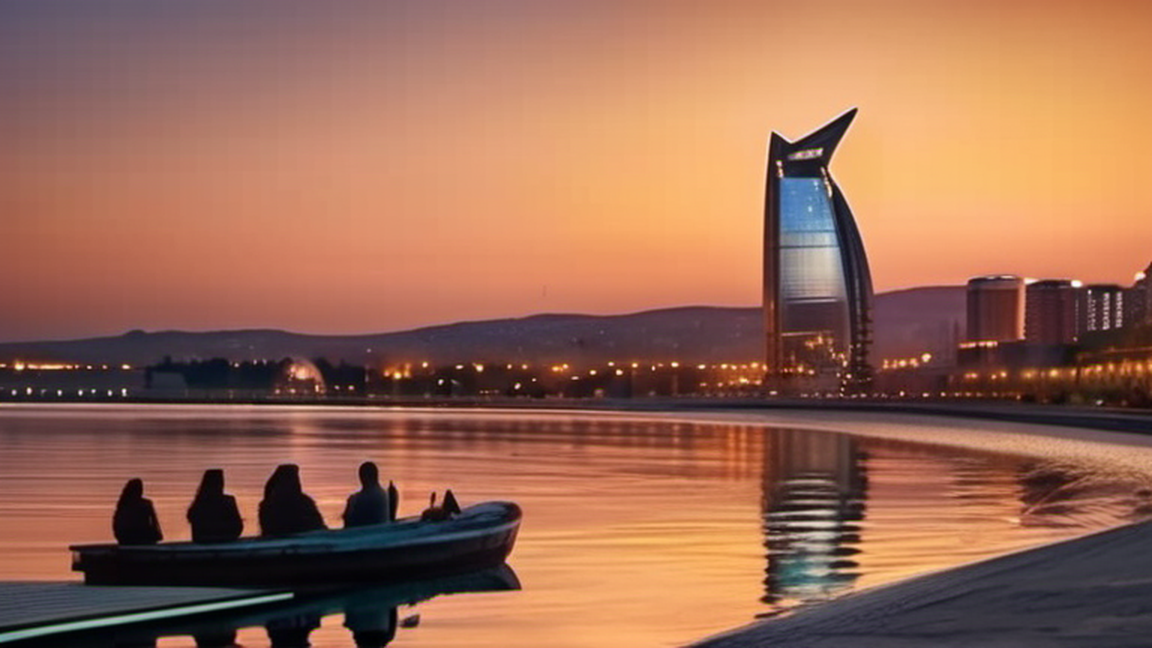
Baku (Azeri: Bakı) is the capital of Azerbaijan and is the largest city in the Caucasus. Baku's Old Town has UNESCO World Heritage status. Many cultures and architectural styles mix in Baku, in particular Turkish-Islamic
Baku (Azeri: Bakı) is the capital of Azerbaijan and is the largest city in the Caucasus. Baku's Old Town has UNESCO World Heritage status. Many cultures and architectural styles mix in Baku, in particular Turkish-Islamic elements meet strong Western European and Russian-Eastern European influences. With 28 metres (92 ft) below sea level, Baku is the lowest-lying capital city in the world.
Baku is on the coast of the Caspian Sea on the southern coast of the Absheron Peninsula. There are three major divisions in Baku: İçəri Şəhər (the Old Town), the Soviet-built city, and the newest part of the city. The population in 2020 was 2.3 million.
The city of Baku is on the semi-arid and dusty Absheron peninsula. The center of Baku is a patch of green in a largely brown area because of the many liters of water that is piped daily to the city. The city has a metro, a well-developed bus and minibus network, and a large area for walking, including the Inner Walled City, The Boluvar, and Fountain Square.
Reading the book Ali and Nino is a good way to get into the mood.
A curious fact about Baku is that its average year-round temperature (14.2°C/57.6°F) matches the average temperature of the entire landmass of the earth to within a tenth of degree. However, seasonal temperature variations are less than in many continental regions at this latitude (about 40 degrees north) owing to the presence of the Caspian Sea. Summers are hot and dry, winters cool, moderately wet and breezy. There is frequent night frost and occasional snowfall during winter. Baku averages 200 mm (8 in) and is the driest place in Azerbaijan. Baku is very breezy most of the year.
As of Jan 2026, Azerbaijan's land borders with its neighbours remain closed to civilian traffic. The only legal way into the country is through an international airport. Land crossings are exit only, and only for non-citizens.
1 Heydar Aliyev International Airport (GYD IATA former Bina International Airport, Azerbaijani: Heydər Əliyev adına beynəlxalq hava limanı), Khazar, Absheron peninsula (Xəzər, Abşeron yarımadası) (25 km (15 mi) from Baku city center), ☏ +994 12 497 2727. It is served by major airlines such as Aeroflot, Turkish Airlines, Lufthansa and Qatar Airways, and many smaller airlines. This is the hub for Azerbaijan Airlines, which serves a number of major airports in Europe, Asia, and the Middle East. The country's flag carrier put aside, in 2025 the only destinations not located on the Asian continent or in Russia are Athens (Aegean Airlines), Podgorica and Tivat (Air Montenegro), Minsk (Belavia), Warsaw (LOT Polish Airlines), Frankfurt (Lufthansa), Budapest and Rome (Wizz Air).
Getting there and away:
By bus – T1 Airport Express runs between the airport and the railway station (the bus waits across the street from the station) with an intermediate stop at Koroglu metro station. The ride costs 1.30 manat with BakiKart; contactless local and international bank cards and mobile wallets such as Apple Pay or Google Pay also work, but a Visa card was charged 1.52 manat in July 2026. The bus runs every 30 minutes. Additionally, N16 runs between the airport and Samed Vurgun Park, in the heart of Baku. The trip costs 1 manat and takes approximately 40–60 min. Service runs every 30 minutes beginning from early in the morning until late night. The bus leaves outside the airport building, across the parking area. The service terminates at 2 Samed Vurgun's Park on 28 May Street.
By minibus – No. 135 runs between the airport traffic circle (15-min walk from the airport) and the 28 May Metro Station. The journey takes an hour and costs 0.40 manat.
By taxi – Getting a smooth ride from the airport to town can be a hassle. The lowest price you can get for a taxi to the center should be around 15 manat (old Lada, unmarked taxi). Only one taxi company is permitted to do business at the airport. This monopoly drives up the price to nearly 50 manat and many times it leaves you with no other options, especially when arriving at late hours. Police occasionally force out all cab drivers trying to do business on the fringes of the airport, leaving you stuck with a high fare. Taxis don't have meters so you must negotiate in advance. If you are not finding a reasonable price, go out of the airport, past the taxi stand, and ask the cabbies at the far end of the parking lot. Be cautious since the majority of Baku cabs are unmarked. Don't let the cab driver renegotiate the price with you. It is a common trick to ask for much more on arrival to your destination. You are not obligated to pay what they demand. For 5 manat you can take a cab from the airport to Metro Koroglu. From there it's 4–6 stations to the city center, but only 06:00–00:00.
There are domestic services from most major cities in Azerbadjan. As of 2026, the only international passenger service operating is the nightly Tbilisi- Baku overnight train.
3 Baku railway station (Bakı Dəmir Yolu Vağzalı). (updated Jun 2026)
Along with trains and ferries, international bus routes have dried up since the border's closure. You can still take buses domestically, but getting into the country on a bus is out of the question.
Once an option to enter from Kazakhstan, passenger service on the Caspian Sea has also ceased.
There are pedestrian alleys and streets around the Fountain Square, the seafront, and the old town. You can walk to other places, too, but you might have to cross busy streets since there aren't always pedestrian tunnels available. The zebra crossings work with an "I'm feeling lucky" principle and aren't usually exactly safe, especially at night. At night, use your phone screen (not your flashlight) to indicate to the approaching cars that you are crossing the street, and follow other people.
Baku is a great town to get around in by bicycle. Except for the up-town, the city, including old town (İçəri Şəhər) and down-town is fairly flat, and though there are some streets that are dangerous to ride, there is almost always a safe, fast route to your destination.
While there are no separate bike lanes on the streets, and cars and cyclists often share narrow streets of Baku, the city is very bike-friendly. While cycling on the street, be very careful watch out for other cyclists, always keep closer to foot-walk side of the street, and show other traffic where you are going (e.g., by holding out your hand) in order to avoid accidents and smoothen the traffic flow.
MyBike, Asef Zeynalli Street, Ichari Shahar. A bicycle rental shop. Make sure to get a good lock (or two), and to use it. If you want to know the best routes, you should get a copy of the beautifully designed Baku by Bike plan, which is available at all bike rental points of MyBike. A passport or identity card must be shown and a refundable deposit is required. While this service is quite convenient, be sure to bring ID or passport and contact information, including hotel phone number, to speed up the paperwork. 10-20 manat per day.
Buses and minibuses cost 0.60 manat (July 2026) per person and can take you to almost any place within Baku. Destinations are usually posted on the front and the right side of the bus.
Newer buses (the red ones) only accept electronic cash in the form of metro cards, available at any metro station. Some larger bus stations have machines to top-up cards, but not to buy new ones.
There are some buses which cost 0.65 manat, e.g. the one to Bibi Heybət Mosque in the south. This makes charging disposable electronic cards a challenge: if you buy the single use tickets, they might not be sufficient if you just load them with 1.20 manat, thinking of going forth and back once.
The metro goes many places throughout Baku and it costs only 0.60 manat (July 2026). It is the least expensive way to get around Baku besides walking. Ask a cashier or attendant. You must obtain a Bakı Metropiliten Kart (3 manat refundable deposit) and load it like a normal metro pass. You can also buy a limited card (0.2 manat) with 1, 2, 3, or 4 trips (the last one costing 1 manat). More than one person may use the same card. Alternatively, you can use a Azerbaycan Sosial Kartı like the ones on some Azerbaijani ATM cards. The metro workers will be more than happy to help if spoken to in either Azeri or Russian, and some may understand English.
You can buy a metro card at the metro station and some bus stops from a ticket machine. You can change the language of the machine to English.
It runs from 06:00 until 24:00 and gets very crowded in rush hours.
Be careful when transferring trains at the transfer stations (28 May and Jafar Jabbarli Cəfər Cabbarlı) as the signage is difficult to spot.
There have been reports of people being arrested while taking photographs of the metro station. There are clear signage on the stations which prohibits taking photos, on the outside it is ok.
The Avtovaghzal metro station is worth seeing from the outside as it is a giant glass pyramid.
The Baku electric train runs through several parts of Baku and the surrounding area including Sumqayit. 1 manat.
The Baku funicular is a great way of getting to the Viewpoint and Flame Towers. It is not too expensive.
London taxi cabs have been introduced in Baku, and travel fees are 0.70 manat per km. Other vehicles however also are available. A taxi costs 4-10 manat for trips within the center of Baku. It's important to agree on the price of the fare before beginning the trip or you may be overcharged.
Most taxi drivers simply double the price for tourists. So, halving it while negotiating and doing the walk-away trick, should reveal the genuine price. Doubling a price is seemingly much easier than tripling it. Otherwise, just use Bolt (a taxi app for your mobile) as indicator or/and negotiator.
Going out of Baku with a taxi, rely on Google Maps and direct the driver. Many driver seem to know just one way in and out to sights outside of Baku, but not efficient ways between them.
Baku Airport Transfer, bakutaxi@gmail.com. 24 hours. Offers online booking and printed receipts/invoices for airport transfers between downtown and Heydar Aliyev International. English is spoken. 33 manat.
189, ☏ 189. Call 189 from an Azeri phone, ask for English language, wait for a moment and then you can arrange a pickup point destination and get a fair price. Wait for 5-10 min. Get notified by SMS after calling and when your cab arrived including the licence plate, destination and price. Very easy. Also works after midnight when public transport stops.
4 AVIS, Huseyn Javid Ave (M: 'Elmlar Akademiyasi'), ☏ +994 50 2230248, fax: +994 12 4975553, info@avis.az. Avis Rent a Car provides cars, SUV and 4WD. Airport pick up and delivery service is also available.
Aznur Car Rental, ☏ +994 4503460308 (Rufat). The local rental service, reliable and friendly. From 60 manat per day for a Mini including full cover (cheaper during weekends). (updated Sep 2019)
5 Naniko Rent a Car, 45 Samad Vurgun, ☏ +994 51 2558899, contact@naniko.az. They have a wide range of rental cars available at Baku. Airport transfers & low rates. From US$15/day.
Many good deals are available with the usual reservation websites. Just beware of hidden extra fees (of the website itself) for insurance you do not really need.
Note that Baku and Azerbaijan in general have many automated speed cameras, and it is not uncommon to get a ticket—which will be sent via SMS directly to the car owner. Don't be surprised when you have to pay a little extra when returning the car. Locals say 60 manat for a weekend trip is not uncommon.
There are a number of interesting sites within Baku's walled fortress, the Old City (a UNESCO World Heritage site), which can all be seen on foot in one day:
1 The Palace of the Shirvan Shahs (Shirvanshahs' Palace; Azerbaijani: Şirvanşahlar sarayı, Russian: Дворец Ширваншахов), Sabayil (Metro Icherisheher 200 m), ☏ +994 12 492-1073, fax: +994 12 437-1246, info@shirvanshah.az. Daily: Apr-Oct 10:00-19:00, Nov-Mar 10:00-18:00. The medieval palace of the Shirvan Shahs is the highlight of the Old City and a must see for any tourist in Baku. The complex contains the main building of the palace, Divanhane, the burial-vaults, the shah's mosque with a minaret, Seyid Yahya Bakuvi's mausoleum, a portal in the east - Murad's gate, a reservoir and the remnants of the bath-house. The main building of the complex was started in 1411 by Shirvanshah Sheykh Ibrahim I. The two-storey building of the palace numbers about 50 different dimensions and outlines of the constructions connected with 3 narrow winding staircases. Foreigners 10 manat, locals 2 manat, 2 manat to take photos. (updated Oct 2017)
2 Saray Mosque (Palatial mosque, Shahs-khans mosque, Azerbaijani: Saray məscidi, Russian: Дворцовая мечеть). Plan of the mosque is rectangular. There is a small hall, small prayer room for women and serving rooms. The northern portal, rotated to a burial vault of Shirvanshahs is more solemn than the eastern one. The latter, which was coming down to underground exit, was intended for habitants of the palace. - Interior. Two-tier windowed prayer room is covered with cupola with spherical sails. Mihrab is located in the southern end of the palace. Cupola area over one a tier women's prayer room ceding to cupola of the hall with its dimensions and replacing its outlines. Aperture of the mosque's portal is clearly described on the severe background of prismatic volume, ended with two cupolas with slightly sharpening calottes. - Minaret. Trunk of the minaret is surrounded by an inscription, a ligature of which has a date of 845 (1441/42). Details of sherefe's stalactites are subtly modeled.
3 Maiden's Tower (Giz Qalasi, Девичья башня), Qüllə (Metro Icherisheher 500 m east). Daily 10:00-19:00. This mysterious and eccentric tower was built somewhere between the 7th and 12th centuries and may have served as a fire beacon, defensive fortification, astronomical observatory, or Zoroastrian temple.The tower, which is Baku's most distinguished landmark, described as the "most majestic and mysterious monument of Baku, the Gyz Galasy", built on a solid rock foundation, demonstrates right on the coast line, a fusion of Arabic, Persian and Ottoman influences. It was constructed alongside a natural oil well. It is a cylindrical eight-story structure that rises to a height of 29.5 m with a base diameter of 16.5 m. The internal space available in the tower is said to be adequate to accommodate 200 people. A long, solid projection to the main tower faces east, which is oriented towards sunrise pointing to the equinoxes, which has led to the conclusion that it was built as an astronomical tower; while the buttress faces east, the door access to the tower faces southeast. Unfortunately, there is no good view from the top, because it is barred by a glass wall, keeping your distance from the edge. Foreigners 15 manat, locals 2 manat. (updated Oct 2019)
36 Mosque of the Martyrs (Turkish Mosque, Azerbaijani: Şəhidlər məscidi), Izzat Nabiyev (Funicular - Shahidlar Khiyabani garden). This is a mosque, near the Martyrs' Lane. It was built in the beginning of 1990s with assistance of the Turkish government. The mosque is used as an official residence of the religious attaché of the Turkish embassy. It opened in 2009. The 154th ayah from Al-Baqara chapter of Quran is written on the façade of the mosque in Arabic and Turkish: "Do not say "Dead!" about those, who died for the sake of Allah. No, they are alive! But you do not feel."
37 Taza Pir Mosque (Tazapir, Teze Pir, Teze-Pir, Tezepir), 7 Mirzə Fətəli Axundzadə. This is a mosque with two minarets. Its construction began in 1905 and was finished by 1914. The idea for the mosque as well as its financing was provided by an Azeri philanthropist, a female, Nabat Khanum Ashurbeyov (Ashurbeyli) - Architecture. The interior of the mosque has an area of 1,400 m² and is decorated with ornaments of painting schools of Azerbaijan and with samples from eastern ornaments. The height of the dome and a half meters. The mihrab and dome of the mosque are made of marble, while decorative elements of the mosque, the tops of minarets and labels are made of gold. - The dome, on which 6 times written La ilaha ilallah from the Muslim proclamation of faith or Shahada, made from Qızılqaya (Gyzylgaya) stone.
38 Saint Gregory the Illuminator's Church (Azerbaijani: Bakı Erməni Kilsəsi, Armenian: Սուրբ Գրիգոր Լուսաւորիչի Եկեղեցի – Surp Grigor Lusavorichi Yekeghetsi), Street Nizami (ул. Низами) (in downtown At the Fountain Square - M 'Sahil' 400 m east). no longer open to the public.. Built in 1887. Now a government building.
39 Holy Myrrhbearers Cathedral / Russian Orthodox Church (Russian: Кафедральный Собор Святых Жён-Мироносиц; Azeri: Müqəddəs Mürdaşıyan Zənənlər Başkilsəsi) (close to Hyatt Regency Hotel), ☏ +994 12 440-4352, baku@eparhia.ru. This Russian Orthodox cathedral was founded in 1909. Hit by a Russian missile in 1990, it was reconstructed and reopened in 2001. It holds a shrine of the apostle St. Bartholomew.
40 Former Church of the Saviour (German: Erlöserkirche, German Kapellhaus, Azeri:Xilaskar Kilsəsi), Dilara Aliyeva and 28 May Street (ул. 28 Мая) cnr (Metro '28 May'). Built with a German donation. This was a Lutheran church, opened in 1899. Now it is a concert hall. The Gothic style church features a portal crowned with a decorated pediment. In 1898, a 213-kg gilded cross was raised atop the church. In early 1899 a bell and an organ were installed.
43 National Art Museum of Azerbaijan (Azerbaijani: Azərbaycan Milli İncəsənət Muzeyi), 31, Istiglaliyat st, ☏ +994 12 923 931. Tu-Su 10:00–18:00. The museum consists of two adjacent buildings. The museum's collection includes over 15,000 artworks. There are over 3,000 items in 60 rooms on permanent display. Seven of the rooms in the first building feature European art, and ten rooms feature Russian art. European art includes works of Italian, French, Dutch/Flemish, German and Polish painters. - The second edifice built in 1885 houses Eastern art, represented particularly by Persian, Turkish, Chinese and Japanese art. Russian art is encompassed notably by paintings of different painters. There are also restored samples of Russian avant-garde. The museum also holds easel and book miniatures of 17th-19th centuries, lacquered miniatures of 18th-19th centuries and collection of sherbet spoons, made of mulberry wood.
44 National Museum of History of Azerbaijan (Taghiyev History Museum, Azerbaijani: Azərbaycan Tarix Muzeyi, Russian: Музей истории Азербайджана), 4 Hadji Zeynal Abdin Taghiyev str. (M: Sahil), ☏ +994 12 493 2387, +994 12 498 5211, fax: +994 12 498 52 11, aztarmuzey@azhistorymuseum.az. M-Sa 11:00-18:00, first Monday of every month closed (– cleanup day). The museum was built in 1893–1902. The Italian Renaissance-style mansion is immense and occupies an entire city block. There are four floors in some parts of the building. It was designed by Polish architect Józef Gosławski. On the second floor of Taghiyev's residence, side-by-side there are two major ballrooms. One is based on Oriental designs (Mauritanian style) and the other, on Western design. The Oriental Room has enormous plate-glass windows, gilded arches, highly ornamental walls, ceilings and chandeliers. The lines in the Occidental Room are more perpendicular to each other – rectangular. The museum has more than 2,000 exhibits and includes the following departments: Modern history, Ethnography, Ancient and medieval history of Azerbaijan, Scientific excursion, Fund of Numismatics, Art design group. 10 manat. (updated Oct 2017)
45 Azerbaijan Carpet Museum (State Museum of Azerbaijan Carpet and Applied Art), Bakı ş., Mikayıl Useynov pr-ti, 28, ☏ +994 124972016. Tu-F 10:00-18:00, Sa Su 10:00-20:00. The museum hosts a wide range of carpets, both old and new. It moved to its current location in 2014 (on the waterfront). The building itself is shaped as a carpet. 10 manat. (updated Feb 2024)
46 Heydar Aliyev Center (Heydər Əliyev Mərkəzi, Центр Гейдара Алиева), Heydər Əliyev prospekti (M Ganjlik 700 m West), ☏ +994 12 505 60 04, info@heydaraliyevcenter.az. This is a 64,103 m² building complex designed by Iraqi-British architect Zaha Hadid and noted for its distinctive architecture and flowing, curved style that eschews sharp angles. The Heydar Aliyev Center represents a fluid form which emerges by the folding of the landscape's natural topography and by the wrapping of individual functions of the Center. All functions of the Center, together with entrances, are represented by folds in a single continuous surface. This fluid form gives an opportunity to connect the various cultural spaces whilst at the same time, providing each element of the Center its own identity and privacy. As it folds inside, the skin erodes away to become an element of the interior landscape of the center. The center houses a conference hall (auditorium), a gallery hall and a museum.
49 Baku Boulevard (Dənizkənarı Milli Park). Seaside promenade with museums, parks, cafes, restaurants, and other attractions. (updated Jun 2020)
50 Fountain Square (Fəvvarələr meydanı, Parapet sq) (near the Old City). This is a downtown pedestrian street in the center of Baku lined with shops, hotels and restaurants. It is a public gathering place, especially after business hours and during the weekend. It hosts public festivals, shows and celebrations.
51 Nizami (Torgovaya) St (Azerbaijani: Nizami küçəsi) (metro station Sahil toward south, and metro station '28 May' toward north). This is a large pedestrian and shopping street in downtown Baku, named after the famed classical poet Nizami Ganjavi. Nizami Street is home to various outlets, from banks to fashion stores and is one of the most expensive streets in the world. The street also accommodates the embassies. - Buildings are mostly from the late 19th-early 20th century, 1950s-1970s and a modern period. Most of the buildings, constructed in the first level, were constructed in neo-renaissance, neo-gothic, baroque and neoclassical styles. Neo-Moorish style is also present, in which architects attempted to use elements of national architecture in its construction. Houses are dressed with limestone – aglay. - Famous houses: No.20 The building of Caspian—Black Sea Oil and Trade Society (built in 1898-1899); No.30 The building of Central Universal Magazine. - No.34 Nargiz shopping center - No.38 Central Library - No.38 St. Gregory the Illuminator's Church (built in 1869), - No.48 Musa Naghiyev's house, built in 1911 - No. 50 Neoclassical apartments of Tagiyev brothers, built in 1912 - No.58 Residential house, constructed by architect I.V.Edel, in 1902. - No.64 Lev Landau house, built in 1911 - No.66 Oilmen's House built in 1956 by Mikayil Huseynov - No.67 ISR Plaza office center - No.69 International Bank of Azerbaijan - No.72 Azerbaijan State Theater of Young Spectators, built 1965 - No.74 National Library of Azerbaijan, opened in 1923 - No.75 Haji Rajabli House, built in 1896 - No.76 Azerbaijan State Song Theater named after Rashid Behbudov. - No.79 Murtuza Mukhtarov House, built in 1896 - No.85 Nasimi Park - No.87 State Committee on Capital Issues - No.90 Former mill - No.93 Musa Naghiyev house, built in 1911 - No.95 Azerbaijan State Academic Opera and Ballet Theater, built in 1911 - No.96 Office center "Landmark" - No.103 residential house, built in 1952 - No.115 Russian Imperial Technical Society, erected in 1899 - No.117 Azerbaijan State Oil Academy
52 Oil Rocks (100 km east of Baku off the tip of the Absheron Peninsula). Neft Daşları began operations in 1949, thus becoming the first offshore oil platform in the world. Later, using the intentionally sunk ships as its foundation, an artificial archipelago has grown around it, interconnected by an extensive network of bridges and supporting a full-sized town inhabited by about 2,000 people. It's possible to visit the oil rock complex, but you should get a permit from the State Oil Company of Azerbaijan.
Outside the city, on the Absheron Peninsula, there are several interesting sites, like Yanar Dag (the burning mountain) and the Atashgah Fire Temple (with roots to ancient Indian migration), for a day or evening trip that are easy to reach via taxi or public transportation. Moreover, the scenery along your route is a fascinatingly ugly desert wasteland with white salt flats and natural oil seeping into pools on the surface.
In addition, the Baku Region is famous for its active mud volcanoes that might also be reached within a day. The 66 Mud Volcano which is supposed to be 15 km north of Baku city centre according to several online maps. It's a mud volcano but without any active mud vents, but instead the waste of the neighbouring communities. However, it provides for a quite apocalyptic photo scenery.
See Baku Region for all the details.
In the evening, go to the national opera on Nizami street. Otherwise, go to the rooftop bar at Sultan Inn in the Old City for a drink and excellent views of the Maiden Tower, Caspian sea and the TV tower.
Boat tours of Baku. Offered from the Baku Blvd. Lasts 40 minutes. 6 manat.
1 Pantomima theatre (Pantomima Teatrı), 49 Azadliq Ave, ☏ +994 12 4414756. Offered from the Baku Blvd. Lasts 40 minutes. 6 manat.
2 National Opera and Ballet (Opera Və Balet Teatrı), 95 Nizami St, ☏ +994 12 4931651.
3 Baku Funicular Railroad. Runs from the square on Neftchilar Avenue up to the Alley of the Marytrs. 1 manat.
4 Aqua Park Baku, Rashid Behbudov, 59, ☏ +994 12 4470303. US$19 for ages 7 and up.
5 Baku Entertainment Center (Bakı Əyləncə Mərkəzi), Khatai District, F. Bayramov St, 1130/33, ☏ +994 12 490-22-22, fax: +994 012 490-22-05, info@bem.az. Baku Entertainment center has been around for more than half a decade. It has a shopping center, bowling alley certified by the AMF, health club, conference venue with a capacity of 350 people, and various restaurants and clubs.
6 Mini-Venice. 10:30-23:30. A charming little complex of man-made waterways accessible on a boat. There are also some restaurants in the immediate proximity. The ticket booth is 10-15 meters to the right when coming from the north. It is cheap but the signage to the ticket booth is lacking. (updated Jun 2018)
Football. The men's national team play soccer at Tofiq Bahramov Stadium, capacity 31,000. Five clubs in the city play in the Premier League, Azerbaijan's top tier. (updated Jul 2023)
7 Azersun stadium. Qarabağ FK. Capacity 5,800. (updated May 2019)
8 ASK Arena (Inter Arena, Shafa stadium). Keşla FK (formerly Inter Baku). Capacity 8,200. (updated May 2019)
9 Bakcell Arena (Eighth Kilometer District Stadium). Neftçi. Capacity 11,000. (updated May 2019)
Zira Olympic sports complex. Zira FK (updated Jul 2023)
Asco Arena. Sabail FK. (updated Jul 2023)
10 Tofiq Bahramov Republican Stadium (1 km north of city centre, metro Ganjlik). As the previous stadia are small by European standards, big club games may transfer to this stadium. E.g. a host venue for the Euro 2020 tournament.
11 Baku Olympic Stadium. This also hosts big games, such as the 2019 UEFA Europa League Finals. (updated May 2019)
Baku City Circuit. A 6 km on-street motor-racing circuit along the shore used for Formula One and other events. The next F1 races are 19-21 Sep 2025 then 25-27 Sept 2026. (updated Jun 2025)
Hamam Mehellesi (Public Baths (Hamamlar)) (Hamam Mehellesi is in the Old Town. From the station, enter the old city through the gate, turn right and go down the street. The hamam is a few blocks down, on the left side of the street, you will see a note on one of the walls "hamam mehellesi" and a little further—the bath's domes.). This is the oldest public bath in Baku, located near the Icharishahar metro station, inside the old city. Mondays and Fridays are reserved for women, the rest of the days are only for men. 10 manat and they offer two types of service, hise (skin peel) for 15 manat, and massage for 20 manat. (updated Feb 2024)
12 Aga Mikayil Bath House (XVIII century hamami), Icheri sheher, Kichik Gala 3/16, ☏ +994 503452144, +994 124927421. Daily 09:00-23:00, Women only: M F. Sauna and pools, nice ambiance. 10 manat, plus massage 10 manat. (updated Aug 2017)
13 Naftalan Bath (close to Kempinski Hotel). Naftalan, a city close to Ganja, is famous for oil baths. However you can also get an oil treatment in Baku, with imported Naftalan oil. It's like a small hospital and not very recreational. However it's great fun and positively strange to dip for 15 min into hot crude oil. Decide for yourself whether this is safe and healthy. 20 manat for medical checkup, 20 manat for one oil bath. (updated Mar 2016)
14 The Spa at Park Hyatt Baku, Park Hyatt Baku Hotel, 1033 Izmir St, ☏ +994 12 4901234, baku@hyattintl.com.
15 Teze Bey Hamami (Taze Bey Bath). Public baths (hamamlar). This men-only public bath is in the old town and offers Finnish and Turkish baths, etc., so it may be a bit pricier than its competitors.
There are a couple of beaches including Shikhov Beach, but they are polluted by sewage and industrial waste. On the northern side of the peninsula are the much nicer Bilgəh and Amburan beaches, on the north coast of the Absheron Peninsula are great spots to cool off from heat. Further afield are the beaches and resorts of Northeastern Azerbaijan.
AF Beach Club, Novkhani, ☏ +994 12 448-30-30. This complex has 5 swimming pools, fast food, a restaurant with cooks from Azerbaijan and Europe, a disco, a game hall, Wi-Fi, water sports, beach volley, beach football, entertainment, and a professional animation team. 80-600 manat.
Amburan Beach Club, Bilgah, ☏ +994 12 453-86-85, fax: +994 12 453-86-84, info@amburan.com. This complex has a 3 swimming pools, fast food outlets, a restaurant with cooks from Azerbaijan and Europe, a disco, a game hall, Wi-Fi, water sports, beach volley, beach football, entertainment, and a professional animation team.
Baku Jazz Festival, ☏ +994 12 437-55-33, infofestival@jazz.az. Organised by the famous saxophonist and Baku resident Rain Sultanov to showcase Azerbaijan's love of jazz which grew during the Soviet era when it was banned by the authorities. Features acts from around the world, the annual festival lasts for a week, and will run from 7-14 June. Tickets can be purchased from Baku Jazz Center, 19 Rashid Behbudov St or by phone..
Bankomats (ATMs) are available all around the city, mainly in downtown and metro stations exits. If you have a cell phone with either a Bakcell or Azercell SIM card, you can recharge your account balance using various ATMs. The International Bank of Azerbaijan has a list of their ATMs in Baku. Some of them have euros and US dollars available. It is advisable to withdraw in US dollars and change it to AZN in an exchange house, which usually gives a far better rate.
Antiques from Old City (İçəri Şəhər)
Rugs
Apples from Quba
Tea and Talish stockings from Lankaran
Halva from Sheki
Traditional dolls created by ladies' groups in Barda
Mega Memi. A chain for second-hand clothes, which has a few outlets around Baku, offering a good range of second-hand clothes at fairly low prices (1.5-manat scarf, 5-manat shirt, etc.). (updated Mar 2019)
1 Chiraq bookstore, Istiqlaliyyat 47, (Zərgərpalan, Улица Истиглалият) (near M: İçəri Şəhər (Old City)). Phrasebooks, maps and guides can be found here.
Taza Bazaar (On Samad Vurgun street near the state circus). A huge famous food and spice market. Nonetheless, very much a market for the locals rather than tourists. Haggle to your heart's content (best to know a couple of phrases in Russian for this one).
Sabunchu Flea Market (Take the red line metro to Nefchilar, and from there catch the no. 40 bus to Sabunchu. Stay on the bus until you see an indoor food market; the main flea market is through this on the left). A huge flea market next to some oil fields, seems to be mainly Azerbaijani families selling off old stuff from their homes. Some great finds to be had but it does take a while to sift through all the mounds of odd clothing and random bits of scrap metal. Women visiting alone should be more cautious than in central Baku, foreigners attract attention here and being followed isn't unheard of.
AF MALL, in the heart of the city just off the Torgovaya on Samed Vurgun St 34, ☏ +994 12 5965506. This mall has many trendy shops, a summer lounge with a tropical garden and a rooftop pool.
Park Bulvar Shopping Mall, Along the boulevard, right across Park Inn Hotel. This mall has many trendy shops, a cinema, a planetarium, a bowling alley and many cozy cafes. There are many famous fast food chains, including KFC and Sbarro.
There are many restaurants in Baku and kebab shops can be found easily for a quick meal.
1 Half Way Inn, 6, 28 May St (Bus 2, 61, 85, 88, 90, 95 to Milli Bank), ☏ +994 12 5980905. International cuisine. 5-10 manat.
2 Nergiz Restaurant, Fountain Square, 9 Tərlan. (updated May 2022)
3 Bizim Ev Restaurant & Cafe, 7 Khagani Street. (updated May 2022)
4 Doner House, 16/21 Azadliq Ave. (updated May 2022)
5 Lavas Bistro / Fasali Cafe (Right outside Icherisheher metro, on the left). Two take-away places, one next to the other, run by the same people. Do a wide range of usual Azeri/Turkish take-away food - but good quality, very popular with the locals, expect to queue! 3 manat for a kebab/pancake which will completely fill you up.
6 Lezzet Taste Shop, Ahmad Javad St. (updated May 2022)
Anadolu, Pushkin St 5 & Rasul Rza St 3/5, ☏ +994 12 498-87-58, +994 012 498-804. Turkish/European restaurant. 8-15 manat.
7 Firuze Restaurant, 14 Tarlan Aliyarbeyov, ☏ +994 503186545, +994 124939634. 12:00-01:00. Serves excellent, very filling Piti. [1]. (updated Sep 2019)
Tonqal Restoranı, 82, Acad, Hasan Aliyeve St, ☏ +994 12 449-91-98. The various meat dishes include kebabs and organ-meat-based delicacies.
Lido, Cnr of Nkhchivani St, ☏ +994 12 462-94-49. European and Azeri cuisine.
Masal, 29/44 Mahammad Hadi Rd, ☏ +994 50 600 60 25. Kebabs, or, if you prefer, flatbreads and pizza.
Mugam Club, 9 A. Rzayeva St, ☏ +994 12 492-40-85. European and Azeri cuisine. 10-15 manat.
Namli Kebab, Mardanov Brothers st., 3 (close to Russian Dramatic Theatre and Austin Hotel), ☏ +994 12 493 03 98. Turkish and Azeri cuisine. 10-15 manat.
8 U Dali, 5, Mirza Ibrahimov Street (Bus to 'Şahmat məktəbi' or M 'Nizami' 0.6km N), ☏ +994 12 4949356. Georgian cuisine. 3-6 manat.
Sultan Inn rooftop or Meridien hotel rooftop restaurants for European/fusion with excellent views or head back to the Fountain Square for a greater variety of inexpensive cuisine.
Gazelli Cafe, 93 Nizami St, ☏ +994 12 404 93 00. European cafe that does up some stylish and tasteful plates. 5-16 manat.
Dolce Vita, 19 Aziz Aliyev St, ☏ +994 50 273 99 19. Italian restaurant. Offerings include a duck or meatball salad.
Grand Hotel Europe, 20 Tbilisi avenue, ☏ +994 12 490-70-90. International cuisine.
Cafe City Sahil, 8 Rashid Behbudov St (St closest to the L side of Park Bulvar, close to Sahil Bagi and Central Public Library), ☏ +994 12 598 88 33. Mixed cuisine cafe.
Mexicana Baku, Terlan Eliyarbeyov 12, ☏ +994 55 288 24 08. Tacos and Mexican cuisine 6-14 manat.
Park Inn's Glory Restaurant, 1 Azadlig Ave, ☏ +994 12 490 60 00. Views of the skyline and perhaps the Caspian Sea are paired with European cuisine. 8-18 manat.
Pizza Holiday, 119 Lermontov Kuchasi (Near Baku Soviet), ☏ +994 12 497-37-72. An Azeri pizza and Italian-cuisine chain 5-15 manat.
Paris Bistro, 1/4 Zarifa Aliyeva street, ☏ +994 12-404-82-15, reservations@parisbistro.az. 24 hr. French cuisine 6-19 manat.
Buddha Bar Baku, Azadliq Square, JW Marriott Absheron 3rd floor, ☏ +994 50 404 82 09. Fusion Cuisine, everything is done up with quite a bit of class at this Marriott venue.
Maharaja, 6 Abdulkarim Ali-Zadeh St, ☏ +994 12 492 43 34. Indian and Pakistani food, with the possibility of a buffet.
Taj Mahal Indian Restaurant, 4 Haji Zeynalabdin Taghiyev St, ☏ +994 12 598 19 98. Similar to other one, with buffet at times.
Chinar, 1 Shovket Alekperova St, ☏ +994 12 404 82 11. Pan-Asian cuisine, modern tea house and late night cocktail bar.
Mezzo, 6 Izmir St (in Hyatt Hotel), ☏ +994 12 490 12 34. Italian wine and cuisine in a dining room overlooking the hotel's garden.
Terrace Garden, 20 Boyuk Gala (atop Sultan Inn Boutique Hotel), ☏ +994 12 437 23 05. Another opportunity to feast your eyes on the Baku scene while you dine on European and Azeri cuisine.
There are many outdoor tea houses (çayxanalar) serving tea and sweets that offer a sense of the local culture. If you are adventurous, try challenging a local Bakuvian to a game of backgammon (nard) or dominoes.
There is a good selection of cafés throughout Baku. Expect to pay Western prices for your coffee.
Aroma Cafe, 18, U. Hajibayov St, ☏ +994 12-598-07-07.
Azza Cafe, 1, I. Safarli St/Fountains Sq, ☏ +994 12 437 0111, kafe@azza.az. 12-23. They bake cakes aside from doing coffee.
Baku Roasting Company, Alasgar Alakbarov Street, 12 (Near Ramstore in Elmlar), ☏ +994 12 510 98 76. Tu-Su 09:00-21:00. Here you can get a nice roast and maybe an egg burrito type of thing as well. 2.5-7 manat.
Chocolates Cafe Baku, Yusif Mammadaliyev str. 4, ☏ +994 12 498 72 60. Not just coffee and chocolatey desserts, but sandwiches too.
Although tea houses (çay xanalar) (found throughout Azerbaijan) serve local beer (piva) - draft at 50 qapick/glass or bottles at 70 qapick/bottle or vodka (araq) at 2 manat/bottle, for anything exotic (e.g. tequila, gin, or rum), you will have to go to a normal bar or hotel and pay Western prices there.
The Lounge & Bar, 6 Izmir St (in Hyatt Hotel), ☏ +994 12 490 12 34. A distinguished place to have a drink
Caspian Bar, 20 Tbilisi Avenue (inside the Grand Hotel Europe), ☏ +994 12 490 70 90.
Finnegan’s, 8 Abdulkarim Ali-Zadeh St, ☏ +994 12 498 65 64. Next to History Museum. Free wifi. Good beer prices and Happy Hour offers. Ridiculously expensive wine, however. It doesn't serve Guinness. April 2016.
360 Bar, 1B Azadlig Avenue (in the Hilton Baku), ☏ +994 12 464 50 00. Here you can have a refreshment from atop the Hilton hotel tower, or, if you prefer to stay more grounded, there is also the Sugar Lounge below offering tea, baklava and vodka.
Victor's Bar, 1, Azadlig St (in the Park Inn by Radisson Baku Hotel), ☏ +994 12-490-60-00. Classy cocktails
The Phoenix Bar, 10, Mammadaliyev St, ☏ +994 12 305 90 90. Lots of booze on hand here.
Hops Pub Baku, 24 Tarlan Aliyarbeyov St, ☏ +994 50 700 55 37. Good for socializing and a game of snooker or pool.
Caledonia Bar, 20 Qachaq Nabi, ☏ +994 50 653 05 03, dave@Caledoniabar.Com. 09:30-late. Offers a familiar pub atmosphere with photos and memorabilia from Scotland. Screens for watching sporting events.
1 Otto Club, Tarlan Aliyarbekov st., 3B (close to Fountain Square), ☏ +994 55 744-63-93. Club for dancing on the weekend. Make sure to arrive after midnight if you don't want to be alone. Expect electro and dance music from a DJ as you would expect in European countries (updated Mar 2016)
1 Caspian Hostel, Asef Zeynalli 29 (Old Town, around the corner from Meridian Hotel, above Thousand Camels Hostel), ☏ +994 503778444. Great location in the Old Town. 2 dorm rooms and 1 private room. Dorm bed 16 manat.
2 Guest House Inn, Harbci St? 17, Icheri Sheher (Baki Soveti metro station), ☏ +994 12 4371262, +994 55 6827714, fax: +994 12 4371263. Check-in: any time, check-out: 12:00. This hotel is in the center of Old Town in a calm area, 10 minutes on foot to the nearest metro station, very friendly staff. Room with TV, fridge, private bathroom, hot water 60 manat per person.
3 Atropat Old City Hotel Baku, 11-13-79 Magomayev Str. (walk through the hallway from the boulevard, take the stairs to the right up, and the apartment is right at the other end of the open terrace), ☏ +994 12 497 89 50. (updated Aug 2017)
4 Cheeky Carabao Backpackers Hostel, 171 Tolstoy Street 1st floor. (next to Face Studio, it's easy to miss as the outside of the building is under construction and the sign keeps getting stolen), ☏ +994 12 596 37 29. Well located upbeat hostel with Ping pong, Wii, movies on the projector, and more. Very clean has kitchen, dorms, privates, laundry service. Dorms sleep 8. (updated Dec 2017)
Altstadt Hotel, Mammedyarov str. 3/2A (Ilyas Efendiyev str.3/2A), Icheri Sheher (exit at Icheri Sheher metro, enter the Old Town, walk uphill to the left), ☏ +994 124926402, aae@box.az. A "better" two-star hotel, with buffet breakfast, spotless private facilities, A/C, Wi-Fi, TV. Offers excursions, helps with visas if necessary. Run by the very friendly Mr. Elmin (Beatles fan) who is always happy to give info and help guests. 50 manat for double/twin.
5 Consul Hotel, 92c Hasan Aliyev St (From Metro 'Ganjlik' West 1.2km), ☏ +994 12 498 6095, +994 124651282, consulhotel@ultel.net. This is a hotel option in the Genclik district. Twin 50 manat.
Days Hotel Baku, Babek Prospect, 21/99, ☏ +994 12 310 07 20, fax: +994 12 4967500, info@dayshotelbaku.az. 15 minutes' drive from the Heydar Aliyev International Airport and 10 minutes from the city center. 102 rooms with Wi-fi Internet access, one international restaurant, one lounge-bar and two conference rooms. 75-105 manat.
Diplomat Hotel, Suleyman Rahimov St, 185, ☏ +994 12 596-11-27, fax: +994 012 596-11-28, sales@diplomathotelbaku.com. Centrally located. Credit cards accepted. Double 90 manat.
Empire Hotel, Xaqani St 49, ☏ +994 125982123, +994 125982128, fax: +994 125982129, info@empirehotelbaku.com.
Holiday Inn Baku Airport, Heydar Aliyev International Airport (25-min drive from the city centre), ☏ +994 12 437 4949, info.bakap@ihg.com. Facilities include a kids stay and eat free program, Internet access in all rooms, various restaurants, complimentary shuttle to downtown and a spa.
Park Inn by Radisson Baku Hotel, Azadlig Ave 1, ☏ +994 12 490 6000, fax: +994 12 496 8900, reservations.baku@rezidorparkinn.com. Fully-equipped business centre, restaurant, bar and coffee shop, five modern conference rooms and an elegant ballroom with a large foyer. Also offers Wi-Fi in all guest rooms, gift shop, free airport shuttle, 24-hour room service, workout room, open parking facilities, 24-hour concierge. 169 manat.
Rigs Hotel, 63 d Uzeyir Hajibeyov, ☏ +994 12 493 92 41, fax: +994 493 85 28, info@rigshotel.com. 24 rooms
AF Hotel Aqua Park, Novkhana, 1130/33, ☏ +994 12 448-30-30, office@afhotel.info. Check-in: 12:00, check-out: 12:00. There have been complaints with this hotel – please check online reviews.AF Hotel is the largest hotel and resort in the Caucasus. This complex houses pools, saunas, salons, water slides, an entertainment center, and hotel facilities. From 80 manat for a standard double room up to 500 manat for a presidential. (updated Sep 2017)
Amburan Beach Club, Bilgah, ☏ +994 12 453-86-85, fax: +994 12 453-86-84, info@amburan.com. This complex has a 3 swimming pool, fast food outlets, a restaurant with cooks from Azerbaijan and Europe, a disco, a game hall, Wi-Fi Internet, water sports, beach volley, beach football, entertainment, and a professional animation team.
12 Bulvar Inn Baku.
Crescent Beach Hotel, Salyan Hwy, Shikhov, ☏ +994 12 497-47-77, fax: +994 012 497-47-80, ebh@azeronline.com. This complex has an indoor and outdoor pool, beach front, bar, and tourism services. High-speed Wi-Fi zone covering 10 hotel buildings, the hotel yard, restaurant, bars and beach. Please contact hotel reception.
Excelsior Hotel Baku, 2 Heydar Aliyev Ave, ☏ +994 12 496-8000, fax: +994 12 496-8008, info@excelsiorhotelbaku.az. With a 5-star rating, the Excelsior Hotel is one of the nicest hotels in Baku. The rate per night range from US$250-2,450, but will be converted to manat at the hotel's rate.
Hyatt Regency Baku, 1 Bakikhanov, ☏ +994 12-496-1234, fax: +994 12-496-1235, baku.hotels@hyatt.com. Services include high-speed Internet access, chauffeur-driven limousine rental, hotel shops, Wi-Fi, a business center, The Grill, Gourmet Shop, Beluga Bar, Club Oasis Fitness Center, swimming pools, tennis courts, squash courts, a ballroom, 10 meeting rooms, 2 boardrooms, and pre-function and social function space. 270-405 manat.
Park Hyatt Baku, 1033 Izmir St, ☏ +994 12 490 1234, baku.hotels@hyatt.com. 5-star hotel adjacent to a comprehensive meeting & conference centre. Club lounge for free continental breakfast, evening cocktails and boardroom access.
Many cafés in Baku now have free WiFi. In general, Internet cafes in Azerbaijan are called "internet klubs" and they are found throughout Baku. Public WiFi service is available in central areas and attractions, providing easy connection.
Azerbaijan Post locations are dispersed throughout Baku. Mailing an international letter generally costs 0.8 manat.
As Azal seems to be in a permanent state of flux as to where their offices are located, pop into a travel agent and ask about tickets very carefully before buying anything. In some cases, like Naxcevan or last-minute flights, you will absolutely have to go the ever-moving central office during a few random opening times in order to get your tickets processed. One travel agent who can guide you buy phone is reachable at +994 55 4201220 or +994 12 5551320 or 5981619.
Baku is considered a safe city, nevertheless common sense is useful as in all other big cities. Homeless people do not harass or attack people and are safe to be around. The biggest problem in Baku is driving. Many drivers do not obey rules and speed.
The security is rather high, with regular security checks at some attractions and metro stations. The metro has police guarding both ends of the escalators.
Since the Karabakh conflict re-ignited in September 2020, security has been further tightened.
Ambulance: 103
Fire: 101
Gas Emergency 104
Speaking Clock 106
Police: 102
You must speak in Azeri, Turkish or Russian to communicate your needs. It would be a good idea to memorize key phrases before coming to Azerbaijan - see the Talk section for phrasebooks. The police are friendly and try to be helpful. Be nice and understanding and don't get frustrated if you don't understand each other immediately. Write down your phone's IMEI code in case it gets lost so it is easier for the police to find.
The roads can be treacherous at night due to unseen potholes and dimly lit cars. Most areas in and near the downtown are safe. There are some underpasses under particularly busy roads (some with escalators), and some zebra crossings and traffic lights. Watch out for traffic police if otherwise crossing a busy road, they may try to fine you 20 manat for a traffic offence (even though the locals do it constantly).
Many details can also be found here: https://www.embassypages.com/azerbaijan
Bulgaria, Oktay Kerimov str. 34, ☏ +994 12 441-43-81, +994 12 441-41-38, fax: +994 12 440-81-82, Embassy.Baku@mfa.bg.
China, 67, St.Khagani, ☏ +994 12 498 6257, fax: +994 12 498 0010, chinaemb_az@163.com. M W F 09:00-12:00, M W 15:00-18:00. (updated Feb 2024)
1 Georgia, Narimanov raion, Yashar Huseynov St. 13-15, ☏ +994 12 497-45-60, fax: +994 12 497-45-61, baku@geoemb.az. 09:00-18:00.
Greece, Kichic Gala 86-88, ☏ +994 12 492-01-19, fax: +994 12 492-48-35, gremb.bak@mfa.gr.
Romania, Blv. Hasan Aliev nr. 125 A (Narimanov), ☏ +994 12 465 63 78, fax: +994 12 465 60 76, baku@mae.ro. M-F 09:00-18:00. (updated Dec 2021)
Turkey, Samed Vurgun str. 134, ☏ +994 12 444 73 20, fax: +994 12 444 73 55, embassy.baku@mfa.gov.tr. M-F 9:00-18:30.
2 United Kingdom, 45 Khagani Street (Əfzələddin Xaqani) (Metro 'Sahil'), ☏ +994 12 4377878, fax: +994 12 4922739, generalenquiries.baku@fco.gov.uk. M-F 09:00-17:00.
3 United States, 111 Azadlig Ave, ☏ +994 12 488-3300, fax: +994 12 488-3330, ConsularBaku@state.gov.
Nabran – Relax by the Caspian on the beach or in a resort. Azerbaijan's biggest tourist destination for international travellers and a coastal city close to Xachmaz.
Quba – Its urban suburb is home to the largest Azerbaijani Jewish community in the mountains and is considered one of the largest Jewish communities in the former Soviet Union.
Khinalug (Xinaliq) – A scenic, remote and ancient mountain village, and the mountain of the same name nearby. Once a centre of Zoroastrianism; today the few inhabitants are an ethnic isolate believed to be descendants of the Caucasus Albanians (unrelated to modern-day Albanians of Albania).
Sheki – A 7-hour bus ride to the northwest. A beautiful city in the Caucasus mountains with much to see and do. It has one of the largest densities of cultural resources and monuments that span 2,700 years of Azerbaijani history.
Lahich – A cozy and remote highland village, on the way to Sheki. Famous for its copper work.
Shamakhi – The former capital of the medieval state of Shirvan. Famous for its traditional dancers, Şamaxı dancers, and its impressive mosque. An ancient history and once one of the key cities along the Silk Road.
Naftalan – A well-known petroleum spa resort, the centre of medical tourism in Azerbaijan. Go and enjoy the oil baths.
Ganja – One of the oldest cities in the Caucasus.
Nakhchivan (region) – The Baku Airport is one of the few in the world offering flights to Nakhchivan and travelers heading that way should book a flight from here.
If you want to go to destinations in Georgia, Russia, Iran, or Turkey overland and you don't hold an Azerbaijan passport, you can exit on foot at some border crossings. Research which one works best for you.

While most visitors anchor their time to the glittering skyline, the true flavour of Baku lives in its modest seaside neighbourhoods. Head east past the promenade to the old fishing village of Keshla, where low‑rise concrete blocks sit beside humble fish stalls selling freshly grilled sturgeon. Here, a simple tea with a side of locally brewed black tea infused with dried laurel leaves offers insight into the city’s maritime heritage. The walk is best taken at low tide, when the mud flats reveal a network of tidal pools that locals use for salt‑harvesting. This modest routine, invisible from the high‑rise glass towers, reveals a rhythm that has fed Baku’s residents for centuries.
Baku’s moniker, the City of Winds, is more than poetic licence; the prevailing breezes can dictate the comfort of a day spent in Icheri‑Shahar. From late autumn through early spring, a steady north‑westerly gust sweeps across the stone lanes, cooling the narrow alleys and tempering the summer’s heat. This period also coincides with the city’s quieter cultural calendar, allowing unobstructed access to the Shirvanshah’s Palace courtyards and the Maiden Tower’s interior. Pack a light wind‑breaker and a refillable water bottle, and you’ll find the historic quarter surprisingly pleasant for extended exploration, even when the seafront feels brisk.
Fortress walls and towers. Built in 11th–12th centuries.
4 Bukhara Caravanserai (Бухарский караван-сарай) (over the trade highway of Icherisheher). in late 15th century
5 Multani Caravanserai (Караван-сарай Мултани) (opposite to the Bukhara caravansaray).
6 Hajji Gayyib bathhouse (Баня Гаджи Гаиба) (opposite the Maiden Tower). Built in 15th century. Intake portal of the bathhouse is rectangular-shaped. The bathhouse complex is divided into 3 groups: dressing-room, changing room and a bathing area. The dressing and changing rooms have octagonal halls, surrounded by small rooms. Vaults and domes have various figured outlines and were implemented thoroughly. There is a pool with warm and cold water in the centre of the hall. Floors are covered with stone plates. Heating is provided by ceramic pipes or channels under the floors of the rooms. Warm air, produced by water heating circulates along these channels.
7 Agha Mikayil bathhouse (Hacı Ağa Mikayıl Hamami, Баня Ага-Микаила), Kichik Gala street 16?.
8 Small Caravansaray (Khan’s caravansaray” (KİÇİK karvansaray, “Xan karvansarayı”, Ханский караван-сарай), Asef Zeynally St. Built in 1500s.
9 Molla Ahmad’s mosque (Molla Əhməd məscidi, Мечеть Молла Ахмеда). Built in 1290s.
10 Myrzhy Ahmad’s mosque (Мечеть Мирзы Ахмеда) (South from Molla Ahmad’s mosque).
11 Two-Storeyed Caravansaray. Constructed in the 17th century.
12 Hadji Bani (Hajji) mosque (Hacı Bani məscidi, Мечеть Гаджи Бани) (near the Palace of the Shirvanshahs). This was constructed by the architect Hadji Bani in the 16th century.
13 “Chin” mosque (True mosque, Çin məscidi, Чин мечеть) (near the Palace of the Shirvanshahs). Constructed in 1375.
14 Gasim-bek bath (Gasimbey bath, “Shirin” (Sweet) Bathhouse, Баня Гасым-бека), Kichik Gala street (near the Salyan door (gate)). Constructed in the 17th century near the Salyan door (gate).
15 Gasim-bek Caravanserai (Караван-сарай Касым-бека), Asef Zeynali (SW corner of district).
16 Madrasah-mosque (Мечеть-медресе), A.Zeynalli street. The chapel constructed in the 15th century in the yard of Jame mosque
17 Seyed Yahya mosque (Seyid Yahya Murtuza mosque, Мечеть Сеид Яхья), Asef Zeynally Street ~16 (South part of the Old City, on the medieval commercial caravan road). Constructed in the early 17th century.
18 Jame mosque and minaret remains (Emir Sharaf-ad-din Mahmud mosque and minaret, Mosque Cum, Джума мечеть, Azerbaijani: Cümə məscidi), Kiçik Qala. Founded in 1309-10. The mosque was repeatedly reconstructed during its existence. A new Friday Mosque was constructed on the old mosque's site, with the support of the Baku merchant Haji Shikhlali Dadashov, in 1899. A Zoroastrian temple was located on the site of the two mosques. A minaret, constructed in 1437, adjoins Friday Mosque.
19 Bazaar Square (Базарная площадь).
20 Baba Kukhy Baku mosque (Мечеть Баба Кухи Бакуви) (at the Maiden Tower).
21 Cell-madrasa (Келья-медресе) (north from Madrasah-mosque 50 m).
22 Gileyli mosque (Гилейли мечеть). built in 1309, rebuilt 1800s
23 Lezgi mosque / Ashur Mosque (Лезги мечеть, Ləzgi Məscidi), Asef Zeynally Street.
24 Portal of a residential building (Портал жилого дома), Böyük Qala.
25 Sultan oglu Sultan Sheikh Ibrahim mosque (Sheikh Ibrahim mosque, Мечеть Шейха Ибрагима) (over the commercial highway changing own direction for reaching the Salyan gate). Built in 1415-16.
26 Salyan Gates and Shemakha Gates (Шемахинские ворота) (northeast).
27 Muhammad Mosque (Siniggala Mosque, Мечеть Мухаммада) (west 60 m from Cuma Mosque). This mosque was built in the 11th century in Icheri Sheher, Baku. The mosque is also known as Siniggala, for the name of its minaret – Siniggala (“damaged tower”). The mosque acquired its second name in 1723, when a squadron of the Russian army, consisting of 15 warships and led by Admiral Matyushkin, approached the city and demanded its surrender. Russian warships began to bomb the city after its refusal. One of the shells hit the minaret of Muhammad Mosque and damaged it. But a stormy wind blew the Russian ships further out to sea. Baku's citizens interpreted it as a divine scourge sent to the occupants. From that time till the mid-19th century, the minaret of the mosque wasn't reconstructed and symbolized the persistence and courage of the defenders. - It is the first building in Azerbaijan which is related to Islam and dated for its architectural ligature. - According to Arabic inscription which was saved in front of the doorway of northern wall of the mosque, it was built by ustad-rais Muhammad the son of Abu Bakr in 471 of Hijra (1078/79). It means that the architect was not only a master-ustad, but also a rais-head of artificers' corporation. - A minaret adjoins new mosque, which was constructed on the basis of the older one's plan. The trunk of the minaret is strong and slightly thinning. It is constructed from carefully drafted stone. Coarse and flat stalactites of tabling retain the sherefe – the muezzin's balcony enclosed by stone plates. A ribbed dome completes the trunk of minaret. Narrow, winding stairs are inside the trunk. Ligature with Koranic inscription was traced under the tabling with the archaic Kufi alphabet.
28 Beyler Mosque (Мечеть Бейлер) (East 100 m from Palace).
29 Haji Eybata Mosque (Мечеть Гаджи Ейбата), Kichik Qala, dönge 8.
30 Khan's house (Ханский дом) (Northeast part).
31 Khidir mosque. Built in the 1300s.
32 Khanlarov mosque (Khanlar mosque). Built in the late 19th century.
33 Tetragonal tower (Donjon bastion, Донжон башни). In the northern mid-part of the fortress wall.
34 Underground constructions, water reservoir (Подземный ход) (Entrance near the "Icherisheher" subway station).
35 Takiya (Tekkiye) (looks south, at the Maiden Tower). A chapel for dervishes constructed in the 13th century.
41 Church of Michael the Archangel (Russian: Михайло-Архангельский храм; Azerbaijani: Mixayil Arxangel kilsəsi; Flotskaya, Church of the Fleet), Zargarpalan street (Zərgərpalan, Заргярпалан), 38 (in central - Between M 'Nizami' & M 'Icherisheher'), ☏ +99 412 497-3596. This is a Russian Orthodox church. It was founded in 1850.
42 Church of the Virgin Mary’s Immaculate Conception (Azerbaijani: Müqəddəs Bakirə Məryəm kilsəsi, Russian: Церковь Непорочного Зачатия Пресвятой Девы Марии), İzzət Oruczadə küç. ? (next to AMAY Shopping Center - Metro 'Khatai' 500 m). This is a Catholic church. It was built in 2006.
47 Stone Museum. An old factory transformed into a stone exhibition, with samples and replicas from Gobustan and other stone carvings in the region. Free English-speaking guide. Free. (updated Nov 2017)
48 Art exhibition (on the waterfront, going south past the Carpet Museum). On a reformed old factory, two free art exhibitions in two adjacent buildings. Free English-speaking guide. Free. (updated Nov 2017)
53 National Flag Square (Azerbaijani: Dövlət Bayrağı Meydanı). A large city square.
54 Alley of Honor (Azerbaijani: Fəxri Xiyaban, Honorary Alley), Parlament Prospekti. This is a public cemetery and memorial in Baku, Azerbaijan. The Alley includes burials of famed Azerbaijanis and Azerbaijan-affiliated expatriates, including several Presidents, scientists and artists. There are 242 burials in total.
55 Martyrs' Lane (Alley of Martyrs or Şəhidlər Xiyabanı (transliterated to Shehidler Khiyabani)), İzzət Nəbiyev street. Formerly the Kirov Park, it's a cemetery and memorial in Baku, dedicated to those killed by the Soviet Army during Black January and to those killed later in the Nagorno-Karabakh War.
56 International Mugham Center of Azerbaijan (Beynəlxalq Muğam Mərkəzi, Международный центр мугама), Baku Boulevard (Neftçilər Prospekti, просп. Нефтяников) (Funicular 'Shovkat Alakbarova'). This is the center of Azerbaijani arts and music dedicated to promote, preserve and popularize the Azerbaijani music genre Mugam. The center covers 7,500 m² and has 3 stories. The design of the building was based on elements and shapes of Tar, an Azerbaijani musical instrument used in performing Mugham. The concert hall has a capacity of 350 people. The center also has a club, restaurant, study halls and record studios.
57 Magomayev Azerbaijan State Philharmonic Hall, 2, Istiglaliyyat St, ☏ +994 12 497 29 05. Built in 1912 and inspired by the Monte Carlo Casino. Houses the Azerbaijan State Symphony Orchestra among others.
58 Palace of Happiness (Azerbaijani: Səadət Sarayı, Palace of Marriage former Mukhtarov Palace), Sabail Raion, Istiglaliyyat St. 4 (Metro Nariman Narimanov (Nəriman Nərimanov) 600 m N). This is a historic building in the center of Baku, Azerbaijan, built in Neo-Gothic style in 1912. The building was built by an Azerbaijani Oil Baron Murtuza Mukhtarov for his wife Lisa. The designer was the Polish architect Józef Plośko. After Sovietization in 1920 the building was given to the Club of Liberated Turkic Women, after which it functioned as the Shirvanshahs' Museum. During the existence of Azerbaijan SSR, the palace functioned as the Palace of Marriage Registrations. On 2 August 2001, by a resolution issued by the Cabinet of Ministers of Azerbaijan, the building was listed as real estate of historic and state importance and was to be protected as a monument of Azerbaijani culture. The street lying on the right side of the building is named Murtuza Mukhtarov.
59 Gulustan Palace (Azerbaijani: Gülüstan sarayı, Gulustan Wedding Palace Complex), 1 Istiglaliyyat Street, (M: Icherisheher). The complex during the Soviet era is the main state convention center of the Azerbaijani government. From here overlooking the city of Baku and Baku Bay. The palace hosts formal events of governmental and non-governmental organizations. It is notable for having hosted such important events as the Contract of the Century and other significant oil and gas contracts, signing of TRACECA project, the wedding of Leyla Aliyeva, the daughter of the President of Azerbaijan Ilham Aliyev, international and state conferences, etc.
60 Ismailiyya building (İsmailiyye palace, Azerbaijani: İsmailiyyə Sarayı), Istiglaliyyat Street, (M: Icherisheher). This is a historical building serves as the Presidium of the Academy of Sciences of Azerbaijan. - The palace was constructed in 1913, for the Muslim Charity Society by Józef Plośko, funded by millionaire Musa Naghiyev in commemoration of his deceased son Ismayil, and was named Ismailiyya after him. The building was constructed in Venetian Gothic style. (updated Jun 2020)
61 Baku TV Tower (Azerbaijani: Televiziya Qülləsi, Телевышка), Sabail district (Bus to 'Abbasqulu Abbaszadə'). Built in 1996, is a free-standing concrete telecommunications tower. With a height of 310 m, it is the tallest structure in Azerbaijan and the tallest reinforced concrete building in Caucasus. The tower is one of the most prominent hallmarks of Baku. - A rotating restaurant on the 62nd floor (175 m) of Azeri TV Tower was opened in 2008. Friendly staff. 20 manat.
62 Flame Towers (Ismailiyya Bldg, Azerbaijani: Alov Qüllələri), Mehdi Huseyn Street (next to Parliament - Take the 'Funicular' or bus to 'Milli Məclis'). These are the tallest skyscrapers in Baku, Azerbaijan with a height of 190 m (620 ft). They consist of apartments, a hotel and office blocks. The estimated cost of Flame Towers was around US$350 million. Construction began in 2007, with completion in 2012. The facades of the three Flame Towers are turned into gigantic display screens with the use of more than 10,000 high-power LED luminaires, supplied by the Osram subsidiary Traxon Technologies and Vetas Electric Lighting. Definitely worth seeing from the old town.
63 Oil Pump Fields (Take bus 125 (e.g. near the Azneft dairəsi roundabout south of the old town) for 0.35 manat, you need a Baki Card.). The famous oil pump fields from the opening scene of the James Bond picture The World is Not Enough. (updated Oct 2019)
64 Bibi-Heybat Mosque (Azerbaijani: Bibiheybət məscidi)), Salyan Highway (Salyan şossesi) (5 km south. Take bus 125 (e.g. near the Azneft dairəsi roundabout south of the old town) for 0.35 manat, you need a Baki Card.). This is a historical mosque built in the 1990s, and is a recreation of the mosque with the same name built in the 13th century by Shirvanshah Farrukhzad II Ibn Ahsitan II, which was completely destroyed by the Bolsheviks in 1936.The Bibi-Heybat Mosque includes the tomb of Ukeyma Khanum (a descendant of the Prophet Muhammad), and today is the spiritual center for the Muslims of the region and one of the major monuments of Islamic architecture in Azerbaijan. It's locally known as "the mosque of Fatima"The old mosque was situated in the southern part of the tomb, while there was a 20 meter high minaret in the west part of the mosque. Later a crypt and two niches were added to the mosque to the south of the minaret. On the niches there were inscriptions containing the name of Fatali Khan, whose tombstone marble slab is now in the Azerbaijan State Museum of History.From 1305 to 1313, Mahmud Ibn Saad built the mosque's minarets. Western women can enter, when wearing a veil. Free. (updated Oct 2019)
65 Philharmonic Fountain Park (Near the Icherisheher metro station.). A charming park with fountains and kiosks you can pass through when going to the boulevard from the Metro. (updated Jun 2018)
While the UNESCO‑listed walled city draws the eye, Baku’s modern artistic pulse beats in a cluster of repurposed Soviet‑era warehouses along the northern waterfront. Spaces such as the YARAT Contemporary Art Center host rotating exhibitions that juxtapose local avant‑garde work with curatorial projects from the wider Caucasus. Admission is modest, and many exhibitions are free, making them ideal for spontaneous cultural immersion. A particularly rewarding practice is to check the centre’s week‑long programme for artist talks in Azerbaijani, often accompanied by English summaries, offering a rare glimpse into the city’s evolving narrative beyond the grandiose oil‑wealth showcase.
Capital and largest city of Azerbaijan For other uses, see Baku (disambiguation). "Bakı" redirects here. For other uses, see Baki. Capital city in BIR, AzerbaijanBaku Bakı (Azerbaijani)Capital cityFrom top, left to right: Palace of the Shirvanshahs, Maiden Tower, Baku Fortress, Baku City Hall, Ismailiyya Palace, view over Bay of Baku Coat of armsNickname: City of Winds(Küləklər şəhəri)Location of Baku in the Republic of AzerbaijanBakuLocation of Baku in AzerbaijanShow map of AzerbaijanBakuLocation of Baku in AsiaShow map of AsiaCoordinates: 40°22′32″N 49°49′57″E / 40.37556°N 49.83250°E / 40.37556; 49.83250Country AzerbaijanRegionBIRDistricts (raion)12 districtsGovernment • MayorEldar AzizovArea • Capital city2,140 km2 (830 sq mi)Elevation−28 m (−92 ft)Population (2024) • Capital city2,344,900 • Rank1st • Density1,096/km2 (2,840/sq mi) • Metro3,725,000DemonymBakuvian (Bakılı)GDP (nominal, 2023) • Capital cityAZN 91.2 billion(US$ 53.7 billion) • per capitaAZN 38,912(US$ 22,890)Time zoneUTC+4 (AZT)Postal codeAZ1000Area code+994 12ISO 3166 codeAZ-BAVehicle registration10, 90, 99, 77, 88Websitewww.baku-ih.gov.azUNESCO World Heritage SiteOfficial nameWalled City of Baku with the Shirvanshah's Palace and Maiden TowerTypeCulturalCriteriaivDesignated2000 (24th session)Reference no.958Endangered2003–2009RegionAsia, Europe Baku (US: /bɑːˈkuː, ˈbɑːkuː/, UK: /bæˈkuː, ˈbækuː/; Azerbaijani: Bakı [bɑˈcɯ] ⓘ) is the capital and largest city of Azerbaijan, as well as the largest city on the Caspian Sea and in the Caucasus region. Baku is 28 metres (92 ft) below sea level, which makes it the lowest lying national capital in the world and the largest city in the world below sea level. Baku lies on the southern shore of the Absheron Peninsula, along the Bay of Baku. Baku's urban population was estimated at two million people as of 2009. Baku is the primate city of Azerbaijan. It is the sole metropolis in the country, and about 25% of all inhabitants of the country live in Baku's metropolitan area. Baku is divided into twelve administrative raions and 48 townships. Among these are the townships on the islands of the Baku Archipelago, as well as the industrial settlement of Neft Daşları built on oil rigs 60 kilometres (37 miles) away from Baku, in the Caspian Sea. The Old City, containing the Palace of the Shirvanshahs and the Maiden Tower, was designated as a UNESCO World Heritage Site in 2000. The city is the scientific, cultural, and industrial centre of Azerbaijan. Many sizeable Azerbaijani institutions have their headquarters there. In the 2010s, Baku became a venue for major international events. It hosted the 57th Eurovision Song Contest in 2012, the 2015 European Games, the European Grand Prix in 2016, the 4th Islamic Solidarity Games in 2017, the Azerbaijan Grand Prix since 2017, the final of the 2018–19 UEFA Europa League, UEFA Euro 2020 and the 2024 United Nations Climate Change Conference. The Baku International Sea Trade Port is capable of handling two million tonnes of general and dry bulk cargoes per year. Baku is renowned for its harsh winds, reflected in its nickname, the "City of Winds".
[edit] Baku gets its name from the word Baguan/Bagavan/Bagawan/Bhagawan which comes from the word Baga, which means “God” in Old Persian, and Bhaga in Sanskrit. It was called Bagavan during the Sassanian rule (22-651 CE). and later became known by its Perso-Arabic name باکو (Bākū). Early Arabic sources also refer to the city as Bākuh and Bākuya, all of which seem to come from a Persian name.[citation needed] The further etymology is unclear. A popular etymology in the 19th century considered it to be derived from Persian بادکوبه (Bâd-kube, meaning "wind-pounded city", a compound of bād, "wind", and kube, which is rooted in the verb کوبیدن kubidan, "to pound", thus referring to a place where wind would be strong and pounding, as is the case of Baku, which is known to experience fierce winter snow storms and harsh winds). This popular name (Badkubə in modern Azerbaijani script) gained currency as a nickname for the city by the 19th century (e.g., it is used in Akinchi, volume 1, issue 1, p. 1), and is also reflected in the city's modern nickname as the "City of Winds" (Azerbaijani: Küləklər şəhəri). Another and even less probable folk etymology explains the name as deriving from Baghkuy, meaning "God's town". Baga (now بغ bagh) and kuy are the Old Persian words for "god" and "town" respectively; the name Baghkuy may be compared with Baghdād ("God-given") in which dād is the Old Persian word for "give". During Soviet rule, the city was spelled in Cyrillic as "Бакы" in Azerbaijani (while the Russian spelling was and still is "Баку", Baku). The modern Azerbaijani spelling, which has been using the Latin alphabet since 1991, is Bakı; the shift from the Perso-Arabic letter و (ū) to Cyrillic "ы" and, later, Latin "ı" may be compared to that in other Azerbaijani words (e.g. compare قاپو qāpū in old Perso-Arabic spelling with modern Azerbaijani qapı, "door") or in suffixes, as و was often used to transcribe the vowel harmony in Azerbaijani (which was also the practice in Ottoman Turkish). (See also Azerbaijani alphabet.)
[edit] Main articles: History of Baku and Timeline of Baku Antiquity[edit] Roman stone inscription in Gobustan dating back to AD 84–96 Traces of human settlement in the region of present-day Baku date back to the Stone Age. Bronze Age rock carvings have been discovered near Bayil, and a bronze figure of a small fish in the territory of the Old City. These have led some to suggest the existence of a Bronze-Age settlement within the city's territory. Near Nardaran, a place called Umid Gaya features a prehistoric observatory, where images of the sun and of various constellations are carved into rock together with a primitive astronomic table. Further archeological excavations have revealed various prehistoric settlements, native temples, statues and other artifacts within the territory of the modern city and around it. In the 1st century AD, the Romans organised two Caucasian campaigns and reached what is today Baku. Near the city, in what is today Gobustan, Roman inscriptions dating from AD 84 to 96 survive – some of the earliest written evidences for a city there. According to the 6th-century archbishop and historian St. Sophronius of Cyprus, in 71, St. Bartholomew the Apostle was preaching Christianity in the city of Albana or Albanopolis, with majority academic consensus associating it with Greater Armenia, although some associate it with either present-day Baku or Derbent, both located by the Caspian Sea. St. Bartholomew managed to convert even members of the local royal family who had worshipped the idol Astaroth, but was later martyred by being flayed alive and crucified head down on orders from the pagan king Astyages. The remains of St. Bartholomew were secretly transferred to Mesopotamia. Rise of the Shirvanshahs and the Safavid era[edit] See also: Shirvanshah A miniature painting marking the downfall of the Shirvanshahs at the hands of the Safavids Baku was the realm of the Shirvanshahs during the 8th century AD. The city frequently came under assault from the Khazars and (starting from the 10th century) from the Rus'. Akhsitan I built a navy in Baku and successfully repelled a Rus' assault in 1170. After a devastating earthquake struck Shamakhi, the capital of Shirvan, Shirvanshah's court moved to Baku in 1191. Relics from the sunken Sabayil Castle The Shirvan era greatly influenced Baku and the remainder of present-day Azerbaijan. Between the 12th and 14th centuries, massive fortifications were built in Baku and the surrounding towns. The Maiden Tower, the Ramana Tower, the Nardaran Fortress, the Shagan Castle, the Mardakan Castle, the Round Castle and also the Sabayil Castle on the island of the Bay of Baku date from this period. The city walls of Baku were also rebuilt and strengthened. By the early 16th century, Baku's wealth and strategic position attracted the attention of its larger neighbours; in the previous two centuries, it was under the rule of the Iran-centred Kara Koyunlu and Ak Koyunlu. The fall of the Ak Koyunlu brought the city immediately into the sphere of the newly formed Iranian Safavid dynasty, led by king (shah) Ismail I (r. 1501–1524). Ismail I laid siege to Baku in 1501 and captured it; he allowed the Shirvanshahs to remain in power, under Safavid suzerainty. His successor, king Tahmasp I (r. 1524–1576), completely removed the Shirvanshahs from power and made Baku a part of the Shirvan province. Baku remained as an integral part of his empire and of successive Iranian dynasties for the next centuries, until ceded to the Russian Empire through the 1813 Treaty of Gulistan. The House of Shirvan, which had ruled Baku since the 9th century, was extinguished in the course of Safavid rule. At this time, the city was enclosed within lines of strong walls, which were washed by the sea on one side and protected by a wide trench on land. The Ottomans briefly gained control over Baku as a result of the Ottoman-Safavid War of 1578–1590; by 1607, it came under Iranian control again. In 1604 Shah Abbas I (r. 1588–1629) destroyed Baku fortress. Atashgah is a temple built by Indian traders before 1745, west of the Caspian Sea. The inscription invokes Lord Shiva in Sanskrit at the Atashgah. Baku had a reputation as a focal point for traders from across the world during the Early modern period; commerce was active and the area prospered. Notably, traders from the Indian subcontinent established themselves in the region. These Indian traders built the Ateshgah of Baku during 17th–18th centuries; the temple was used as a Hindu, Sikh, and Zoroastrian place of worship. Downfall of the Safavids and the Khanate of Baku[edit] The Safavids temporarily lost power in Iran in 1722; Emperor Peter the Great of Russia took advantage of the situation and invaded. As a result of the Russo-Persian War of 1722–1723, the Safavids were forced to cede Baku to Russia. By 1730 the situation had deteriorated for the Russians; the successes of Nader Shah (r. 1736–1747) led them to sign the Treaty of Ganja near Ganja on 10 March 1735, ceding the city and all other conquered territories in the Caucasus back to Iran. The eruption of instability following Nader Shah's death in 1747 gave rise to the various Caucasian khanates. The semi-autonomous Persian-ruled Russo-Persian Wars and Iran's cession[edit] Painting of Baku's shoreline in 1861 by Alexey Bogolyubov From the late 18th century, Imperial Russia switched to a more aggressive geopolitical stance towards its two neighbours and rivals to the south, namely Iran and the Ottoman Empire. In the spring of 1796, by Catherine the Great's order, General Valerian Zubov's troops started a large campaign against Qajar Persia. Zubov had sent 13,000 men to capture Baku, and it was overrun subsequently without any resistance. On 13 June 1796, a Russian flotilla entered Baku Bay, and a garrison of Russian troops was stationed inside the city. Later, however, Emperor Paul I of Russia ordered the cessation of the campaign and the withdrawal of Russian forces following Catherine's death. In March 1797 the tsarist troops left Baku, and the city became part of Qajar Iran again. In 1813, following the Russo-Persian War of 1804–1813, Qajar Iran had to sign the Treaty of Gulistan with Russia this provided for the cession of Baku and of most of Iran's territories in the North Caucasus and South Caucasus to Russia. During the next and final bout of hostilities between the two, the Russo-Persian War of 1826–1828, the Iranians briefly recaptured Baku. However, the militarily superior Russians ended this war with a victory as well, and the resulting Treaty of Turkmenchay (1828) made Baku's inclusion in the Russian Empire definite. When Baku was occupied by the Russian troops during the war of 1804–13, nearly the entire population of some 8,000 people was ethnic Tat. In 1809, more than 95% of the population consisted of Azerbaijani Turks. By 1860, this proportion had slightly decreased to 94.4%. The city also included small minority communities. Baku within Russia was the administrative center of the Baku Uyezd, Baku Governorate, and the Baku Gradonachalstvo. After the capture of Baku, the Baku Khanate was abolished, and the city was governed under a military command system in the early years. In 1812, a city court was established where local customs and Russian law were applied together. With the transition to civilian administration in 1840, Baku became a district center attached to the Caspian Province. Following the devastating earthquake in Shamakhi in 1859, the city gained the status of a provincial capital and emerged as one of the major administrative and political centers of the Caucasus. The social structure consisted of privileged groups such as beys and Islamic religious figures, as well as merchants, craftsmen, and a wage-earning working class that developed in connection with port activities. The city was divided into two main areas: the Inner City (Icherisheher) within the walls and the Forstadt outside the walls. In the second half of the nineteenth century, steps toward modernization were taken in the fields of infrastructure, education, and healthcare. Discovery of oil[edit] Main article: Petroleum industry in Azerbaijan Panoramic view of Baku bay in 1861 The Russians built the first oil-distilling factory in Balaxani in 1837. The first person to drill oil in Baku was an ethnic Armenian Ivan Mirzoev, who is also known as a 'founding father of Baku's oil industry.' Drilling for oil began in the 1840s, with the first oil well drilled in the Bibi-Heybat suburb of Baku in 1846. Large-scale oil exploration started in 1872 when the Russian imperial authorities auctioned parcels of oil-rich land around Baku to private investors. The pioneer of oil extracting from the bottom of the sea was the Polish geologist Witold Zglenicki. Soon after, investors appeared in Baku, including the Nobel Brothers in 1873 and the Rothschilds in 1882. An industrial area of oil refineries, better known as Black Town (Russian: Чёрный город), developed near Baku by the early 1880s. Oil workers digging an oil well by hand at Bibi-Heybat Professor A. V. Williams Jackson of Columbia University wrote in his work From Constantinople to the Home of Omar Khayyam (1911): Baku is a city founded upon oil, for to its inexhaustible founts of naphtha it owes its very existence, its maintenance, its prosperity... At present Baku produces one-fifth of the oil that is used in the world, and the immense output in crude petroleum from this single city far surpasses that in any other district where oil is found. Verily, the words of the Scriptures find illustration here: 'the rock poured me out rivers of oil. Oil is in the air one breathes, in one's nostrils, in one's eyes, in the water of the morning bath (though not in the drinking water, for that is brought in bottles from distant mineral springs), in one's starched linen – everywhere. This is the impression one carries away from Baku, and it is certainly true in the environs. By the beginning of the 20th century, half of the oil sold in international markets was extracted in Baku. The oil boom contributed to the massive growth of Baku. Between 1856 and 1910 Baku's population grew at a faster rate than that of London, Paris, New York City, or Tokyo. World War I[edit] Main article: Baku during World War I Soldiers and officers of the army of the Azerbaijan Democratic Republic shortly after the Battle of Baku Neftchiler Avenue in Baku, c. 1920 In 1917, after the October Revolution and amidst the turmoil of World War I and the Russian Revolution, Baku came under the control of the Baku Commune, led by the veteran Bolshevik Stepan Shahumyan. Seeking to capitalize on the existing ethnic conflicts, by spring 1918, Bolsheviks inspired and condoned civil war in and around Baku. During the March Days of 1918, Bolsheviks and Dashnaks, seeking to establish control over Baku streets, faced armed Azerbaijani groups. The Azerbaijanis suffered defeat from the united forces of the Baku Soviet and were massacred by Dashnak teams in what was called the March Days. An estimated 3,000–12,000 Azerbaijanis were killed in their own capital. After the massacre, on 28 May 1918, the Azerbaijani faction of the Transcaucasian Sejm proclaimed the independence of the Azerbaijan Democratic Republic (ADR) in Ganja, thereby founding the first Muslim-majority democratic and secular republic. The newly independent Azerbaijani republic, being unable to defend the independence of the country on their own, asked the Ottoman Empire for military support in accordance with clause 4 of the treaty between the two countries. Shortly after, Azerbaijani forces, with support of the Ottoman Army of Islam led by Nuru Pasha, started their advance on Baku, eventually capturing the city from the loose coalition of Bolsheviks, SRs, Dashnaks, Mensheviks and British forces under the command of General Lionel Dunsterville on 15 September 1918. After the Battle of Baku of August–September 1918, the Azerbaijani irregular troops, with the tacit support of the Turkish command, conducted four days of pillaging and killing 10,000–30,000 Armenians of Baku. This pogrom became known as the "September Days". Shortly after this, Baku was proclaimed the new capital of the Azerbaijan Democratic Republic. The Ottoman Empire, recognising defeat in World War I by October 1918, signed the Armistice of Mudros with the British (30 October 1918); this meant the evacuation of Turkish forces from Baku. Headed by General William Thomson, some 5,000 British troops, including parts of the former Dunsterforce, arrived in Baku on 17 November. Thomson declared himself military governor of Baku and implemented martial law in the city until "the civil power would be strong enough to release the forces from the responsibility to maintain the public order". British forces left before the end of 1919. Soviet period[edit] The independence of the Azerbaijani republic was a significant but short-lived chapter in Baku's history. On 28 April 1920, the 11th Red Army invaded Baku and reinstalled the Bolsheviks, making Baku the capital of the Azerbaijan Soviet Socialist Republic within Soviet Russia. The city underwent many major changes. As a result, Baku played a great role in many branches of Soviet life. Baku was the major oil city of the Soviet Union. From about 1921 the city was headed by the Baku City Executive Committee, commonly known in Russian as Bakgorispolkom. Together with Baku Party Committee (known as the Baksovet), it developed the economic significance of the Caspian metropolis. From 1922 to 1930 Baku became the venue for one of the major trade fairs of the Soviet Union, serving as a commercial bridgehead to Iran and the Middle East. World War II[edit] Main article: Baku during World War II The major powers continued to note Baku's growing importance as a major energy hub. During World War II (1939–1945) and particularly during the 1942 Nazi German invasion of the southwestern Soviet Union, Baku became of vital strategic importance to the Axis powers. In fact, capturing the oil fields of Baku was a primary goal of the Wehrmacht's Operation Edelweiss, carried out between May and November 1942. However, the German Army reached only a point some 530 kilometres (329 miles) northwest of Baku in November 1942, falling far short of the city's capture before being driven back during the Soviet Operation Little Saturn in mid-December 1942. Fall of the Soviet Union and later[edit] After the 1991 dissolution of the Soviet Union, Baku embarked on a process of restructuring on a scale unseen in its history. Thousands of panel buildings from the Soviet period were demolished to make way for a green belt on its shores; parks and gardens were built on the land reclaimed by filling up the beaches of the Baku Bay. Improvements were made in general cleaning, maintenance, and garbage collection to bring these services up to Western European standards. The city is growing dynamically and developing at pace on an east–west axis along the shores of the Caspian Sea. Sustainability has become a key factor in future urban development.
[edit] Satellite image of the Absheron peninsula, Landsat 5, 6 September 2010 Baku is situated on the western coast of the Caspian Sea. In the vicinity of the city there are a number of mud volcanoes (Keyraki, Bogkh-bogkha, Lokbatan and others) and salt lakes (Boyukshor, Khodasan, etc.). Climate[edit] Baku has a cold semi-arid climate (Köppen climate classification: BSk) with hot and humid summers, cool and occasionally wet winters, and strong winds all year long. However, unlike many other cities with such climate features, Baku does not see extremely hot summers and substantial sunshine hours. This is largely because of its northerly latitude and the fact that it is located on a peninsula on the shore of the Caspian Sea. Baku, and the Absheron Peninsula on which it is situated, is the most arid part of Azerbaijan (precipitation here is around or less than 200 mm (8 in) a year). This is largely due to the rain shadow effect from the Caucasus Mountains, with corresponding latitudes on the Black Sea on average receiving 2,300 mm (91 in) or more. The majority of the light annual precipitation occurs in seasons other than summer, but none of these seasons is particularly wet. During Soviet times, Baku, with its long hours of sunshine and dry healthy climate, was a vacation destination where citizens could enjoy beaches or relax in now-dilapidated spa complexes overlooking the Caspian Sea. The city's past as a Soviet industrial centre left it one of the most polluted cities in the world, as of 2008[update]. At the same time, Baku is noted as a very windy city throughout the year, hence the city's nickname the "City of Winds", and gale-force winds, the cold northern wind khazri and the warm southern wind gilavar are typical here in all seasons. Indeed, the city is renowned for its fierce winter snow storms and harsh winds. The speed of the khazri sometimes reaches 144 km/h (89 mph), which can cause damage to crops, trees and roof tiles. The daily mean temperature in July and August averages 26.4 °C (79.5 °F), and there is very little rainfall during that season. During summer, the khazri sweeps through, bringing desired coolness. Winter is cool and occasionally wet, with the daily mean temperature in January and February averaging 4.3 °C (39.7 °F). During winter, the khazri sweeps through, driven by polar air masses; temperatures on the coast frequently drop below freezing and make it feel bitterly cold. Winter snow storms are occasional; snow usually melts within a few days after each snowfall. Climate data for Baku (Maştağa) (1991–2020 normals, extremes 1987–present) Month Jan Feb Mar Apr May Jun Jul Aug Sep Oct Nov Dec Year Record high °C (°F) 20.4(68.7) 24.0(75.2) 27.8(82.0) 27.8(82.0) 35.0(95.0) 40.5(104.9) 42.7(108.9) 41.9(107.4) 39.4(102.9) 30.1(86.2) 25.0(77.0) 26.0(78.8) 42.7(108.9) Mean daily maximum °C (°F) 7.3(45.1) 7.6(45.7) 10.9(51.6) 16.8(62.2) 23.4(74.1) 28.0(82.4) 30.5(86.9) 30.6(87.1) 25.8(78.4) 19.5(67.1) 13.4(56.1) 9.4(48.9) 18.6(65.5) Daily mean °C (°F) 4.8(40.6) 4.7(40.5) 7.3(45.1) 11.9(53.4) 18.0(64.4) 23.2(73.8) 26.1(79.0) 26.5(79.7) 22.0(71.6) 16.7(62.1) 10.9(51.6) 6.6(43.9) 14.9(58.8) Mean daily minimum °C (°F) 2.9(37.2) 2.7(36.9) 4.6(40.3) 8.9(48.0) 14.6(58.3) 19.7(67.5) 22.9(73.2) 22.5(72.5) 18.7(65.7) 13.2(55.8) 8.4(47.1) 4.7(40.5) 12.0(53.6) Record low °C (°F) −13.7(7.3) −8.4(16.9) −7.0(19.4) −6.1(21.0) 0.2(32.4) 10.0(50.0) 11.2(52.2) 11.9(53.4) 9.1(48.4) 1.2(34.2) −2.8(27.0) −5.5(22.1) −13.7(7.3) Average precipitation mm (inches) 32.4(1.28) 30.3(1.19) 18.4(0.72) 16.6(0.65) 15.1(0.59) 9.3(0.37) 3.9(0.15) 8.2(0.32) 28.5(1.12) 32.5(1.28) 44.3(1.74) 34.6(1.36) 274.1(10.77) Average precipitation days (≥ 1.0 mm) 6 6 5 4 3 2 1 2 2 6 6 6 49 Average snowy days 4 3 0 0 0 0 0 0 0 0 0 3 10 Average relative humidity (%) 79.2 81.1 83.8 83.9 83.4 78.0 75.3 72.9 72.8 76.1 77.5 78.7 78.6 Mean monthly sunshine hours 79.3 74.8 116.5 194.6 281.1 300.4 311.6 283.6 214.5 144.6 92.3 93.5 2,186.8 Average ultraviolet index 1 2 4 6 8 9 9 8 6 3 1 1 5 Source 1: NOAA (precipitation days and sun 1971–1990) Starlings Roost Weather Source 2: Meoweather (Snowy days) infoclimat.fr (extremes)[better source needed], Weather.Directory
[edit] Map of the districts of Baku Baku is divided into 12 rayonlar (sub-rayons) (administrative districts). Binagadi (Binəqədi) raion Garadagh (Qaradağ) raion Khatai (Xətai) raion Khazar (Xəzər) raion Narimanov (Nərimanov) raion Nasimi (Nəsimi) raion Nizami raion Pirallahi (Pirallahı) raion Sabail (Səbail) raion Sabunchu (Sabunçu) raion Surakhani (Suraxanı) raion Yasamal raion
[edit] Until 1988, Baku had very large Russian, Armenian, and Jewish populations which contributed to cultural diversity and added in various ways (music, literature, architecture and progressive outlook) to Baku's history. With the onset of the First Nagorno-Karabakh War and the pogrom against Armenians starting in January 1990, the city's large Armenian population was expelled. After the collapse of the Soviet Union, Azerbaijani President Heydar Aliyev returned several synagogues and a Jewish college, nationalised by the Soviets, to the Jewish community; he encouraged the restoration of these buildings. Seven of the original 11 synagogues, including the Gilah synagogue, built in 1896, and the large Kruei Synagogue, were renovated. Year Tatars Russians Armenians Jews Others TOTAL Number % Number % Number % Number % Number % 1851 5,000+ 67.3 405 5.5 7,431 1886 37,530 43.3 21,390 24.7 24,490 28.3 391 0.5 2,810 3.2 86,611 1897 40,341 36.0 37,399 33.4 19,099 17.1 3,369 3.0 11,696 10.5 111,904 1903 44,257 28.4 59,955 38.5 26,151 16.8 28,513 18.3 155,876 1913 45,962 21.4 76,288 35.5 41,680 19.4 9,690 4.5 41,052 19.1 214,672 1916 69,366 26.4 79,702 30.4 62,357 23.8 6,412 2.4 44,585 17.0 262,422 Year Turks Russians Armenians Jews Others TOTAL Number % Number % Number % Number % Number % 1917 67,190 28.2 77,123 32.4 52,184 21.9 12,427 5.2 29,244 12.3 238,168 1926 118,737 26.2 167,373 36.9 76,656 16.9 19,589 4.3 70,978 15.7 453,333 Year Azerbaijanis Russians Armenians Jews Others TOTAL Number % Number % Number % Number % Number % 1939 215,482 27.4 343,064 43.6 118,650 15.1 31,050 3.9 79,377 10.1 787,623 1959 211,372 32.9 223,242 34.7 137,111 21.3 24,057 3.7 56,725 8.7 652,507 1970 586,052 46.3 351,090 27.7 207,464 16.4 29,716 2.3 88,193 6.9 1,262,515 1979 530,556 52.4 229,873 22.7 167,226 16.5 22,916 2.3 62,865 6.2 1,013,436 January 1990: Baku pogrom. Massacre and expulsion of Armenian population 1999 1,574,252 88.0 119,371 6.7 378 0.0 5,164 0.3 89,689 5.0 1,788,854 2009 1,848,107 90.3 108,525 5.3 104 0.0 6,056 0.3 83,023 4.1 2,045,815 2019 2,208,486 94.8 65,418 2.8 74 0.0 2,277 0.1 54,170 2.3 2,330,425 Ethnic groups[edit] The Armenian Saint Gregory the Illuminator's Church, Baku Today, the vast majority of Baku's population is made up of ethnic Azerbaijanis, and the rest are Talysh, Russians, Lezgi and others. The intensive growth of the population started in the middle of the 19th century when Baku was a small town with a population of about 7,000 people. The population increased again from about 13,000 in the 1860s to 112,000 in 1897 and 215,000 in 1913, making Baku the largest city in the Caucasus region. Baku has been a cosmopolitan city at certain times during its history, meaning ethnic Azerbaijanis did not constitute the majority of population. It was only in the 1970s that ethnic Azerbaijanis achieved demographic dominance in Baku. In 2003 Baku additionally had 153,400 internally displaced persons and 93,400 refugees. Religion[edit] The 13th-century Bibi-Heybat Mosque was built over the tomb of a descendant of the Islamic prophet Muhammad. The religion with the largest community of followers is Islam. The majority of the Muslims are Shia Muslims, and the Republic of Azerbaijan has the second-highest Shia population percentage in the world, after Iran. The city's notable mosques include Juma Mosque, Bibi-Heybat Mosque, Muhammad Mosque and Taza Pir Mosque. There are some other faiths practised among the different ethnic groups within the country. By article 48 of its Constitution, Azerbaijan is a secular state and ensures religious freedom. Religious minorities include Russian Orthodox Christians, Catholic Levantines, Georgian Orthodox Christians, Albanian-Udi Apostolic Christians, Lutherans, Ashkenazi Jews, Molokans, and Sufi Muslims. Baku is the seat of the Catholic Apostolic Prefecture of Azerbaijan. Zoroastrianism, although extinct in the city as well as in the rest of the country by the present time, had a long history in Azerbaijan and the Zoroastrian New Year (Nowruz) continues to be the main holiday in the city as well as in the rest of Azerbaijan.
[edit] Main article: Economy of Baku Heydar Aliyev Avenue, home to the headquarters of multiple publicly owned companies and enterprises in Azerbaijan. Along with the Bay of Baku, it hosts the majority of the country's skyscrapers Satellite image of Baku at night Baku is the economic hub of Azerbaijan, hosting many of the country's major companies and serving as the center for key industries such as oil and gas, finance, trade, and technology. The city is home to major financial institutions, multinational corporations, and various businesses that contribute to the country's economy. Baku accounts for approximately 65% of Azerbaijan's total GDP. Azerbaijani conglomerates such as PASHA Holding which is headquartered in Baku, and AF Holding, operate in the city. Baku also attracts a significant portion of the country's workforce, with many people relocating for job opportunities and business prospects. As of the end of the first quarter of 2023, 52% of hired workers in Azerbaijan were employed in Baku. In addition to its role as the economic hub, Baku is home to the largest port in the Caspian Sea, the Baku International Sea Trade Port, more commonly known as Port of Baku. It handles a wide range of cargo, including containers, bulk goods, and liquid cargo, with an annual capacity of 15 million tons of cargo. The port also plays an essential role in the Trans-Caspian International Transport Route, facilitating trade between East Asia, Central Asia, Europe, and the Caucasus through integrated sea, rail, and road transport. Port Baku Towers, high-rise office buildings located on Neftchiler Avenue Baku's largest industry is petroleum, and its petroleum exports make it a large contributor to Azerbaijan's balance of payments. The existence of petroleum has been known since the 8th century. In the 10th century, the Arabian traveler, Marudee, reported that both white and black oil were being extracted naturally from Baku. By the 15th century, oil for lamps was obtained from hand-dug surface wells. Commercial exploitation began in 1872, and by the beginning of the 20th century the Baku oil fields were the largest in the world. Towards the end of the 20th century, much of the onshore petroleum had been exhausted, and drilling had extended into the sea offshore. By the end of the 19th century skilled workers and specialists flocked to Baku. By 1900 the city had more than 3,000 oil wells, of which 2,000 were producing oil at industrial levels. Baku ranked as one of the largest centres for the production of oil industry equipment before World War II. The World War II Battle of Stalingrad was fought to determine who would have control of Baku oil fields. Fifty years before the battle, Baku produced half of the world's oil supply.The Crescent Development project The oil economy of Baku is undergoing a resurgence, with the development of the massive Azeri-Chirag-Guneshli field (Shallow water Gunashli by SOCAR, deeper areas by a consortium led by BP), development of the Shah Deniz gas field, the expansion of the Sangachal Terminal and the construction of the BTC Pipeline. The South Caucasus Pipeline (SCP), also known as the Baku-Tbilisi-Erzurum Pipeline, transports natural gas from Azerbaijan's Shah Deniz gas field to Turkey, with further connections to Europe. Spanning over 690 kilometers, the pipeline has been operational since 2007 and plays a central role in the Southern Gas Corridor, which aims to diversify Europe's energy sources with an annual export capacity of up to 25 billion cubic metres of gas. The Baku Stock Exchange is Azerbaijan's largest stock exchange, and largest in the Caucasian region by market capitalization. A relatively large number of transnational companies are headquartered in Baku. One of the more prominent institutions headquartered in Baku is the International Bank of Azerbaijan, which employs over 1,000 people. International banks with branches in Baku include HSBC, Société Générale and Credit Suisse. Tourism and shopping[edit] Deniz Mall, one of the largest shopping centers in Baku and South Cacuasus National Flag Square of Baku is home to the largest flag ever raised, towering over the skyline of the capital city Crescent Mall, part of the Crescent Development project Baku is one of the most important tourist destinations in the Caucasus, with hotels in the city earning 7 million euros in 2009. Many sizable world hotel chains have a presence in the city. Baku has many popular tourist and entertainment spots, such as the downtown Fountains Square, the One and Thousand Nights Beach, Shikhov Beach and Oil Rocks. Baku's vicinities feature Yanar Dag, an ever-blazing spot of natural gas. On 2 September 2010 with the inauguration of National Flag Square, Baku set the world record for tallest flagpole; on 24 May 2011, the city of Dushanbe in Tajikistan set a new record with a 3 metres (9.8 feet)-higher flagpole. A few years later, the Flag Pole was dismantled and the National Flag Square was closed off with fences. It was opened once again after years of repair on 8 November 2024, to commemorate the Victory Day over Armenia's forces in Nagorno-Karabakh region of Azerbaijan. The National Flag Square features a museum, with a collection of about 400 items, along with flags of Khanates and Empires that have been prevalent in the region. Back area of the Crescent Mall Baku has several shopping malls, including Ganjlik Mall, Deniz Mall, Crescent Mall, Port Baku Mall, 28 Mall, Park Bulvar, City Park and Metro Park. The retail areas contain shops from chain stores up to high-end boutiques. Ganjlik Mall particularly stands out, as it is the largest mall in the city of Baku. Crescent Mall is the newest shopping center in Baku, opening on 28 May 2024. It adds to the city's growing collection of malls, bringing a variety of stores, restaurants, and entertainment options to the area. Nizami Street is considered to be one of the most popular tourist attractions in Baku The city is listed 48th in the 2011 list of the most expensive cities in the world conducted by the Mercer Human Resource Consulting. Nizami Street, also known as Targovaya, and the Neftchilar Avenue, a street known for being home to many luxury and high fashion shops such as Gucci, Dolce & Gabbana, Tom Ford, Burberry, Celine, are among the most expensive streets in the world. Monthly expenses for a single person in Baku are estimated to be around 945 manat without rent (US$555), which is significantly lower in comparison to other countries. For example, average cost of living for a person in Los Angeles, California, is about US$1308, while in Seoul, South Korea, its US$1074. Living costs in Baku per person are below average when comparing to other developed countries, however, average reported salary of a Bakuvian sits at 997 manat, or about US$586.
[edit] Inner City of Baku is the oldest area of the capital Baku, often referred to as the "Paris of the East," is a city where Eastern and Western cultural traditions coexist. The city's core is the historic center, known as Icheri Sheher or the Inner City, commonly referred to as the Old City, which contains various landmarks dating back to at least the 12th century. Among these are the Maiden Tower and the Shirvanshahs' Palace. These buildings reflect the city's history and the Asian architectural styles that have influenced Baku's development. The city's skyline showcases a blend of traditional and contemporary architecture, with places like Baku Boulevard and Fountains Square presenting a harmonious mix of historic and modern design elements. The urban landscape of Baku is characterized by a diverse range of buildings that combine the charm of the past with the innovation of the present. Baku also has a variety of museums and galleries, including the National Art Museum of Azerbaijan and the National Museum of History of Azerbaijan, which display both traditional Azerbaijani and contemporary art. The city maintains certain traditional crafts such as carpet-weaving and pottery, of which majority are displayed in Azerbaijan National Carpet Museum, with older techniques still practiced. Baku's theater scene includes institutions like the Azerbaijan State Academic Opera and Ballet Theater and the Azerbaijan State Academic National Drama Theatre, which host both local and international performances. Music is an important part of Baku's cultural landscape, with mugham being a traditional genre of music that has been recognized by UNESCO as part of the Intangible Cultural Heritage of Humanity, which was proclaimed to be a "Masterpiece of the Oral and Intangible Heritage of Humanity." The city also has a diverse music scene, with genres such as pop, rock, and jazz being represented. Additionally, Baku hosts events like the Baku International Jazz Festival and the Baku International Film Festival. In 2007, the Heydar Aliyev Cultural Centre, designed by Pritzker Prize-winning architect Zaha Hadid, was opened. Baku also has many museums such as Baku Museum of Modern Art and National Museum of History, most notably featuring historical artifacts and art. Many of the city's cultural sites were celebrated in 2009 when Baku was designated an Islamic Culture Capital. Baku was chosen to host the Eurovision Dance Contest 2010. It has also become the first city to host the first European Games in 2015. Heydar Aliyev Cultural Center Theatres[edit] Azerbaijan State Academic Opera and Ballet Theater Azerbaijan State Academic Opera and Ballet Theater Azerbaijan State Academic National Drama Theatre Azerbaijan State Russian Drama Theatre named after Samad Vurgun Baku Puppet Theatre (formally Azerbaijan State Puppet Theatre named after Abdulla Shaig) Azerbaijan State Theatre of Young Spectators Azerbaijan State Theatre of Musical Comedy Baku State Circus "Oda" Theatre Baku Marionette Theatre Baku Municipal Theatre Azerbaijan State Pantomime Theatre Mugham Azerbaijan National Music Theatre Azerbaijan State Theatre of Song named after Rashid Behbudov "UNS" Theatre "Yugh" Theatre Among Baku's cultural venues are Azerbaijan State Philharmonic Hall, Azerbaijan State Academic Opera and Ballet Theatre. The main movie theater is Azerbaijan Cinema. Festivals include Baku International Film Festival, Baku International Jazz Festival, Novruz Festival, Gül Bayramı (Flower Festival) and the National Theater Festival. International and local exhibitions are presented at the Baku Expo Centre. Museums[edit] National Museum of History Nizami Museum of Literature National Art Museum Villa Petrolea Baku Museum of Modern Art “From Waste to Art” Museum The Museum Centre Museum of Archaeology and Ethnography Azerbaijan State Carpet Museum Azerbaijan Museum of Geology “From Waste to Art” Museum Absheron Museum of History and Local Studies[edit] The Absheron Museum of History and Local Studies(Azerbaijani: Abşeron Tarix-Diyarşünaslıq Muzeyi) started its activities on 21 November 1983. The area of the museum, which was thoroughly renovated in 2015, is 296 square meters and consists of 5 halls. Currently, about 3000 exhibits are preserved in the museum and 1800 items are displayed in the exposition. Exhibits reflecting the history, geography, nature, everyday life and culture of Absheron region are preserved in the museum. The museum consists of 4 halls, 1 fund room and 1 room for employees. The exhibition area is 250 square meters, the manager's room is 1 square meter, the fund room is 10 square meters, and the staff room is 25 square meters. In 2018, the number of visitors to the museum was 1,932. Libraries[edit] National Library of Azerbaijan ANAS Central Library of Science Presidential Library (former Library of the Armenian Philanthropic Society) Architecture[edit] Main article: Architecture in Baku Maiden Tower in Old Baku, a UNESCO World Heritage Site built in the 11th–12th century, recognised as the symbol of the city. Multani Caravanserai, Baku Baku has wildly varying architecture, ranging from the Old City core to modern buildings and the spacious layout of Baku port. Many of the city's landmarks were built during the early 20th century, when architectural elements of the European styles were combined in eclectic style. Baku has an original and unique appearance, earning it a reputation as the Paris of the East. Baku joined UNESCO's Network of Creative Cities as a Design City on 31 October 2019 on the occasion of World Cities' Day. Hamams[edit] There are a number of ancient hamams in Baku dating back to the 12th, 14th and 18th centuries. Hamams play a very important role in the architectural appearance of Baku. Teze Bey Hamam[edit] Teze Bey is the most popular hamam (traditional Islamic bath) in Baku. It was built in 1886 in the centre of Baku, and in 2003 it was fully restored and modernised. Along with its modern amenities, Teze Bey features a swimming pool and architectural details inspired by Oriental, Russian and Finnish baths. Gum Hamam[edit] Gum Hamam was discovered during archaeological excavations underneath the sand; hence the name: Gum hamam (sand bath). It was built sometime during the 12th–14th centuries. Bairamali hamam[edit] In ancient times, Bairamali Hamam was called "Bey Hamam". The original structure was built sometime during the 12th–14th centuries and was reconstructed in 1881. Agha Mikayil Hamam[edit] Agha Mikayil Hamam was constructed in the 18th century by Haji Agha Mikayil on Kichik Gala Street in the Old City (Icherisheher). It is still operating in its ancient setting. The Hamam is open to women on Mondays and Fridays and to men on the other days of the week. Modern architecture[edit] Late modern and postmodern architecture began to appear in the early 2000s. With economic development, old buildings such as Atlant House were razed to make way for new ones. Buildings with all-glass shells have appeared around the city, the most prominent examples being the International Mugham Center, Azerbaijan Tower, Heydar Aliyev Cultural Centre, Flame Towers, Baku Crystal Hall, Baku White City, SOCAR Tower and DENIZ Mall. These projects also caught the attention of international media as notable programmes such as Discovery Channel's Extreme Engineering did pieces focusing in on changes to the city. The Old City of Baku, also known as the Walled City of Baku, refers to the ancient Baku settlement. Most of the walls and towers, strengthened after the Russian conquest in 1806, survived. This section is picturesque, with its maze of narrow alleys and ancient buildings: the cobbled streets past the Palace of the Shirvanshahs, two caravansaries, the baths and the Juma Mosque (which used to house the Azerbaijan National Carpet and Arts Museum but is now a mosque again). The old town core also has dozens of small mosques, often without any particular sign to distinguish them as such. In 2003, UNESCO placed the Inner City on the List of World Heritage in Danger, citing damage from a November 2000 earthquake, poor conservation as well as "dubious" restoration efforts. In 2009 the Inner City was removed from the List of World Heritage in Danger. Visual arts[edit] See also: List of statues in Baku The three main institutions for exhibiting modern and contemporary art in Baku are: Baku Museum of Modern Art Heydar Aliyev Centre Yarat Contemporary Art Space (Azerbaijani: Yarat Müasir İncəsənət Mərkəzi) Music and media[edit] Baku Crystal Hall during the Eurovision Song Contest 2012 Further information on (1916 to 1920): The Hajibeyli Brothers' Opera-Operetta Artists' Troupe The music scene in Baku can be traced back to ancient times and villages of Baku, generally revered as the fountainhead of meykhana and mugham in the Azerbaijan. Recently, the success of Azerbaijani performers such as AySel, Farid Mammadov, Sabina Babayeva, Safura and Elnur Hüseynov in the Eurovision Song Contest has boosted the profile of Baku's music scene, prompting international attention. Following the victory of Azerbaijan's representative Eldar & Nigar at the Eurovision Song Contest 2011, Baku hosted the Eurovision Song Contest 2012. 2005 was a landmark in the development of Azerbaijani jazz in the city. It has been home to legendary jazz musicians like Vagif Mustafazadeh, Aziza Mustafa Zadeh, Rafig Babayev and Rain Sultanov. Among Baku's prominent annual fairs and festivals is Baku International Jazz Festival, which features some of the world's most identifiable jazz names. Baku also has a thriving International Centre of Mugham, which is located in Baku Boulevard, Gulustan Palace and Buta Palace, one of the principal performing arts centres and music venues in the city. The majority of Azerbaijan's media companies (including television, newspaper and radio, such as, Azad Azerbaijan TV, Ictimai TV, Lider TV and Region TV) are headquartered in Baku. The films The World Is Not Enough and The Diamond Arm, among others, are set in the city, while Amphibian Man includes several scenes filmed in Old City. The city's radio stations include: Ictimai Radio, Radio Antenn, Burc FM, Avto FM, ASAN Radio and Lider FM Jazz Some of Baku's newspapers include the daily Azadliq, Zaman (The Time), Bakinskiy Rabochiy (Baku Worker), Echo and the English-language Baku Today. Baku is also featured in the video game Battlefield 4. Nightlife[edit] Many clubs that are open until dawn can be found throughout the city. Clubs with an eastern flavour provide special treats from the cuisine of Azerbaijan along with local music. Western-style clubs target younger, more energetic crowds. Most of the public houses and bars are located near Fountains Square and are usually open until the early hours of the morning. Parks and gardens[edit] Philarmony garden Baku has large sections of greenery, either preserved by the National Government or designated as green zones. The city, however, continues to lack a green belt development as economic activity pours into the capital, resulting in massive housing projects along the suburbs. Baku Boulevard is a pedestrian promenade that runs parallel to Baku's seafront. The boulevard contains an amusement park, yacht club, musical fountain, statues and monuments. The park is popular with dog-walkers and joggers and is convenient for tourists. It is adjacent to the newly built International Centre of Mugham and the musical fountain. Other parks and gardens include Heydar Aliyev Park, Samad Vurgun Park, Narimanov Park, Alley of Honor and the Fountains Square. The Martyrs' Lane, formerly the Kirov Park, is dedicated to the memory of those who died during the Nagorno-Karabakh conflict and also to the 137 people killed on Black January.
[edit] 2018 Azerbaijan Grand Prix Chelsea playing against Arsenal at Baku Olympic Stadium during the 2019 UEFA Europa League Final Baku hosts a Formula One race on the Baku City Circuit. The first was the 2016 European Grand Prix, with the track going around the old city. The track measures 6.003 km (3.730 mi), and it has been on the Formula One calendar since its 2016 debut. The city also hosted three group games and one quarter-final of the UEFA Euro 2020 European Football Championship. Since 2002, Baku has hosted 36 major sporting events and also hosted the 2015 European Games, which was the first edition. Baku is also to host the fourth edition of the Islamic Solidarity Games in 2017. Baku is also one of world's leading chess centres, having produced grandmasters like Teimour Radjabov, Vugar Gashimov, Garry Kasparov, Shahriyar Mammadyarov and Rauf Mammadov, as well as the arbiter Faik Hasanov. The city also annually hosts the international tournaments such as Baku Chess Grand Prix, President's Cup, Baku Open and bidding to host 42nd Chess Olympiad in 2014. First class sporting facilities were built for the indoor games, including the Palace of Hand Games and Heydar Aliyev Sports and Exhibition Complex. It hosted many sporting events, including FIFA U-17 Women's World Cup, Rhythmic Gymnastics European Championships in 2007 and 2009, 2005 World Rhythmic Gymnastics Championships, 2007 FILA Wrestling World Championships and 2010 European Wrestling Championships, 2011 World Amateur Boxing Championships, 2009 Women's Challenge Cup and European Taekwondo Championships in 2007. Since 2011 the city annually hosts WTA tennis event called Baku Cup. The Synergy Baku Cycling Project participates in the Tour d'Azerbaïdjan a 2.2 multi-stage bicycle race on the UCI Europe Tour. Baku made a bid to host the 2016 Summer Olympics and 2020 Summer Olympics, but failed to become a Candidate City both times. The largest sports hub in the city is Baku Olympic Stadium with 69,870 seating capacity, whose construction was completed in 2015. UEFA Europa League Final 2019 was played at the Olympic Stadium in Baku on 29 May 2019 between English sides Chelsea and Arsenal. The city's main football clubs is Neftçi Baku of who first has nine Premier League titles, making Neftchi the second most successful Azerbaijani football club. Baku also has several football clubs in the premier and regional leagues, including Zira in the Premier League, and Sabail in the First League. The city's second-largest stadium, Tofiq Bahramov Stadium hosts a number of domestic and international competitions and was the main sports centre of the city for a long period until the construction of Baku Olympic Stadium. In the Azerbaijan Women's Volleyball Super League, Baku is represented by Rabita Baku, Azerrail Baku, Lokomotiv Baku and Azeryol Baku. Baku has been designated the World Capital of Sport for 2026.
[edit] Baku black cab, introduced in 2011 Baku Metro Throughout history, the transport system of Baku used the now-defunct horsecars, trams and narrow gauge railways. As of 2011[update], 1,000 black cabs are ordered by Baku Taxi Company, and as part of a programme originally announced by the Transport Ministry of Azerbaijan, there is a plan to introduce London cabs into Baku. The move was part of £16 million agreement between Manganese Bronze subsidiary LTI Limited and Baku Taxi Company. Local rail transport includes the Baku Funicular and the Baku Metro, a rapid-transit system notable for its art, murals, mosaics and ornate chandeliers. Baku Metro was opened in November 1967 and includes 3 lines and 25 stations at present; 170 million people used Baku Metro over the past five years. In 2008, the Chief of Baku Metro, Taghi Ahmadov, announced plans to construct 41 new stations over the next 17 years. These will serve the new bus complex as well as the international airport. In 2019, the Baku suburban railway opened. BakuCard is a single Smart Card for payment on all types of city transport. The intercity buses and metro use this type of card-based fare-payment system. Baku Railway Station is the terminus for national and international rail links to the city. The Kars–Tbilisi–Baku railway, which directly connects Turkey, Georgia and Azerbaijan, began to be constructed in 2007 and opened in 2017. The completed branch will connect Baku with Tbilisi in Georgia, and from there trains will continue to Akhalkalaki, and Kars in Turkey. Baku Funicular Sea transport is vital for Baku, as the city is practically surrounded by the Caspian Sea to the east. Shipping services operate regularly from Baku across the Caspian Sea to Turkmenbashi (formerly Krasnovodsk) in Turkmenistan and to Bandar Anzali and Bandar Nowshar in Iran. The commuter ferries, along with the high-speed catamaran Seabus (Deniz Avtobusu), also form the main connection between the city and the Absheron peninsula. Baku Port was founded in 1902 and claims to be the largest Caspian Sea port. It has six facilities: the main cargo terminal, the container terminal, the ferry terminal, the oil terminal, the passenger terminal and the port fleet terminal. The port's throughput capacity reaches 15 million tonnes of liquid bulk and up to 10 million tons of dry cargoes. In 2010, the Baku International Sea Trade Port began to be reconstructed. The construction was planned to take place in three stages and to be completed by 2016. The estimated costs were US$400 million. From April to November, Baku Port is accessible to ships loading cargoes for direct voyages from Western European and Mediterranean ports. The State Road M-1 and the European route E60 are the two main motorway connections between Europe and Azerbaijan. The motorway network around Baku is well-developed and is constantly being extended. The Heydar Aliyev International Airport is the only commercial airport serving Baku. The new Baku Cargo Terminal was officially opened in March 2005. It was constructed to be a major cargo hub in the CIS countries, and is actually now one of the biggest and most technically advanced in the region.[unreliable source?] There are also several smaller military airbases near Baku, such as Baku Kala Air Base, intended for private aircraft, helicopters and charters.
[edit] See also: List of universities in Baku Baku Oxford School, international school Secondary schools[edit] Elite Gymnasium
[edit] According to the Ministry of Healthcare, healthcare facilities in Baku are "highly developed compared with the regions and doctors are waiting to work there. The regions, meanwhile, lack both doctors and clinics providing specialized medical treatment." Resulting in citizens travelling for many hours to Baku to receive adequate medical treatment.
[edit] Main article: List of people from Baku Further information: Category:People from Baku Physicist Lev Landau, Baku State University student, winner of the Nobel Prize in Physics in 1962 Kerim Kerimov, one of the founders of the Soviet space program Garry Kasparov, chess grandmaster, former World Chess Champion Mikayil Mushfig, Bakuvian poet and victim of the Stalinist purges Tofiq Bahramov, a Soviet footballer and football referee from Azerbaijan Vagit Alekperov, President of the leading Russian oil company LUKOIL Muslim Magomayev, singer Mstislav Rostropovich, Grammy Award–winning cellist Yuli Gusman, film director and actor, founder and CEO of the Nika Award Natallia Arsiennieva, Belarusian playwright, poet and translator Vladimir Menshov, Soviet and Russian actor and film director Alakbar Mammadov, Soviet footballer, four-time champion player in the Soviet Top League Matvey Skobelev, Russian revolutionary and politician
[edit] See also: List of twin towns and sister cities in Azerbaijan Twin towns and sister cities[edit] Baku is twinned with:[in chronological order] Country City State / Province / Region / Governorate Date Senegal Dakar Dakar Region 1967 Italy Naples Campania 1972 Iraq Basra Basra Governorate 1972 Bosnia and Herzegovina Sarajevo Sarajevo Canton 1975 United States Christiansted Virgin Islands 1976 United States Houston Texas 1976 France Bordeaux Aquitaine 1979 Iran Tabriz East Azerbaijan province 1980 Turkey İzmir İzmir Province 1985 Vietnam Vũng Tàu Bà Rịa–Vũng Tàu province 1985 Russia Moscow Moscow City Russia Saint Petersburg Saint Petersburg City United States Honolulu County Hawaii 1998 Turkey Sivas Sivas Province 2000 Brazil Rio de Janeiro State of Rio de Janeiro 2013 Ukraine Kyiv Kyiv City 2021 Israel Haifa Haifa District South Africa Johannesburg Johannesburg City South Africa Pretoria Pretoria City Turkey Ankara Ankara City 2016 Saudi Arabia Jeddah Jeddah City Kyrgyzstan Bishkek Bishkek City 2022 Tajikistan Dushanbe Dushanbe City 2022 Partner cities[edit] Mainz, Germany (1984) Paris, France Vienna, Austria Tbilisi, Georgia Astana, Kazakhstan Minsk, Belarus (2024) Moscow, Russia Volgograd, Russia Kizlyar, Russia Tashkent, Uzbekistan Chengdu, China