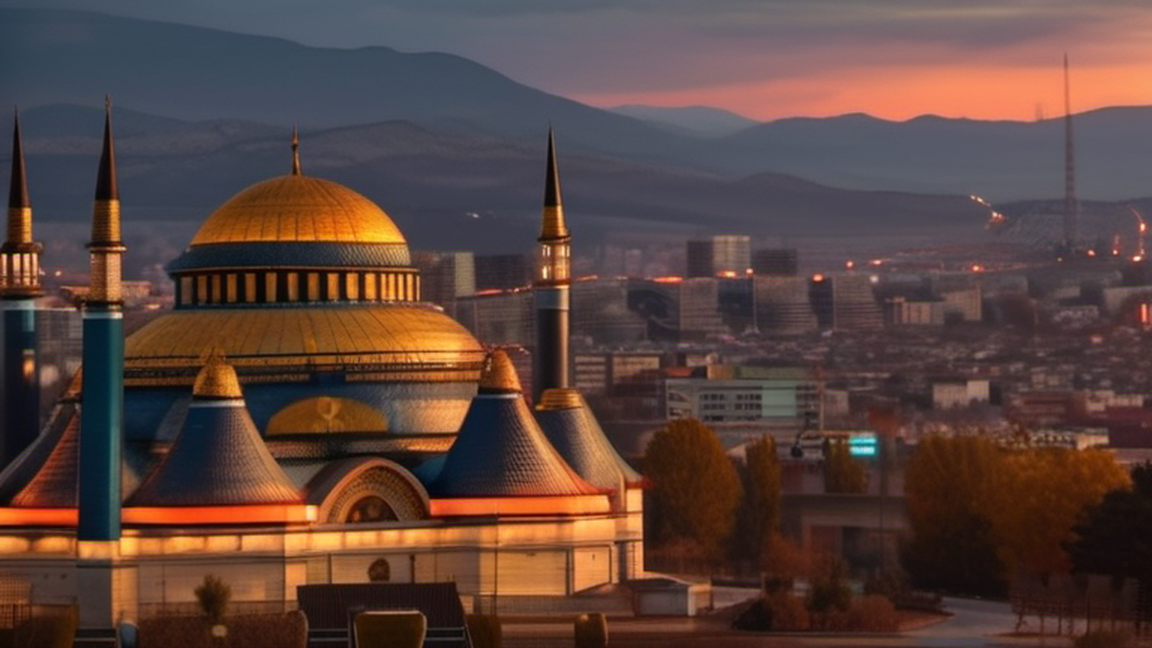
Ankara is the capital of Turkey, central within the country on the plateau of Central Anatolia. It's a sprawling modern place around an ancient citadel, and in 2022 had a population of almost 5.2 million (second in size
Ankara is the capital of Turkey, central within the country on the plateau of Central Anatolia. It's a sprawling modern place around an ancient citadel, and in 2022 had a population of almost 5.2 million (second in size to Istanbul), with a further 600,000 living in the wider metropolis.
Until 1923, Ankara was a provincial town of less than 30,000. Then Atatürk made it the capital of the new Republic of Turkey, a deliberate shift from the Ottoman capital of Istanbul with its literally Byzantine political life. The plateau was swiftly covered by drab concrete buildings and snarled highways, leavened by parks and woodlands, and occasional striking architecture. Although it never wrested the cultural crown from Istanbul, Ankara has a rich heritage in its museums, galleries and mosques, and tourists who just transit on the way to Cappadocia are missing an important chapter in the story of Turkey and Asia Minor.
The city was already old when the ancient Greeks called it "the anchor", Аγκυρα, which to a sea-faring people indicated a base or home. Hattian, Hittite, Lydian, Phrygian and Galatian civilisations had risen and fallen before them; Persians, Romans and Byzantines were yet to come. In 1402, Timur - the Tamburlaine of legend - stormed all the way from Kabul and won a battle that almost extinguished the Ottoman dynasty, but didn't stay to consolidate. So it was an Ottoman city and province for the next 500 years, giving the name "Angora" to long-haired cats, goats, rabbits and mohair textiles. Other European powers meddled in local affairs but concentrated on Istanbul, especially after Turkey was defeated in the First World War, and Greece was awarded much Turkish territory and tried to seize more. Atatürk rallied resistance in Ankara and the east, and the city's unconquered status made it a fitting capital.
Ankara acquired populations of government workers, university students, and incomers from the impoverished countryside. It didn't attract foreign immigration, but there's a stream of diplomatic visitors, and Ankara is more outward-looking than other Turkish cities bar Istanbul. Locals are generally friendly and helpful, and students / lecturers are keen to show off their English, but service staff such as hotel receptionists are not as widely fluent as in Western capitals. You might want a translation app on your phone, especially if you're travelling further out.
City centre is the broad strip from Ulus south through Sıhhiye to Kızılay:
- Ulus means "nation" as the republic's original parliament and other major institutions were here, grouped around the inevitable equestrian statue of Atatürk.
- Sıhhiye means "sanitary works" as the Ministry of Health stands here. This district is bisected by the railway tracks, so on this page it's described as "south", with its rump north of the tracks described as Ulus.
- Kızılay was named for the headquarters of the Red Crescent, the Turkish equivalent of the Red Cross, now replaced by a shopping mall. It has the Metro interchange.
Citadel is the term used here to describe the older districts east of Ulus: Hisar around the hilltop castle, and Hamamönü just south down the hill.
Further south from Kızılay are the upmarket (and uphill) districts of Kavaklıdere, Gaziosmanpaşa and Çankaya. The city's most expensive hotels and restaurants are found here, as are the embassies.
Southwest from Kızılay is Bakanlıklar (meaning government ministries), then İsmet İnönü Boulevard leads into the district of Eskişehir Yolu (referring to the former highway to Eskişehir). It's lined by university campuses and public buildings, including the National Parliament. Interminable ribbon development eventually gives way to the open steppe.
Ankara has a semi-arid, continental climate, with hot, dry summers and cold, snowy winters. Most rainfall is spring, with afternoon showers and thunderstorms.
Summers are hot, regularly topping 30°C in July and August, but humidity is low. Summer nights can be chilly, especially if a breeze starts up.
Early autumn has the best climate. Nights are cold but daytimes are mild and dry, unlike the wet spring months.
Winters are cold and often snowy, though the snow is seldom heavy, and cold below -20°C is very rare - not like the mountainous east of the country with perishing cold in mid-winter.
1 Ankara Esenboğa Airport (ESB IATA), Özal Blv, ☏ +90 312 590 4000. This has fewer international flights than Istanbul or the resort towns of Western Turkey, but Sun Express has direct flights from German-speaking cities with large Turkish expat communities, such as Munich. Turkish Airlines maintains a significant presence at the airport through its budget subsidiary AJet with thrice-weekly flights to London Stansted, Paris CDG and Madrid. Central Asia is well-served, with direct flights to Bishkek, Tashkent, Almaty and Astana, as are Baku (2-3x flights daily) and Tbilisi (4x weekly). The Gulf States, Egypt, Iraq, Syria, Lebanon, Jordan and Iran are also all reachable directly from Ankara.International operators are scare, but include Iraqi Airways, Qatar Airways, AZAL, Uzbekistan Airways and FlyDubai. Most other routes involve a change in Istanbul at IST or SAW airports. Both have hourly flights to Ankara, taking an hour, by Turkish Airlines, their subsidiary AJet or Pegasus. Ankara has flights from most Turkish cities: from the beach resorts and Ercan in Northern Cyprus these connect with the direct flights into Europe. The airport has the usual facilities including baggage storage and car hire. See Sleep for hotels in or near the airport. 200 tl by coach to city centre.. (updated Mar 2026)
Transport is the major shortcoming of this airport. It's 30 km north of the centre, along a congested main road; there are no plans to extend the Metro here.
Two companies operate express coaches to the airport - Ankara Air (cash only) and Havaş (cash or card). Download the Havaş app for an unreliable timetable. Both companies run from Kızılay, and Havaş also runs from the main AŞTİ terminal. Both cost 200 tl per person, with capacity for luggage. The Belko Air service referenced in many online guides no longer exists.
Local public transportation EGO bus Route 442 runs from the airport (arrivals level, watch for a crowd on the very far end of the dropoff lane on the arrivals level) to Kızılay and takes 40-50 minutes to the train station. This bus is cheaper than the private options (130 tl in April 2026) but takes longer.
Wikivoyage has an article on Rail travel in Turkey
Ankara is on the YHT high-speed rail network, with trains:
- from Istanbul taking 4½ hours, 13 daily via Pendik (for Sabiha Gokcen airport), Gebze, Izmit, Arifiye (for Adapazarı), Eskişehir (for Bursa) and Eryaman (for west Ankara suburbs). In April 2023 the fare is 248 TL economy, 372 TL business. The temporary terminus for Istanbul is Söğütlüçeşme, pending the interminable reconstruction of Haydarpaşa, but check for updates.
- from Konya taking 90 min, five daily. Two per day start from Karaman, with connections from Adana and Cyprus.
- from Sivas taking 2½ hours.
Other mainline trains (anahat trenler) are slow and scenic, with the emphasis on slow, but are called "Express" to compensate.
- Ankara Ekspresi departs from Istanbul Halkali station at 22:00, picking up at Söğütlüçeşme, Bostanci and Pendik plus nine other intermediate stations, reaching Ankara before 07:00. The return service has similar times, taking nine hours, and there are seats and sleepers plus a dining car.
- Izmir Mavi departs from Izmir Basmane station at 18:00 and takes 14 hrs overnight via Kütahya and Eskişehir; the return departs Ankara at 19:00.
- Destinations east of Ankara are served by overnight trains. The main services are from Kurtulan and Diyarbakir (Güney Kurtalan Ekspresi), from Kars and Erzurum (Doğu Ekspresi), and from Tatvan (Van Gölü Ekspresi), linked by dolmus or ferry to Van. Van has a train twice a week from Tehran and Tabriz in Iran.
Some of these trains have tourist versions, though all remain suspended in 2023. For instance the Turistik Doğu Ekspresi runs from Ankara to Kars with long stops for sightseeing eastbound at İliç (for Kemaliye), Erzincan and Erzurum; the westbound train makes long stops at Divriği and Bostankaya. Journey time each way is 30 hours.
For timetables and tickets, see TCDD, Turkish Republic State Railways.
Local trains (bölgesel trenler) run five times a day to Polatlı. These can't be booked.
The railway from Azerbaijan and Georgia was completed in 2017 and passenger trains have been promised ever since, but to date the line only carries freight. Trains from Syria and Iraq are all suspended indefinitely and the tracks are ruined.
2 Ankara railway station, Hipodrom Cd. The north side is the original 1930s Art Deco station for slow trains and Başkentray suburban lines, and quickest accessed off Hipodrom Cd. South side is the modern station for YHT trains, quickest accessed off Celal Bayar Blv: this is gleaming steel and glass, with a shopping mall and hotel to complete the resemblance to an airport. The nearest metro station is Ulus 500 m northeast. (updated Apr 2023)
Buses from Istanbul depart every 15 min round the clock, and take six hours to Ankara non-stop, for a fare in 2023 of 250 TL. Slower services may stop at Gebze, Izmit, Adapazarı and Bolu. Many are running through to cities further east, all of which have good connections to Ankara, see individual pages.
Buses from Izmir take 8 hours and from Adana 7 hours, with hourly services. From Bursa is six hours, but the usual method is to take the bus to Eskişehir to join the YHT fast train. Similarly from Antalya you join the train at Konya.
The main bus operators are Metro Turizm, Pamukkale and Flixbus, who took over Kamil Koç. Buses are clean and comfortable, see Turkey#Get around for tips on using them and buying tickets.
3 Ankara Intercity Terminal (AŞTİ, Ankara Şehirlerarası Terminal İşletmeleri), Mevlana Blv ( AŞTİ), ☏ +90 312 207 1000, info@asti.com.tr. AŞTİ (pronounced ash-tee) is a huge two-storey building with extended wings. Normally buses arrive on the lower floor and depart from the upper floor, but this varies for buses running through with Ankara as an interim stop. The building is modern, and easy to navigate when the departure screens are working. It has ticket kiosks, left-luggage lockers (15 TL for 12 hr), cafes, shops and toilets. Two hotels are 500 m south, see sleep. AŞTİ is best reached by metro with changing at Kızılay station. Here follow the signs "Ankaray". (updated Apr 2023)
Söğütözü. Some coaches (especially those operated by Kamil Koç / Flixbus) terminate near this metro stop in the Southwest rather than AŞTİ. As AŞTİ is quite easily accessed, there's no reason to go out of your way to book a bus to here, unless it's cheaper. (updated Mar 2026)
The city has a dense bus network, a two-line Metro, and an east-west suburban railway called Başkentray. There is no provision by any mode of public transport for travellers with restricted mobility. EGO (or toplu taşıma) is the municipality public transportation company.
All buses are operated by EGO. Most of them are white or blue, while the newer ones are red. Central bus stops often have displays of real-time services. Bus fares cannot be paid in cash, but can be paid by contactless card payment. However, unlike in other Turkish cities, foreign cards do not reliably work, so you should buy a Başkent Kart travel card from a kiosk or metro station or download the EGO Cep'te mobile app for QR scan. The same cards are used for the Metro, and each trip permits a transfer between bus and Metro not exceeding 45 min. Note these are not the Ankarakart, a discount card for Turkish students, teachers and elderly Ankara residents - this card might be available to you if you are a foreigner studying in Turkey, but not for tourists.
Kızılay and Ulus are both hubs for privately operated minibuses and dolmuş, which usually display a list of destinations on a board behind the windscreen - if in doubt, ask the driver. Cash only.
The Metro, run by EGO the city transport operator, has three lines, which intersect at Kızılay (the station's official name is 15 Temmuz Millî Irade Kızılay) Remarkably, EGO have contrived to muddle their numbering. M1, M2 and M3 do not operate as separate lines - you can stay on the same train all the way from Koru to OSB-Törekent - only if you want to get the M4 do you need to change at Kızılay.
Ankara Metro main line (M1, M2, M3) runs from the northwest suburbs of Sincan, Törekent and Eryaman to city centre (Ulus, Kızılay and Sıhhiye) then southwest to Çayyolu. Another line (M4) runs north from Kızılay to Keçiören.
Ankaray is styled differently yet is part of the same network. It runs east-west from Dikimevi via Kızılay to AŞTİ bus station.
Tickets are identical to the EGO buses and valid for transfer, see above for prices, and you buy them at kiosks or metro stations. The Başkent Kart can also be used. Contactless payment is also possible, but not always reliable, presumably due to the poor internet connection at underground stations.
All stations are announced both on a (really cool) analogue display and by voice in the metros.
Başkentray is the suburban line, transecting the city between Sincan and Eryaman in the west, through city centre and the main railway station, to Kayaş in the east. Trains run every 10 minutes from 07:00 to 21:00, then every 30 min to 23:00.
The line is shown in blue on transport maps and may be marked as B1. It's 37 km long, all above ground, and has 24 stations. There's nothing of visitor interest near the outlying stations, but to the west Eryaman is an interchange with YHT trains to Konya, Eskişehir and Istanbul, and Sincan is an interchange with other mainline trains. Kayaş to the east is also a mainline interchange, but not for YHT.
The system is owned and operated by TCDD Turkish State Railways, and until 2016 the same track carried mainline trains. That was incompatible with YHT and expansion of the suburban service so in 2016 the system closed for a couple of years while Ankara station was rebuilt and new tracks were laid parallel. It's planned to extend it northwest to Yenikent and Akçaören.
Once again, you can pay by Başkent Kart.
Taxis are numerous: they are yellow, have the sign Taksi on top of the car, and the letter T in their license plates. Have nothing to do with unlicensed drivers. The rates for day and night are same. Tipping is not usual but you round up to the next TL.
Scams are the same the world over: offering a fixed price way above the metered rate, special airport / luggage fees, failing to start the meter, going a silly route, tricks with banknotes / change, and so on.
Castle and its neighbor Hamamönü is home to Ottoman architecture.
1 Ankara Castle (1.3 km east of : Ulus). Daily 10:00-20:00. This volcanic outcrop has probably been fortified since the dawn of mankind, but the earliest traces are from the Phrygians of 8th century BC. The castle was reinforced by the Galatians then the Romans. You stroll up through cobbled streets to the double walls and can climb one of the towers, with views of the sprawling city and distant mountains. Free. (updated Apr 2023)
North Tower is another bastion of the citadel, 200 m north of the castle. You're aiming for the fluttering Turkish flag.
Sultan Alaeddin Mosque, Alitaş Sk (100 m west of castle). This is the city's oldest mosque, built in AH 574 (1178 AD) according to the inscription on its walnut mimber, but much modified since. (updated Apr 2023)
Turk-Russian Friendship House (Türk-Rus Dostluk Evi) is a bright modern art gallery at Kale Kapısı Sk 20 below the castle, open daily 10:00-17:00. It has three floors, with Belarusian and Ukrainian sections too. There is a gift shop selling Russian and English books and DVDs very cheaply. There is an entrance fee of about 20 tl, but if the man at the door doesn't understand you he tends to let you in for free.
2 Roman Theatre, Bentderesi Cd (1 km east of Ulus), ☏ +90 312 310 7280. M-Sa 09:00-19:00, Su 10:00-17:00. Scrappy remains of the stage and backstage, they haven't restored the seating. Statues from the site are in the Museum of Anatolian Civilisations. Free. (updated Apr 2023)
3 Arslanhane Mosque (Ahi Şerafeddin Camii), Can Sk (1 km north of and Kurtuluş). Built in 1290 in Seljuk style, and repaired in 1330 under Ahi Şerafeddin hence its other name. Well worth the hike up the hill for its finely-carved interior, notably the ceiling supported by a forest of wooden columns. In 2023, five wooden mosques in Central Anatolia were inscribed on the UNESCO World Heritage List - Aslanhane was one of them. (updated Apr 2023)
Ahielvan Mosque, Koyunpazari Sk (200 m below Arslanhane Mosque). Built in the late 14th and early 15th centuries, it has a richly carved walnut mimber or pulpit. (updated Apr 2023)
4 Museum of Anatolian Civilizations (Anadolu Medeniyetleri Müzesi), Gözcü Sk 2 (800 m east of Ulus), ☏ +90 312 324 3160. Daily 08:30-17:30. Excellent display ranging from prehistory to the proto-Greek and Roman eras. Adult 80 TL. (updated Apr 2023)
Kelime Museum, Gözcü Sk 11 (opposite Museum of Anatolian Civilisations), ☏ +90 312 311 6893. Tu-Su 10:00-17:00. Small private art museum. Signage is only in Turkish. (updated Apr 2023)
Essentially 'the old city', sometimes that also includes the Citadel. For traveller purposes it's worth distinguishing the more modern district close to Ulus Metro Station, extending south to the mainline railway station and tracks. Its south end merges into Sıhhiye district.
9 Victory Monument (Zafer Anıtı) in Ulus Square is the focus of the district, a marble and bronze monument with Atatürk on horseback. Since it was erected in 1927 a year before the "alphabet reform", it's one of the few republican monuments inscribed in Ottoman Turkish, using Arabic script.
Museum of the War of Independence (Kurtuluş Savaşı Müzesi), Cumhuriyet Cd 14/22 (on Ulus Square), ☏ +90 312 310 5361. Daily 09:00-17:00. This was the first site of the Turkish Republican Parliament, from 1920 to 1924. The 1921-22 War of Independence was directed from here, and there are photos and other memorabilia. Later the building housed various government functions until becoming a museum in 1981. Signage is only in Turkish. (updated Apr 2023)
Cardo Maximus is a stretch of Roman road 216 m long by 7 m wide, coursing north from Anafartlar Cd towards the Column of Julianus. It was discovered in 1995: its artefacts have been taken to the Museum of Anatolian Civilisations.
10 Column of Julianus (Julian Sütunu, Belkıs Minaresi) is a 15 m column in the square behind the İş Bankası building. It was erected in 362 CE to commemorate the visit of Emperor Julian (331-363 AD), who stopped off in town while marching against Persia. He rejected Christianity and revived earlier pagan rites, so by Christians he was derided as "Julian the Apostate". His campaign in Persia started well then was a debacle and he was fatally wounded; his successor Jovian reinstated Christianity so Julianus was the last pagan emperor. His story is retold, with many artistic liberties, in the 1964 novel Julian by Gore Vidal.
11 Hacı Bayram Mosque (Hacı Bayram Veli Cami), Sarıbağ Sk 13. 24 hours. This was built in 1428, restored by Mimar Sinan in the 16th century, and with Kütahya tiles added in the 18th. Hacı Bayram Veli (1352–1430) was a poet and Sufi teacher, and his ornate tomb is a pilgrimage site. (updated Apr 2023)
Temple of Augustus (Monumentum Ancyranum), Sarıbağ Sk (next to Hacı Bayram Mosque). 24 hours. The Romans conquered Anatolia in the Mithridatic Wars of 88-63 BC, and created the province of Galatea with Ancyra as its capital. From 25 BC they built over what had been a Phyrigian temple to make an "Augusteum" for the worship of their emperor Octavian or Augustus (an outstanding ruler, a contrast to his successor, the dark and dissipated Tiberius). In the 5th century it was converted into a church by the Byzantines. Only the side walls and ornate doorway remain. Free. (updated Apr 2023)
Most sights are in Sıhhiye beyond the railway tracks or a couple of km further in Kızılay.
16 Anıtkabir is an extensive hilltop site centred on the mausoleum of Mustafa Kemal Atatürk (1881-1938), founder of the Republic of Turkey. He died at Dolmabahçe Palace in Istanbul and lay for 15 years at what is now the Ankara Ethnographic Museum before transferring here in 1953. It's a 20th century Giza, a pharaonic collection of tombs, monuments and museums in Art Deco style, with individual opening hours. The site is free to enter 24 hours, walk south up the parkland avenue from Tandoğan / Anadolu. The last section is the 262 m "Road of Lions", flanked by statues of lions representing the ancient Turkic tribes. (The gaps between paving stones imbue visitors with a suitably reverent attitude, apparently.) This concludes in the Ceremonial Plaza, where the coloured flagstone patterns are those of traditional rugs and kilims. Expect military pageantry and flag-waving here on all state occasions.
Hall of Honor holds the tomb. What you see is the symbolic ground-level sarcophagus. Atatürk lies 7 m below in an ornate but private Tomb Room, where he mingles with soil from all the Turkish regions of his day, including from Salonica his birthplace now in Greece, parts of Hatay now in Syria, and northern Cyprus.
Atatürk & Independence War Museum (Atatürk ve Kurtuluş Savaşı Müzesi). M-Sa 09:00-17:00. This is beneath the Hall of Honor and displays belongings and memorabilia of Atatürk, the 1915 battles of Gallipoli / Çanakkale and the 1920/21 War of Independence, and the postwar overthrow of the Ottomans and proclamation of the republic. Free. (updated Apr 2023)
Mausoleum of İsmet İnönü (1884-1973) is southwest side of the Ceremonial Plaza. He was Atatürk's right-hand man, the country's second president and had three spells as Prime Minister, embedding the Republic's modernisations. The tomb is small at ground level but below is an exhibition hall - this is only open for one week from Oct 29 Republic Day and for two weeks from Dec 25 the anniversary of his death.
Ten towers line Ceremonial Plaza, but they're set within the colonnade and don't stand tall. Their low pitched roofs are meant to symbolise Turkic tents, and they contain various statues and inscriptions of an uplifting patriotic nature. For example the tower west side of the Hall of Honor depicts the opening of the Turkish Grand National Assembly on 23 April 1920, and holds Atatürk's Cadillac. So it's called 23 Nisan Kulesi but he didn't own 23 Nissans.
This covers all other districts out to the ring road O-20 some 20 km out.
23 Akköprü (200 m north of Akköprü) means "white bridge" though it's rosy basalt. With seven arches, it was built from 1222 to carry the main highway across the Çubuk River. Modern traffic rushes past on Fatih Sultan Mehmet Blv: this may be your best viewpoint, as in 2020 the bridge was barricaded off as a construction site.
24 Atatürk Forest Farm (Atatürk Orman Çiftliği), Alparslan Türkeş Cd 68 (Başkentray train to Gazi then one km north), ☏ +90 312 211 0170. W-Su 09:00-17:00. Extensive model farm established by Atatürk, to prove that the dusty steppes around Ankara could be converted into good farmland. (His successors preferred to cover everything with concrete.) The barn has been turned into a museum of farming methods. Free. (updated Apr 2023)
25 Turkish Air Force Museum (Türk Hava Kuvvetleri Müzesi), Fatih Sultan Mehmet Blv (corner with 2453rd Sk), ☏ +90 312 244 8550. Tu-Su 09:00-16:00. A collection of two dozen military aircraft. Adult 60 TL. (updated Apr 2023)
26 Altınköy Open Air Museum (Altınköy Açık Hava Müzesi), 2022nd Sk, Beşikkaya (Buses from Ulus), ☏ +90 312 375 1588. Tu-Su 10:00-20:00. A reconstruction of 1930s-50s Anatolian village life, with buildings relocated from rural Western Karadeniz and demonstrations of crafts. The suspension bridge is a catchpenny extra. Adult 10 TL. (updated Apr 2023)
27 Lake Mogan is a 5 km long recreational lake south side of the town of Gölbaşı, 20 km south of city centre. It has camping areas, coarse fishing, picnic spots and walking trails. In 2023 you pay 5 TL per car.
28 Tulumtas Cave, Tulumtaş, Gölbaşı (by the intersection of O-20 and Turgut Özal Blv). A prehistoric cave, extensively decorated, discovered during construction of the ring road. (updated Oct 2025)
Golden Pavilion Museum (Merik Konağı (Altın Kosk)), Üniversiteler, İhsan Doğramacı Blv No:39, 06800 Çankaya/Ankara, ☏ +90 312 266 10 15. Tu-Su - 10:30 - 16:30. Eccentric reproduction of an Ottoman-style wooden mansion, built by a local businessman during the 1960s. Now open to the public as a museum, with a decent cafe inside. A particular highlight is the signed photos of George H.W. Bush and Margaret Thatcher. 250 tl. (updated Mar 2026)
1 Ankara Opera & Ballet (Opera Sahnesi), Atatürk Blv 20, ☏ +90 312 324 6801. This opened in 1948 and looks it, the grandeur is kinda faded. It hosts theatre as well as opera and ballet. (updated Apr 2023)
2 Presidential Symphony Orchestra. (updated Feb 2025)
3 Atatürk Culture Center. (updated Feb 2025)
4 Feza Gürsey Science Center. (updated Feb 2025)
5 Goksu Park, off 1 TBMM Cd, Etimesgut (Bus 501, 502). Daily 06:00-23:00. Ranged around Susuz Lake, with an island restaurant, cafes and funfair. (updated Apr 2023)
6 Youth Park. (updated Feb 2025)
7 Seğmenler Park. (updated Feb 2025)
8 Dikmen Valley. (updated Feb 2025)
Ankara International Music Festival is in April.
Bilkent Mayfest is organised by Billkent University .
Burn Sonance Festival of music is next held June.
Jazz Festival is in Oct / Nov.
Ankara Film Festival is next held on Nov.
Şefika Kutluer Festival of music is in December.
Football: MKE Ankaragücü were relegated in 2024 and again in 2025 so they play soccer in TFF Second League, the third tier. Their home ground Eryaman Stadium (capacity 20,560) is in the western suburbs, take the Metro to Devlet Mahallesi. MKE, since you were wondering, stands for Machinery and Chemical Industry. They will be returning to their homecourt of 19 May Stadium, starting from the 2026-27 season.
- Gençlerbirliği SK share Eryaman Stadium. They were promoted in 2025 to Süper Lig, the top tier.
- Ankara Keçiörengücü SK play in First League. Their home ground is Aktepe Stadium (capacity 5000) 8 km north of city centre on Adnan Kahveci Cd.
- Ankaraspor were known as Osmanlıspor from 2014 to 2020 but have re-adopted their former name. They play in Second League at Osmanlı (Yenikent) Stadium, capacity 18,000, west edge of the city. Take the Ankaray train to its west terminus at Sincan then a local bus onward to Yenikent.
Basketball: Türk Telekom BK plays in Turkish Basketball Super League and the EuroCup. Their homecourt is the Ankara Arena.
Golf: courses and ranges within the city remain closed in 2023. Regnum Golf Country Club is 50 km southwest near Halaçlı village.
Running: Annual Runkara International Half Marathon.
Ankara hosts some universities that are internationally high-ranking as well as having large campuses, such as Bilkent, Hacettepe and ODTÜ / METU.
One could also attend to hobby or vocational courses provided by the metropolitan municipality's Halk Eğitim Merkezi.
Useful to know: AVM stands for Alışveriş Merkezi, shopping centre.
Citadel approaches up Kale Kapısı Sk have been a merchandising area for centuries. There are lots of tourist-trappy outlets for carpets, leather and fake antiquities. At least you hope they're fake, because if genuine it's illegal to export them.
1 Ankamall, Mevlana Blv 2 (: Akköprü), ☏ +90 312 541 1212. Daily 10:00-22:00. Huge shopping mall to the northwest with underground parking and food court. (updated Apr 2023)
2 Armada, Dumlupınar Blv 6, ☏ +90 312 219 1319. Daily 10:00-22:00. Large mall 500 m south of the bus terminal. (updated Apr 2023)
Karum AVM, Iran Cd 21, ☏ +90 312 468 4984. Daily 10:00-21:00. Next to the Sheraton, this is the main south-side mall. (updated Apr 2023)
3 Metromall, 30 Ağustos Dumlupınar Cd 2, Eryaman, ☏ +90 312 504 1515. Daily 10:00-22:00. Large mall with cinema, bowling alley and food court. It's northwest edge of the city so visitors might use it arriving or departing on the Istanbul motorway. (updated Apr 2023)
Kentpark AVM, Mustafa Kemal, 06510 Çankaya/Ankara (: ODTÜ or Soğutözü). 10:00 - 22:00. Large mall with many eateries and pubs. Expensive and aimed more at locals and university students than tourists. (updated Mar 2026)
Ankara has a variety of local/traditional and international food restaurants such as Asian, French, Italian, Persian and Somalian cuisine throughout the city.
Kızılay has a pedestrianised block full of little cafes and takeaways. It's east of Atatürk Blv and north of Ziya Gökalp Cd. Çiğ köfte and regular köfte carts/shops could be found all over the city for a quick snack.
Ward Restaurant and café مطعم ورد, Bayındır-1 Sk (in Kızılay cafe block), ☏ +90 505 033 0022. Daily 08:00-00:00. This is the place to come for Iraqi food. (updated Apr 2023)
Zelal Cafe, Yüksel Cd 24 (50 m north of Komagene), ☏ +90 312 431 3232. Inexpensive trad food. (updated Apr 2023)
Nado's, Ataç-1 Sk 26 (100 m east of Kızılay cafe block), ☏ +90 312 433 3131. Daily 11:00-19:00. Friendly budget pizzeria. (updated Apr 2023)
1 Kırık Oklava, Cemal Gürsel Cd 16, ☏ +90 312 362 1989. Daily 08:30-22:30. Great place by Ankara University Cebeci Campus for inexpensive wraps and pancakes. (updated Apr 2023)
Ulus has a bazaar with a row of many small food outlets. Gözleme, simit and similar snacks available cheaply.
The area around the National Library (Millî Kütüphane) has many cafes and chain fast food outlets (Komagene, Tavuk Dünyası etc.) popular with students especially.
Aşkabat Cd is a street west side of Anıtkabir with a slew of eating places while Esat Cd is home to Ankara's renown ASPAVAs.
Yargitay Evi Lokali, Milli Müdafa Cd 10, Kızılay (west side of Güvenpark), ☏ +90 312 418 5675. M-Sa 12:00-22:00. Inexpensive place looking onto Kızılay Square, quality erratic. (updated Apr 2023)
2 Tarihi Çiçek Lokantası, Necatibey Cd 15, ☏ +90 312 229 4400. Daily 08:00-21:00. Smart place with good cuisine. (updated Apr 2023)
James Cook Pub, Tunus Cd 19, ☏ +44 312 419 9688. Daily 10:30-01:00. Good value pub and restaurant. (updated Apr 2023)
Sudem is a tavern at Konur Sk 63 with tapas / meze-style servings and Turkish music, open daily 11:00-01:00.
Korelee, Bestekar Cd 27, ☏ +44 312 418 0688. Daily 11:30-21:00. Delicious Korean food. (updated Apr 2023)
3 Cafe des Cafes, Tunalı Hilmi Cd 83/A, Kavaklıdere, ☏ +44 312 426 5511. M-Sa 09:00-23:00, Su 09:30-22:00. Slick European-style cafe with Italian and Spanish choices. (updated Apr 2023)
Kıtır, Tunali Hilmi Cd 114 (south of Cafe des Cafes next to Kuğulu Park), ☏ +90 312 427 4444. Daily 12:00-00:00. Traditionally a rock bar but nowadays more of a restaurant. (updated Apr 2023)
Ege (which means Aegean) serves seafood on Tunali Hilmi Cd, open daily 12:00-01:00.
Göksu Lokantası, Bayındır-1 Sk 22, off Ziya Gökalp Cd (200 m east of Kızılay station), ☏ +44 312 431 4727. M-Sa 11:00-23:30. Great dining here. They have another branch south at Nenehatun Cd 5. (updated Apr 2023)
4 Marti Restaurant, Bayındır-2 Sk 37, Kocatepe. It has a nice and relaxing atmosphere. There are two outdoor seating areas. The appetizers are great, and the food is perhaps even more so. (updated Aug 2022)
5 Hanzade Konağı, Hacettepe İnanli Sok., Hamamönü, Tacettin Dergahi Karşisi No:5. It is a very stylish place with plants hanging on the wall and from the ceiling. Decor, presentation and taste are great. Employees are smiling and interested. (updated Sep 2022)
Uludağ Kebapçısı, Denizciler Cd 54, ☏ +90 312 309 0400. Daily 11:00-22:00. Named for the mountain above Bursa, this is an above-par kebab restaurant. (updated Apr 2023)
Kınacızade Konağı, Kale Kapısı Sk 28 (by castle), ☏ +90 555 256 9755. Daily 10:30-21:00. Atmospheric place just outside castle, good value, not tourist-trappy. (updated Apr 2023)
6 Urumchi Uyghur Restaurant, Ziya Gökalp Cd 76, ☏ +90 312 433 5204. Daily 11:00-09:30. Ürümqi is in the far west of China, so they've quite a range of Asian cuisines to go at. It's a great place for different flavours, try the roast macaroni. (updated Apr 2023)
Gaziosmanpaşa area of Çankaya district is home to many upper class premises such as;
Louise Cafe Brasserie & Loft at Filistin Cd.
Trilye Restaurant at Kuleli Sk.
Naya Restaurant Lounge at Atakule.
Chef Bro's at Halıcı Sk.
Develi1912 at Arjantin Cd.
8 Quick China, Uğur Mumcu Sk 64/B, Çankaya, ☏ +90 312 437 0303. Daily 11:00-22:00. The name suggests a fast-food chain, and they do have other branches in Ankara and elsewhere, but this is excellent Chinese, Korean, Japanese and Thai cuisine. (updated Apr 2023)
Most cafes and restaurants serve beer, wine and rakı. Ankara has two major strips for pubs and bars that flanks around the areas of 'Tunalı Hilmi' and 'Sakarya St'. A third would be 'Bahçeli'.
Meyhanes are taverns with fixed meze-style menus, drinks and traditional Turkish music and dancing. They're along the same stretch as the other bars. There used to be a cluster around the citadel, but these relied on the tourist trade and disappeared during covid.
Apart from the usual nightlife ones (also mostly found around Tunalı Hilmi area) there also are 'pavyons' - which are essentially Turkish take on gentleman's club (mostly located around Maltepe area).
Telwe Bar, İnkılap Sk 6, ☏ +90 312 433 5454. Daily 11:30-05:00. Bar and late spot in the Kizilay eating strip. (updated Apr 2023)
Soul Pub, Olgunlar Cd 18, ☏ +90 312 424 0144. Daily 12:00-01:00. Friendly place with generous servings of pub food. (updated Apr 2023)
Corvus, Bestekar Cd 59, ☏ +90 312 426 5480. Daily 17:00-02:00. Lively late-night pub with rock music. (updated Apr 2023)
Twister, Bestekar Cd 82A, ☏ +90 553 888 0841. Daily 10:00-01:30. Pub with live music and belly-dancing. (updated Apr 2023)
Sakal Kafe Bar, John F Kennedy Cd 13, ☏ +90 312 424 1670. Daily 09:00-01:00. Cool place with a wide range of music. (updated Apr 2023)
Sixtiees Pub, Tunalı Hilmi Cd 96. A LGBT-friendly bar in Ankara. (updated Apr 2023)
Hayyami wine bar is next door at Bestekar Cd 82B.
Manhattan Rock Bar is at Üsküp Cd 11, open W-Sa 20:30-04:00.
Always Rock Bar is at İnkılap Sk 5/11
Granma Pub is at Konur Sk 59/13
Haymatlos is at Konur Sk 73
Afitap is a well-known meyhane at Tunus Cd.
Clubs:
6:45 is at Tunus Cd.
IF Performance Hall is at Tunus Cd.
Kite is at Güvenlik Cd.
Accommodation is clustered in Ulus north of the railway station, in Sıhhiye south of the tracks, and in Kızılay further south. A strip of mid-range business hotels follows D200 a few km west - these are more convenient for the bus station.
1 Bihostel (Deeps Hostel), Ataç-2 Sk 46 (,: Kizilay), ☏ +90 531 872 4975. Amazing to find such a friendly well-equipped hostel so central. Open all year with dorms and private rooms. (updated Apr 2023)
Deeps Hostel 2, Southside at Libya Cd 2, ☏ +90 533 789 0886. Another branch.
2 Yeni Bahar Oteli, Çankırı Cd 25, ☏ +90 312 310 4895. Clean and helpful, you can find cheaper on this strip north of Ulus Square but most are dismal. (updated Apr 2023)
Divan Ankara Çukurhan, 3 Depo Sk, off Gözcü Sk (facing Koc Museum near castle), ☏ +90 312 306 6400. Charming hotel in a han, a former marketplace. (updated Apr 2023)
3 Ankara Gold, Güfte Cd 4, off Tunus Cd, ☏ +90 312 419 4868. Clean friendly central place. (updated Apr 2023)
4 Hotel Midas Kavaklıdere, Tunus Cd 20, ☏ +90 312 424 0110. Welcoming central mid-price hotel. (updated Apr 2023)
King Hotel, Güvenlik Cd 13 (east side of Parliament), ☏ +90 312 418 9099. Simple rooms but good value for the prime location. (updated Apr 2023)
New Park Hotel, Ziya Gökalp Cd 58 ( Kolej), ☏ +90 312 458 0000. Boxy modern hotel, usually clean, some street noise. (updated Apr 2023)
5 Ramada, Tunalı Hilmi Cd 66, ☏ +90 312 428 8000. Functional central hotel, a bit worn. (updated Apr 2023)
Radisson Blu, Istiklal Cd 20 (next to : Ulus), ☏ +90 312 310 4848. Good value hotel 500 m from railway station. (updated Apr 2023)
Grand Mercure, Yaşam Cd 1 (west side of bus station), ☏ +90 312 999 0006. Next to bus station, but not the ideal flop after a long journey as they play loud music to 1 am. (updated Apr 2023)
6 Green Park Hotel, 1443rd Cd (block west of Mevlana Blv), ☏ +90 312 258 0000. Value-for-money hotel one km south of bus station, rooms kinda worn. (updated Apr 2023)
Airport (ESB IATA): the hotel within Esenboğa airport remains closed in 2023. Ibis is 1 km south, and Holiday Inn Express is a further km south.
Ankara Hotel, Celal Bayar Blv 78 (within railway station), ☏ +90 312 508 1010. Opened in 2022, this is a smart convenient place within the YHT Gar, pity the sound-proofing is inadequate. (updated Apr 2023)
Mövenpick Ankara, Yaşam Cd 1 (facing Mercure west side of bus station), ☏ +90 312 258 5800. Slick business hotel, the only gripe is street noise. (updated Apr 2023)
7 Sheraton Ankara, Şehit Ömer Haluk Sipahioğlu Sk (off Arjantin Cd), ☏ +90 312 457 6000. Good reviews for comfort and service at this hotel and convention centre, which towers like a monument above the south-side streets. (updated Apr 2023)
Ankara HiltonSA, Tahran Cd 12 (200 m north of Sheraton), ☏ +90 312 455 0000. Good scores all round for this efficient friendly hotel. (updated Apr 2023)
8 Crowne Plaza Ankara, 171th Sk (next to Gimart shopping mall), ☏ +90 312 320 0000. Smart business hotel in IHG chain, clean and efficient. (updated Apr 2023)
Ankara is generally safe, even for single females at night, since as the capital it's well-policed. (The cops are looking for traffic offences, dissident trouble-makers and squaddies in town without a liberty pass.) Take usual care of valuables. The main hazard is traffic - vehicles are driven at silly speeds with scant regard to traffic lights and pedestrians. The side walks are often in poor condition: anyone with restricted mobility will be forced onto the roadway, and on ill-lit streets at night you risk falling into uncovered drains.
For emergencies call the emergency number 112 or approach any officer or go to the nearest station. Ankara nominally has a tourist police section with multilingual staff, based at AŞTİ bus station. The covid slump in tourism saw them redeployed to other duties, but perhaps staffing will resume as tourism and related incidents increase.
Ankara is the national capital so most countries have an embassy or equivalent consular service. Most are in the southern districts of Kavaklıdere, Gaziosmanpaşa and Çankaya.
Algeria, Şehir Ersan Cd 42, Çankaya, ☏ +90 312 468 7719, fax: +90 312 468 7593, svconsulaire@algerianembassy.com.tr. (updated Apr 2023)
Australia, Uğur Mumcu Cd 88, ☏ +90 312 459 9500, fax: +90 312 446 4827. This also serves Georgia and Azerbaijan. (updated Apr 2023)
Austria, Atatürk Blv 189, Kavaklıdere, ☏ +90 312 405 5190. M–Th 08:15–16:30, F 09:00–16:00. (updated Apr 2023)
Bangladesh, Kılıç Ali Cd 14, Çankaya, ☏ +90 312 495 2720, fax: +90 312 495 2744, mission.ankara@mofa.gov.bd. M-F 09:00-17:00. (updated Apr 2023)
Belgium, Mahatma Gandi Cd 55, Gaziosmanpaşa, ☏ +90 312 405 6166, fax: +90 532 684 4348, Ankara@diplobel.fed.be. Visas are processed here, their main office is Dumlupınar Blv 98 by the MTA Metro station. (updated Apr 2023)
Canada, Cinnah Cd 58, Çankaya, ☏ +90 312 409 2700. They also provide consular services for Azerbaijan, Georgia, Iran and Turkmenistan. (updated Apr 2023)
Chile, Hafta Sk 4, Gaziosmanpaşa (corner of Reşit Galip Cd), ☏ +90 312 447 3418. (updated Apr 2023)
China, Ferit Recai Ertuğrul Cd 18, ☏ +90 312 436 0628. (updated Apr 2023)
Cuba, Pak Sk 1/28, Çankaya, ☏ +90 312 442 8970. M-F 09:00-14:00. (updated Apr 2023)
Denmark, Turan Güneş Blv 106, ☏ +90 312 408 3300, ankamb@um.dk. (updated Apr 2023)
Ecuador, Kelebek Sk 21/1, Gaziosmanpaşa, ☏ +90 312 446 0160, eecturquia@cancilleria.gob.ec. M-F 09:30-17:00. (updated Apr 2023)
Egypt, Atatürk Blv 126, Kavaklıdere, ☏ +90 312 426 1026. M-F 09:00-16:00. (updated Apr 2023)
Finland, Beyaz Zambaklar Sk 44, Çankaya, ☏ +90 312 457 4400, sanomat.ank@formin.fi. M-Th 08:30-16:30, F 08:30-15:15. (updated Apr 2023)
France, Paris Cd 70, Çankaya, ☏ +90 312 455 4545. (updated Apr 2023)
Germany, Atatürk Blv 114, ☏ +90 312 455 5100. (updated Apr 2023)
Greece, Ziaur Rahman Cd 9, Çankaya, ☏ +90 312 448 0387. (updated Apr 2023)
India, Cinnah Cd 77/A, Çankaya, ☏ +90 312 438 2195, fax: +90 312 440 3429, cul.istanbul@mea.gov.in. M-F 09:00-13:00 and 13:30-17;30. (updated Apr 2023)
Indonesia, Sukarno Cd, Çankaya, ☏ +90 312 969 7354, fax: +90 312 969 7356, ankara.kbri@kemlu.go.id. (updated Apr 2023)
Iran, Tahran Cd 10, Kavaklıdere, ☏ +90 312 468 2821, fax: +90 312 468 2823. (updated Apr 2023)
Ankara has 4G from all Turkish carriers. As of Jan 2024, 5G has not rolled out in Turkey.
Northwest, Highway D140 follows an ancient trade and pilgrimage route from Baghdad to Ankara and Constantinople. Towns along it westbound are Ayaş, Beypazarı, Çayırhan and Nallıhan.
Kızılcahamam 80 km north has thermal springs amid forests — bears and wolves lurk in Soğuksu National Park.
Boğazkale northeast is the hub for visiting ancient Hattuşa, the capital of Hittites.
Çağırkan Japanese Gardens are 10 km past Kaman on the road southeast to Kırşehir.
South you pass Tuz Gölü ("Salt Lake") on the road to Aksaray.
Aksaray is a laid-back city and great base for the attractions near Güzelyurt.
Haymana 80 km southwest is a down-at-heel spa town with hot springs. Gavurkale and Kulhoyuk nearby have rock friezes and Hittite burial grounds.
Gordion (Yassıhöyük) is 96 km west, near Polatlı off the highway to Eskişehir. One of the most important ancient cities in Turkey, it had been home for Hittites, Phyrigians, Persians, Greeks, and Romans since 3000 BC. The remnants of the city are displayed in Gordion Museum and Anatolian Civilizations Museum in Ulus.

While the capital’s silhouette is dominated by government façades, a short tram ride northward reveals a different rhythm. The neighbourhood of Çankaya houses a cluster of converted warehouses that now host independent galleries, craft workshops and low‑key cafés where designers showcase Anatolian textile experiments. Visiting during the weekly “Art Walk”—usually Thursday evenings—lets you chat directly with the makers, learn about the revival of traditional kilim motifs in contemporary fashion, and sample street‑food stalls serving çiğ köfte with a modern twist. This side of Ankara feels less like a bureaucratic centre and more like a living laboratory where Turkey’s cultural heritage is being re‑imagined for a global audience.
At an elevation just under a kilometre, Ankara enjoys a continental climate that can feel starkly different from the coastal resorts most tourists associate with Turkey. The city’s many pine‑lined parks, such as Seğmenler and Arboretum, create micro‑climates that soften summer heat and offer surprisingly cool evenings. Pack a light jacket even in July if you plan to linger after sunset; the rustle of pine needles and distant call of nightingales provide a quiet counterpoint to the bustling streets. These green pockets are also ideal for early‑morning jogs or a brief respite between museum visits, giving travellers a taste of Anatolian seasonal nuance without leaving the urban core.
Eryaman is a station in the west suburbs of Ankara where YHT trains also stop, and you can transfer to the cross-town Başkentray train. They no longer stop at Sincan (terminus of the Başkentray line) but slow trains from the west stop there not at Eryaman.
Koç Museum, Depo Sk 1 (100 m south of Museum of Anatolian Civilisations), ☏ +90 312 309 6800. Tu-Th 10:00-17:00, Sa Su 10:00-19:00. Rahmi M Koç (b 1930) is the businessman who built up Kâmil Koç bus company, now part of Flixbus. This museum, a smaller version of the one in Istanbul, is crowded with exhibits on transport, communication and science since the 1850s. It's housed in Çengel Han, a caravanserai built in 1523. Adult 625 TL. (updated Sep 2025)
5 Chess Museum (Gökyay Vakfı Satranç Müzesi), Basamaklı Sk 3, off Ulucanlar Cd, ☏ +90 312 312 1304. Tu-Su 10:00-18:00. More chess sets ancient and modern than you'd think possible, including weird versions such as the three-sided game. Adult 15 TL. (updated Apr 2023)
6 Molla Great Mosque (Molla Büyük Cami), Yasa Sk. A modest building in spite of the name, this was built around 1500. (updated Apr 2023)
7 Cenâbî Ahmet Paşa Mosque, Ulucanlar Cd 56. Built by the famous architect Sinan in 1566, it's in finely-crafted Ankara stone. The mimber (pulpit) and mihrap (prayer niche) are of white marble. (updated Apr 2023)
8 Ulucanlar Prison Museum (Ulucanlar Cezaevi Müzesi), Ulucanlar Cd 63 (Bus 308, 324, 354, 369 to Plevne Cd; 1 km north of Dikimevi), ☏ +90 312 507 0138. Tu-Su 10:00-16:00. This bleak place was built as a barracks then converted to a prison in 1925. It held almost 800, in a mix of semi-open and maximum security wings. It was a brutal instrument of political repression, with its inmates a long roll-call of literati and activists, torture was common, and 19 were hanged in the prison yard mostly for being Marxist. There was a series of riots in 1999. It closed in 2006 and was converted into a museum in 2011. Adult 60 TL. (updated Sep 2025)
Erimtan Archaeology and Art Museum - is an archaeology museum and music venue.
Kahve Müzesi - advertised by signs all over the tourist citadel. Where it actually is is not clear.
12 Roman Baths (Roma Hamami), Çankırı Cd 43, ☏ +90 312 310 7280. Daily 10:00-16:30. Ruins of a large Roman bath complex, built under Emperor Caracalla circa 200 AD and in use for 500 years. They follow the classical design of frigidarium (cold room), tepidarium (warm room) and caldarium (hot room), and their relative sizes show that Ancyra had winters as chilly then as now - those coins that fixed the dates were obviously not paid out to get even colder. Adult 20 TL. (updated Apr 2023)
Aviation Association Museum (Türk Hava Kurumu Müzesi), Hipodrom Cd 2 (200 m northwest of railway station), ☏ +90 312 303 7452. Tu-Su 08:30-17:30. Small collection of aircraft around a parachute training tower (only 41 m, so don't expect much freefall time), and a small indoor collection. Not to be confused with the military aviation museum west edge of the city. Free. (updated Mar 2025)
Korean War Memorial just west of the Aviation Museum commemorates the Turkish Brigade, which fought under UN command in the Korean War. Their biggest engagement was the series of battles at Kunu-ri in late 1950. Some 15,000 rotated through the Brigade, with 721 killed in action, 2111 wounded and 168 missing.
PTT Post Museum, Ataturk Blv 13 (200 m southeast of Ulus), ☏ +90 312 324 0871. Daily 09:00-17:00. Display of stamps and other postal memorabilia. Free. (updated Apr 2023)
Vakif Museum, Ataturk Blv 23 (300 m southeast of Ulus), ☏ +90 312 311 4925. Tu-Su 09:00-17:00. Crowded collection of antique Turkish carpets, candle holders and Korans, watches, woodworks, tiles and other crafts. The 1927 building used to be a law school. Free. (updated Apr 2023)
Melike Hatun Mosque next to Vakif Museum was built in 2017 but in traditional Ottoman style.
Gençlik Park stretches east from the railway station to Hatun Mosque. It has a large ornamental lake and is sometimes a venue for open-air events.
13 Cermodern, Altınsoy Cd 3 (500 m east of Sıhhiye), ☏ +90 312 310 0000, info@cermodern.org. Tu-Su 10:00-19:00. Contemporary art museum in the former power plant for Turkish Railways. Adult 40 TL. (updated Apr 2023)
14 Painting and Sculpture Museum (Resim ve Heykel Müzesi), Türkocağı Sk, off Talatpaşa Blv ( Sıhhiye), ☏ +90 312 310 2095. Tu-Su 09:00-18:00. Built from 1927, this hosts a permanent display of Turkish art from late 1800s to present day, plus temporary exhibitions. (updated Apr 2023)
Ethnography Museum (Etnoğrafya Müzesi), Türkocağı Cd 4, off Talatpaşa Bulv (behind Painting and Sculpture Museum), ☏ +90 312 311 3007. Daily 08:30-17:30. Huge array of Turkic art covering painting, porcelain, woodwork, clothing, carpets, metalwork and weaponry. It was built 1925-28 and from 1938 to 1953 housed the sarcophagus of Atatürk, pending completion of his mausoleum of Anıtkabir. (updated Apr 2023)
15 Hacettepe Art Museum, Hacattepe University (500 m northeast of Sıhhiye), ☏ +90 312 305 4343. M-F 10:00-16:00. Extensive display of Turkish painters and artists from the early days of the Republic until present times. (updated Apr 2023)
Mehmet Akif Ersoy Home Museum, Hacettepe University (within Taceddin Mosque 200 m east of Art Museum), ☏ +90 312 312 1873. Tu-Su 10:00-17:00. Ersoy (1873-1936) trained as a vet but became politicised in the dying days of the Ottoman Empire. He's best known for composing the Turkish national anthem. This museum reconstructs his stay here. Free. (updated Apr 2023)
17 Hittite Sun Disc Statue is the twee structure on Atatürk Blv as it enters Sıhhiye beneath the railway tracks. Its deer, two oxen and sun disc are supposed to commemorate Anatolian Hittite culture - a powerful realm from 18th to 12th century BC then gobbled up by Egyptian and Assyrian rivals. If you were disappointed at Anitkabir by not finding 23 Nissans, they're right here nose-to-tail in the traffic snarl.
Abdi Ipekci Park is just east of Sıhhiye station and the Hittite statue.
18 Monument to Security (Güvenlik Anıtı) is the sinister focus of Güven Park just outside Kızılay. "Turk! Be proud, work hard, and believe in yourself" is Atatürk's sage advice to his people, above which two gun-toting thugs pose, the "or else!" of the police and army. It was erected in 1935.
19 Kocatepe Mosque, Dr Mediha Eldem Sk 67 (1 km southeast of Kizilay). 24 hours. This had been in the planning since 1944, but attempts at a modern style were thwarted by the conservatives. So what was built from 1967 to 1987 is a neoclassical Ottoman structure. Free. (updated Apr 2023)
20 Çankaya Mansion (Çankaya Köşkü), Ziaur Rahman Cd (4 km south of Kızılay), ataturkmuzekosku@tccb.gov.tr. Closed. Atatürk took a liking to this countryside mansion, which was rebuilt to become the presidential home after the capital moved to Ankara. The mansion became centrepiece of a large government campus, so "Çankaya" meant the presidency similar to "White House", "Kremlin" or "Downing Street". In 2018 the president's residence was moved 10 km north to the humongous (and off-limits) Ak Palace, but the vice-president's residence and several government offices remain here. It used to be possible to arrange guided tours of the mansion and other buildings, but these are no longer available. (updated Apr 2023)
21 Atakule Tower is an oh-so-Seventies telecoms tower, 125 m high, with a rotating observation deck and restaurant. However it's closed as the shopping mall at its foot is demolished, and in 2023 it's not known when it might re-open.
Botanical Park is the large green space north of the tower, bounded by Cinnah Cd west and Çankaya Cd east. It's free 24 hours.
22 METU Science and Technology Museum (Odtu Bilim Ve Teknoloji Müzesi), Dumlupınar Blv 1 (METU campus 1 km south of Bilkent), ☏ +90 312 210 6043. M-F 09:00-17:00. Large museum of science and technology. Has a particularly good collection of military aircraft, and a large steam locomotive. However, not accessible to the general public usually - you have to have an invitation to the METU campus or TEKNOKENT to pass security. Free - appointment only. (updated Apr 2023)
7 Tarihi Mutfak Lokantası, Kocatepe, Mithatpaşa Cd. No:64. Historical Kitchen Restaurant. Typical Turkish cuisine. One of the places that make the best beyti in Ankara. A great presentation and the waiters are incredible. (updated Sep 2022)
Ireland, Uġur Mumcu Cd 88, ☏ +90 312 459 1000. M-F 09:30-13:00 and 14:00-17:00. (updated Apr 2023)
Japan, Reşit Galip Cd 81, Çankaya, ☏ +90 312 446 0500. (updated Apr 2023)
Luxembourg, Reşit Galip Cd 70/2, Gaziosmanpaşa, ☏ +90 312 459 1400, fax: +90 312 436 5055. M-F 09:00-12:30 and 14:00-17:30. (updated Apr 2023)
Mexico, Pak Sk, Aziziye, Çankaya, ☏ +90 312 442 3033. (updated Apr 2023)
Netherlands, Mevlana Blv 221, ☏ +90 312 409 1800. M-F 09:00-17:00. (updated Apr 2023)
New Zealand, Kızkulesi Sk 11, Gaziosmanpaşa, ☏ +90 312 446 3333, fax: +90 312 446 3317, newzealandembassyankara@gmail.com. M-F 08:30-17:00. They also handle consular services to Azerbaijan, Israel and Jordan. (updated Apr 2023)
Norway, Turan Güneş Blv 106, ☏ +90 312 408 4800, fax: +90 312 408 4899, emb.ankara@mfa.no. M-Th 08:30-16;30, F 08:30-14:00. (updated Apr 2023)
Pakistan, İran Cd 37, Çankaya, ☏ +90 312 427 1410, parepankara@mofa.gov.pk. M-F 09:00-17:00. (updated Apr 2023)
Philippines, Kumkapı Sk 36, Çankaya, ☏ +90 312 442 3824, ankara.pe@dfa.gov.ph. (updated Apr 2023)
Romania, Bükreş Sk 4, Çankaya, ☏ +90 312 466 3706, ankara@mae.ro. (updated Apr 2023)
Russia, Andrey Karlov Sk 5, Çankaya, ☏ +90 312 439 2183, fax: +90 312 438 3952, rus-ankara@yandex.ru. (updated Apr 2023)
South Africa, Filistin Cd 27, ☏ +90 312 405 6861, general.ankara@dirco.gov.za. (updated Apr 2023)
Spain, Dr Aziz Sancar Cd 8, Çankaya, ☏ +90 312 405 8076. (updated Apr 2023)
Sweden, Katip Çelebi Sk 7, Kavaklıdere, ☏ +90 312 455 4100, fax: +90 312 455 4120, ambassaden.ankara@gov.se. M-Th 10:30-12:00 and 14:00-15:00, F 10:30-13:30. (updated Apr 2023)
Switzerland, Atatürk Blv 247, Çankaya, ☏ +90 312 457 3100. (updated Apr 2023)
Taiwan, Reşit Galip Cd, Rabat Sk 16, Gaziosmanpaşa, ☏ +90 312 436 7255, turtaipei@gmail.com. M-F 09:00-12:00. (updated Apr 2023)
Ukraine, 512nd Sk 17, Çankaya, ☏ +90 312 440 5289. (updated Apr 2023)
United Kingdom, Şehit Ersan Cd 46/A, Çankaya, ☏ +90 312 455 3344, info.officer@fco.gov.uk. M-F 08:45-17:00. (updated Apr 2023)
United States of America, Atatürk Blv 110, Kavaklıdere, ☏ +90 312 455 5555, webmasterankara@state.gov. M-F 09:30-17:30. Since 2022, US visas are processed at their offices at 1480th Sk near the bus station, ☏ +90 312 294 0000. (updated Apr 2023)
When set against other European‑Asian capitals, Ankara’s scale and pace stand out. Its metropolitan area spreads over 4,100 km², dwarfing many historic capitals that are confined to compact cores. Yet, unlike the sprawling megacities of the Gulf, Ankara retains a modest skyline; the tallest structures—such as the Atakule tower—are height‑modest, fostering a human‑scaled streetscape. This balance means you can traverse major sites on a single day without the fatigue common in cities like Moscow or Istanbul, while still feeling the weight of national significance. For travellers seeking a capital that feels both administratively central and manageable on foot, Ankara offers a rare combination.
Capital of Turkey This article is about the Turkish capital city. For other uses, see Ankara (disambiguation). Not to be confused with Ankaran. Capital city and metropolitan municipality in Central Anatolia, TurkeyAnkaraCapital city and metropolitan municipalitySöğütözü business districtAtakuleKocatepe MosqueRepublic MuseumAnıtkabirNation's Library Emblem of Ankara Metropolitan MunicipalityNickname: Heart of Turkey(Turkish: Türkiye'nin Kalbi)AnkaraLocation within TurkeyShow map of TurkeyAnkaraAnkara (Asia)Show map of AsiaCoordinates: 39°55′44″N 32°51′17″E / 39.92889°N 32.85472°E / 39.92889; 32.85472Country TurkeyRegionCentral AnatoliaProvinceAnkaraDistricts25Government • MayorMansur Yavaş (CHP) • GovernorVasip ŞahinArea • Urban4,130.2 km2 (1,594.7 sq mi) • Metro25,632 km2 (9,897 sq mi)Elevation938 m (3,077 ft)Population (31 December 2025) • Capital city and metropolitan municipality5,910,320 • Rank2nd in Turkey • Urban5,293,367 • Urban density1,282/km2 (3,320/sq mi)Demonym(s)Ankaran(Turkish: Ankaralı)GDP (nominal, 2024) • Capital city and metropolitan municipality₺4.673 trillion(US$142.3 billion) • Per capita₺788,859(US$24,031)Time zoneUTC+03:00 (TRT)Postal code06xxxArea code+90 312Vehicle registration06Websitewww.ankara.bel.trwww.ankara.gov.tr Ankara is the capital city of Turkey. Located in the central part of Anatolia, the city has a population of over 5.3 million residents in its urban center, out of 6 million residents in Ankara Province. Ankara is Turkey's second-largest city by population after Istanbul. Ankara was historically known as Ancyra and Angora. Serving as the capital of the ancient Celtic state of Galatia (280–64 BC), and later of the Roman province with the same name (25 BC–7th century), Ankara has various Hattian, Hittite, Lydian, Phrygian, Galatian, Greek, Persian, Roman, Byzantine, and Ottoman archeological sites. The Ottomans made the city the capital of the Anatolia Eyalet (1393 – late 15th century), the Angora Eyalet (1827–1864), and the Angora Vilayet (1867–1922). On 23 April 1920, the Grand National Assembly of Turkey was established in Ankara, which became the headquarters of the Turkish National Movement during the Turkish War of Independence. Ankara became the new Turkish capital upon the establishment of the Republic on 29 October 1923, succeeding the former Ottoman capital Istanbul following the fall of the Ottoman Empire. The historical center of Ankara is a rocky hill rising 150 m (500 ft) over the left bank of the Ankara River, a tributary of the Sakarya River. The hill remains crowned by the ruins of Ankara Castle. Few of its outworks have survived, but there are well-preserved examples of Roman and Ottoman architecture throughout the city. The government is a prominent employer, but Ankara is also an important commercial and industrial city located at the center of Turkey's road and railway networks. The city gave its name to the Angora wool shorn from Angora rabbits, the long-haired Angora goat (the source of mohair), and the Angora cat. The area is also known for its pears, honey and Muscat grapes. Although situated in one of the driest regions of Turkey and surrounded mostly by steppe vegetation (except for the forested areas on the southern periphery), Ankara can be considered a green city in terms of green areas per inhabitant, at 72 square meters (775 square feet) per head. Home to numerous universities, Ankara is among the top 100 science and technology clusters in the world.
[edit] The orthography of the name Ankara has varied over the ages. It has been identified with the Hittite cult center Ankuwaš, although this remains a matter of debate. In classical antiquity and during the medieval period, the city was known as Ánkyra (Ἄγκυρα, lit. 'anchor') in Greek and Ancyra in Latin; the Galatian Celtic name was probably a similar variant. Following its annexation by the Seljuk Turks in 1073, the city became known in many European languages as Angora; it was also known in Ottoman Turkish as Engürü (انگورو). The form "Angora" is preserved in the names of breeds of many different kinds of animals, and in the names of several locations in the US (see Angora).
[edit] Main article: History of Ankara For a chronological guide, see Timeline of Ankara. This section needs additional citations for verification. Please help improve this article by adding citations to reliable sources in this section. Unsourced material may be challenged and removed. (October 2017) (Learn how and when to remove this message) The region's history can be traced back to the Bronze Age Hattic civilization, which was succeeded in the 2nd millennium BC by the Hittites, in the 10th century BC by the Phrygians, and later by the Lydians, Persians, Greeks, Galatians, Romans, Byzantines, and Turks (the Seljuk Sultanate of Rûm, the Ottoman Empire and finally republican Türkiye). Alaca Höyük bronze standards on display at the Museum of Anatolian Civilizations, which is considered as the city's symbol. Ancient history[edit] The oldest settlements in and around the city center of Ankara belonged to the Hattic civilization which existed during the Bronze Age and was gradually absorbed c. 2000 – 1700 BC by the Indo-European Hittites. The city grew significantly in size and importance under the Phrygians starting around 1000 BC, and experienced a large expansion following the mass migration from Gordion, (the capital of Phrygia), after an earthquake which severely damaged that city around that time. In Phrygian tradition, King Midas was venerated as the founder of Ancyra, but Pausanias mentions that the city was actually far older, which accords with present archeological knowledge. Phrygian rule was succeeded first by Lydian and later by Persian rule, though the strongly Phrygian character of the peasantry remained, as evidenced by the gravestones of the much later Roman period. Persian sovereignty lasted until the Persians' defeat at the hands of Alexander the Great who conquered the city in 333 BC. Alexander came from Gordion to Ankara and stayed in the city for a short period. After his death at Babylon in 323 BC and the subsequent division of his empire among his generals, Ankara, and its environs fell into the share of Antigonus. Another important expansion took place under the Greeks of Pontos who came there around 300 BC and developed the city as a trading center for the commerce of goods between the Black Sea ports and Crimea to the north; Assyria, Cyprus, and Lebanon to the south; and Georgia, Armenia and Persia to the east.[citation needed] By that time,[citation needed] the city also took its name Ἄγκυρα (Ánkyra, meaning anchor in Greek) which, in slightly modified form, provides the modern name of Ankara. Celtic history[edit] The Dying Galatian was a famous statue commissioned some time between 230 and 220 BC by King Attalos I of Pergamon to honor his victory over the Celtic Galatians in Anatolia. Roman marble copy of a Hellenistic work of the late 3rd century BC, at the Capitoline Museums, Rome. In 278 BC, the city, along with the rest of central Anatolia, was occupied by a Celtic group, the Galatians (Gauls), who were the first to make Ankara one of their main tribal centers, the headquarters of the Tectosages tribe. Other centers were Pessinus, today's Ballıhisar, for the Trocmi tribe, and Tavium, to the east of Ankara, for the Tolistobogii tribe. The city was then known as Ancyra. The Celtic element was probably relatively small in numbers; a warrior aristocracy which ruled over Phrygian-speaking peasants. However, the Celtic language continued to be spoken in Galatia for many centuries. At the end of the 4th century, St. Jerome, a native of Dalmatia, observed that the language spoken around Ankara was very similar to that being spoken in the northwest of the Roman world near Trier. Roman history[edit] The city was subsequently passed under the control of the Roman Empire. In 25 BC, Emperor Augustus raised it to the status of a polis and made it the capital city of the Roman province of Galatia. Ankara is famous for the Monumentum Ancyranum (Temple of Augustus and Rome) which contains the official record of the Acts of Augustus, known as the Res Gestae Divi Augusti, an inscription cut in marble on the walls of this temple. The ruins of Ancyra still furnish today valuable bas-reliefs, inscriptions and other architectural fragments. Two other Galatian tribal centers, Tavium near Yozgat, and Pessinus (Balhisar) to the west, near Sivrihisar, continued to be reasonably important settlements in the Roman period, but it was Ancyra that grew into a grand metropolis. An estimated 200,000 people lived in Ancyra in good times during the Roman Empire, a far greater number than was to be the case from after the fall of the Roman Empire until the early 20th century. The small Ankara River ran through the center of the Roman town. It has now been covered and diverted, but it formed the northern boundary of the old town during the Roman, Byzantine and Ottoman periods. Çankaya, the rim of the majestic hill to the south of the present city center, stood well outside the Roman city, but may have been a summer resort. In the 19th century, the remains of at least one Roman villa or large house were still standing not far from where the Çankaya Presidential Residence stands today. To the west, the Roman city extended until the area of the Gençlik Park and Railway Station, while on the southern side of the hill, it may have extended downward as far as the site presently occupied by Hacettepe University. It was thus a sizeable city by any standards and much larger than the Roman towns of Gaul or Britannia.[citation needed] Ancyra's importance rested on the fact that it was the junction point where the roads in northern Anatolia running north–south and east–west intersected, giving it major strategic importance for Rome's eastern frontier. The great imperial road running east passed through Ankara and a succession of emperors and their armies came this way. They were not the only ones to use the Roman highway network, which was equally convenient for invaders. In the second half of the 3rd century, Ancyra was invaded in rapid succession by the Goths coming from the west (who rode far into the heart of Cappadocia, taking slaves and pillaging) and later by the Arabs. For about a decade, the town was one of the western outposts of one of Palmyrean empress Zenobia in the Syrian Desert, who took advantage of a period of weakness and disorder in the Roman Empire to set up a short-lived state of her own. The town was reincorporated into the Roman Empire under Emperor Aurelian in 272. The tetrarchy, a system of multiple (up to four) emperors introduced by Diocletian (284–305), seems to have engaged in a substantial program of rebuilding and of road construction from Ancyra westwards to Germe and Dorylaeum (now Eskişehir). In its heyday, Roman Ancyra was a large market and trading center but it also functioned as a major administrative capital, where a high official ruled from the city's Praetorium, a large administrative palace or office. During the 3rd century, life in Ancyra, as in other Anatolian towns, seems to have become somewhat militarized in response to the invasions and instability of the town. Marble head of a Roman woman on display at the Museum of Anatolian Civilizations. The Res Gestae Divi Augusti is the self-laudatory autobiography completed in 13 AD, just before his death, by the first Roman emperor Augustus. Most of the text is preserved on the walls of the Monumentum Ancyranum. The Roman Baths of Ankara were constructed by the Roman emperor Caracalla (212–217) in honor of Asclepios, the God of Medicine, and built around three principal rooms: the caldarium (hot bath), the tepidarium (warm bath) and the frigidarium (cold bath) in a typically laid-out 80-by-120-meter (260-by-390-foot) classical complex. Byzantine history[edit] The Column of Julian (362) was erected in honor of the Roman emperor Julian the Apostate's visit to Ancyra. The city is well known during the 4th century as a center of Christian activity (see also below), due to frequent imperial visits, and through the letters of the pagan scholar Libanius. Bishop Marcellus of Ancyra and Basil of Ancyra were active in the theological controversies of their day, and the city was the site of no fewer than three church synods in 314, 358 and 375, the latter two in favor of Arianism. The city was visited by Emperor Constans I (r. 337–350) in 347 and 350, Julian (r. 361–363) during his Persian campaign in 362, and Julian's successor Jovian (r. 363–364) in winter 363/364 (he entered his consulship while in the city). After Jovian's death soon after, Valentinian I (r. 364–375) was acclaimed emperor at Ancyra, and in the next year his brother Valens (r. 364–378) used Ancyra as his base against the usurper Procopius. When the province of Galatia was divided sometime in 396/99, Ancyra remained the civil capital of Galatia I, as well as its ecclesiastical center (metropolitan see). Emperor Arcadius (r. 383–408) frequently used the city as his summer residence, and some information about the ecclesiastical affairs of the city during the early 5th century is found in the works of Palladius of Galatia and Nilus of Ancyra. In 479, the rebel Marcian attacked the city, without being able to capture it. In 610/11, Comentiolus, brother of Emperor Phocas (r. 602–610), launched his own unsuccessful rebellion in the city against Heraclius (r. 610–641). Ten years later, in 620 or more likely 622, it was captured by the Sassanid Persians during the Byzantine–Sassanid War of 602–628. Although the city returned to Byzantine hands after the end of the war, the Persian presence left traces in the city's archeology, and likely began the process of its transformation from a late antique city to a medieval fortified settlement. In 654, the city, also known in Arabic sources as Qalat as-Salasil ("fortress of the chains"), was captured for the first time by the Arabs of the Rashidun Caliphate, under Muawiyah, the future founder of the Umayyad Caliphate. At about the same time, the themes were established in Anatolia, and Ancyra became capital of the Opsician Theme, which was the largest and most important theme until it was split up under Emperor Constantine V (r. 741–775); Ancyra then became the capital of the new Bucellarian Theme. The city was captured at least temporarily by the Umayyad prince Maslama ibn Hisham in 739/40, the last of the Umayyads' territorial gains from the Byzantine Empire. Ancyra was attacked without success by Abbasid forces in 776 and in 798/99. In 805, Emperor Nikephoros I (r. 802–811) strengthened its fortifications, a fact which probably saved it from sack during the large-scale invasion of Anatolia by Caliph Harun al-Rashid in the next year. Arab sources report that Harun and his successor al-Ma'mun (r. 813–833) took the city, but this information is later invention. In 838, however, during the Amorium campaign, the armies of Caliph al-Mu'tasim (r. 833–842) converged and met at the city; abandoned by its inhabitants, Ancara was razed to the ground, before the Arab armies went on to besiege and destroy Amorium reaching as far as Smyrna. In 859, Emperor Michael III (r. 842–867) came to the city during a campaign against the Arabs, and ordered its fortifications restored. In 872, the city was menaced, but not taken, by the Paulicians under Chrysocheir. The last Arab raid to reach the city was undertaken in 931, by the Abbasid governor of Tarsus, Thamal al-Dulafi, but the city again was not captured. Ecclesiastical history[edit] St. Theodotus of Ancyra Early Christian martyrs of Ancyra, about whom little is known, included Proklos and Hilarios who were natives of the otherwise unknown nearby village of Kallippi, and suffered repression under the emperor Trajan (98–117). In the 280s we hear of Philumenos, a Christian corn merchant from southern Anatolia, being captured and martyred in Ankara, and Eustathius. As in other Roman towns, the reign of Diocletian marked the culmination of the persecution of the Christians. In 303, Ancyra was one of the towns where the co-emperors Diocletian and his deputy Galerius launched their anti-Christian persecution. In Ancyra, their first target was the 38-year-old Bishop of the town, whose name was Clement. Clement's life describes how he was taken to Rome, then sent back, and forced to undergo many interrogations and hardship before he, and his brother, and various companions were put to death. The remains of the church of St. Clement can be found today in a building just off Işıklar Caddesi in the Ulus district. Quite possibly this marks the site where Clement was originally buried. Four years later, a doctor of the town named Plato and his brother Antiochus also became celebrated martyrs under Galerius. Theodotus of Ancyra is also venerated as a saint. However, the persecution proved unsuccessful and in 314 Ancyra was the center of an important council of the early church; its 25 disciplinary canons constitute one of the most important documents in the early history of the administration of the Sacrament of Penance. The synod also considered ecclesiastical policy for the reconstruction of the Christian Church after the persecutions, and in particular the treatment of lapsi—Christians who had given in to forced paganism (sacrifices) to avoid martyrdom during these persecutions. Though paganism was probably tottering in Ancyra in Clement's day, it may still have been the majority religion. Twenty years later, Christianity and monotheism had taken its place. Ancyra quickly turned into a Christian city, with a life dominated by monks and priests and theological disputes. The town council or senate gave way to the bishop as the main local figurehead. During the middle of the 4th century, Ancyra was involved in the complex theological disputes over the nature of Christ, and a form of Arianism seems to have originated there. In 362–363, Emperor Julian passed through Ancyra on his way to an ill-fated campaign against the Persians, and according to Christian sources, engaged in a persecution of various holy men. The stone base for a statue, with an inscription describing Julian as "Lord of the whole world from the British Ocean to the barbarian nations", can still be seen, built into the eastern side of the inner circuit of the walls of Ankara Castle. The Column of Julian which was erected in honor of the emperor's visit to the city in 362 still stands today. In 375, Arian bishops met at Ancyra and deposed several bishops, among them St. Gregory of Nyssa. In the late 4th century, Ancyra became something of an imperial holiday resort. After Constantinople became the East Roman capital, emperors in the 4th and 5th centuries would retire from the humid summer weather on the Bosporus to the drier mountain atmosphere of Ancyra. Theodosius II (408–450) kept his court in Ancyra in the summers. Laws issued in Ancyra testify to the time they spent there. The Metropolis of Ancyra continued to be a residential see of the Eastern Orthodox Church until the 20th century, with about 40,000 faithful, mostly Turkish-speaking, but that situation ended as a result of the 1923 Convention Concerning the Exchange of Greek and Turkish Populations. The earlier Armenian genocide put an end to the residential eparchy of Ancyra of the Armenian Catholic Church, which had been established in 1850. It is also a titular metropolis of the Ecumenical Patriarchate of Constantinople. Both the Ancient Byzantine Metropolitan archbishopric and the 'modern' Armenian eparchy are now listed by the Catholic Church as titular sees, with separate apostolic successions. Seljuk and Ottoman history[edit] Ottoman houses in Hamamönü district After the Battle of Manzikert in 1071, the Seljuk Turks overran much of Anatolia. By 1073, the Turkish settlers had reached the vicinity of Ancyra, and the city was captured shortly after, at the latest by the time of the rebellion of Nikephoros Melissenos in 1081. In 1101, when the Crusade under Raymond IV of Toulouse arrived, the city had been under Danishmend control for some time. The Crusaders captured the city, and handed it over to the Byzantine emperor Alexios I Komnenos (r. 1081–1118). Byzantine rule did not last long, and the city was captured by the Seljuk Sultanate of Rum at some unknown point; in 1127, it returned to Danishmend control until 1143, when the Seljuks of Rum retook it. After the Battle of Köse Dağ in 1243, in which the Mongols defeated the Seljuks, most of Anatolia became part of the dominion of the Mongols. Taking advantage of Seljuk decline, a semi-religious cast of craftsmen and trade people named Ahiler chose Angora as their independent city-state in 1290. Orhan, the second Bey of the Ottoman Empire, captured the city in 1356. Timur defeated Bayezid I at the Battle of Ankara in 1402 and took the city, but in 1403 Angora was again under Ottoman control. The Levant Company maintained a factory in the town from 1639 to 1768. In the 19th century, its population was estimated at 20,000 to 60,000. It was sacked by Egyptians under Ibrahim Pasha in 1832. From 1867 to 1922, the city served as the capital of the Angora Vilayet, which included most of ancient Galatia. Prior to World War I, the town had a British consulate and a population of around 28,000, roughly 1⁄3 of whom were Christian. Turkish republican capital[edit] President Mustafa Kemal Atatürk (center) and Prime Minister İsmet İnönü (left) leaving the Grand National Assembly of Türkiye during the 7th anniversary celebrations of the Turkish Republic in 1930 Following the Ottoman defeat in World War I, the Ottoman capital Constantinople (modern Istanbul) and much of Anatolia was occupied by the Allies, who planned to share these lands between Armenia, France, Greece, Italy and the United Kingdom, leaving for the Turks the core piece of land in central Anatolia. In response, the leader of the Turkish nationalist movement, Mustafa Kemal Atatürk, established the headquarters of his resistance movement in Angora in 1920. After the Turkish War of Independence was won and the Treaty of Sèvres was superseded by the Treaty of Lausanne (1923), the Turkish nationalists replaced the Ottoman Empire with the Republic of Turkey on 29 October 1923. A few days earlier, Angora had officially replaced Constantinople as the new Turkish capital city, on 13 October 1923, and Republican officials declared that the city's name is Ankara. A view of the old general directorate building of Ziraat Bank. It was designed by Istanbul-born Italian Levantine architect Giulio Mongeri and built between 1926 and 1929. After Ankara became the capital of the newly founded Republic of Turkey, new development divided the city into an old section, called Ulus, and a new section, called Yenişehir. Ancient buildings reflecting Roman, Byzantine, and Ottoman history and narrow winding streets mark the old section. The new section, now centered on Kızılay Square, has the trappings of a more modern city: wide streets, hotels, theaters, shopping malls, and high-rises. Government offices and foreign embassies are also located in the new section. Ankara has experienced a phenomenal growth since it was made Turkey's capital in 1923, when it was "a small town of no importance". In 1924, the year after the government had moved there, Ankara had about 35,000 residents. By 1927 there were 44,553 residents and by 1950 the population had grown to 286,781. After 1930, the city officially became known in Western languages as Ankara. By the late 1930s, the English name "Angora" was no longer in popular use. The Presidential Library in Ankara is the largest library in Turkey, with a collection of over 4 million printed books and over 120 million electronic editions published in 134 languages. Ankara continued to grow rapidly during the latter half of the 20th century and eventually outranked İzmir as Turkey's second-largest city, after Istanbul. Ankara's urban population reached 4,587,558 in 2014, while the population of Ankara Province reached 5,150,072 in 2015. The Presidential Palace of Turkey is situated in Ankara. This building serves as the main residence of the president.
[edit] Köppen map of Ankara Province and surrounding regions:   BSk  Csb  Dfb  Dsb Geographically, Ankara is located in between the Kızılırmak and Sakarya rivers, and the Sakarya River forms its border with Eskişehir in the west. Ankara shares its borders with Bolu and Çankırı in the north; Konya in the south and Kırıkkale in the east. Ankara and its province are located in the Central Anatolia Region of Turkey. The Çubuk Brook flows through the city center of Ankara. It is connected in the western suburbs of the city to the Ankara River, which is a tributary of the Sakarya River. Climate[edit] Ankara has a cold semi-arid climate under the Köppen climate classification (BSk), while under the Trewartha climate classification, the city is classified as humid continental (Dc). Due to its elevation and inland location, Ankara has cold and snowy winters, and hot and dry summers. Rainfall occurs mostly during the spring and autumn. The city lies in USDA Hardiness zone 7b, and its annual average precipitation is fairly low at 414 millimeters (16 in), nevertheless precipitation can be observed throughout the year. Monthly mean temperatures range from 0.9 °C (33.6 °F) in January to 24.3 °C (75.7 °F) in July, with an annual mean of 12.6 °C (54.7 °F). Ankara's overall temperature regime is very similar to New York City. Climate data for Ankara (Turkish State Meteorological Service Compound, Keçiören), 1991–2020, extremes 1927–2023 Month Jan Feb Mar Apr May Jun Jul Aug Sep Oct Nov Dec Year Record high °C (°F) 18.4(65.1) 21.3(70.3) 27.8(82.0) 31.6(88.9) 34.4(93.9) 37.0(98.6) 41.0(105.8) 40.5(104.9) 39.1(102.4) 33.3(91.9) 24.7(76.5) 20.4(68.7) 41.0(105.8) Mean daily maximum °C (°F) 4.7(40.5) 7.4(45.3) 12.2(54.0) 17.5(63.5) 22.8(73.0) 27.3(81.1) 31.0(87.8) 31.0(87.8) 26.5(79.7) 20.3(68.5) 13.0(55.4) 6.7(44.1) 18.4(65.1) Daily mean °C (°F) 0.9(33.6) 2.7(36.9) 6.7(44.1) 11.5(52.7) 16.5(61.7) 20.6(69.1) 24.2(75.6) 24.3(75.7) 19.6(67.3) 13.9(57.0) 7.3(45.1) 2.8(37.0) 12.6(54.7) Mean daily minimum °C (°F) −2.2(28.0) −1.2(29.8) 1.9(35.4) 6.0(42.8) 10.5(50.9) 14.1(57.4) 17.2(63.0) 17.4(63.3) 13.1(55.6) 8.4(47.1) 2.7(36.9) −0.3(31.5) 7.3(45.1) Record low °C (°F) −24.9(−12.8) −24.2(−11.6) −19.2(−2.6) −7.2(19.0) −1.6(29.1) 3.8(38.8) 4.5(40.1) 5.5(41.9) −1.5(29.3) −9.8(14.4) −17.5(0.5) −24.2(−11.6) −24.9(−12.8) Average precipitation mm (inches) 38.6(1.52) 36.6(1.44) 46.9(1.85) 44.5(1.75) 51.0(2.01) 40.2(1.58) 14.8(0.58) 14.6(0.57) 17.9(0.70) 33.4(1.31) 31.9(1.26) 43.2(1.70) 413.6(16.28) Average precipitation days 11.67 10.9 10.47 11.63 12 9.27 3.37 3.67 4.17 7.63 7.67 11.27 103.72 Average relative humidity (%) 76.7 70.7 63.2 58.4 56.3 53.1 45.5 45.3 48.8 60.2 68.6 76.7 60.2 Mean monthly sunshine hours 69.6 100.9 147.3 187.9 239.2 279.5 327.8 308.7 261.9 190.6 125.0 72.4 2,287.2 Mean daily sunshine hours 2.2 3.6 4.8 6.3 7.7 9.3 10.6 10.0 8.7 6.2 4.3 2.4 6.3 Source 1: Turkish State Meteorological Service Source 2: NOAA (humidity, sun 1991–2020)
[edit] Historical populationYearPop.±% p.a.20074,466,756—    20124,965,542+2.14%20175,445,026+1.86%20225,782,285+1.21%Source: TÜİK Ankara metropolitan area Ankara had a population of 75,000 in 1927. There were 74,632 male residents and 48,882 female residents in Ankara according to the 1935 census. As of 2022, the population of the Ankara Province was 5,782,285. When Ankara became the capital of the Republic of Turkey in 1923, it was designated as a planned city for 500,000 future inhabitants. During the 1920s, 1930s and 1940s, the city grew in a planned and orderly pace. However, from the 1950s onward, the city grew much faster than envisioned, because unemployment and poverty forced people to migrate from the countryside into the city to seek a better standard of living. As a result, many illegal houses called gecekondu were built around the city, causing the unplanned and uncontrolled urban landscape of Ankara, as not enough planned housing could be built fast enough. Although precariously built, the vast majority of them have electricity, running water and modern household amenities. Nevertheless, many of these gecekondus have been replaced by huge public housing projects in the form of tower blocks such as Elvankent, Eryaman and Güzelkent; and also as mass housing compounds for military and civil service accommodation. Although many gecekondus still remain, they too are gradually being replaced by mass housing compounds, as empty land plots in the city of Ankara for new construction projects are becoming impossible to find. Çorum and Yozgat, which are located in Central Anatolia and whose population is decreasing, are the provinces with the highest net migration to Ankara. About one third of the Central Anatolia population of 15,608,868 people resides in Ankara. The literacy rate in the whole province for people who are 15 years old or older is 98.18% according to 2020 TÜİK data. Ankara Province also has the highest percentage of tertiary education graduates in Turkey with 29.08% of the population having either an undergraduate, master's or doctor's degree.
[edit] Başkent Millet Park in Ankara Ankara has long been a productive agricultural region in Anatolia. In the Ottoman period, Ankara was well known for producing grain, cotton, and fruits. The city has exported mohair (from the Angora goat) and Angora wool (from the Angora rabbit) internationally for centuries. In the 19th century, the city also exported substantial amounts of goat and cat skins, gum, wax, honey, berries, and madder root. It was connected to Istanbul by railway before the First World War, continuing to export mohair, wool, berries, and grain. The Central Anatolia Region is one of the primary locations of grape and wine production in Turkey, and Ankara is particularly famous for its Kalecik Karası and Muscat grapes; and its Kavaklıdere wine, which is produced in the Kavaklıdere neighborhood within the Çankaya district of the city. Ankara is also famous for its pears. Another natural product of Ankara is its indigenous type of honey (Ankara Balı) which is known for its light color and is mostly produced by the Atatürk Forest Farm and Zoo in the Gazi district, and by other facilities in the Elmadağ, Çubuk and Beypazarı districts. Çubuk-1 and Çubuk-2 dams on the Çubuk Brook in Ankara were among the first dams constructed in the Turkish Republic. Kızılay Square and Emek Business Center (1959–1965), the first International Style office tower and shopping center in Turkey. Ankara is the center of the state-owned and private Turkish defence and aerospace companies, where the industrial plants and headquarters of the Turkish Aerospace Industries, MKE, ASELSAN, HAVELSAN, ROKETSAN, FNSS, Nurol Makina, and numerous other firms are located. Exports to foreign countries from these defense and aerospace firms have steadily increased in the past decades. The IDEF in Ankara is one of the largest international expositions of the global arms industry. A number of the global automotive companies also have production facilities in Ankara, such as the German bus and truck manufacturer MAN SE. Ankara hosts the OSTIM Industrial Zone, Turkey's largest industrial park. A large percentage of the complicated employment in Ankara is provided by the state institutions; such as the ministries, subministries, and other administrative bodies of the Turkish government. There are also many foreign citizens working as diplomats or clerks in the embassies of their respective countries.
[edit] See also: Ankara Metro, Ankara railway station, Ankara Esenboğa Airport, and List of airports in Ankara Ankara railway station is a hub for conventional trains. The new ATG terminal is a hub for the high-speed rail (YHT) services. The Electricity, Gas, Bus General Directorate (EGO) operates the Ankara Metro and other forms of public transportation. Ankara is served by a suburban railway named Başkentray (B1), 1 light rail transit line named Ankaray (A1) and 2 Metro lines (M1-M2-M3, M4) of the Ankara Metro with about 400,000 total daily commuters, while additional lines (A2, M5, M6, M7, M8) are planned. Ankara Central Station is a major rail hub in Turkey. The Turkish State Railways operates passenger train service from Ankara to other major cities, such as: Istanbul, Eskişehir, Balıkesir, Kütahya, İzmir, Kayseri, Adana, Kars, Elazığ, Malatya, Diyarbakır, Karabük, Zonguldak and Sivas. Commuter rail also runs between the stations of Sincan and Kayaş. On 13 March 2009, the new Yüksek Hızlı Tren (YHT) high-speed rail service began operation between Ankara and Eskişehir. On 23 August 2011, another YHT high-speed line commercially started its service between Ankara and Konya. On 25 July 2014, the Ankara–Istanbul high-speed line of YHT entered service. Ankara Esenboğa Airport, located in the north-east of the city, is Ankara's main airport. Whilst the AŞTİ is the main coach terminal. Ankara public transportation statistics[edit] The average amount of time people spend commuting on public transit in Ankara on a weekday is 71 minutes. 17% of public transit passengers, ride for more than two hours every day. The average amount of time people wait at a stop or station for public transit is sixteen minutes, while 28% of users wait for over twenty minutes on average every day. The average distance people usually ride in a single trip with public transit is 9.9 km (6.2 mi), while 27% travel for over 12 km (7.5 mi) in a single direction. Esenboğa International Airport
[edit] See also: List of mayors of Ankara Mansur Yavaş of the CHP is the Mayor of Ankara. Since 8 April 2019, the mayor of Ankara is Mansur Yavaş from the Republican People's Party (CHP), who won the mayoral election in 2019 and 2024. Ankara is politically a triple battleground between the ruling conservative AK Party, the opposition Kemalist center-left Republican People's Party (CHP) and the nationalist far-right MHP. The province of Ankara is divided into 25 districts. Historically, the CHP's key and almost only political stronghold in Ankara lay within the central area of Çankaya, which is the city's most populous district. While the CHP has always gained between 60 and 70% of the vote in Çankaya since 2002, political support elsewhere throughout Ankara was minimal. The high population within Çankaya, as well as Yenimahalle to an extent, has allowed the CHP to take overall second place behind the AK Party in both local and general elections, with the MHP a close third, despite the fact that the MHP was politically stronger than the CHP in almost every other district. Overall, the AK Party enjoyed the most support throughout the city. The electorate of Ankara thus tended to vote in favor of the political right, far more so than the other main cities of Istanbul and İzmir. In retrospect, the 2013–14 protests against the AK Party government were particularly strong in Ankara, proving to be fatal on multiple occasions. Ankara district Municipalities Local elections, 2024 CHP16 / 25 AK Party8 / 25 Independent1 / 25 The city suffered from a series of terrorist attacks in 2015 and 2016, most notably on 10 October 2015; 17 February 2016; and 13 March 2016. The city was also one of the sites of the coup attempt on 15 July 2016. Melih Gökçek was the Metropolitan Mayor of Ankara between 1994 and 2017. Initially elected in the 1994 local elections, he was re-elected in 1999, 2004 and 2009. In the 2014 local elections, Gökçek stood for a fifth term. The MHP's metropolitan mayoral candidate for the 2009 local elections, Mansur Yavaş, stood as the CHP's candidate against Gökçek in 2014. In a heavily controversial election, Gökçek was declared the winner by just 1% ahead of Yavaş amid allegations of systematic electoral fraud. With the Supreme Electoral Council and courts rejecting his appeals, Yavaş declared his intention to take the irregularities to the European Court of Human Rights. Although Gökçek was inaugurated for a fifth term, most election observers believe that Yavaş was the winner of the election. Gökçek resigned on 28 October 2017 and was replaced by the former mayor of Sincan district, Mustafa Tuna; who was succeeded by Mansur Yavaş of the CHP, the current mayor of Ankara, elected in 2019.
[edit] Ancient/archeological sites[edit] Ankara castle and citadel At the Monumentum Ancyranum (Temple of Augustus and Rome) in Ulus, the primary intact copy of Res Gestae written by the first Roman emperor Augustus survives. The foundations of the Ankara castle and citadel were laid by the Galatians on a prominent lava outcrop (39°56′28″N 32°51′50″E / 39.941°N 32.864°E / 39.941; 32.864), and the rest was completed by the Romans. The Byzantines and Seljuks further made restorations and additions. The area around and inside the citadel, being the oldest part of Ankara, contains many fine examples of traditional architecture. There are also recreational areas to relax. Many restored traditional Turkish houses inside the citadel area have found new life as restaurants, serving local cuisine. The citadel was depicted in various Turkish banknotes during 1927–1952 and 1983–1989. The remains, the stage, and the backstage of the Antique Rome theatre of Ankara can be seen outside the castle. Roman statues that were found here are exhibited in the Museum of Anatolian Civilizations. The seating area is still under excavation. The Augusteum, now known as the Temple of Augustus and Rome, was built 25 x 20 BC following the conquest of Central Anatolia by the Roman Empire. Ancyra then formed the capital of the new province of Galatia. After the death of Augustus in AD 14, a copy of the text of the Res Gestae Divi Augusti (the Monumentum Ancyranum) was inscribed on the interior of the temple's pronaos in Latin and a Greek translation on an exterior wall of the cella. The temple on the ancient acropolis of Ancyra was enlarged in the 2nd century and converted into a church in the 5th century. It is located in the Ulus quarter of the city. It was subsequently publicized by the Austrian ambassador Ogier Ghiselin de Busbecq in the 16th century. The Roman Baths of Ankara have all the typical features of a classical Roman bath complex: a frigidarium (cold room), a tepidarium (warm room) and a caldarium (hot room). The baths were built during the reign of the Roman emperor Caracalla in the early 3rd century to honor Asclepios, the God of Medicine. Today, only the basement and first floors remain. It is situated in the Ulus quarter. The Roman Road of Ankara or Cardo Maximus was found in 1995 by Turkish archeologist Cevdet Bayburtluoğlu. It is 216 meters (709 feet) long and 6.7 meters (22.0 feet) wide. Many ancient artifacts were discovered during the excavations along the road and most of them are displayed at the Museum of Anatolian Civilizations. The Column of Julian or Julianus, now in the Ulus district, was erected in honor of the Roman emperor Julian the Apostate's visit to Ancyra in 362. Roman Baths of Ankara Mosques[edit] Top: Kocatepe Mosque (1987)Bottom: Ahmet Hamdi Akseki Mosque (2013) Kocatepe Mosque is the largest mosque in the city. Located in the Kocatepe quarter, it was constructed between 1967 and 1987 in classical Ottoman style with four minarets. Its size and prominent location have made it a landmark for the city. Ahmet Hamdi Akseki Mosque is located near the Presidency of Religious Affairs on the Eskişehir Road. Built in the Turkish neoclassical style, it is one of the largest new mosques in the city, completed and opened in 2013. It can accommodate 6 thousand people during general prayers, and up to 30 thousand people during funeral prayers. The mosque was decorated with Anatolian Seljuk style patterns. Yeni (Cenab Ahmet) Mosque is the largest Ottoman mosque in Ankara and was built by the famous architect Sinan in the 16th century. The mimber (pulpit) and mihrap (prayer niche) are of white marble, and the mosque itself is of Ankara stone, an example of very fine workmanship. Hacı Bayram Mosque (1428) Hacı Bayram Mosque, in the Ulus quarter next to the Temple of Augustus, was built in the early 15th century in Seljuk style by an unknown architect. It was subsequently restored by architect Mimar Sinan in the 16th century, with Kütahya tiles being added in the 18th century. The mosque was built in honor of Hacı Bayram-ı Veli, whose tomb is next to the mosque, two years before his death (1427–28). The usable space inside this mosque is 437 m2 (4,704 sq ft) on the first floor and 263 m2 (2,831 sq ft) on the second floor. Ahi Elvan Mosque was founded in the Ulus quarter near the Ankara Citadel and was constructed by the Ahi fraternity during the late 14th and early 15th centuries. The finely carved walnut mimber (pulpit) is of particular interest. The Alâeddin Mosque is the oldest mosque in Ankara. It has a carved walnut mimber, the inscription on which records that the mosque was completed in early AH 574 (which corresponds to the summer of 1178 AD) and was built by the Seljuk prince Muhiddin Mesud Şah (died 1204), the Bey of Ankara, who was the son of the Anatolian Seljuk sultan Kılıç Arslan II (reigned 1156–1192.) Modern monuments[edit] There are at least 50 monuments and reliefs throughout the city. Some notables are: Top: Victory Monument (1927)Bottom: Hittite Sun Course Monument (1978) The Victory Monument (Turkish: Zafer Anıtı) was crafted by Austrian sculptor Heinrich Krippel in 1925 and was erected in 1927 at Ulus Square. The monument is made of marble and bronze and features an equestrian statue of Mustafa Kemal Atatürk, who wears a Republic era modern military uniform, with the rank Field Marshal. Located at Zafer(Victory) Square (Turkish: Zafer Meydanı), the marble and bronze Statue of Atatürk was crafted by the Italian sculptor Pietro Canonica in 1927 and depicts a standing Atatürk who wears a Republic era modern military uniform, with the rank Field Marshal. The Security Monument, located in Güvenpark near Kızılay Square, was erected in 1935 and bears Atatürk's advice to his people: "Turk! Be proud, work hard, and believe in yourself." (There is debate on whether or not Atatürk actually said "Use your mind"(Turkish: öğün) instead of "Be proud"(Turkish: övün)) The monument was depicted on the reverse of the Turkish 5 lira banknote of 1937–1952 and of the 1000 lira banknotes of 1939–1946. Erected in 1978 at Sıhhiye Square, the Hatti Monument impressive monument symbolizes the Hatti Sun Disc (which was later adopted by the Hittites) and commemorates Anatolia's earliest known civilization. The Hatti Sun Disc has been used in the previous logo of Ankara Metropolitan Municipality. It was also used in the previous logo of the Ministry of Culture & Tourism. The Monument to Turkish Soldiers Fighting in Korea opened in 1973 to commemorate the veterans and martyrs of the Turkish Brigade. Inns[edit] Çengelhan Rahmi M. Koç Museum's courtyard has been covered with a glass roof. Suluhan is a historical Inn in Ankara. It is also called the Hasanpaşa Han. It is about 400 meters (1,300 ft) southeast of Ulus Square and situated in the Hacıdoğan neighborhood. According to the vakfiye (inscription) of the building, the Ottoman era han was commissioned by Hasan Pasha, a regional beylerbey, and was constructed between 1508 and 1511, during the final years of the reign of Sultan Bayezid II. There are 102 rooms (now shops) which face the two yards. In each room there is a window, a niche and a chimney. Çengelhan Rahmi M. Koç Museum is a museum of industrial technology situated in Çengel Han, an Ottoman era Inn which was completed in 1523, during the early years of the reign of Sultan Suleiman the Magnificent. The exhibits include industrial/technological artifacts from the 1850s onwards. There are also sections about Mustafa Kemal Atatürk, the founder of modern Turkey; Vehbi Koç, Rahmi Koç's father and one of the first industrialists of Turkey, and Ankara city.
[edit] Armada Shopping Mall Foreign visitors to Ankara usually like to visit the old shops in Çıkrıkçılar Yokuşu (Weavers' Road) near Ulus, where myriad things ranging from traditional fabrics, hand-woven carpets and leather products can be found at bargain prices. Bakırcılar Çarşısı (Bazaar of Coppersmiths) is particularly popular, and many interesting items, not just of copper, can be found here like jewelry, carpets, costumes, antiques and embroidery. Up the hill to the castle gate, there are many shops selling a huge and fresh collection of spices, dried fruits, nuts, and other produce. Atakule Tower and Atrium Shopping Mall Modern shopping areas are mostly found in Kızılay, or on Tunalı Hilmi Avenue, including the modern mall of Karum (named after the ancient Assyrian merchant colonies called Kârum that were established in central Anatolia at the beginning of the 2nd millennium BC) which is located towards the end of the Avenue; and in Çankaya, the quarter with the highest elevation in the city. Atakule Tower next to Atrium Mall in Çankaya has views over Ankara and also has a revolving restaurant at the top. The symbol of the Armada Shopping Mall is an anchor, and there is a large anchor monument at its entrance, as a reference to the ancient Greek name of the city, Ἄγκυρα (Ánkyra), which means anchor. Likewise, the anchor monument is also related with the Spanish name of the mall, Armada, which means naval fleet. Sheraton Ankara and Karum Shopping Mall As Ankara started expanding westward in the 1970s, several modern, suburbia-style developments, mini-cities and business districts such as Söğütözü began to rise along the western highway, also known as the Eskişehir Road. The Armada, CEPA and Kentpark malls on the highway, the Galleria, Arcadium and Gordion in Ümitköy, and a huge mall, Real in Bilkent Center, offer North American and European style shopping opportunities (these places can be reached through the Eskişehir Highway.) There is also the newly expanded ANKAmall at the outskirts, on the Istanbul Highway, which houses most of the well-known international brands. This mall is the largest throughout the Ankara region. In 2014, a few more shopping malls were open in Ankara. They are Next Level and Taurus on the Boulevard of Mevlana (also known as Konya Road).
[edit] The arts[edit] Ankara Opera House of the Turkish State Opera and Ballet (1933) CSO Ada Ankara serves as the Presidential Symphony Orchestra Concert Hall. Turkish State Opera and Ballet, the national directorate of opera and ballet companies of Turkey, has its headquarters in Ankara, and serves the city with three venues: Ankara Opera House (Opera Sahnesi, also known as Büyük Tiyatro) is the largest of the three venues for opera and ballet in Ankara. Music[edit] Ankara is host to five classical music orchestras: Presidential Symphony Orchestra (Turkish Presidential Symphony Orchestra) Bilkent Symphony Orchestra (BSO) is a major symphony orchestra of Turkey. Hacettepe Symphony Orchestra was founded in 2003 and directed by Erol Erdinç Başkent Oda Orkestrası (Chamber Orchestra of the Capital) There are four concert halls in the city: CSO Concert Hall Bilkent Concert Hall is a performing arts center in Ankara. It is located in the Bilkent University campus. MEB Şura Salonu (also known as the Festival Hall), It is noted for its tango performances. Çankaya Çağdaş Sanatlar Merkezi Concert Hall was founded in 1994. The city has been host to several well-established, annual theater, music, film festivals: Ankara International Music Festival, a music festival organized in the Turkish capital presenting classical music and ballet programs. Ankara also has a number of concert venues such as Eskiyeni, IF Performance Hall, Jolly Joker, Kite, Nefes Bar, and Route, which host the live performances and events of popular musicians. Theater[edit] The Turkish State Theatres also has its head office in Ankara and runs the following stages in the city: 125. Yıl Çayyolu Sahnesi Büyük Tiyatro, Küçük Tiyatro, Şinasi Sahnesi, Akün Sahnesi, Altındağ Tiyatrosu, İrfan Şahinbaş Atölye Sahnesi, Oda Tiyatrosu, Mahir Canova Sahnesi, Muhsin Ertuğrul Sahnesi. In addition, the city is served by several private theater companies, among which Ankara Sanat Tiyatrosu, who have their own stage in the city center, is a notable example. Museums[edit] There are about 50 museums in the city. Some notables include; Museum of Anatolian Civilizations[edit] The Museum of Anatolian Civilizations (Anadolu Medeniyetleri Müzesi) is situated at the entrance of the Ankara Castle. It is an old 15th century bedesten (covered bazaar) that has been restored and now houses a collection of Paleolithic, Neolithic, Hatti, Hittite, Phrygian, Urartian and Roman works as well as a major section dedicated to Lydian treasures. Anıtkabir[edit] Atatürk's Mausoleum is the mausoleum of Mustafa Kemal Atatürk, founder of the Republic of Turkey. Anıtkabir is located on an imposing hill, which forms the Anıttepe quarter of the city, where the mausoleum of Mustafa Kemal Atatürk, founder of the Republic of Turkey, stands. Completed in 1953, it is a fusion of ancient and modern architectural styles. An adjacent museum houses a wax statue of Atatürk, his writings, letters and personal items, as well as an exhibition of photographs recording important moments in his life and during the establishment of the Republic. Anıtkabir is open every day, while the adjacent museum is open every day except Mondays. Ankara Aviation Museum[edit] Ankara Aviation Museum (Hava Kuvvetleri Müzesi Komutanlığı) is located near the Istanbul Road in Etimesgut. The museum opened to the public in September 1998. It is home to various missiles, avionics, aviation materials and aircraft that have served in the Turkish Air Force (e.g. combat aircraft such as the F-86 Sabre, F-100 Super Sabre, F-102 Delta Dagger, F-104 Starfighter, F-5 Freedom Fighter, F-4 Phantom; and cargo planes such as the Transall C-160.) Also a Hungarian MiG-21, a Pakistani MiG-19, and a Bulgarian MiG-17 are on display at the museum. Cermodern[edit] Cermodern is the modern-arts museum of Ankara, inaugurated on 1 April 2010. It is situated in the renovated building of the historic TCDD Cer Atölyeleri, formerly a workshop of the Turkish State Railways. The museum incorporates the largest exhibition hall in Turkey. The museum holds periodic exhibitions of modern and contemporary art as well as hosting other contemporary arts events. Ankara Ethnography Museum[edit] Ethnography Museum of Ankara Ankara Ethnography Museum (Etnografya Müzesi) is located opposite to the Ankara Opera House on Talat Paşa Boulevard, in the Ulus district. There is a fine collection of folkloric items, as well as artifacts from the Seljuk and Ottoman periods. In front of the museum building, there is a marble and bronze equestrian statue of Mustafa Kemal Atatürk (who wears a Republic era modern military uniform, with the rank Field Marshal) which was crafted in 1927 by the Italian sculptor Pietro Canonica. Mehmet Akif Literature Museum Library[edit] The Mehmet Akif Literature Museum Library is an important literary museum and archive opened in 2011 and dedicated to Mehmet Akif Ersoy (1873–1936), the poet of the Turkish National Anthem. METU Science and Technology Museum / Archaeology Museum[edit] Both the METU Science and Technology Museum (ODTÜ Bilim ve Teknoloji Müzesi) and the Archaeology Museum (ODTÜ Arkeoloji Müzesi) are located inside the Middle East Technical University campus. Republic & War of Independence Museum[edit] The War of Independence Museum, used as the first Turkish Grand National Assembly building Both the Republic Museum and War of Independence Museum are located on Ulus Square. They were originally the first and second Parliament building (TBMM) of the Republic of Turkey, respectively. The War of Independence was planned and directed here as recorded in various photographs and items presently on exhibition. In another display, wax figures of former presidents of the Republic of Turkey are on exhibit. State Art and Sculpture Museum[edit] State Art and Sculpture Museum The State Art and Sculpture Museum (Resim-Heykel Müzesi) which opened to the public in 1980 is close to the Ethnography Museum and houses a rich collection of Turkish art from the late 19th century to the present day. There are also galleries which host guest exhibitions. TCDD Open Air Steam Locomotive Museum[edit] The TCDD Open Air Steam Locomotive Museum is an open-air museum which traces the history of steam locomotives. Art Galleries[edit] There are two well-established art galleries in Ankara: Galeri Nev and Siyah Beyaz. Galeri Nev[edit] Galeri Nev is a long-established art gallery based in Ankara, Turkey. Founded in 1984, it has hosted numerous exhibitions and contributed to the development of contemporary art in Turkey. Galeri Siyah Beyaz[edit] Galeri Siyah Beyaz is a well-known art gallery founded in 1984 in Ankara, Turkey. The gallery showcases modern and contemporary artworks and hosts both solo and group exhibitions. Sports[edit] Ankara Arena As with all other cities of Turkey, football is the most popular sport in Ankara. The city currently has one football club competing in the top flight of Turkish football, Gençlerbirliği. Ankara Keçiörengücü currently compete in the second tier of Turkish football, the TFF First League. Ankaragücü, founded in 1910, currently compete in the third tier, the TFF Second League. Ankaragücü are the oldest club in Ankara and are associated with Ankara's military arsenal manufacturing company MKE. They were the Turkish Cup winners in 1972 and 1981. Gençlerbirliği, founded in 1923, are known as the Ankara Gale or the Poppies because of their colors: red and black. They were the Turkish Cup winners in 1987 and 2001. Ankara Keçiörengücü also compete in this tier. They were founded in 1987, and bear purple and white colours on their home kit. Büyükşehir Belediye Ankaraspor also played in the Süper Lig until 2010, when they were expelled. The club was reconstituted in 2014 as Osmanlıspor but have since returned to their old identity as Ankaraspor. Ankaraspor currently play in the TFF Second League at the Etimesgut Belediyesi Atatürk Stadium. Gençlerbirliği's B team, Hacettepe S.K. (formerly known as Gençlerbirliği OFTAŞ) played in the Süper Lig but folded in 2023. Ankara Demirspor and Etimesgut Belediyespor also play in the TFF Second League. Ankara has a large number of minor teams, playing at regional levels, including Çankaya FK, Altındağspor, Mamak FK, Çubukspor, and Bağlumspor. In the Turkish Basketball Super League, Ankara is represented by Türk Telekom B.K., who play at the Ankara Arena. TED Ankara Kolejliler, MKE Ankaragücü, and OGM Ormanspor play in the second-tier Turkish First League. Türk Telekom became the fourth team in the country's history to participate in EuroCup finals (22-23). Halkbank Ankara is the leading domestic powerhouse in men's volleyball, having won many championships and cups in the Turkish Men's Volleyball League and even the CEV Cup in 2013. Ankara Buz Pateni Sarayı is where the ice skating and ice hockey competitions take place in the city. There are many popular spots for skateboarding which is active in the city since the 1980s. Skaters in Ankara usually meet in the park near the Grand National Assembly of Turkey. Handball[edit] The 2012-built THF Sport Hall hosts the Handball Super League and Women's Handball Super League matches scheduled in Ankara. The women's handball teams Yenimahalle Bld. and Ankara Yurdum compete in the Super League.
[edit] Botanik Park Göksu Park Ankara has many parks and open spaces mainly established in the early years of the Republic and well maintained and expanded thereafter. The most important of these parks are: Gençlik Parkı (houses an amusement park with a large pond for rowing), Botanik Park, Seğmenler Park, Anayasa Park, Kuğulu Park (famous for the swans received as a gift from the Chinese government), Abdi İpekçi Park, Esertepe Parkı, Güven Park (see above for the monument), Kurtuluş Park (has an ice-skating rink), Altınpark (also a prominent exposition/fair area), Harikalar Diyarı (claimed to be Biggest Park of Europe inside city borders) and Göksu Park. Dikmen Vadisi (Dikmen Valley) is a 70 hectares (170 acres) park and recreation area situated in Çankaya district. Gençlik Park was depicted on the reverse of the Turkish 100 lira banknotes of 1952–1976. Atatürk Forest Farm and Zoo (Atatürk Orman Çiftliği) is an expansive recreational farming area which houses a zoo, several small agricultural farms, greenhouses, restaurants, a dairy farm and a brewery. It is a pleasant place to spend a day with family, be it for having picnics, hiking, biking or simply enjoying good food and nature. There is also an exact replica of the house where Atatürk was born in 1881, in Thessaloniki, Greece. Visitors to the "Çiftlik" (farm) as it is affectionately called by Ankarans, can sample such famous products of the farm such as old-fashioned beer and ice cream, fresh dairy products and meat rolls/kebabs made on charcoal, at a traditional restaurant (Merkez Lokantası, Central Restaurant), cafés and other establishments scattered around the farm.
[edit] Main article: Education in Ankara Universities[edit] Ankara is noted, within Turkey, for the multitude of universities it is home to. These include the following, several of them being among the most reputable in the country: Ankara University Atılım University Başkent University Bilkent University Çankaya University Gazi University Gülhane Military Medical Academy Hacettepe University Middle East Technical University TED University TOBB University of Economics and Technology Turkish Aeronautical Association University Turkish Military Academy Turkish National Police Academy Ufuk University Yıldırım Beyazıt University
[edit] Angora cat[edit] Main article: Turkish Angora Angora cat with odd eyes (heterochromia), which is common among the Angoras Ankara is home to a world-famous domestic cat breed – the Turkish Angora, called Ankara kedisi (Ankara cat) in Turkish. Turkish Angoras are one of the ancient, naturally occurring cat breeds, having originated in Ankara and its surrounding region in central Anatolia. They mostly have a white, silky, medium to long length coat, no undercoat and a fine bone structure. There seems to be a connection between the Angora Cats and Persians, and the Turkish Angora is also a distant cousin of the Turkish Van. Although they are known for their shimmery white coat, there are more than twenty varieties including black, blue and reddish fur. They come in tabby and tabby-white, along with smoke varieties, and are in every color other than pointed, lavender, and cinnamon (all of which would indicate breeding to an outcross.) Eyes may be blue, green, or amber, or even one blue and one amber or green. The W gene which is responsible for the white coat and blue eye is closely related to the hearing ability, and the presence of a blue eye can indicate that the cat is deaf to the side the blue eye is located. However, a great many blue and odd-eyed white cats have normal hearing, and even deaf cats lead a very normal life if kept indoors. Ears are pointed and large, eyes are almond shaped and the head is massive with a two plane profile. Another characteristic is the tail, which is often kept parallel to the back. Angora goat[edit] Main article: Angora goat Angora goat The Angora goat (Turkish: Ankara keçisi) is a breed of domestic goat that originated in Ankara and its surrounding region in central Anatolia. This breed was first mentioned in the time of Moses, roughly in 1500 BC. The first Angora goats were brought to Europe by Charles V, Holy Roman Emperor, about 1554, but, like later imports, were not very successful. Angora goats were first introduced in the United States in 1849 by James P. Davis. Seven adult goats were a gift from Sultan Abdülmecid I in appreciation for his services and advice on the raising of cotton. The fleece taken from an Angora goat is called mohair. A single goat produces between five and eight kilograms (11 and 18 pounds) of hair per year. Angoras are shorn twice a year, unlike sheep, which are shorn only once. Angoras have high nutritional requirements due to their rapid hair growth. A poor quality diet will curtail mohair development. The United States, Turkey, and South Africa are the top producers of mohair. For a long period of time, Angora goats were bred for their white coat. In 1998, the Colored Angora Goat Breeders Association was set up to promote breeding of colored Angoras. Today, Angora goats produce white, black (deep black to greys and silver), red (the color fades significantly as the goat gets older), and brownish fiber. Angora goats were depicted on the reverse of the Turkish 50 lira banknotes of 1938–1952. Angora rabbit[edit] Main article: Angora rabbit Angora rabbit The Angora rabbit (Turkish: Ankara tavşanı) is a variety of domestic rabbit bred for its long, soft hair. The Angora is one of the oldest types of domestic rabbit, originating in Ankara and its surrounding region in central Anatolia, along with the Angora cat and Angora goat. The rabbits were popular pets with French royalty in the mid-18th century, and spread to other parts of Europe by the end of the century. They first appeared in the United States in the early 20th century. They are bred largely for their long Angora wool, which may be removed by shearing, combing, or plucking (gently pulling loose wool). Angoras are bred mainly for their wool because it is silky and soft. They have a humorous appearance, as they resemble a fur ball. Most are calm and docile but should be handled carefully. Grooming is necessary to prevent the fiber from matting and felting on the rabbit. A condition called "wool block" is common in Angora rabbits and should be treated quickly. Sometimes they are shorn in the summer as the long fur can cause the rabbits to overheat.
[edit] See also: List of twin towns and sister cities in Turkey Twin towns and sister cities[edit] Ankara is twinned with: Seoul, South Korea (since 1971) Islamabad, Pakistan (since 1982) Kuala Lumpur, Malaysia (since 1984) Beijing, China (since 1990) Amman, Jordan (since 1992) Bishkek, Kyrgyzstan (since 1992) Budapest, Hungary (since 1992) Khartoum, Sudan (since 1992) Moscow, Russia (since 1992) Sofia, Bulgaria (since 1992) Havana, Cuba (since 1993) Kyiv, Ukraine (since 1993) Ashgabat, Turkmenistan (since 1994) Kuwait City, Kuwait (since 1994) Sarajevo, Bosnia and Herzegovina (since 1994) Tirana, Albania (since 1995) Tbilisi, Georgia (since 1996) Ufa, Bashkortostan, Russia (since 1997) Alanya, Turkey Bucharest, Romania (since 1998) Hanoi, Vietnam (since 1998) Manama, Bahrain (since 2000) Mogadishu, Somalia (since 2000) Santiago, Chile (since 2000) Astana, Kazakhstan (since 2001) Dushanbe, Tajikistan (since 2003) Kabul, Afghanistan (since 2003) Ulaanbaatar, Mongolia (since 2003) Cairo, Egypt (since 2004) Chișinău, Moldova (since 2004) Sanaa, Yemen (since 2004) Tashkent, Uzbekistan (since 2004) Pristina, Kosovo (since 2005) Kazan, Tatarstan, Russia (since 2005) Kinshasa, Democratic Republic of the Congo (since 2005) Addis Ababa, Ethiopia (since 2006) Minsk, Belarus (since 2007) Zagreb, Croatia (since 2008) Damascus, Syria (since 2010) Bissau, Guinea-Bissau (since 2011) Washington, D.C., US (since 2011) Bangkok, Thailand (since 2012) Tehran, Iran (since 2013) Doha, Qatar (since 2016) Podgorica, Montenegro (since 7 March 2019) North Nicosia, Northern Cyprus Djibouti City, Djibouti (since 2017) Partner cities[edit] Skopje, North Macedonia (since 1995) Vienna, Austria