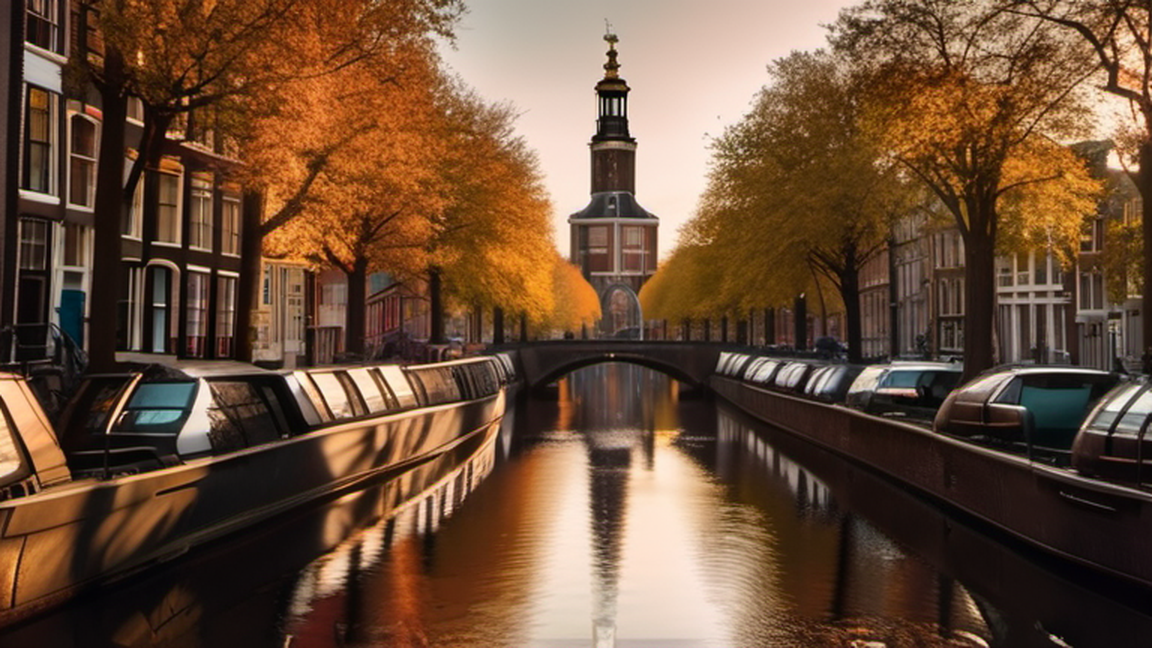
Amsterdam is the capital of the Netherlands. It is known for the canals that cross the city, its impressive architecture, museums and art galleries, its notorious red light district, and more than 1,500 bridges.
The city
Amsterdam is the capital of the Netherlands. It is known for the canals that cross the city, its impressive architecture, museums and art galleries, its notorious red light district, and more than 1,500 bridges.
The city has earned the title of Venice of the North for a good reason: few other cities have intricate web of canals, exquisite architecture, and a staggering collection of over 1500 bridges weave an undeniable charm. Whether you're here for the rich cultural heritage, the vibrant nightlife, or the serene alleyways, Amsterdam's magnetic pull is universal.
Although once an innocuous and humble fishing village during the late 12th century, Amsterdam catapulted into global prominence during the 17th century as a bustling trading hub. The city's evolution birthed iconic districts like Jordaan and the Canal Belt, the latter earning UNESCO World Heritage status in 2010. The 19th and 20th centuries ushered in expansion, punctuated by modernist districts.
With a population surpassing 934,000 in 2025 – and soaring well past a million when you account for the immediate surroundings – Amsterdam unquestionably holds the crown as the Netherlands' largest city. Numbers aside, Amsterdam is the financial, cultural, and creative heart of the nation. English is widely spoken and understood by almost everyone, so language barriers are rarely an issue for travellers.
The "Amsterdam" that most visitors experience is the city centre, the semi-circle with Centraal Station at its apex. It corresponds to the city as it was around 1850. Five major concentric canals ring the Binnenstad: Singel, Herengracht, Keizersgracht, Prinsengracht and Singelgracht, together forming the Canal District. Other districts inside the city centre are the Jordaan, a former working class area now popular with yuppies, and Plantage, a leafy and spacious area with botanical gardens and the zoo. The Nassaukade, Stadhouderskade and Mauritskade surround the city centre and mark the location of the former city moat and fortifications. Almost everything outside this line was built after 1870.
The semi-circle is on the south side of the IJ, which is often called a river but more exactly is an estuary. Going east from Centraal Station, the railway passes the artificial islands of the redeveloped Eastern Docklands. North of the IJ is mainly housing, although a major dockland redevelopment has started there too.
The river Amstel flows into the city from the south. Originally, it flowed along the line Rokin-Damrak. The dam in the Amstel, which gives the city its name, was located under the present Bijenkorf department store near Dam Square. The original settlement was on the right bank of the Amstel, on the present Warmoesstraat: it is therefore the oldest street in the city. The city has expanded in all directions, except to the northeast of the A10 ring motorway. That area is a protected rural landscape of open fields and small villages considered a part of the Waterland region.
The radius of the semi-circle is about 2 km. All major tourist destinations, and most hotels, are located inside it or just outside it. As a result, a large swathe of Amsterdam is not visited by the average tourist: at least 90% of the population lives outside this area. Most economic activity in Amsterdam—the offices of the financial sector, the port—is near or outside the ring motorway, which is 4–5 km from the centre.
The expansion of Amsterdam outside the ring motorway and the expansion of activity outside the city centre is redefining what locals consider the 'central area' of Amsterdam. Zuid, especially with the construction of the Noord/Zuidlijn and the Zuidas, is becoming more and more important in the daily lives of the locals. Its significance for tourists has increased by the now completed reconstruction work on the Museumplein and the adjoining museums.
Amsterdam was first referred to as Aemstelledamme ("dam on the Amstel") in 1204, and known as Aemsterdam by 1327. It was first part of Utrecht, and around 1300 Gwijde van Henegouwen, bishop of Utrecht, gave Amsterdam city rights. After his death, the city was inherited by Count William III and became a part of Holland. Two fires swept the city in 1421 and 1452, and few wooden buildings from this period remain. A notable exception is the Houten Huis (Wooden House) at the Begijnhof.
In 1558, the Dutch started to revolt against the Spanish as the local nobility demanded more political power and religious freedom. Amsterdam supported the Spanish, but as it became more and more isolated and trade suffered accordingly, it switched sides in 1578. A relative freedom of religion emerged in the newly established Dutch Republic, and many migrants sought refuge in Amsterdam, including Jews from the Iberian Peninsula, merchants from Antwerp and Huguenots (French Protestants). Catholicism could not be practiced openly.
Amsterdam prospered in the 17th century and became one of the world's great cities. A global trading network and overseas possessions made Amsterdam the centre of shipping in Europe and the world's leading financial centre. The arts flourished too, with great painters like Rembrandt producing works that are widely acclaimed as of this day. The city expanded outside of its original boundaries as the Canal Belt was constructed for wealthy merchants and the Jordaan for the working class. Immigrants formed the majority of the population and there was a strong immigration from Lutheran Protestant Germans.
The Dutch Republic was not a unitary state, but a confederation in which the independent provinces and the larger cities were politically autonomous. There was a strong animosity between the Orange faction with its power base in The Hague and the republican faction with Amsterdam as its most outspoken representative, up to the point that the city was beleaguered by the army. The Orange faction supported the idea of hereditary political leadership vested in the princes of Orange as Stadtholders, while the republican faction supported civic independence. This long-standing culture of republicanism and non-conformism against the political elites in The Hague exists to this day.
The 18th and 19th centuries were a turbulent period for Amsterdam. The economy suffered from decreased trade opportunities with the colonies and ongoing wars with the United Kingdom and France. Napoleon's brother Louis was crowned King of Holland in 1806 and took possession of the city hall on Dam Square, from then on referred to as the Royal Palace. The Netherlands was fully annexed by France in 1810, and Napoleon crowned Amsterdam "third city" of the French Empire. Prussian and Russian troops liberated the Netherlands, but it remained a unitary state and a monarchy, that now included Belgium.
Amsterdam is a large city and a major tourist destination, so you can visit it all year round. However, in winter the days are short (8 hours of daylight around Christmas between 08:45 and 16:30), and the weather may be too cold to walk around the city comfortably, let alone cycle. January and February are the coldest months, with lows around 0 °C (32 °F) and highs around 5 °C (41 °F). Snow does occur a few times each winter, but it's often light and rarely stays on the ground more than a couple of days.
In summer, heat waves (3 days above 30 °C (86 °F)) are common, as is a temperature of 18 °C (64 °F) with rainfall. July and August are the warmest months, with an average temperature of 22 °C (72 °F) at daytime and 14 °C (57 °F) at night. Days with very high temperatures above 27 °C (81 °F) are often followed with nights around or above 17 °C (63 °F). Sunsets are as late as 22:00 and sunrise is around 05:30 during the summer.
Neither summer nor winter constantly have the mentioned values. Always be prepared for rain. On average, it's raining one in every two days, but it might well be raining the full week of your trip if you visit during winter. Gray clouds cover Amsterdam most of the time, but in spring and summer the sun shines six to eight hours a day on average.
King's Day (Koningsdag) is always celebrated on 27 April, unless this date occurs on a Sunday (then it's celebrated the Saturday before). The weather on King's Day is usually quite good, with temperatures hovering around 17 °C (63 °F). If it's raining, there will be considerably fewer people on the streets.
1 I amsterdam Visitor Centre (VVV Amsterdam), Stationsplein 10 (Koffiehuis Stationsplein, across from Central Station), ☏ +31 20 702-6000. Daily 09:00-18:00. Amsterdam's tourist office is opposite Centraal Station in the same building as Smits Koffiehuis. Besides maps, brochures and bookings, you can also buy tram and metro tickets at the GVB office. There are some touch screens with general information about visiting Amsterdam. (updated Jun 2016)
I amsterdam City Card. This card allows admittance to a selection of the city's museums and attractions at no extra cost, plus unlimited travel across the city's on public transport, plus a list of discounts at some other attractions. The card does not include the Van Gogh Museum. 24 hr – €65, 48 hr – €90, 72 hr – €110, 96 hr – €125, 120 hr - €135. (updated Nov 2025)
1 Amsterdam Airport Schiphol (AMS IATA) (15 km (9.3 mi) southwest of the city.). This airport is among the five busiest in Europe for passenger traffic, serving over 66 million passengers in 2024. KLM is the largest carrier operating at Schiphol and offers flights to many major cities around the world. British Airways offers up to 16 flights per day to 2 London Airports; Heathrow and London City. Transavia, Vueling, TUIfly, Easyjet, and other low-cost carriers serve Schiphol, offering service to many cities in Europe.
Flying to other airports than Schiphol could prove cheaper as some budget airlines have their base in Eindhoven or Rotterdam. Buses and trains can be used to get to Amsterdam, and renting a car is also an option. Taxis are not advisable, a ride from Rotterdam costs about €120 and from Eindhoven a whopping €200.
From Eindhoven Airport (EIN IATA), take a local bus (Bravo/Hermes bus 400, €3.22 using an OV-chipkaart or OVpay or bus 401, €2.83) to Eindhoven Centraal train station (2025 prices). Both buses have a frequency of four-six times per hour, duration about 25 minutes. From there take a train to Amsterdam Centraal (duration approx 1 hr 15 min, frequency four times per hour, single €25.60) (2026). Combination tickets for bus and train are available as etickets or on the NS vending machines (choose Eindhoven Airport as destination).
From Rotterdam The Hague Airport (RTM IATA), take a city bus (RET airport shuttle bus 33, duration 25–30 minutes, frequency every 10–20 minutes, €2.27 using the OV-chipkaart or OVpay) to Rotterdam Centraal train station. If you change to metroline E from bus 33 at Meijersplein to Rotterdam Centraal, it will save you 5–10 minutes, €2.29 (2025). As a trial, bus 533 runs between the airport and Meijersplein between 10:00–16:00, 2 times per hour.
From Rotterdam Centraal, take a train to Amsterdam Centraal (duration about an hour, frequency every 10–20 minutes, single €20.20, 2026).
Most trains arrive and depart from 2 Amsterdam Centraal. This architecturally stunning station was built in 1889 on an artificial island between the medieval centre and the IJ waterfront.
Other important train stations in Amsterdam are Amstel, Bijlmer ArenA, Sloterdijk and Zuid. Most international trains run directly to Amsterdam Centraal. The Eurocity Direct from Brussels stops at Amsterdam Zuid.
There are several options to pay your train fare within the Netherlands.
Nederlandse Spoorwegen (NS) is the main (domestic) train operator for travel to much of the country. Trains to more distant locales may require change of train in another city or town and may be less frequent. They also offer international service to neighbouring countries in cooperation with Belgian Rail (Belgium) and Deutsche Bahn (Germany). See below:
The ICE Berlin runs 5 times a day and connects Amsterdam with Osnabrück, Hanover, and Berlin (5 hr 51 min). A Bordrestaurant coach is available on each train. Tickets can also be bought via Deutsche Bahn
The Eurocity Direct Brussels runs up to 16 times a day from Brussels (2 hr 8 min) and Antwerp (1 hr 23 min) and takes a bit longer than the Eurostar. However, the prices are usually lower than Eurostar and a good alternative coming from Belgium. Please note: this train stops at Amsterdam Zuid instead of Amsterdam Centraal. Depending on the location of you accommodation, this might be beneficial.
ICE International connects Amsterdam up to seven times each day with Düsseldorf (2 hr 6 min), Cologne (2 hr 20 min), and Frankfurt (3 hr 46 min). There is a BordBistro coach available on each ICE train. Nightjet runs nightly from Zürich, Vienna, and Innsbruck via Basel, Frankfurt and Cologne. Tickets for all are available through Deutsche Bahn (DB).
Eurostar runs a daily high-speed service from London St Pancras International to Amsterdam Centraal. The journey is approximately 3 hr 40 min, and prices start at £35 one way. You should arrive between 90 and 30 minutes prior to departure to clear border control. Passengers travelling from Brussels can also book Eurostar journeys to Amsterdam. Tickets are sold on the Eurostar website.
Eurostar (formerly Thalys) also runs a high-speed service that connects Amsterdam with Paris Gare du Nord (3 hr 19 min), Brussels Zuid/Midi (1 hr 54 min), and Antwerp Centraal (1 hr 12 min). These trains run up to ten times a day. The cheapest tickets are sold early, so book in advance if possible. There is a bar coach available; if you're travelling in first class, a snack and drinks are included in the price. Eurostar also stops at Schiphol Airport and Rotterdam.
Frequently served intercity bus stops are:
3 Sloterdijk intercity bus station. Reachable by Bus 22, tram 19, trains and metro line 50 and 51. The Amsterdam Sloterdijk stop is at the bus platforms at the Piarcoplein, on the north side of Sloterdijk station. Please follow the signs "Piarcoplein" in the station.
4 Bijlmer ArenA intercity bus stop International buses share a bus stop with EBS buses on Hoogoorddreef, ("Hoogoorddreef/Atlas") which is located outside the busstation under the train and metro platforms. This stop is between the Europlaza tower and the multistorey car park P9.
5 Schiphol Airport intercity bus stop
There are dozens of daily international bus services. Nearby international destinations in Germany, Belgium and France (Paris and Lille) and London are served at high frequency. Their stops and stations are located at the Amsterdam Sloterdijk Station, the airport and/or another locations:
Flixbus, (bus stops) Amsterdam Sloterdijk, Amsterdam Schiphol Airport, Amsterdam Bijlmer ArenA & Amsterdam Centraal. German low-cost bus company offering connections to many German cities such as Berlin, Cologne and Munich and other European cities as well. Also offering domestic service within the Netherlands. (updated Nov 2025)
BlaBlaCar Bus, (bus stops) Amsterdam Sloterdijk, Amsterdam Schiphol Airport. It runs a coach service between Paris and Lille to Amsterdam among others. (updated Nov 2025)
RegioJet, (bus stop) Amsterdam Sloterdijk, ☏ +420 222 222 221, info@regiojet.com. (formerly Student Agency) A Czech operator with a daily service from Prague, departing from the Amsterdam Sloterdijk Station. (updated Nov 2025)
Twiliner, (bus stop) Amsterdam Sloterdijk, service@twiliner.com. Buses take 12 hr 30 min from Zurich via Basel, Luxembourg (city), Brussels and Rotterdam. Their seats fold flat into a bunk: there's some disturbance from bumps in the road and noise at intermediate stops, but no worse than in a railway sleeping car, for similar comfort and half the price. (updated Jan 2026)
There are only a few long-distance national bus services in the Netherlands, and apparently none to Amsterdam Centraal. Bus 300 connects Haarlem train station with Hoofddorp, Schiphol Airport, Amstelveen and Amsterdam Bijlmer ArenA.
The western part of the Netherlands has a dense (and congested) road network. Coming from the east (Germany), motorway directly leads to Amsterdam. If you're taking motorway A12 from Arnhem, change in Utrecht onto the A2 in the northern direction. From the south (Belgium), follow motorways A16, A27 and A2, in that order in northern direction. From The Hague, the A4 leads to Amsterdam. All motorways to Amsterdam connect to the Ring motorway, the A10. From this motorway, main roads lead radially into Amsterdam (the roads S101 through S118).
In most cases, you'll want to avoid getting into the area enclosed by the ring road. Traffic is dense and parking spaces are expensive and difficult to find. Instead, when on the A10, follow the signs to one of the P+R-spots (P+R Zeeburg to the east, P+R Johan Cruijff ArenA to the southeast, P+R Olympisch Stadion to the south, P+R Noord to the north, and P+R Sloterdijk to the west). Here you can park your car and take public transport to the city centre. There is a rate of €8-13 a day. To benefit from the discounted rate, you need to use a OV-chipkaart or disposable GVB OV-chipkaart: OVpay or QR-tickets are not accepted. Please note: the last check-in or transfer must be within the city centre zone.
You can park for free at a few places that have metro or tram stops nearby (e.g. IKEA near metro station Bullewijk).
The speed limit on Dutch motorways is 100 km/h during the day and 130 km/h during the night, except where indicated. On the A10 ring motorway around Amsterdam, the maximum speed is 100 km/h, and 80 km/h on the Western section. These limits are strictly enforced and there are many speed cameras.
The 6 Passenger Terminal Amsterdam is close to the city centre but is only used for cruise ships. The nearest ferry port is IJmuiden, where ferries from Newcastle upon Tyne dock. DFDS Seaways offers daily overnight ferry services from Newcastle upon Tyne (more specifically, North Shields) in the United Kingdom.
Other ferry services dock at Rotterdam Europoort (ferry from Hull) and Hook of Holland (ferry from Harwich). These are about 70 km away from Amsterdam. Intercity and Intercity Direct trains run direct from Amsterdam Centraal to Rotterdam Centraal every 10 to 15 minutes taking approximately 1 hr 15 min. See the National train operator NS website for booking and information.
For the Stena Line ferry to Harwich: from Rotterdam Centraal, change for Rotterdam Metro Line B direct to Hoek Van Holland Station where you will be able to walk onto the Ferry. See Rotterdam RET website for tickets and information. For P&O to Hull: there is no public transport however Taxis are readily available at Rotterdam Centraal. P&O offer some coach options via their website.
Amsterdam's city centre is quite compact, and pretty flat, so you can easily get to most tourist destinations on foot. From Amsterdam Centraal, most areas in the city centre can be reached within half an hour.
Public transport within the city is operated by the GVB. The tram is the main form of public transport and there is a metro and dozens of bus routes. Most routes operate from 06:00 (06:30 Saturdays and 07:45 Sundays) until around midnight. There are a few overnight bus routes as well. Regional buses, and some suburban buses, are operated by Connexxion and EBS.
For many years, an OV-chipkaart provided the only way to pay transportation fees in the city. However, as of 2023, fees may be paid at the station or on the tram, bus, or NS train by using a contactless credit or debit card (OVpay) either on a card or on a mobile device. Many travellers find their bank card easier than buying and keeping track of an OV-chipkaart, as they do not have to obtain, maintain, and monitor the balance on the contactless card. User procedures (tapping in and out) on both kinds of cards are the same. To travel with a contactless card or an OV-chipkaart, you have to check in at the start of your journey and check out at the end by holding the card in front of the card reader.
Besides using a debit or credit card, you have other options: an OV-chipkaart, an OV-pas or the GVB app.
Three types of OV-chipkaart are available:
Personal card on which you can load money and weekly, monthly, or yearly subscriptions. You can also load GVB hours, day and multi-day tickets on the card.
Anonymous card on which you can load money that can be spent on public transport
Disposable card that can be used for a limited period of time (an hour or a few days)
The first two types of cards come with no credit included and cost €7.50 and expires after 5 years. To travel in the city you have to top up such a card for at least €4 before a journey begins. A disposable card, on the other hand, already has a product bundled with it, but it can not be re-used after this product expires.
Anonymous and disposable OV-chipkaarts can be obtained from GVB vending machines in most metro stations (cash only, except on line 52), from the desks at some larger stations (including Amsterdam Centraal) and some shops. Additionally 1-hour disposable cards can be bought on a tram at the tram conductor but only PIN (debit and credit) cards are accepted to purchase them on board. After purchasing disposable cards from the tram conductor, you must check in and check out with that card.
The OV-pas is being phased in since 2025 as a replacement for the OV-Chipkaart and is only available as a personal card. The OV-pas is slightly cheaper than the OV-Chipkaart €6.00 and also expires after 5 years.
Tickets can also be purchased through the GVB mobile app - just scan the QR code on your mobile at the card reader.
For those who stay in Amsterdam longer, one of the day or multi-day passes could be a useful option. You can get them for 24 hours up to 168 hours. This allows the holder to travel on an unlimited number of journeys on the tram, metro and bus throughout the validity period of the pass. Travel passes can be loaded on the anonymous cards but existing credit on such cards cannot be applied towards the purchase of a pass. These passes are not valid on buses operated by Connexxion, EBS and Keolis. These passes can be purchased at tourist offices (at Schiphol Airport and just outside Amsterdam Centraal), many hotels and GVB ticket offices. Additionally, a one-day pass can be purchased from the conductor on a tram (but not on a bus).
GVB cards. Multi-day cards are valid for an exact number of hours available in the respective period of days. 1 hour €3.40, 1 day (24 hr) €10.00, child 1 day €5.00, 2 days €16.00, 3 days €21.50, 4 days €27.50, 5 days €34.00, 6 days €39.00, 7 days €43.00. (updated Jan 2026)
If you stay longer in Amsterdam, you can buy discounted monthly tickets online or at ticket sale points which are cheaper. GVB tickets are not valid on trains or Connexxion bus 197 to Schiphol Airport. You can use them on GVB bus 369 to Schiphol but it's quicker to get there by train.
Alternatively, you can buy:
Amsterdam Travel Ticket. It includes a return ticket to and from Schiphol for a train (to any of Amsterdam's stations) and bus 397, plus unlimited travel on all GVB trams, metro and (night)buses for 1, 2 or 3 days. These tickets are based on calendar days, and expire at 04:00 in the morning after the last valid day. €20 (1 day), €27 (2 days) and €34 (3 days). (updated Jan 2026)
Or
I amsterdam City Card is a good option that combines museum entries.
Or even
Amsterdam & Region Travel Ticket. A pass for 1, 2 or 3 days which allows unlimited travel in a whole greater Amsterdam area. These tickets are based on calendar days, and expire at 04:00 in the morning after the last valid day. You must check in and out whenever you enter or leave a public transit vehicle. Among the locations included on the card are Zandvoort, Edam, Aalsmeer, Keukenhof gardens, Volendam and Zaanse Schans. These tickets are available at I amsterdam Visitor Centre, at service centres of GVB, EBS, Connexxion and some other locations like hotels, campsites etc. They can also be purchased online. €23.00 (1 day), €34.00 (2 days), €44.00 (3 days). (updated Jan 2026)
There are five metro lines in Amsterdam, including a short underground section in the city centre, that serves the suburbs. It takes 15–20 minutes from Centraal Station to Zuid or Bijlmer ArenA in Zuidoost. However, in practice, M50, M51 and M53 all act as branch lines of M54 (including sharing the same tracks). The 5th metro line, the Noord/Zuidlijn (M52 North–South Line), finally opened in 2018, and the only line to functionally act as a separate line. It's an underground metro line that connects the north of Amsterdam directly with the south of the city through the city centre, hence the name.
The tram network has 15 lines and it is considered the major carrier in the central area of the city. Amsterdam Centraal is the largest hub of the tram system with 8 tram lines terminating there. 7 Leidseplein is the next largest hub with 7 tram lines passing through. Tram lines 5 and 25 serve the neighbouring municipality of Amstelveen, and tram line 19 serves the neighbouring municipality of Diemen. Many metro stations provide connections with nearby tram lines.
All tram stops have a detailed map of the system and the surrounding area. You can also get a free public transport map at the GVB ticket office (just outside Amsterdam Centraal).
Most trams these days have conductors, near the rear of the tram. Board by the driver or the conductor. If you have questions, the conductor will be sure to respond to your query. You can buy 1-hour, 24-hour, and 48-hour tickets from the conductors.
Just like the tram and metro, local buses are operated by the GVB. There are also suburban buses to nearby towns such as Haarlem and Uithoorn; these are operated by Connexxion or EBS (the company name and house style is prominent on the bus side) and can be used within Amsterdam if you travel with an OV-chipkaart or OVpay. Enter buses only via the front door. Generally, almost all bus routes operate very frequently throughout the week.
There are several ferry services across the IJ river, between the city centre and Noord, the most frequent runs every 7 minutes. They all leave from a new jetty on the northern (rear) side of Amsterdam Centraal. All ferries are free of charge and provide nice views of the harbour and skyline.
The nicest one is the 15-min service to the NDSM-werf, a funky, up and coming, industrial neighbourhood with a nice cafe-bar (IJkantine), restaurant (Noorderlicht), indoor skateboard park, and the Pancake Boat (Pannenkoekenboot) which sails many times each week. Ferries leave every 30 minutes from Amsterdam Centraal and from the NDSM-werf. Double frequencies during rush hours.
You can also hop on the ferry to Buiksloterweg, and then make a short walk to the EYE Film Institute for its architecture and free exhibition in the basement.
A pleasant way to cover a lot of ground is to rent a bicycle. There are approximately 750,000 people living in Amsterdam and they own about 800,000 bicycles. The city is very, very bike-friendly, and there are separate bike lanes on most major streets. In the city centre, however, there is often not enough space for a bike lane, so cars and cyclists share narrow streets.
Cycling is the main mode of transport for most locals in the city and traffic is high paced. Be mindful of your surroundings and consider that if you don't have much experience cycling, you might be more comfortable using public transport or walking.
Cyclists do not have the right of way even though it might appear like that when observing the typical Amsterdammer's cycling behaviour. Be very careful and watch out for other cyclists. Always show other traffic where you're going (e.g. by holding out your hand) in order to avoid accidents and smoothen the traffic flow. If not indicated otherwise by signs, the right-before-left rule applies.
Avoid getting your tyre in the tram rails; it's a nasty fall. Always cross tram rails at an angle. When crossing tram lines, watch out for fast-approaching taxis, which have a rather ruthless driving style. Let none of the above deter you from doing it the Amsterdam way. Rent a bike! There are bike rental shops at railway stations and several others in and around the city centre. Bikes cost about €9 to €20 per day. Bring wet gear.
A good map for cycling routes, repairs, rentals and also public transport is Amsterdam op de fiets (a Cito-plan). Bicycles can be taken for free on all ferries across the IJ, on all metros, and on some carriages of tram 26 with a bike supplement fee on the OV-chipkaart (€2.20 in 2025, not allowed in rush hours). Use the special bike racks, locations indicated by a bicycle sign on the outside of the carriage.
Make sure to get a good lock (or two), and to use it. Amsterdam has one of the highest bicycle theft rates in the world. If you are buying a bike, prices that seem too good to be true are stolen bikes. Any bike offered for sale to passers-by, on the street, is certainly stolen. There's an old Amsterdam joke: when calling out to a large group of cyclists passing by "Hey, that's my bike!" about five people will jump off "their" bikes and start running.
A-Bike Rental & Tours Vondelpark, Tesselschadestraat 1-E (right next to the Vondelpark), ☏ +31 202181292, shop@a-bike.eu. 09:00–21:00 daily. Well maintained bikes. No bright colors, so you will blend in with the locals. €10.95 (1 hr), €17.50 (24 hr), every day extra €14.50. (updated Jan 2026)
Amsterdam Highlights by Bike (13 km) - Discover the best of Amsterdam in one cycle tour
Amsterdam Amstel Cycle Route (54 or 46 km) - Idyllic rivers, villages and forts.
Marken Cycle Route (51 or 45 km) - Former island on the doorstep of Amsterdam.
The ride-hailing services of Uber and Bolt are available in Amsterdam. With them you can avoid a lot of the problems associated with taking an Amsterdam taxi from busy areas (Centraal Station/Leidseplein) and at peak evening hours.
Taxis in Amsterdam are plentiful but expensive. Hailing taxis on the street is generally not to be recommended unless you are going to a well-known destination (e.g. Centraal Station or Schiphol). The liberalization of the taxi market in Amsterdam led to an influx of taxi drivers who have little or no clue of where they are going and who drive erratically and dangerously (e.g., driving on bicycle lanes instead of the main road or ignoring red lights). Tourists are advised to stick to public transport if at all possible. Get into a taxi only if you know the route yourself and are able to give directions to the taxi driver and if you know roughly how much the journey ought to cost so you don't get cheated.
Some drivers, traditionally at Centraal Station or Leidseplein, will refuse short trips or will quote outrageously high fares, even though all taxis are metered. Even if you convince the driver to use the meter, he will often take a circuitous route that racks up €15 or more on the meter. For reference, no trip within the historic centre should cost more than €10 or so.
The Netherlands (and Amsterdam) is in the middle of a huge taxi liberalization scheme which has been jarring to all involved. After many missteps, the government has introduced an unusual pricing scheme. First you feel sticker shock as the initial fare is now €7.50. Luckily, that includes the first 2 km of travel and there is no charge for waiting in traffic. If you need to run in somewhere, you need to negotiate a waiting fee with the driver. 50 cents per minute is customary.
Unlicensed, illegal cabbies operate mainly in Zuidoost. These aren't easily recognized as such, and most certainly don't drive Mercedes cars. They are known as snorders and most easily reached by mobile phone. Rides within Zuidoost (the Bijlmer) range from €2.50 to €5, whereas Zuidoost-Centre can run up to €12.50. Snorders have a shady reputation, so consider their services only if you are adventurous.
Staxi offers fixed fares for every pre-booked taxi ride.
Cars are anything but miserable torture only outside the historic centre; within the historic centre, public transport is by far your best bet. In Amsterdam, a car is generally a liability and not an asset, as traffic is dense and parking spaces are quite expensive and very hard to find. Use a car only if you are going to an obscure location many kilometers out that is not served by public transport, or during the less busy times of the day or week, you may want to park near the Centraal Station and take the tram or walk. Driving here is a pain: many of the streets are narrow, the traffic (and parking) signs are baroque and obscure, and cyclists and pedestrians may get in your way. Plus, petrol is about €1.54 to €1.7 per liter.
Parking on the street at the city centre can reach as much as €7.76 an hour (2025)! Luckily there is a cheaper way, specially if you are going to park for more than a couple of hours. Mobypark is a shared parking platform where you can find and book parking in the centre of Amsterdam as well as some great P+R location like RAI Amsterdam
You can also try parking at one of the secured parking garages, for example under Museumplein, or near Centraal Station, and then walk around the city centre, or get on a tram. Car parking is very expensive in Amsterdam and it's often hard to find a place to park. You can choose to pay by the hour or for the whole day. Parking is free outside the centre on Sunday—there is always a spot available on the Albert Cuypstraat (which is a market during the rest of the week). From there, it is a 5-minute tram ride or 15 minutes walk to the city centre.
You can park for free in some parts of Amsterdam outside the city centre though this is slowly changing. Parking is still free in some areas in Noord, and you can take metro 52 from Noord or Noorderpark to the city centre. Another option is to park your car outside the city centre at a Park and Ride facility, as described in the Get in section.
Popular car rental chains operate in a smaller capacity in Amsterdam, including Avis and Budget. Free2move has 400 all-electric cars available within and around the city.
Ice skating is a longstanding tradition in the Netherlands, and you will sometimes see locals skating down the canals when they freeze over in the winter. However, the ice has to be thick enough for you to be able to do this safely, and this requires temperatures to stay below −5 °C (23 °F) continuously for at least 2 weeks. Take the cue from the locals, and only skate when you see large numbers of locals doing so. Also, be particularly careful near bridges as the ice tends to be thinner there. If you see the locals avoiding a particular area, you should too.
Amsterdam has one of the largest historic city centres in Europe, with about 7,000 registered historic buildings. The street pattern has been largely unchanged since the 19th century—there was no major bombing during World War II. The centre consists of 90 islands linked by 400 bridges, some of them beautifully lit at night.
The inner part of the city centre, the Binnenstad, dates from medieval times. The oldest streets are the Warmoesstraat and the Zeedijk in the Oudezijde of the Binnenstad. As buildings were made of wood in the Middle Ages, not many of this period's buildings have survived. Two medieval wooden houses did survive though, at Begijnhof 34 and Zeedijk 1. Other old houses are Warmoesstraat 83 (built around 1400), Warmoesstraat 5 (around 1500) and Begijnhof 2-3 (around 1425). The Begijnhof is a late-medieval enclosed courtyard with the houses of beguines, Roman Catholic women living in a semi-religious community. Beguines are found in Northern France, Belgium, the Netherlands, and north-western Germany. House number 34 at the Begijnhof is the oldest home in Amsterdam. Entry to the courtyard and surrounding gardens is free, but be careful not to disturb the local community still living here.
One of the most prominent features is the Canal District, a concentric ring of canals built in the 17th century. The merchant-based oligarchy that ruled the trading city of Amsterdam built canal houses and mansions in the most prestigious locations here, especially along the main canals. Typical for the country are its traditional white draw bridges. The best example has to be the Magere Brug, which is over 300 years old and nearly in its original capacity. It is a beautiful place to overlook the river and take in some traditional Dutch architecture.
The Jordaan was built around 1650 along with the Canal District, but not for the wealthy merchants. For a long time it was considered a typical working-class area, and included some notorious slums. The name probably derives from the nickname 'Jordan' for the Prinsengracht. Apart from a few wider canals, the streets are narrow, in an incomplete grid pattern (as the grid followed the lines of the former polders located here in medieval times). This district is the best example of "gentrification" in the Netherlands, becoming a hip boutique district.
There are several large warehouses for more specific uses. The biggest is the Admiralty Arsenal (1656-1657), now Het Scheepvaartmuseum at Kattenburgerplein. Others include the former turf warehouses (1550) along the Nes, now the municipal pawn office; a similar warehouse at Waterlooplein 69-75 (Arsenaal, 1610), now an architectural academy, and the warehouse of the West India Company (1642) at the corner of Prins Hendrikkade and 's-Gravenhekje. The city office for architectural heritage has an excellent online introduction to the architectural history and the types of historical buildings available. The website includes a cycle route along important examples.
Amsterdam has an amazing collection of museums. The most popular ones can get very crowded in the summer peak season, so it's worth exploring advance tickets or getting there off-peak (e.g. very early in the morning). Avoid the museums in the Binnenstad as these are mostly tourist traps. The quality museums can be found in Zuid, the Canal District and Plantage.
The museums in Zuid are located at the Museumplein, a square surrounded by quality museums. The country's national museum is the Rijksmuseum, a must-visit with a large collection of paintings from the Dutch Golden Age. Some artists that can't be overlooked are Rembrandt, Johannes Vermeer, Frans Hals and Jan Steen. The most widely regarded paintings are Rembrandt's Night Watch and Vermeer's Milkmaid. The museum also boasts a substantial collection of Asian art. Reopened after a reconstruction of about ten years, its renewed set-up is absolutely worthwhile, leading the visitor through the ages from the late Middle Ages to the early 20th century.
Even someone with little knowledge of art must have heard about Vincent van Gogh, the Dutch Post-Impressionist painter whose work had a far-reaching influence on 20th century art for its vivid colours and emotional impact. The Van Gogh Museum has the largest collection of Van Gogh's paintings and drawings in the world. The Stedelijk Museum is all about modern art, contemporary art and design. A newer addition to Amsterdam's already stellar set of art museums is the H'ART Museum in Plantage which has affiliations with Centre Pompidou, British Museum and Smithsonian American Art Museum.
A major museum is the Anne Frank House, dedicated to Anne Frank, a Jewish girl who kept a diary while hiding from Nazi persecution in hidden rooms at the rear of a building in the Canal District (known as the Achterhuis). It's an exhibition on the life of Anne Frank, but also highlights other forms of persecution and discrimination. Amsterdam has hundreds of museums about pretty much every topic one could think of. They are described in the city's district articles.
The Museumkaart costs €75.00 for adults and €39.00 for those under 18 years old (2025). It covers the cost of admission to over 500 museums across the Netherlands and you can buy it at most major museums. You can opt for a digital or a physical card. Note that if you choose for the latter one and do not buy it in advance, you will be issued a temporary card that is only valid for 5 museum visits over a period of 31 days until you receive the permanent card, which can be mailed to a EU address after being registered. It is valid for an entire year. If you are going to the Rijksmuseum and Van Gogh Museum, those are €25.00 and €24.00 (2025) respectively, so this card can quickly pay for itself. The tickets to the major museums, including the audio guide, can be bought early from the tourist information desk at no extra cost. Alternatively, for short stays, you can consider buying the I amsterdam City Card, starting at €65 (2025) per day, which includes "free" access to Amsterdam museums, public transport and discounts on many tourist attractions.
Since the Middle Ages, the Netherlands has been a country with a relatively high degree of freedom and tolerance towards other religions and cultures, especially compared to other countries in Europe, with the major exception being the persecution of Catholics after winning the war with Spain and during and after the Eighty Years' War. Between 1590 and 1800, the estimated foreign-born population was never less than 5 percent, many of them settling in Amsterdam. This led to a large migration of Jews, Huguenots (French Protestants), Flemings, Poles and other people to the city. Jews in particular had a large presence in Amsterdam, notably in the Jodenbuurt, though this quarter has changed significantly after World War II. The most prominent synagogue is The Esnoga (or The Portuguese Synagogue), built in 1675 in an austere Classicist style.
As the Netherlands was a Protestant nation, most of the churches are from this branch of Christianity. The oldest church in Amsterdam, the Netherlands-gothic Oude Kerk on the Oudezijds Voorburgwal at Oudekerksplein, is now surrounded by window prostitution. It was built in 1306, and became a Calvinist church after the Reformation in 1578. The Nieuwe Kerk, at Dam Square, dates from the 15th century and is now used for royal coronations and exhibitions. From the 17th century onwards, four compass churches were built that would serve the areas outside the Binnenstad.
The late-medieval city also had smaller chapels such as the Sint Olofskapel (circa 1440) on Zeedijk, and convent chapels such as the Agnietenkapel on the Oudezijds Voorburgwal 231 (originally 1470), now the University of Amsterdam museum. Later churches included the Oosterkerk (1669) in the eastern islands, and the heavily restored Lutheran Church on the Singel (1671), now used by a hotel as a conference centre. Catholic churches were long forbidden, and built again only in the 19th-century. The most prominent is the Neo-Baroque Church of St. Nicholas (1887) opposite Centraal Station. Also, investigate some of the "hidden churches" found in Amsterdam, mainly Catholic churches that remained in activity following the Reformation. A prominent hidden church is Ons' Lieve Heer op Solder. Well worth the visit. Two hidden churches still in use are the Begijnhofchapel near the Spui, and the Papegaaikerk in the Kalverstraat (both Catholic).
Since there was little large-scale demolition in the historic city centre, most modern architecture is outside of it. Immediately outside the Singelgracht (the former city moat) is a ring of 19th century housing. The most prominent buildings from this period are the Amsterdam Centraal railway station (1889) and the Rijksmuseum (1885), both by Pierre Cuypers. De Pijp is a textbook example of 19th century revolution-build, cheap construction housing. The most prominent in architectural history are the residential complexes by architects of the Amsterdam School, for instance at Zaanstraat and Oostzaanstraat in West. The Amsterdam School is a style of Expressionist architecture that arose from 1910 through about 1930. Examples can be found in De Baarsjes in West and the Rivierenbuurt in Zuid.
A completely different approach to architecture has been followed in the Bijlmer, a huge architectural project undertaken in the 1970s. A series of nearly identical high-rise buildings were laid out in a hexagonal grid with a strict separation of pedestrian and car traffic. It has been a revolutionary way of thinking in the architectural world, but within a decade the district started to make headlines with crime and robberies. As these high-rises are being torn down, the safety situation has improved, and now modern office buildings are taking their place.
The 1990s and 2000s also left its mark as a revolutionary time in architectural design. The Eastern Docklands is the largest concentration of modern residential buildings. The zone includes three artificial islands: Borneo, Sporenburg, and KNSM/Java-eiland. The latter has been designed as a modern re-imagining of the old Canal District. Across from it is the brand new Piet Heinkade and some adjoining projects. The largest concentration of box-like office buildings is in the Zuidas and in Zuidoost. Some spectacular buildings are Johan Cruijff ArenA (formerly Amsterdam ArenA) stadium and the new Bijlmer ArenA railway station.
The locals spend their summer days in Amsterdam uncorking bottles of red wine in the Vondelpark. Every district in Amsterdam has at least one park, but the Vondelpark stands out for its size and convivial atmosphere. The neighbourhood best known for its trees and gardens is the Plantage. Besides leafy boulevards and grand mansions it also features the botanical gardens of the Hortus Botanicus and has Artis Zoo for the kids.
Another major patch of nature is Amsterdamse Bos, which, directly translated, means Amsterdam Forest, but is more like a giant park. Amsterdamse Bos also offers Fun Forest, a climbing trail between the trees, and the Bosmuseum about the forest, which is actually a lot of fun, especially if you're travelling with children. Both are near the main entrance in Amsterdam Zuid. Amsterdamse Bos is on the outskirts of the city, not far from Schiphol, partially in Amstelveen and Ouderkerk, and near Aalsmeer Nieuw Oosteinde.
Amsterdam also has several city beaches in West (Zwemstrand Sloterplas), Noord (Pllek), Oost (Kaap and Strand IJburg), Zuid (Strandzuid) and Zuidoost (Gaasperplas).
You can also watch a film at one of the more than 55 cinemas. Rialto in Zuid and Kriterion in Plantage run a selection of art house and alternative films, and LAB111 in West often shows cult movies. The EYE Film Institute in Noord is dedicated to film conservation, but also has screenings and exhibitions.
Football: AFC Ajax play soccer in Eredivisie, the Dutch top tier, and often win it. Their home ground is Johan Cruijff ArenA (capacity 56,120) 5 km south of the centre, metro and train station Bijlmer ArenA, which also hosts internationals. Their second-string team Jong Ajax (or "Ajax 2") plays in Eerste Divisie, the second tier, at Sportpark De Toekomst near the ArenA.
A canal cruise usually lasts from one to two hours. Commentary on the surroundings is given during the route. Departures from Prins Hendrikkade opposite Centraal Station, quayside Damrak, Rokin near Spui and Stadhouderskade 25 near Leidseplein. If it's a warm day, avoid the enclosed boats with glass ceilings—they get hot. You can also cruise the canals yourself with a pedal boat or rented boat.
Eco Boats Amsterdam. Rent a private and eco friendly boat and cruise the canals yourself.
Canal Motorboats. The oldest boat rental in Amsterdam. Rent a boat and drive it yourself.
Amsterdam Boats B.V.. Personal rental of a wide variety of boats. You can rent a gondola, hand made by a girl from Amsterdam. She traveled to Venice to learn the craft, then built her own Gondola which she brought back to Amsterdam.
Amsterdam Jewel Cruises. An evening dinner cruise. It is the only classic boat offering a private table for a romantic candlelight dinner. À la carte dining, but not cheap! The cruise starts at 19:30 and lasts just under three hours. €99-113.
Boaty Rent a Boat. Boaty Rent a Boat rents small boats (max. 6 people) to make your own private boat tour on the Amsterdam canals. These rental boats are electrically driven which means they are silent and free of exhaust fumes. (updated Jan 2021)
Boats4rent Boat Rental, ☏ +31 6 26326420, info@boats4rent.nl. open every day from March to October. Boats4rent is a boat rental where you can rent a boat without a skipper. With a three or four hour rental you can make a private trip on the Amsterdam canals and the Amstel river. best rates in Amsterdam. (updated Jan 2021)
Boatboys Private Boat Tours, ☏ +31 6 45 25 100, info@amsterdamprivateboat.com. Operates every day for private luxury boat tours on a historic classic boat. 1hr starting from €250. (updated Jul 2023)
Canal Company. The Canal Hopper runs three fixed routes, stopping near major attractions (Rijksmuseum, Anne Frank's House, etc.). You can get on or off as often as you like, but it is relatively expensive with €20 per 24 hours. The first boats start between 09:15 and 10:45, depending on which stop you get on. The last boats start dropping off at around 19:00. It also has four locations for renting your own boat; two-seater canal bikes cost €8 per person per hour.
Lovers Company. Starts opposite the Rijksmuseum, but you cannot get on or off. The cruise takes about 1 hr 30 min. €16.
Sloepdelen. Self operated electric rental boats. A boating license is not required and the open boats can seat up to twelve passengers. €60 p/h (with a minimum of 2 hours) plus €150 deposit). (updated Nov 2016)
On Saturdays and Sundays you can tour the city centre by vintage tram. Tours begin and end in Dam Square by the Nieuwe Kerk, it is not possible to enter or leave the tram at any other point on the route. Tours run every 30 minutes from 11:00 to 17:00 and last for about 30 minutes. Adults €10, €5 for children under 12 and non-miniature dogs (2025). Due to the historic nature of the vehicles, the tour is not suitable for people with restricted mobility (no wheelchair space, steep steps to enter the car).
From Wednesday to Sunday a tram converted into a restaurant departs at 18:30 from Amstel Station (Julianaplein) as The AmsterTram. The fare includes a seasonal five-course menu, served during a 2½-hour loop of the city (€119.95). Advance online booking (at least 48 h) is essential, and steep steps plus limited wheelchair space mean those with restricted mobility should contact the operator before reserving.
Amsterdam is a cultural haven with year-round festivals for every pocket.
January/February
Chinese New Year. Celebrated with festivities in Chinatown.
April
King's Day. Formerly Queen's Day, this national holiday, nominally in celebration of the King's birthday, is difficult to describe to anyone who's never been there. The city turns into one giant mass of orange-dressed people with flea markets, bands playing, and many on-street parties, ranging from small cafes placing a few kegs of beer outside to huge open-air stages hosting world-famous DJs. The Vondelpark is the place where children sell toys and perform. An experience you'll never forget. Normally held on April 27, but if that is a Sunday, it is celebrated one day earlier.
KunstRAI. A modern art fair in the RAI exhibition and conference centre. If you want to know what the latest developments are in Dutch galleries, this is where to find them all in one place. (updated Dec 2025)
June
Holland Festival. A performing arts festival that brings together events from all over the world in the fields of music, opera, theater and dance. (updated Dec 2025)
Taste of Amsterdam. A culinary festival where you can explore the food of famous Amsterdam restaurants and their chefs.
Open Garden Days (Opentuinendagen). Normally you can see only the front of the canal houses, but during the Open Garden Days you get to go past the entrance and see the green world behind them, often bigger than you would have expected. You can buy one ticket that gives you entry to all participating gardens, and there is a special canal boat to take you from one location to another. (updated Nov 2025)
Amsterdam Roots Festival. A free open-air festival with music from non-Western countries accompanied by paid film and theater performances in the surrounding theaters. (updated Nov 2025)
July
Julidans, ☏ +31 20 795 99 00, info@julidans.nl. International contemporary dance festival, always showing the latest developments in modern dance. (updated Dec 2025)
July/August
Vondelpark Openluchttheater. This free festival offers many different performances every day. Go to the open air theater just by the fountain and let the entertainment do the work. From cabaret to drama to concerts to dance, there is something for everyone here and for all ages.
Amsterdam International Fashion Week. Twice a year, this event presents young and upcoming fashion in Europe with a focus on Dutch design.
Amsterdam has two universities, both offer summer courses and other short courses (with academic credits). It also has one venerable institute.
2 Universiteit van Amsterdam. Founded as the Athenaeum Illustre in 1632, in 1877 it became the University of Amsterdam. With about 25,000 students, the UvA is on three separate campuses in the city centre and many smaller sites scattered over Amsterdam.
Volksuniversiteit. Despite the name, it is not a university, but a venerable institute for public education. Among the many courses are Dutch language courses for foreigners.
3 Vrije Universiteit. Founded in 1880, the VU campus is located southwest of the city centre, and approximately 20 minutes away by bicycle. It is the only Protestant general university in the Netherlands.
Many people will find it difficult to get a suitable job if they do not speak Dutch. However, hostels and hotels in Amsterdam may need bar staff, night porters etc., who speak English and other languages. There are also specialist websites for English and non-Dutch speakers looking to work in Amsterdam and they are often a good place to start.
Immigration matters are dealt with by the immigration service IND. Registration is done by both police and municipalities. Immigration policy is restrictive and deliberately bureaucratic, this is especially true for non-EU citizens.
European Union citizens do not require a work permit. Australians, New Zealanders and Canadians are afforded a one-year working-holiday visa. In general the employer must apply for work permits. Immigration is easier for higher educated (Bachelor's or higher) earning a gross annual salary of over €45000 (over €33000 for those under 30).
Individual listings can be found in Amsterdam's district articles
The main central shopping streets run in a line from Centraal Station to the Leidseplein: Nieuwendijk, Kalverstraat, Heiligeweg, Leidsestraat. The emphasis is on clothing and fashion, but there are plenty of other shops. These are not upmarket shopping streets, and the north end of Nieuwendijk is a bit seedy. English-language books can be found in the shops around Spui, and a used book market is held there every Friday. There is a concentration of Chinese shops in Zeedijk and Nieuwmarkt, and flowers can be bought at the Bloemenmarkt. However, do not buy bulbs there. They are usually too old to have even a slight chance of growing. Other concentrations of shops in the centre are Utrechtsestraat, Spiegelstraat (art and antiques) and Staalstraat (specialty shops).
Interesting independent shops and boutiques are located in the side streets of the main canals (Prinsengracht, Keizersgracht, Herengracht) and especially in the Jordaan. The Haarlemmerstraat and Haarlemmerdijk are claimed as best shopping streets in the Netherlands. The area around Museumplein in Zuid has Amsterdam's upmarket shopping streets. The P.C. Hooftstraat and the Cornelis Schuytstraat have the finest designer shops in the city. You can find designer shoes, health and well-being specialists, massage parlors, fashion boutiques, designer interiors, designer florists and specialist shops. The partly gentrified neighbourhood of De Pijp—around Ferdinand Bolstraat and Sarphatipark—is slowly becoming the 'second Jordaan'.
Street markets originally sold mainly food, and most still sell food and clothing, but they have become more specialized. The Albert Cuyp Market is the largest in Amsterdam, and the best-known street market in the country. The Waterloopleinmarkt is partly a flea market, partly an alternative and second hand clothing and accessories market. It is more oriented towards tourists than to locals. If you're looking for authenticity, visit the Dappermarkt in Oost or the Ten Katemarkt in West. Both have food, households, flowers and clothing, and have a multicultural flavor.
In the areas surrounding the city centre, the main shopping streets are the Kinkerstraat, Ferdinand Bolstraat, Van Woustraat, and the Javastraat. The most ethnically diverse shopping street in Amsterdam is the Javastraat. There are some toy stores and clothing shops for kids in the centre, but most are in the shopping streets further out, because that's where families with children live. Particularly IJburg has a good set of shops for families.
Individual listings can be found in Amsterdam's district articles
Amsterdam's culinary scene boasts a vibrant tapestry of flavours, offering a rich variety of dining experiences. The city unfolds as a treasure trove for those craving Asian cuisine, albeit catered to the milder local palate. Adventurous taste buds, fear not – it's not impossible to find spicy food.
Most noticeably, a legacy of Dutch colonial history is woven into the dining fabric, evident through the profusion of Indonesian and Surinamese restaurants. Like other cities filled with tourists, Amsterdam's true culinary scene can be found along the quieter byways, where value and authenticity often intermingle away from the bustling tourist centres.
The Lange Leidsedwarsstraat (just off Leidseplein) has about five Italian restaurants that sell pasta or pizza for €5 among many tourist traps. Many restaurants of all kinds can be found in the Haarlemmerbuurt. Also worth trying is the Van Woustraat in De Pijp, or continue to the Rijnstraat in the Rivierenbuurt. Exquisite but expensive restaurants can be found in the Utrechtsestraat. While there are exceptions, in general avoid restaurants along Damrak and be cautious around Leidseplein—they are well known tourist traps.
Amsterdam's de facto Chinatown is at Zeedijk, near the bustling Nieuwmarkt square, where you can find a delightful array of Asian eateries, not limited to Chinese, Thai and Japanese restaurants. It contains many tokos, which are small East Asian grocery stores containing Eastern culinary treasures and aromatic spices. Chinatown also contains Indonesian and Indian restaurants, though the latter can get expensive, depending on your budget.
Budget-friendly feasts can be found along the charming lanes of Damstraat and Muntplein, where many Middle Eastern establishments can be found.
Amsterdam may not be your first thought when it comes to Surinamese cuisine, but nobody said you couldn't savour this relatively-unknown culinary delight. The best places to find Surinamese cuisine are Zuid and Zuidoost, especially along the eminent Albert Cuypstraat. Local favourites include roti met bonen, moksi meti, petjil, and the sweet finale of bojo as a dessert.
A popular drink that you can't not try is dawet – it's a unique beverage crafted from milk, coconut and rose syrup, featuring delightful sago balls (kids also ostensibly like it). Although popularised in Suriname, its origins trace back to Indonesia – as such, you can find it in several Indonesian restaurants.
Cheese can be bought at the Albert Cuyp Market, or at specialist cheese shops found around the city centre. Dutch cheese is traditionally firm, made in large wax-covered wheels, and falls into two main categories—young and old. There is a rich variety within these categories. Among the more unusual young cheeses is cumin cheese (komijnenkaas), which is particular to the Netherlands. Sheep cheese (schapenkaas) and goat cheese (geitenkaas) are also common. Old cheese can be made of any sort of milk, and is often reminiscent of Italian Parmesan in consistency and sharpness of flavour.
Check out bitterballen, fried breaded ragout balls, and kroketten (the same, but shaped like a cylinder), but take care not to burn your mouth. Also don't forget to try a traditional herring or a broodje haring (herring sandwich), available from fish stalls around the city. Herring in Amsterdam is usually served with onions and pickles. A good try is the fish stand on the Koningsplein near the Bloemenmarkt. Syrup waffles (stroopwafels) are made fresh at the Albert Cuyp. If you're visiting in late November or December, you can enjoy oliebollen, which are round blobs of sweet fried dough available with or without raisins (sultanas) embedded and dusted with powdered sugar.
Individual listings can be found in Amsterdam's district articles
Amsterdam's famously wild nightlife caters to all tastes and budgets. The archetypical Amsterdam watering hole is the bruine café ("brown bar"), a neighbourhood bar of sorts with gorgeous dark wood panelling—hence the name—and booths. Grand cafés are more grand and spacious, and also serve small food portions. These usually have at least one long table with newspapers and magazines. Lounge and designer bars pop up across the city catering to the city's younger and more trend susceptible crowd. If you're a beer lover consider visiting a beer shop or tasting room in the Binnenstad or the brewery in Plantage. There are some excellent beers you can get from this part of the world such as wheat beer (witbeer).
The nightclubs in Amsterdam are not as rough as one might think. Many of them congregate around Leidseplein and Rembrandtplein in the Canal District. You can't go wrong at Melkweg, Sugar Factory and Paradiso, three live music venues that usually have large queues on weekends. Paradiso has the best interior, as it used to be a church, while Melkweg feels more like a nightclub. Sugar Factory is a little more intimate and is a multidisciplinary platform for young talent. Jimmy Woo is an impressive VIP-room, and a strict dress code applies. There are also some nightclubs in Oost, such as Panama, and near the Westerpark. Amsterdam's gay nightlife is not as vibrant it used to be, but there is still an active community in the Reguliersdwarsstraat in the Canal District. The annual gay pride in August is a fun event that can be attended by gays and straights alike.
Amsterdam is renowned for its liberal drug policy. Coffeeshops (in English, but written as one word; not to be confused with coffeehouses or cafés) are allowed to sell cannabis and hash for personal use, i.e. not more than 5 grams. While still illegal, mostly to comply with international treaties, personal use of soft drugs is regulated by the Ministry of Justice under an official policy of gedogen. Literally this means to accept or tolerate; legally it is a doctrine of non-prosecution on the basis that action taken would be so highly irregular as to constitute selective prosecution. The city council of Amsterdam allows coffeeshops to operate only with the provision of set, non-transferable licenses as shown by an official green and white sticker on the window of a coffeeshop. Coffeeshops are to sell only soft drugs such as cannabis, selling of other drugs is not allowed. Also selling of dried hallucinogenic mushrooms is not allowed.
There are about 250 coffeeshops in Amsterdam, most of them in the Binnenstad. Marijuana is mostly sold in one-gram increments with a maximum limit of 5 grams per transaction. Prices hover around €10 for 1 gram, with the average joint holding around 0.33g. Most coffeeshops are happy to recommend varieties and prepare your joint for you. Some offer vaporizers/inhalers for people who don't want to smoke. Smoking paraphernalia is usually available upon request. It is common practice not to smoke at a coffeeshop without purchasing something from the establishment first, be it coffee, a Coke, or marijuana. All coffeeshops do, indeed, sell coffee as well. ID is requested upon entrance to each establishment, and more often than not the only acceptable ID is a passport.
Many coffeeshops offer a 'smoking lounge' where soft drugs may be used. Despite the confusion on the subject, the country-wide smoking ban applies only to tobacco. However, since the Dutch commonly smoke tobacco mixed with their marijuana or hash, many coffeeshops, especially those unaccustomed to tourists, may require all smoking to be done in a separated smoking section or outdoors. Most central coffeeshops with large tourist clientèles will allow marijuana or hash smoking in their entire space, requiring you to smoke in the separated section only if your joint contains tobacco. Many coffeeshops also provide a non-tobacco herbal filler for those who find pure joints too strong. You may usually smoke joints containing this herbal filler anywhere within the coffeeshop although individual house rules may vary. If in doubt, always ask the staff.
The Red Light District consists of several canals, and the side streets between them, south of Centraal Station and east of Damrak. It is known as De Wallen (the quays) in Dutch, because the canals were once part of the city defences (walls and moats). Prostitution itself is limited to certain streets, mainly side streets and alleys, but the district is considered to include the canals, and some adjoining streets. The smell inside can be nauseating especially if you detest the smell of cannabis or even tobacco - keep in mind especially if you're with a group, as it can be very difficult even with a mask on (pre-COVID, at least).
The area has many sex shops and peep show bars and is a common attraction for bachelors celebrating a stag night, both of which have become an eye-sore for most locals; if you ever get hassled, a firm and loud "leave me alone" will work most of the time. The whole area has a heavy police presence and many security cameras. Nevertheless, it is still a residential district and has many bars and restaurants, and also includes historic buildings and museums.
Individual listings can be found in Amsterdam's district articles
Amsterdam has over 400 registered hotels of varying standards from budget facilities to some of the most expensive hotels in Europe. Advance booking is recommended, especially for weekends and holidays. Don't expect you'll find an affordable bed once you're here. Most hotels and hostels can be found in the Binnenstad, notably south of Centraal Station, and in Zuid around the Museum Quarter. Charming boutique accommodation can be found in the wealthy residential Canal District, home to the rich and famous and its squares are the prime nightlife spots of the city. The Jordaan is another area for hip boutique accommodations, slightly upmarket, but still for mid-range prices. Some cheaper hostels can also be found in the Red Light District.
A simple bed in a hostel starts around €18 on weekdays in the winter and up to €90 on a weekend in the summer. Hostels often expect you to book at least 2 nights in a weekend. A twin room in a budget hotel, 1-2 stars, might cost around €40 on weekdays in the winter and up to €100 on summer weekends. In a three and four-star hotel, the prices would range from €100 to €200, depending on season, and five-star hotels can cost between €150 and €400 a night. As a rule of thumb, summer is high season and price can be double compared to winter times. September and October tend to be cheaper months to travel.
Do not expect a wide number of services from cheaper end hostels and hotels. Most of these do not have elevators and have the usual steep staircases; if you suffer from vertigo, do get an assurance that you will be getting a first or second floor room or book a hotel that has an elevator.
If you are looking for a reasonably priced hostel and cannot find any in whole Amsterdam (especially on summer weekends), check the hostels in Purmerend (Hostel 45, City Trip) and Zandaam (Room Mate, City Trip). They lie outside of the Amsterdam city borders and so aren't displayed if looking for accommodation in "Amsterdam" at online travel agencies. Still from all places you reach the centre of Amsterdam in 30min by public transport.
It might surprise some visitors, but Amsterdam is one of Europe's safest cities. It has an overall easy-going, laid-back feel and crime is not common. Amsterdam is female friendly, women can easily travel alone here and feel comfortable and safe. Gay and lesbian travellers also have little to worry about. However, you should take normal precautions against scams, pickpockets and baggage theft, especially in the main shopping streets, in trams and trains, at stations, and anywhere where tourists congregate.
What looks like a footpath, especially along a canal bank, may be a bike lane. Bike lanes are normally marked by red/purple tiles or asphalt, and a bike icon on the ground. However, the colour fades over time, so you might miss the difference. Don't expect cyclists to be kind to pedestrians: some consider the sidewalk an extension of the road, to be used when it suits them. Never stay or walk on the bike path or street for extended periods of time, as you will be greeted only by angry bell ringing. Keep in mind that for many Amsterdammers, the bike is their main means of transportation.
Watch out for trams when crossing the street. Taxis are also allowed to use some tram lanes, and even if not allowed, they often use them anyway. If you're driving, always give way to trams unless you're driving on a priority road.
Amsterdam's canals are picturesque and full of fun - but are also (by far) the single biggest cause of death to tourists in Amsterdam. On average, about 25 people drown every year in the canals, almost all of them tourists. Invariably the victims are male and fall in while attempting to urinate in the canal - often the bodies are found with open fly. Typically, there is a lot of alcohol involved, sometimes mixed with other drugs. There is some speculation that fainting due to dropping blood pressure caused by the combination of relaxation from relieving oneself and sudden exposure to cold may be involved, but generally being blind drunk and completely unstable is a perfectly adequate explanation. So: peeing in a canal is not only unhygienic and antisocial, it's also potentially lethal if you're under the influence. Please pee in the place you are drinking or failing that at an outdoor urinal. If you really can't find one, do it against a tree (risking a fine) rather than in a canal (risking your life).
The city centre is generally safe. However, there are differences between the neighbourhoods. For instance, Leidseplein and Rembrandtplein are the tourist traps of Amsterdam. They have relatively high prices with lots of scams. Zeedijk and Warmoesstraat had a reputation for gang violence and riots in the 1970s and 1980s. However, the security situation has improved significantly, and now they are safe to visit.
Be cautious in the Red-Light District. All kinds of people walk around there during the day, including families with children, but the area does attract seedier visitors and vagrants after sunset. As a tourist hotspot, the area attracts a lot of pickpockets. Do not take photographs of the prostitutes, you will be yelled at or worse. Groups of women visiting the Red-Light District at night might feel harassed in the aggressive environment, though this is said to be the safest area because of the police presence. Keep to main streets and groups. Although not really dangerous, women might want to avoid the narrow lane north of the Oude Kerk after dark, as the atmosphere can be quite intimidating.
Other areas in the city centre are mostly safe, but can get pretty much deserted after midnight, so you might want to avoid walking alone there at night. This is also true for the Kalverstraat and Nieuwendijk, even though shops are lit all night.
The outer boroughs have profound differences in safety levels. Nieuw-West (especially Osdorp) and Zuidoost still have a bruised image regarding violence and harassment. Urban renewal projects have improved conditions, but you should still be aware of the situation. Noord also has some rougher neighbourhoods, but the rural parts are safe. Oost is largely safe, but there are some neighbourhoods east of Oosterpark where some travelers might not feel comfortable. Zuid is perfectly safe, even at night.
Neighbourhoods with a bad reputation might still be worth seeking out, but be cautious at day and avoid at night. As most tourists only visit the city centre and Zuid, they do not have much to worry about except for the usual precautions (e.g. scams and pickpockets).
It cannot be denied that many tourists come to Amsterdam for the coffeeshops. If you're not a smoker, and you really want to try, start with something light, make sure you don't have an empty stomach, and don't combine it with any other drugs or intoxicants, including alcohol. Be forthright with the counter person about your inexperience, they see it all the time. Go with an experienced person if you can. Regardless of the strength, your first experience can be quite a sensation at first, but will quickly decrease in intensity. You may want to plan to return to your hotel and "hole up" for a couple of hours until you become comfortable with the feeling. If you do find yourself too strongly under the influence—feeling nauseated, woozy or faint—drink orange juice or eat something sweet like cookies or candy, and get fresh air. Dutch-grown nederwiet (a.k.a. super skunk) is much stronger than you might expect, even if you are experienced. The THC level can be as high as 25%.
Quality varies. Coffeeshops aimed at tourists are more likely to have overpriced and poor quality products. A simple rule of thumb is: if the place looks good and well-kept, chances are their wares will be good as well. Don't just enter a coffeeshop being overwhelmed that it's possible at all to buy and consume cannabis openly: be discerning as to the quality. Coffeeshops sell only soft drugs such as marijuana and hash—asking for other drugs is pointless because coffeeshops are watched closely by the authorities, and nothing will get them closed faster than having hard drugs for sale.
There's a small chance you will be approached by people offering to sell you hard drugs in the street, especially as you are walking through the Red-Light District. Ignoring (or failing that, a firm refusal) is enough—they will not pester you. The selling of drugs in the street is illegal and often dangerous; moreover, the drugs sold to strangers are usually fake. When they invite you to see the goods, they can lure you into a narrow street and rob you.
So-called smartshops do not sell any illegal products, but a range of dietary supplements, including 'herbal ecstasy'—a legal attempt at an ecstasy pill alternative which is a complete waste of money with various more or less obscure psychedelic herbs. The usage of magic mushrooms has been forbidden since 2008, but magic truffles (also containing psilocybin) remain legal. They can cause problems, as people often underestimate their strength. Psilocybin mushrooms have few physical risks attached to them, but can have a very strong psychological effect, which can either be great or very distressing. This is largely unpredictable, but is influenced by your own mindset (e.g. if you are relaxed, have any serious worries, history of mental illness, etc.) and your surroundings (e.g. if you feel comfortable and safe in them).
Community pharmacies can be found via Apotheek.nl (in Dutch). Most pharmacies close between 17:00 and 18:00. The Leidsestraat Apotheek in the Leidsestraat is open daily until 20:00. Apotheek OLVG West is open 24 hours per day.
Some basic OTC drugs can be bought e.g. in Kruidvat or Etos (drugstore/chemist) and Albert Heijn or Jumbo (supermarkets).
The first Internet cafes in the country opened in Amsterdam, but they vanished as quickly as they appeared. Only a few smaller Internet cafes remain in the Binnenstad. Outside of it, you might want to try your luck at one of the phone shops (belwinkels) that cater to immigrant communities, but they usually have only one or two terminals.
Free Wi-Fi is provided at OBA public libraries and municipal district offices. Library workstations are available for a fee (or for free with an OBA card).
If you bring a laptop, many hotels in the city offer Wi-Fi for guests, but check in advance as some places still charge high fees, while cheaper hotels and hostels may have no Internet service at all. Several fast food chain restaurants and an ever increasing number of cafés and restaurants offer free Wi-Fi for guests, although you are typically expected to order a drink. Shops like Albert Heijn supermarkets also provide Wi-Fi service. Speed and stability obviously differ per place.
All Dutch providers (KPN, Vodafone and Odido) have wide 5G coverage in Amsterdam. Be advised that you could incur steep data charges when roaming on a non-EU cellular plan.
The country code for the Netherlands is 31 and Amsterdam's area code is 020. You only need to dial the 0 if you're calling from within the Netherlands.
Public phone boxes have been taken out of service. If you need to make a call and do not have access to a phone, it is best to go to a phone shop (belwinkel). Phone shops can be found all over the city. Outside the city centre, they mostly serve immigrants calling their home country at cheap rates.
The major mobile operators are KPN, Odido and VodafoneZiggo. If you have a simlock-free mobile phone suitable for European networks, consider buying a prepaid simcard. You can buy these in electronics stores, phone shops or brand stores of one of the three large providers.
Many people choose to visit Amsterdam because of its reputation for tolerance and progressivism. Prostitution is legal and licensed in the Netherlands, so window prostitution is very visible in some areas of Amsterdam. The possession and consumption of small quantities of cannabis and hash, while it is illegal, is tolerated by authorities (the policy of gedogen). Coffeeshops are allowed to sell cannabis and hash for personal use, and Amsterdam has hundreds of these scattered over the city.
This does not mean that you can get away with anything in Amsterdam. In any case, public attitudes and official policy have hardened compared to some tourist perceptions. The number of coffeeshops has decreased significantly and new laws forbid the selling of dried hallucinogenic mushrooms. Window prostitution outside the Oudezijds Achterburgwal is slowly but surely being phased out by the local authorities.
Depending on your viewpoint some people will consider Amsterdam an unwholesome city whereas other people will find the relaxed attitudes refreshing. If you avoid the Red Light District, Amsterdam is an excellent family destination.
Since the 2000s tourism to Amsterdam has exploded and the city now suffers from overtourism. As a tourist you might be met with hostility. Avoiding a few faux pas helps diminishing this risk. Don't walk on cycling lanes or cycling tracks but stick to the pavement. Don't go around brawling, and don't drink in public. Avoid the Red Light District, and consider another destination for your bachelor(ette) party. If you're going for the monuments and can't cope with mass tourism, remember there are many smaller but similar cities in the Netherlands, like Utrecht, Haarlem, and Delft.
Even though Amsterdam is the capital of the Netherlands, most embassies are in The Hague, as is the government.
The Amsterdam Spoke Magazine, info@amsterdam-spoke.com. An English magazine featuring Amsterdam's daily life, its ambiance and trends, fashion and events. (updated Nov 2025)
Time Out Amsterdam. The monthly bible for what is going on in town. Can be purchased all over town.
Uitkrant. A free monthly magazine, listing all concerts, classical, jazz, pop etc., exhibitions, museums and anything cultural to do in Amsterdam. It can be picked up at many spots in the city, e.g. at the Uitburo at the Leidseplein.
Basiliek van de Heilige Nicolaas, Prins Hendrikkade 73 (tram or metro Centraal Station), ☏ +31 20 624-8749. Eucharist Su 10:30 (Dutch), 13:00 (Spanish), Low Mass M W Th Sa 12:30 (Dutch), Tu 12:30 (English), F 12:30 (Spanish).
Begijnhofkapel, Begijnhof 29 (tram 2, 12 or 17 to Spui), ☏ +31 20 622-1918. Eucharist M-F 09:00 and 17:00, Sa 09:00, Su 10:00 (all Dutch) and 11:15 (French). Roman Catholic chapel at the Begijnhof, officially known as the HH. Johannes en Ursulakapel.
De Krijtberg, Singel 448 (tram 2, 12 or 17 to Koningsplein), ☏ +31 20 623-1923. Eucharist M-Sa 12:30, 17:45, Su 12:30, 17:15 (all Dutch), High Mass Su 09:30, 11:00 (Latin). Officially St. Franciscus Xaveriuskerk.
De Papegaai, Kalverstraat 58 (tram 2, 12 or 17 to Dam). Low Mass M-Sa 10:30 (Dutch), High Mass Su 10:30 (Latin), 12:15 (Latin). Officially the HH. Petrus en Pauluskerk.
English Reformed Church (Engelse Hervormde Kerk), Begijnhof 48 (tram 2, 12 or 17 to Spui), ☏ +31 20 624-9665. Sunday worship at 10:30 (English). A Reformed Church led by a (Presbyterian) Church of Scotland minister. An English speaking congregation at the Begijnhof.
The Lady of All Nations, Diepenbrockstraat 3 (near the RAI Convention Centre), ☏ +31 20 662-0504. Holy Mass M W F Sa 12:15, Tu: 07:15, Th 18:30, Su 9:30, 11:15 (all Dutch). Mass times are subject to change. Call to be certain.
Onze Lieve Vrouwekerk, Keizersgracht 220, info@olvkerk.nl. Holy Mass Sa 19:00 (Dutch), Su 11:15 (Dutch), 18:00 (English).
Oud-Katholieke Kerk Amsterdam, Ruysdaelstraat 39 (tram 24 to Ruysdaelstraat), ☏ +31 20 662-8313. Eucharist Su 10:00 (Dutch). A Dutch denomination in communion with the Church of England (Anglican).
Parish of the Blessed Trinity, Zaaiersweg 180 (tram 19 to Brinkstraat), ☏ +31 20 465-2711. Mass Su 10:30 and 12:00 (both English).
Almost any place in the Netherlands can be reached within 3 hours of rail travel. To avoid a big list, day trips have been divided into those close to the city (about 30 minutes by public transport) and those further afield.
Alkmaar — historic town with a cheese market
Enkhuizen — interesting small town with the Zuiderzee Museum that shows how people used to live with the persistent danger of the sea
Haarlem — the closest of the historic cities, just 15 minutes from Amsterdam Centraal by train
Muiden — formerly a small port at the mouth of the Vecht, it has the Muiderslot, the best-known castle of the country
Naarden — surrounded by a complete ring of 17th-century fortifications
Hilversum — affluent town known for its magnificent town hall, also offers cycling tours through forests and the heath
Waterland — picturesque countryside villages that can be reached by bicycle
Zaanse Schans — historic windmills, tradesmen workshops and an open-air museum
Zandvoort — closest beach resort to Amsterdam
Delft — well known for its traditional blue and white ceramics
Gouda — historic town famous for its Gouda cheese and the cheese market
's-Hertogenbosch — traditional southern city that goes crazy during carnival
Keukenhof — blooming flower gardens, a seasonal attraction in spring
Kinderdijk — an authentic network of windmills that shows the Dutch countryside at its best
Leiden — vibrant student town with the country's oldest university and several museums
Rotterdam — has a history of rivalry with Amsterdam and a completely different atmosphere with modern architecture
The Hague — political heart of the country with Madurodam, Binnenhof and beaches
Utrecht — historic city with a somewhat less-ambitious canal system

While most visitors pedal past the museum quarter, the true rhythm of the city is felt in the quieter suburbs. Head east to the Oosterpark neighbourhood where the canals thin out and houseboats give way to modest 19th‑century workers' homes. Here, a short ride past the Tropenmuseum leads to the historic vegetable market at Dapperstraat, where locals still haggle over fresh beetroot and seasonal fish. The flat terrain and extensive bike‑share network make it easy to spend a morning tracing the route of the old dike that once protected the city from the nearby IJ. The experience offers a glimpse of Amsterdam’s pragmatic relationship with water, long before the iconic canals became tourist symbols.
Amsterdam’s role as a 17th‑century trade hub left a linguistic legacy that persists in everyday conversation. In the Jordaan district, street signs feature Dutch, English and, surprisingly, a sprinkling of Turkish and Indonesian phrases, a nod to the city’s former colonial ties and post‑war migration waves. Visiting a traditional brown café for a local grain‑spirit, you’ll hear a bartender switch effortlessly between languages, offering a brief lesson in the origins of the word “bitterballen”. This multilingual ambience is most palpable during the annual “World Languages Festival” in the Westergasfabriek, where impromptu poetry readings and music showcase the city’s layered cultural dialogues beyond the standard guidebook narrative.
While The Hague had functioned as de facto capital of the Republic, Amsterdam (together with Brussels) became the new capital of the Kingdom. The appointment of Amsterdam as the new capital was a conciliatory gesture of the Orange faction towards the city and a recognition of the strong civic and republican basis of the new Kingdom. The Hague remained the seat of government and the political centre of the country. When Belgium seceded in 1830, Amsterdam became the sole capital and got the rights to trade with the country's overseas possessions.
The North Sea Canal and Noordhollandsch Kanaal connected Amsterdam's harbour directly with the Rhine and the North Sea. The Industrial Revolution arrived around 1860, which led to strong economic growth, but also to overpopulation as the city could not cope with the sudden demographic surge. The Jordaan was a notorious working class slum in this period, and neighbourhoods like De Pijp were built to provide housing as cheaply and quickly as possible for the lower middle class. Social issues that arose in this period made Amsterdam the centre of social democracy in the country.
In World War II, German troops occupied the city and more than 100,000 Jews were deported to death camps, most famously Anne Frank. The diamond trade, before the war one of Amsterdam's top industries, almost completely disappeared as these businesses were mostly in the hands of Jews. The cultural revolution of the 1960s and 1970s changed Amsterdam radically. Soft drugs were tolerated, squatting became commonplace and riots with the police occurred on a daily basis. The coronation of Queen Beatrix in 1980 turned violent as protesters demanded a stop to the housing demolition that took place for the construction of Amsterdam's first metro line.
In subsequent decades, Amsterdam has lost some of its revolutionary appeal, becoming a centre for wealthy yuppies. Once poor districts like the Jordaan became upper class districts, and poorer inhabitants moved out of the centre to the outer boroughs and other cities. The city's once progressive ideals have faded as squatting is cracked down on, coffeeshops are increasingly closed and prostitution is outlawed outside of the Red Light District. However, it is still a progressive and tolerant city by international standards. Its culture of republicanism and non-conformism are going through tough times as well, but the ubiquitous "Republic of Amsterdam" street signs show that it remains a defining characteristic of the city.
If you plan to take a train to Amsterdam, it's advisable to check the train times in the international journey planner. Most tickets are sold online, and often it is cheaper to book tickets in advance. Tickets are also sold at the international ticket offices at Amsterdam Centraal and at Schiphol Airport.
Coming from Germany with the Deutschland-Ticket, you can take the RE19 e.g. from Düsseldorf/Duisburg to Arnhem. From Arnhem, a direct Intercity leaves every 30 min to Amsterdam Centraal (€22.10, 2026); four other connections per hour require a cross platform transfer at Utrecht Centraal. Alternatively, you can take the Flixbus to Amsterdam (updated Jan 2026)
Black Bikes (Het Zwarte Fietsenplan), Nieuwezijds Voorburgwal 146 (tram 1, 2, 5, 13 or 17 to Dam), ☏ +31 20 670-8531. M-F 08:00-20:00, Sa Su 09:00-19:00. Rent traditional black bikes. There are no bright red, yellow, blue or orange bikes in their shops. There are three locations throughout the city centre and the shops have long opening hours, 7 days a week. Also rents out cargobikes for kids. €9 (3 hr), €13 (24 hr).
Frederic, Brouwersgracht 78, ☏ +31 20 624-5509. Bike, insurance, bags, locks, and children seats all included in the asking price. Close to Centraal Station. Bikes are offered "incognito", for the discerning guest who does not want to appear "touristy". €8 (3 hr), €10 (day till 17:30), €15 (24 hr), €25 (2 days), €35 (3 days).
MacBike, Stationsplein 33 (tram or metro to Centraal Station), ☏ +31 20 625-3845. 24 hours daily. Perhaps the most ubiquitous bicycle rental agency in Amsterdam, their bicycles are painted red with a MacBike sign on the front, everyone will know you're visiting. The bicycles are reliable, and in a good condition. Several locations around the city centre for assistance or repairs. Online bicycle reservations at their website. €7.50 (3 hr), €9.75 (24 hr), every day extra €6.
Rent a bike Damstraat, Damstraat 20-22 (tram 4, 9, 16 or 24 to Dam), ☏ +31 20 625-5029. 09:00-18:00 daily. Daily to weekly rentals. They have promotions in place with several hotels for "discount tickets", ask at the front desk. Offers repairs for your bike and also has new and used bike sales. €12.50 for the first 24 hr, insurance included.
OV-fiets, any Amsterdam train station (except Holendrecht and Science Park), plus other locations. This cycle hire service, run by Dutch Railways (NS), is mostly used by Dutch residents, as a Dutch bank account is required, as well as a personal OV-chipkaart. If you manage to obtain these, it's a very good option due to its ubiquity (these bikes can be hired on every large train station in the Netherlands) and low cost. €3.85 per 24 hr (usage), 72 hours max. (updated Nov 2017)
The bicycle is a good way to explore the surrounding countryside. Within half an hour you're out of town. Go north, take the ferry across the IJ and cycle to Waterland. Or go south, into the Amsterdamse Bos, a giant park, or follow the river Amstel where Rembrandt worked. You can also take your bike onto the metro to the end of line station Gaasperplas, and cycle along rivers and windmills to old fortified towns like Weesp, Muiden and Naarden.
Windmills were not built in urban areas, since the buildings obstructed the wind. The windmills in Amsterdam were all originally outside its city walls. There are a total of eight windmills in the city, most of them in West. However, the best one to visit is De Gooyer, which is not far from the city centre, and is being used as a brewery. The only windmill fully open to the public is the Molen van Sloten in Sloten, a former village now part of West.
Amsterdam Boat Experience, Nieuwe Spiegelstraat 70-1 (Office), ☏ +31 20 771 59 30, Info@amsterdamboatexperience.com. 09.00-22.00. Amsterdam Boat Experience was founded in 2015 and has been steadily expanding its fleet and now offers exclusive private charters while also operating a fixed route from the Anne Frank house. Tickets for the 1 hour cruise on the luxurious electric open boats with live narrating are €15. while you relax the hostess serves drinks on the boat. (updated Oct 2017)
Adam's Boats, ☏ +31 614 316 465, info@adamsboats.com. Rent a boat without the need for a licence. The Amstel river can be reached within 2 minutes from the hire place. (updated Jul 2023)
Starboard Boats. This eco friendly boat company organises luxurious private boat rentals. Starting locations on requests. From €195 per hour. (updated Jul 2023)
VriendenLoterij SummerConcerts (formerly Robeco Summer Nights). Affordable classical music concerts taking place at the prestigious Concertgebouw. (updated Dec 2025)
De Parade, Martin Luther King Park. Circus turns vintage, on an old-fashioned fairground with many different tents, the performers are each trying to attract their public, featuring spectacles of dance, theater, magic, art, animation and music. (updated Nov 2025)
August
Pride Amsterdam. Amsterdam's LGBTQIA+ pride around the first weekend in August. One of the biggest festivals in Amsterdam with parties, performances, workshops and a boat parade on the Prinsengracht on Saturday afternoon (Canal parade) which is always well worth seeing by gays and straights alike. (updated Nov 2025)
Prinsengrachtconcert and Grachtenfestival. Third weekend of August each year. A free open-air classical music concert is held every year on a stage in the middle of the Prinsengracht. If you have a little boat, join the crowds and make sure to bring a bottle of rose wine or prosecco for full enjoyment. It takes place during the Grachtenfestival, a 10 days classical music festival with about 150 concerts throughout the city, but is organized independently from it.
Sail Amsterdam. Tall-ships from all over the world come to visit the Amsterdam harbour every five years, the next one is planned in 2030. (updated Dec 2025)
September
National Restaurant Week. Two times a year, participating restaurants offer a full 3 course dinner for a mere €29.95 (excluding drinks), allowing you to try a different restaurant for a change or a chance to have an affordable meal at one of the famous five-star restaurants.
October
Amsterdam Dance Event. Usually held during the second last weekend in October, this electronic music annual festival gathers cream of the crop faces from the house and techno scenes. Buy your tickets in advance to avoid paying more at the door and having to queue for hours. Besides partying for four nights in a row, the conference offers workshops, seminars, presentations etc. €79+.
November
Museumnacht. Long before the film came out, this "night at the museum" attracts new crowds at the traditional Amsterdam museums with special performances at unusual locations. Do as the locals do and hire a bike to go from one place to the other. (updated Dec 2025)
PAN Amsterdam. The biggest national art and antiques fair in the Netherlands. €27+. (updated Nov 2025)
International Documentary Film Festival (IDFA). The largest festival in the world for documentary films with screenings of about 200 documentary films and videos.
Imagine Film Festival. A two weeks celebration of drive-in, exploitation and cult films, generally of the lower budget variety. Takes up all the screening rooms of the EYE Film Institute in Noord. (updated Nov 2025)
December
Museumplein. Amsterdam celebrates the holy day of Sint Nicholaas on 5 December as Christmas in the Dam Square also known as "Christmas Square". However, on Christmas Day, i.e. 25 December, the people of Amsterdam are also getting used to celebrating Christmas alongside English speakers.
December/January
Amsterdam Light Festival. Outdoor light installations/artworks exposition in the canals of Binnenstad. Each year the festival has a different theme. (updated Dec 2025)
Amsterdam hosts the Cannabis Cup, the most important marijuana related event in the world every year during the week of Thanksgiving. The Cannabis Cup is organized by High Times magazine, and offers both tourists and natives the chance to enjoy 5 days of consuming and judging marijuana in different forms. Participants are eligible to pay $199 in advance or €250 at the door to obtain a "judges pass", which allows entry to the event for all five days, admission to numerous concerts and seminars held during the event, the ability to vote on numerous awards that are handed out, and free bus tours to and from the event. Day passes are available for €30 for each day, and certain concerts sell tickets at the door provided they are not already sold out.
The first time you try this should always be in a familiar and trusted environment, not on the streets of an unfamiliar city. If you do decide to try, please get informed first by asking for information from the smartshop attendants. Most recommended is experimenting in your own room, or a quiet place away from traffic, with a sober and trusted friend around who can help you if you need. Make sure that being intoxicated will not endanger your safety, or that of anybody else.
If you're not sure of how much to take, take a small dose. Then you'll know what your "tolerance" level is. Never take more than one packet of mushrooms—usually half is good for your first time. A good smart shop can give you more information about this.
Since 2023, smoking cannabis on the street is banned in the Red Light District to reduce nuisance for residents.
After dusk the canals transform from daylight spectacles to reflective arteries for the city’s nocturnal life. Rather than boarding the typical tourist boat, consider a late‑night ferry from the Central Station to the northern Schiphol‑area. The ride offers unfiltered views of the illuminated bridges, while the onboard commentary focuses on the engineering feats that keep the water level constant despite the city’s sub‑sea elevation. Disembark in the cutting‑edge De Hallen cultural hub, where you can sample a craft beer brewed on site and mingle with locals attending underground electronic gigs. This itinerary reveals how Amsterdam’s water infrastructure continues to shape its social landscape after the sun sets.
Capital and largest city of the Netherlands For other uses, see Amsterdam (disambiguation). Capital city and municipality in North Holland, NetherlandsAmsterdamCapital city and municipalityAerial view of the canals of AmsterdamKeizersgracht/ReguliersgrachtRoyal Palace on Dam SquareRoyal ConcertgebouwRijksmuseumBasilica of St. Nicholas FlagCoat of armsLogoNicknames: The Venice of the North, Mokum, DamskoMotto: Heldhaftig, Vastberaden, Barmhartig (Valiant, Steadfast, Compassionate)Location of Amsterdam municipalityInteractive map of AmsterdamAmsterdamLocation within the NetherlandsShow map of NetherlandsAmsterdamLocation within EuropeShow map of EuropeCoordinates: 52°22′22″N 04°53′37″E / 52.37278°N 4.89361°E / 52.37278; 4.89361CountryNetherlandsProvinceNorth HollandRegionMetropolitan Region AmsterdamFoundedc. 1275; 751 years ago (1275)City HallStoperaBoroughs 7 boroughs, 1 urban area CentrumNieuw-WestNoordOostWeespWestZuidZuidoost Government • BodyMunicipal council • MayorFemke Halsema (GL)Area • Municipality219.32 km2 (84.68 sq mi) • Land165.76 km2 (64.00 sq mi) • Water53.56 km2 (20.68 sq mi) • Metro region2,580.26 km2 (996.24 sq mi) • Randstad6,296.91 km2 (2,431.25 sq mi)Elevation−2 m (−6.6 ft)Population (June 2024) • Municipality933,680 • Density5,277/km2 (13,670/sq mi) • Urban1,477,213 • Metro region2,480,394 • Randstad8,116,000DemonymAmsterdammerGDP • Metro region€201.100 billion (2022) • Randstad€602.711 billion (2024)Time zoneUTC+1 (CET) • Summer (DST)UTC+2 (CEST)Postcode1000–1183Area code020ClimateTemperate oceanic climate (Cfb)GeoTLD.amsterdamWebsiteamsterdam.nl Amsterdam (Dutch: [ˌɑmstərˈdɑm] ⓘ; lit. 'Dam in the Amstel') is the capital and largest city of the Netherlands. It has a population of 933,680 in June 2024 within the city proper, 1,457,018 in the urban area and 2,480,394 in the metropolitan area. Located in the Dutch province of North Holland, Amsterdam is colloquially referred to as the "Venice of the North", for its large number of canals, now a UNESCO World Heritage Site. Amsterdam was founded at the mouth of the Amstel River, which was dammed to control flooding. Originally a small fishing village in the 12th century, Amsterdam became a major world port during the Dutch Golden Age of the 17th century, when the Netherlands was an economic powerhouse. Amsterdam was the leading centre for finance and trade, as well as a hub of secular art production. In the 19th and 20th centuries, the city expanded and new neighborhoods and suburbs were built. The city has a long tradition of openness, liberalism, and tolerance. Cycling is key to the city's modern character, and there are numerous biking paths and lanes spread throughout. Amsterdam's main attractions include its historic canals; the Rijksmuseum, the state museum with Dutch Golden Age art; the Van Gogh Museum; the Dam Square, where the Royal Palace of Amsterdam and former city hall are located; the Amsterdam Museum; Stedelijk Museum, with modern art; the Concertgebouw concert hall; the Anne Frank House; the Scheepvaartmuseum, the Natura Artis Magistra; Hortus Botanicus, NEMO, the red-light district and cannabis coffee shops. The city is known for its nightlife and festival activity, with several nightclubs among the world's most famous. Its artistic heritage, canals, and narrow canal houses with gabled façades, well-preserved legacies of the city's 17th-century Golden Age, have attracted millions of visitors annually. The Amsterdam Stock Exchange, founded in 1602, is considered the oldest "modern" securities market stock exchange in the world. As the commercial capital of the Netherlands and one of the top financial centres in Europe, Amsterdam is considered an alpha-world city. The city is the cultural capital of the Netherlands. Many large Dutch institutions have their headquarters in the city. Many of the world's largest companies are based in Amsterdam or have established their European headquarters there, such as technology companies Uber, Netflix, and Tesla. Although Amsterdam is the official capital of the Netherlands, it is not the seat of government. The main governmental institutions, and foreign embassies, are located in The Hague. In 2022, Amsterdam was ranked the ninth-best city to live in by the Economist Intelligence Unit and 12th on quality of living for environment and infrastructure by Mercer. The city was ranked 4th place globally as a top tech hub in 2019. The Port of Amsterdam is the fifth largest in Europe. The KLM hub and Amsterdam's main airport, Schiphol, is the busiest airport in the Netherlands, third in Europe. The Dutch capital is one of the most multicultural cities in the world, with about 180 nationalities represented. Immigration and ethnic segregation in Amsterdam is a current issue. Amsterdam's notable residents throughout its history include painters Rembrandt and Vincent van Gogh, 17th-century philosophers Baruch Spinoza, John Locke, René Descartes, and Holocaust victim and diarist Anne Frank.
[edit] Main article: History of Amsterdam For a chronological guide, see Timeline of Amsterdam. Prehistory[edit] Due to its geographical location in what used to be wet peatland, the founding of Amsterdam is later than other urban centres in the Low Countries. However, around the area of what later became Amsterdam, farmers settled as early as three millennia ago. They lived along the prehistoric IJ river and upstream of its tributary Amstel. The prehistoric IJ was a shallow and quiet stream in peatland behind beach ridges. This secluded area was able to grow into an important local settlement centre, especially in the late Bronze Age, the Iron Age and the Roman Age. Neolithic and Roman artefacts have also been found in the prehistoric Amstel bedding under Amsterdam's Damrak and Rokin, such as shards of Bell Beaker culture pottery (2200–2000 BC) and a granite grinding stone (2700–2750 BC), but the location of these artefacts around the river banks of the Amstel probably points to the presence of a modest semi-permanent or seasonal settlement. Until water issues were controlled, a permanent settlement would not have been possible, since the river mouth and the banks of the Amstel in this period in time were too wet for permanent habitation. Founding[edit] See also Other names of Amsterdam The origins of Amsterdam are linked to the development of a dam on the Amstel River called Amestelle, meaning 'watery area', from Aa(m) 'river' + stelle 'site at a shoreline', 'river bank'. In this area, land reclamation started as early as the late 10th century. Amestelle was located along a side arm of the IJ. This sidearm took its name from the eponymous land: Amstel. Amestelle was inhabited by farmers, who lived more inland and more upstream, where the land was not as wet as at the banks of the downstream river mouth. These farmers were starting the reclamation around upstream Ouderkerk aan de Amstel, and later at the other side of the river at Amstelveen. The Van Amstel family, known in documents by this name since 1019, held the stewardship in this northwestern nook of the ecclesiastical district of the bishop of Utrecht. The family later served also under the count of Holland. A major turning point in the development of the Amstel River mouth was the All Saint's Flood of 1170. In an extremely short time, the shallow river IJ turned into a wide estuary, which from then on offered the Amstel an open connection to the Zuiderzee, IJssel, and waterways further afield. This made the water flow of the Amstel more active, so excess water could be drained better. With drier banks, the downstream Amstel mouth became attractive for permanent habitation. Moreover, the river had grown from an insignificant peat stream into a junction of international waterways. A settlement was built here immediately after the landscape change of 1170. Right from the start of its foundation it focused on traffic, production, and trade; not on farming, as opposed to how communities had lived further upstream for the past 200 years and northward for thousands of years. The construction of a dam at the mouth of the Amstel, eponymously named Dam, is historically estimated to have occurred between 1264 and 1275. The settlement first appeared in a document from 1275, concerning a road toll granted by the count of Holland Floris V to the residents apud Amestelledamme 'at the dam in the Amstel' or 'at the dam of Amstelland'. This allowed the inhabitants of the village to travel freely through the County of Holland, paying no tolls at bridges, locks and dams. This was a move in a years-long struggle for power in the area between the count of Holland and the Amstel family who governed the area on behalf of the bishop of Utrecht. By 1327, the name had developed into Aemsterdam. See also: van Dam Middle Ages[edit] The Oude Kerk was consecrated in 1306 AD.The bishop of Utrecht granted Amsterdam zone rights in either 1300 or 1306. The Mirakel van Amsterdam [nl] in 1345 rendered the city an important place of pilgrimage. During the heyday of the Stille Omgang, which became the expression of the pilgrimage after the Protestant Reformation, up to 90,000 pilgrims came to Amsterdam. From the 14th century on, Amsterdam flourished, largely from trade with the Hanseatic League. From the 15th century on the city established an independent trade route with the Baltic Sea in grain and timber, cutting out the Hanseatic League as middlemen. The city became the staple market of Europe for bulk cargo. This was made possible due to innovations in the herring fishery, from which Amsterdam reaped great wealth. Herring had demand in markets all around Europe. Inventions of on-board gibbing and the haringbuis in 1415, made longer voyages feasible and hence enabled Dutch fishermen to follow the herring shoals far from the coasts, giving them a monopoly in the industry. The herring industry relied on international trade cooperation and large initial investments in ships. This required many highly skilled and unskilled workers to cooperate, as well as the import of the necessary raw materials to turn an unfinished product into a marketable one. This required merchants to then sell it throughout the continent and bookkeepers and accountants to divide the profit. In short, the herring industry was setting up the foundations for what would later become the transcontinental trade system and the Dutch Golden Age, with Amsterdam at its centre, hence the saying "Amsterdam is built on Herringbones". War with Spanish Empire[edit] Amsterdam citizens celebrating the Peace of Münster, 30 January 1648. Painting by Bartholomeus van der Helst The Low Countries were part of the Habsburg inheritance and came under the Spanish Empire in the early sixteenth century. The Dutch rebelled against Philip II of Spain, who led a defense of Catholicism during the Protestant Reformation. The main reasons for the uprising were the imposition of new taxes, the tenth penny, and the religious persecution of Protestants by the newly introduced Inquisition. The revolt escalated into the Eighty Years' War, which ultimately led to Dutch independence. Strongly pushed by Dutch Revolt leader William the Silent, the Dutch Republic became known for its relative religious tolerance. Jews from the Iberian Peninsula, Protestant Huguenots from France, prosperous merchants, and printers from Flanders, and economic and religious refugees from the Spanish-controlled parts of the Low Countries found safety in Amsterdam. The influx of Flemish printers and the city's intellectual tolerance made Amsterdam a centre for the European free press. Centre of the Dutch Golden Age[edit] Courtyard of the Amsterdam Stock Exchange by Emanuel de Witte, 1653. The Amsterdam Stock Exchange was the first stock exchange to introduce continuous trade in the early 17th century. During the 17th century, Amsterdam experienced what is considered its Golden Age, during which it became the wealthiest city in the Western world. Ships sailed from Amsterdam to the Baltic Sea, the Caribbean, North America, and Africa, as well as present-day Indonesia, India, Sri Lanka, and Brazil, forming the basis of a worldwide trading network. Amsterdam's merchants had the largest share in both the Dutch East India Company (VOC) and the Dutch West India Company. These companies acquired overseas possessions that later became Dutch colonies. Amsterdam was Europe's most important hub for the shipment of goods and was the leading financial centre of the Western world. In 1602, the Amsterdam office of the Dutch East India Company became the world's first stock exchange by trading in its own shares. The Bank of Amsterdam started operations in 1609, acting as a full-service bank for Dutch merchant bankers and as a reserve bank. From the 17th century onwards, Amsterdam also became involved in the Atlantic slave trade. The city was a major destination port for Dutch slave ships participating in the triangular trade, which lasted until the United Netherlands abolished the Netherlands' involvement in the trade in 1814 at the request of the British government. Decline and modernization[edit] Amsterdam's prosperity declined during the 18th and early 19th centuries. The wars of the Dutch Republic with England (latterly, Great Britain) and France took their toll on the city. During the French Revolutionary Wars and the Napoleonic Wars, Amsterdam's significance reached its lowest point, with Holland being absorbed into the French Empire. However, the later establishment of the United Kingdom of the Netherlands in 1815 marked a turning point. View of Vijzelstraat looking towards the Muntplein, 1891 The end of the 19th century is sometimes called Amsterdam's second Golden Age. New museums, a railway station, and the Concertgebouw were built; At the same time, the Industrial Revolution reached the city. The Amsterdam–Rhine Canal was dug to give Amsterdam a direct connection to the Rhine, and the North Sea Canal was dug to give the port a shorter connection to the North Sea. Both projects dramatically improved commerce with the rest of Europe and the world. In 1906, Joseph Conrad gave a brief description of Amsterdam as seen from the seaside, in The Mirror of the Sea. 20th century – present[edit] This section needs additional citations for verification. Please help improve this article by adding citations to reliable sources in this section. Unsourced material may be challenged and removed. (April 2025) (Learn how and when to remove this message)Photochrom of Amsterdam's Dam Square at the beginning of the 20th century Shortly before the First World War, the city started to expand again, and new suburbs were built. Even though the Netherlands remained neutral in this war, Amsterdam suffered a food shortage, and heating fuel became scarce. The shortages sparked riots in which several people were killed. These riots are known as the Aardappeloproer (Potato Rebellion). People started looting stores and warehouses to get supplies, mainly food. The rebuilt Magere Brug around 1938 On 1 January 1921, after a flood in 1916, the depleted municipalities of Durgerdam, Holysloot, Zunderdorp and Schellingwoude (all lying north of Amsterdam) were, at their own request, annexed to the city. Between the wars, the city continued to expand, most notably to the west of the Jordaan district in the Frederik Hendrikbuurt and surrounding neighbourhoods. Nazi Germany invaded the Netherlands on 10 May 1940 and took control of the country. Some Amsterdam citizens sheltered Jews, thereby exposing themselves and their families to a high risk of being imprisoned or sent to concentration camps. More than 100,000 Dutch Jews were deported and murdered in Nazi concentration camps, including 56,521 victims in Auschwitz and a further number of 34,082 accounted for in Sobibor. Around 60,000 Jewish inhabitants, including Jewish prewar refugees from Austria and Germany, were living in Amsterdam at the time of the Nazi occupation. Only those provided with a safe haven, avoiding deportation and denunciation, or the very few who returned from the camps at the end of the war, managed to survive. At first the German occupation authorities were very cautious, wanting to convince the city inhabitants of their sincerity. However, their outlook soon turned to cynicism and brutality. A cause in the change of their behaviour was an attack by a Dutch resistance fighter against a collaborator belonging to the paramilitary Dutch fascist organisation, the NSB. The injured man died and in response Heinrich Himmler ordered reprisals. 427 Amsterdam Jews were arrested on 22 February 1941 and sent to Mauthausen concentration camp. Only two people survived. Incensed, a broad spectrum of passive resistance was organized by the Dutch Underground. Trade unions, among them socialist and Communist Party activists, led the protest. Their outcry received support from white collar employees in the civil service and support from the local diocese of the Church. Approval was also given and encouraged by the Dutch government-in-exile under Queen Wilhelmina in London. The German authorities were taken completely by surprise by the level of resistance known as the February strike. 300,000 people participated in the protest against the arrests of Jews. However, the occupier soon responded crudely and brutally, smashing union and illegal party activity. With the edifice of resistance removed the SS and German police apparatus, supported by collaborators in the Dutch auxiliary police, arrested thousands of defenceless Jews in Amsterdam's Jewish Quarter. The two main waves of arrest, culminating in deportation, occurred on 26 May 1943 and on 20 June 1943. The most famous deportee was the young Jewish girl Anne Frank, whose safe hiding place with her family was betrayed and discovered in August, 1944. After a spell at the 'holding camp' in Westerbork Anna and her family were sent to Auschwitz, where her mother was murdered. From there she and her sister Margot were moved onto Bergen-Belsen concentration camp where they died amidst appalling and inhumane conditions in early 1945. At the end of the Second World War, and as a consequence of the Nazi occupation, Amsterdam was in a state of crisis. Communication with the rest of the country broke down, and food and fuel became scarce. Many citizens traveled to the countryside to forage. Dogs, cats, raw sugar beets, and tulip bulbs—cooked to a pulp—were consumed to stay alive. Many trees in Amsterdam were cut down for fuel, and wood was taken from the houses, apartments and other buildings of deported Jews. The city was finally liberated by Canadian forces on 5 May 1945, shortly before the end of the war in Europe. People celebrating the liberation of the Netherlands at the end of World War II on 8 May 1945 Many new suburbs, such as Osdorp, Slotervaart, Slotermeer and Geuzenveld, were built in the years after the Second World War. These suburbs contained many public parks and wide-open spaces, and the new buildings provided improved housing conditions with larger and brighter rooms, gardens, and balconies. Because of the war and other events of the 20th century, almost the entire city centre had fallen into disrepair. As society was changing,[clarification needed] politicians and other influential figures made plans to redesign large parts of it. There was an increasing demand for office buildings, and also for new roads, as the automobile became available to most people. A metro started operating in 1977 between the new suburb of Bijlmermeer in the city's Zuidoost (southeast) exclave and the centre of Amsterdam. Further plans were to build a new highway above the metro to connect Amsterdam Centraal and the city centre with other parts of the city. The required large-scale demolitions began in Amsterdam's former Jewish neighborhood. Smaller streets, such as the Jodenbreestraat and Weesperstraat, were widened and almost all houses and buildings were demolished. At the peak of the demolition, the Nieuwmarktrellen (Nieuwmarkt riots) broke out; the rioters expressed their fury about the demolition caused by the restructuring of the city. As a result, the demolition was stopped and the highway into the city's centre was never fully built; only the metro was completed. Only a few streets remained widened. The new city hall was built on the almost completely demolished Waterlooplein. Meanwhile, large private organizations, such as Stadsherstel Amsterdam, were founded to restore the entire city centre. Although the success of this struggle is visible today, efforts for further restoration are still ongoing. The entire city centre has reattained its former splendour and, as a whole, is now a protected area. Many of its buildings have become monuments, and in July 2010 the Grachtengordel (the three concentric canals: Herengracht, Keizersgracht, and Prinsengracht) was added to the UNESCO World Heritage List. The 17th-century Canals of Amsterdam were listed as UNESCO World Heritage Sites in 2010, contributing to Amsterdam's fame as the "Venice of the North".[unreliable source?][unreliable source?] Along with De Wallen, the canals are the focal point for tourists in the city. In the 21st century, the Amsterdam city centre has attracted large numbers of tourists: between 2012 and 2015, the annual number of visitors rose from 10 to 17 million. Real estate prices have surged, and local shops are making way for tourist-oriented ones, making the centre unaffordable for the city's inhabitants. These developments have evoked comparisons with Venice, a city thought to be overwhelmed by the tourist influx. Construction of a new metro line connecting the part of the city north of the IJ to its southern part was started in 2003. The project was controversial because its cost had exceeded its budget by a factor of three by 2008, because of fears of damage to buildings in the centre, and because construction had to be halted and restarted multiple times. The new metro line was completed in 2018. Since 2014, renewed focus has been given to urban regeneration and renewal, especially in areas directly bordering the city centre, such as Frederik Hendrikbuurt. This urban renewal and expansion of the traditional centre of the city—with the construction of artificial islands of the new eastern IJburg neighbourhood—is part of the Structural Vision Amsterdam 2040 initiative.
[edit] Satellite photo of Amsterdam, 2020 Topographic map of Amsterdam Large-scale map of the city centre of Amsterdam, including sightseeing markers, as of April 2017[update] Amsterdam is located in the Western Netherlands, in the province of North Holland, the capital of which is not Amsterdam, but rather Haarlem. The river Amstel ends in the city centre and connects to a large number of canals that eventually terminate in the IJ. Amsterdam's elevation is about −2 m (−6.6 ft) below sea level. The surrounding land is flat as it is formed of large polders. An artificial forest, Amsterdamse Bos, is in the southwest. Amsterdam is connected to the North Sea by the North Sea Canal. Amsterdam is intensely urbanised, as is the Metropolitan Region Amsterdam surrounding the city. Comprising 219.4 km2 (84.7 sq mi) of land, the city proper has 4,457 inhabitants per km2 and 2,275 houses per km2. Parks and nature reserves make up 12% of Amsterdam's land area. Water[edit] Amsterdam has more than 100 km (60 mi) of canals, most of which are navigable by boat. The city's three main canals are the Prinsengracht, the Herengracht, and the Keizersgracht. In the Middle Ages, Amsterdam was surrounded by a moat, called the Singel, which now forms the innermost ring in the city, and gives the city centre a horseshoe shape. The city is also served by a seaport. It has been compared with Venice, due to its division into about 90 islands, which are linked by more than 1,200 bridges.[unreliable source?] Climate[edit] Nieuwendammerdijk en Buiksloterdijk, Amsterdam-Noord, winter 2010 Amsterdam has an oceanic climate (Köppen: Cfb) strongly influenced by its proximity to the North Sea to the west, with prevailing westerly winds. Amsterdam, as well as most of the North Holland province, lies in USDA Hardiness zone 8b. Frosts mainly occur during spells of easterly or northeasterly winds from the inner European continent. Even then, because Amsterdam is surrounded on three sides by large bodies of water, as well as having a significant heat-island effect, nights rarely fall below −5 °C (23 °F), while it could easily be −12 °C (10 °F) in Hilversum, 25 km (16 mi) southeast. Summers are moderately warm with several hot and humid days with occasional rain every month. The average daily high in August is 22.1 °C (72 °F), and 30 °C (86 °F) or higher is only measured on average on 2.5 days, placing Amsterdam in AHS Heat Zone 2. The record extremes range from −19.7 °C (−3.5 °F) to 36.3 °C (97.3 °F).[unreliable source?] Days with more than 1 mm (0.04 in) of precipitation are common, on average 133 days per year. Amsterdam's average annual precipitation is 838 mm (33 in). A large part of this precipitation falls as light rain or brief showers. Cloudy and damp days are common during the cooler months of October through March. Climate data for Amsterdam Airport Schiphol Month Jan Feb Mar Apr May Jun Jul Aug Sep Oct Nov Dec Year Record high °C (°F) 14.0(57.2) 16.6(61.9) 24.1(75.4) 28.0(82.4) 31.5(88.7) 33.2(91.8) 36.3(97.3) 34.5(94.1) 31.0(87.8) 25.3(77.5) 18.2(64.8) 15.5(59.9) 36.3(97.3) Mean daily maximum °C (°F) 6.2(43.2) 6.9(44.4) 10.1(50.2) 14.3(57.7) 17.8(64.0) 20.3(68.5) 22.5(72.5) 22.4(72.3) 19.2(66.6) 14.7(58.5) 10.0(50.0) 6.9(44.4) 14.3(57.7) Daily mean °C (°F) 3.8(38.8) 4.1(39.4) 6.5(43.7) 9.8(49.6) 13.3(55.9) 16.0(60.8) 18.1(64.6) 18.0(64.4) 15.1(59.2) 11.3(52.3) 7.4(45.3) 4.6(40.3) 10.7(51.2) Mean daily minimum °C (°F) 1.2(34.2) 1.0(33.8) 2.8(37.0) 5.2(41.4) 8.6(47.5) 11.3(52.3) 13.5(56.3) 13.4(56.1) 11.0(51.8) 7.7(45.9) 4.5(40.1) 1.5(34.7) 6.8(44.3) Record low °C (°F) −16.3(2.7) −19.7(−3.5) −16.7(1.9) −4.7(23.5) −1.1(30.0) 2.3(36.1) 5.0(41.0) 5.0(41.0) 2.0(35.6) −3.4(25.9) −8.1(17.4) −14.8(5.4) −19.7(−3.5) Average precipitation mm (inches) 66.5(2.62) 54.7(2.15) 51.8(2.04) 39.6(1.56) 53.9(2.12) 64.8(2.55) 82.3(3.24) 98.6(3.88) 84.4(3.32) 86.7(3.41) 85.3(3.36) 81.7(3.22) 850.3(33.48) Average snowfall cm (inches) 4.8(1.9) 5.3(2.1) 2.8(1.1) 0.2(0.1) 0(0) 0(0) 0(0) 0(0) 0(0) 0.1(0.0) 0.8(0.3) 3.9(1.5) 17.9(7.0) Average precipitation days (≥ 1 mm) 12.2 10.8 9.7 8.6 8.9 9.7 10.9 11.6 10.9 12.4 13.4 14.1 133.2 Average relative humidity (%) 87.3 84.9 81.0 75.6 74.5 76.3 77.2 78.3 81.8 84.9 88.4 88.5 81.6 Mean monthly sunshine hours 69.0 94.3 146.0 197.7 230.7 217.2 225.4 203.5 154.2 116.9 66.8 58.2 1,779.9 Percentage possible sunshine 26.8 33.6 39.6 47.4 47.4 43.4 44.7 44.6 40.4 35.3 25.2 24.1 37.7 Average ultraviolet index 1 1 2 4 5 6 6 5 4 2 1 0 3 Source: Royal Netherlands Meteorological Institute (1991–2020 normals) (1971–2000 extremes) and Weather Atlas (UV index)
[edit] Amsterdam population pyramid in 2022 Historical population[edit] Estimated population, 1300–1564YearPop.±% p.a.13001,000—    14004,700+1.56%151411,000+0.75%YearPop.±% p.a.154613,200+0.57%155722,200+4.84%156430,900+4.84%Source: Bureau Monumentenzorg en Archeologie (1300)Ramaer 1921, pp. 11–12, 181 (1400 and 1564)Van Dillen 1929, pp. xxv–xxvi (1514, 1546 and 1557) In 1300, Amsterdam's population was around 1,000 people. While many towns in Holland experienced population decline during the 15th and 16th centuries, Amsterdam's population grew, mainly due to the rise of the profitable Baltic maritime trade especially in grain after the Burgundian victory in the Dutch–Hanseatic War in 1441. The population of Amsterdam was only modest compared to the towns and cities of Flanders and Brabant, which comprised the most urbanized area of the Low Countries. Historical population in 10-year intervals, 1590–presentYearPop.±%159041,362—    160059,551+44.0%161082,742+38.9%1620106,500+28.7%1630135,439+27.2%1640162,388+19.9%1650176,873+8.9%1660192,767+9.0%1670206,188+7.0%1680219,098+6.3%1690224,393+2.4%1700235,224+4.8%1710239,149+1.7%1720241,447+1.0%1730239,866−0.7%1740237,582−1.0%1750233,952−1.5%1760240,862+3.0%1770239,056−0.7%1780228,938−4.2%1790214,473−6.3%1800203,485−5.1%YearPop.±%1810201,347−1.1%1820197,831−1.7%1830206,383+4.3%1840214,367+3.9%1850223,700+4.4%1860244,050+9.1%1870279,221+14.4%1880323,784+16.0%1890417,539+29.0%1900520,602+24.7%1910573,983+10.3%1920647,427+12.8%1930757,386+17.0%1940800,594+5.7%1950835,834+4.4%1960869,602+4.0%1970831,463−4.4%1980716,967−13.8%1990695,221−3.0%2000731,289+5.2%2010767,773+5.0%2020872,380+13.6%Source: Nusteling 1985, p. 240 (1590–1670)Van Leeuwen & Oeppen 1993, p. 87 (1680–1880)Department for Research, Information and Statistics (1890–present) This changed when, during the Dutch Revolt, many people from the Southern Netherlands fled to the North, especially after Antwerp fell to Spanish forces in 1585. Jews from Spain, Portugal, and Eastern Europe similarly settled in Amsterdam, as did Germans and Scandinavians. In thirty years, Amsterdam's population more than doubled between 1585 and 1610. By 1600, its population was around 50,000. During the 1660s, Amsterdam's population reached 200,000. The city's growth levelled off and the population stabilized around 240,000 for most of the 18th century. In 1750, Amsterdam was the fourth largest city in Western Europe, behind London (676,000), Paris (560,000) and Naples (324,000). This was all the more remarkable as Amsterdam was neither the capital city nor the seat of government of the Dutch Republic, which itself was a much smaller state than Great Britain, France or the Ottoman Empire. In contrast to those other metropolises, Amsterdam was also surrounded by large towns such as Leiden (about 67,000), Rotterdam (45,000), Haarlem (38,000), and Utrecht (30,000). The city's population declined in the early 19th century, dipping under 200,000 in 1820. By the second half of the 19th century, industrialization spurred renewed growth. Amsterdam's population hit an all-time high of 872,000 in 1959, before declining in the following decades due to government-sponsored suburbanisation to so-called groeikernen (growth centres) such as Purmerend and Almere. Between 1970 and 1980, Amsterdam experienced a sharp population decline, peaking at a net loss of 25,000 people in 1973. By 1985 the city had only 675,570 residents. This was soon followed by reurbanization and gentrification, leading to renewed population growth in the 2010s. Also in the 2010s, much of Amsterdam's population growth was due to immigration to the city. Immigration[edit] In the 16th and 17th centuries, non-Dutch immigrants to Amsterdam were mostly Protestant Huguenots and Flemings, Sephardic Jews, and Westphalians. Huguenots came after the Edict of Fontainebleau in 1685, while the Flemish Protestants came during the Eighty Years' War against Catholic Spain. The Westphalians came to Amsterdam mostly for economic reasons; their influx continued through the 18th and 19th centuries. Before the Second World War, 10% of the city population was Jewish. Just twenty percent of them survived the Holocaust. Amsterdam experienced an influx of religions and cultures after the Second World War. With 180 different nationalities, Amsterdam is home to one of the widest varieties of nationalities of any city in the world. The proportion of the population of immigrant origin in the city proper is about 50% and 88% of the population are Dutch citizens. The first mass immigration in the 20th century was by people from Indonesia, who came to Amsterdam after the independence of the Dutch East Indies in the 1940s and 1950s. In the 1960s guest workers from Turkey, Morocco, Italy, and Spain immigrated to Amsterdam. After the independence of Suriname in 1975, a large wave of Surinamese settled in Amsterdam, mostly in the Bijlmer area. Other immigrants, including refugees asylum seekers and undocumented immigrants, came from Europe, the Americas, Asia, and Africa. In the 1970s and 1980s, many 'old' Amsterdammers moved to 'new' cities like Almere and Purmerend, prompted by the third Land-use planning bill of the Dutch Government. This bill promoted suburbanization and arranged for new developments in so-called "groeikernen", literally cores of growth. Young professionals and artists moved into neighborhoods De Pijp and the Jordaan abandoned by these Amsterdammers. The non-Western immigrants settled mostly in the social housing projects in Amsterdam-West and the Bijlmer. In 2006, people of non-Western origin made up approximately one-fifth of the population of Amsterdam, and more than 30% of the city's children. A slight majority of the residents of Amsterdam have at least one parent who was born outside the country. However, a much larger majority has at least one parent who was born inside the country (intercultural marriages are common in the city). Only a third of inhabitants under 15 are autochthons (person with two parents of Dutch origin). In 2023, autochthons were a minority in 40% of Amsterdam's neighborhoods. Segregation along ethnic lines is visible, with people of non-Western origin, considered a separate group by Statistics Netherlands, concentrating in specific neighborhoods especially in Nieuw-West, Zeeburg, Bijlmer and in certain areas of Amsterdam-Noord. In 2000, Christians formed the largest religious group in the city (28% of the population). The next largest religion was Islam (8%), most of whose followers were Sunni. By 2015, this remained largely unchanged, with a slight decrease in the Muslim population to 7.1%. Amsterdam has been one of the municipalities in the Netherlands that provided immigrants with extensive and free Dutch-language courses, which have benefited many immigrants. Origin Background group 1996 2000 2005 2010 2015 2020 2024 Numbers % Numbers % Numbers % Numbers % Numbers % Numbers % Numbers % Dutch natives 419,863 58.5% 406,727 55.6% 384,155 51.7% 384,480 50% 402,105 48.9% 387,775 44.43% 375,842 40.4% Western migration background 94,955 13.2% 97 232 13.3% 104,452 14.1% 114,730 14.9% 134,524 16.4% 170 164 19.5% – – Germany 18 475 17 451 17 070 17 099 17 688 19 374 21,179 United Kingdom 7 817 7 927 9 315 9 841 11 463 15 338 17,028 United States 4 015 4 785 5 891 6 540 7 872 11 582 14,696 Italy 3 509 3 689 4 148 4 972 7 062 11 462 14,427 France 3 038 3 456 4 058 4 945 6 379 9 316 11,972 Non-Western migration background 203,301 28.3% 227 329 31.1% 254,176 34.2% 268,247 35% 285,123 34.7% 314,818 36.07% – – Morocco 47 723 54 722 64 385 69 433 74 254 77,210 8.85% 79,157 Suriname 69 095 71 218 70 380 68 938 66 638 64,218 7.36% 62 174 Turkey 30 864 33 705 37 957 40 365 42 375 44,465 5.09% 46 820 Indonesia 28 489 28 037 26 900 26 436 26 091 24,075 2.76% 23,242 Dutch Antilles and Aruba 10 003 11 122 11 500 11 707 12 141 12,174 1.39% 12 833 Ghana 6 859 8 574 10 167 10 944 11 884 11 884 13 864 Somalia 677 1 179 991 1 071 1 492 1 714 2 010 Iraq 1 027 2 113 2 536 2 626 2 701 3 080 3 352 Non-Dutch migration background 298,256 41.5% 324,561 44.4% 358,628 48.3% 382,977 50% 419,647 51.9% 484,982 55.6% 555,456 59.6% Total 718,119 100% 731,288 100% 742,783 100% 767,457 100% 821,752 100% 872,757 100% 931,298 100% Religion[edit] Religion in Amsterdam (2015) Non affiliated (62.2%) Catholic Church (13.3%) Protestant Church (9.80%) Other Christian (5.80%) Islam (7.10%) Hinduism (1.10%) Buddhism (1.00%) Judaism (0.70%) In 1578, the largely Catholic city of Amsterdam joined the revolt against Spanish rule, late in comparison to other major northern Dutch cities. Catholic priests were driven out of the city. Following the Dutch takeover, all churches were converted to Protestant worship. Calvinism was declared the main religion. It was forbidden to openly profess Roman Catholicism and the Catholic hierarchy was prohibited until the mid-19th century. This led to the establishment of clandestine churches, covert religious buildings hidden in pre-existing buildings. Catholics, some Jews, and dissenting Protestants worshipped in such buildings. A large influx of foreigners of many religions came to 17th-century Amsterdam, in particular Sephardic Jews from Spain and Portugal, Huguenots from France, Lutherans, Mennonites, as well as Protestants from across the Netherlands. This led to the establishment of many non-Dutch-speaking churches.[citation needed] In 1603, the Jewish received permission to practice their religion in the city. In 1639, the first synagogue was consecrated. The Jews came to call the town "Jerusalem of the West". As they became established in the city, other Christian denominations used converted Catholic chapels to conduct their own services. The oldest English-language church congregation in the world outside the United Kingdom is found at the Begijnhof. Regular services there are still offered in English under the auspices of the Church of Scotland. Being Calvinists, the Huguenots soon integrated into the Dutch Reformed Church, though often retaining their own congregations. Some, commonly referred to by the moniker 'Walloon', are recognizable today as they offer occasional services in French.[citation needed] In the second half of the 17th century, Amsterdam experienced an influx of Ashkenazim, Jews from Central and Eastern Europe. Jews often fled the pogroms in those areas. The first Ashkenazis who arrived in Amsterdam were refugees from the Khmelnytsky uprising occurring in Ukraine and the Thirty Years' War, which devastated much of Central Europe. They not only founded their own synagogues but had a strong influence on the 'Amsterdam dialect' adding a large Yiddish local vocabulary. Despite an absence of an official Jewish ghetto, most Jews preferred to live in the eastern part, which used to be the centre of medieval Amsterdam. The main street of this Jewish neighbourhood was Jodenbreestraat. The neighbourhood comprised the Waterlooplein and the Nieuwmarkt. Buildings in this neighbourhood fell into disrepair after the Second World War a large section of the neighbourhood was demolished during the construction of the metro system. This led to riots, and as a result, the original plans for large-scale reconstruction were abandoned by the government. The neighbourhood was rebuilt with smaller-scale residence buildings based on its original layout. The Westerkerk in the Centrum borough, one of Amsterdam's best-known churches Catholic churches in Amsterdam have been constructed since the restoration of the episcopal hierarchy in 1853. One of the principal architects behind the city's Catholic churches, Cuypers, was also responsible for the Amsterdam Centraal station and the Rijksmuseum. In 1924, the Catholic Church hosted the International Eucharistic Congress in Amsterdam; numerous Catholic prelates visited the city, where festivities were held in churches and stadiums. Catholic processions on the public streets, however, were still forbidden under law at the time. Only in the 20th century was Amsterdam's relation to Catholicism normalised, but despite its far larger population size, the episcopal see of the city was placed in the provincial town of Haarlem. Historically, Amsterdam has been predominantly Christian. In 1900 about 70% of the city's population was Christian; the largest religious denomination was the Dutch Reformed Church, adhered to by about 45% of residents, while members of the Catholic Church formed 25%. In recent times, the city's religious demography has diversified due to immigration from former colonies. Hinduism has been introduced by immigrants from Suriname and several distinct branches of Islam have been brought from various parts of the world. Islam is now the largest non-Christian religion in Amsterdam. The large community of Ghanaian immigrants has established African churches, often in parking garages in the Bijlmer area.
[edit] See also: List of tallest buildings in Amsterdam View of the city centre looking southwest from the Oosterdokskade A 1538 painting by Cornelis Anthonisz showing a bird's-eye view of Amsterdam. The famous Grachtengordel had not yet been established. Amsterdam fans out south from the Amsterdam Centraal station and Damrak, the main street off the station. The oldest area of the town is known as De Wallen (English: "The Quays"). It lies to the east of Damrak and contains the city's famous red-light district. To the south of De Wallen is the old Jewish quarter of Waterlooplein. The medieval and colonial age canals of Amsterdam, known as grachten, embraces the heart of the city where homes have interesting gables. Beyond the Grachtengordel are the former working-class areas of Jordaan and de Pijp. The Museumplein with the city's major museums, the Vondelpark, a 19th-century park named after the Dutch writer Joost van den Vondel, as well as the Plantage neighbourhood, with the zoo, are also located outside the Grachtengordel. Several parts of the city and the surrounding urban area are polders. This can be recognised by the suffix -meer which means lake, as in Aalsmeer, Bijlmermeer, Haarlemmermeer and Watergraafsmeer. Canals[edit] Main article: Canals of Amsterdam Rokin – November 1977 The Amsterdam canal system is the result of conscious city planning. In the early 17th century, when immigration was at a peak, a comprehensive plan was developed that was based on four concentric half-circles of canals with their ends emerging at the IJ bay. Known as the Grachtengordel, three of the canals were mostly for residential development: the Herengracht (where "Heren" refers to Heren Regeerders van de stad Amsterdam, ruling lords of Amsterdam, while gracht means canal, so that the name can be roughly translated as "Canal of the Lords"), Keizersgracht (Emperor's Canal) and Prinsengracht (Prince's Canal). The fourth and outermost canal is the Singelgracht, which is often not mentioned on maps because it is a collective name for all canals in the outer ring. The Singelgracht should not be confused with the oldest and innermost canal, the Singel. Herengracht Prinsengracht The canals served for defense, water management and transport. The defenses took the form of a moat and earthen dikes, with gates at transit points, but otherwise no masonry superstructures. The original plans have been lost, so historians, such as Ed Taverne, need to speculate on the original intentions: it is thought that the considerations of the layout were purely practical and defensive rather than ornamental. Construction started in 1613 and proceeded from west to east, across the breadth of the layout, like a gigantic windshield wiper as the historian Geert Mak calls it – and not from the centre outwards, as a popular myth has it. The canal construction in the southern sector was completed by 1656. Subsequently, the construction of residential buildings proceeded slowly. The eastern part of the concentric canal plan, covering the area between the Amstel River and the IJ Bay, has never been implemented. In the following centuries, the land was used for parks, senior citizens' homes, theatres, other public facilities, and waterways without much planning. Over the years, several canals have been filled in, becoming streets or squares, such as the Nieuwezijds Voorburgwal and the Spui. Expansion[edit] Main article: Expansion of Amsterdam since the 19th century The Egelantiersgracht lies west of the Grachtengordel, in the Jordaan neighbourhood. After the development of Amsterdam's canals in the 17th century, the city did not grow beyond its borders for two centuries. During the 19th century, Samuel Sarphati devised a plan based on the grandeur of Paris and London at that time. The plan envisaged the construction of new houses, public buildings, and streets just outside the Grachtengordel. The main aim of the plan, however, was to improve public health. Although the plan did not expand the city, it did produce some of the largest public buildings to date, like the Paleis voor Volksvlijt. Following Sarphati, civil engineers Jacobus van Niftrik and Jan Kalff designed an entire ring of 19th-century neighbourhoods surrounding the city's centre, with the city preserving the ownership of all land outside the 17th-century limit, thus firmly controlling development. Most of these neighbourhoods became home to the working class. In response to overcrowding, two plans were designed at the beginning of the 20th century which were very different from anything Amsterdam had ever seen before: Plan Zuid (designed by the architect Berlage) and West. These plans involved the development of new neighbourhoods consisting of housing blocks for all social classes. After the Second World War, large new neighbourhoods were built in the western, southeastern, and northern parts of the city. These new neighbourhoods were built to relieve the city's shortage of living space and give people affordable houses with modern conveniences. The neighbourhoods consisted mainly of large housing blocks located among green spaces, connected to wide roads, making the neighbourhoods accessible by motor car. The western suburbs which were built in that period are collectively called the Westelijke Tuinsteden. The area to the southeast of the city built during the same period is known as the Bijlmer. Architecture[edit] The Royal Palace of Amsterdam, by architects Jacob van Campen and Daniël Stalpaert, is characteristic of the architecture of the Dutch Baroque architecture. Amsterdam has a rich architectural history. The oldest building in Amsterdam is the Oude Kerk (English: Old Church), at the heart of the Wallen, consecrated in 1306. The oldest wooden building is Het Houten Huys at the Begijnhof. It was constructed around 1425 and is one of only two existing wooden buildings. It is also one of the few examples of Gothic architecture in Amsterdam. The oldest stone building in the Netherlands, The Moriaan is built in 's-Hertogenbosch. In the 16th century, wooden buildings were razed and replaced with brick ones. During this period, many buildings were constructed in the architectural style of the Renaissance. Buildings of this period are very recognisable with their stepped gable façades, which is the common Dutch Renaissance style. Amsterdam quickly developed its own Renaissance architecture. These buildings were built according to the principles of the architect Hendrick de Keyser. One of the most striking buildings designed by Hendrick de Keyser is the Westerkerk. In the 17th century baroque architecture became very popular, as it was elsewhere in Europe. This roughly coincided with Amsterdam's Golden Age. The leading architects of this style in Amsterdam were Jacob van Campen, Philips Vingboons and Daniel Stalpaert. The Begijnhof is one of the oldest hofjes in Amsterdam. The Openbare Bibliotheek Amsterdam and Conservatorium van Amsterdam, two examples of 21st-century architecture in the centre of the city Philip Vingboons designed splendid merchants' houses throughout the city. A famous building in baroque style in Amsterdam is the Royal Palace on Dam Square. Throughout the 18th century, Amsterdam was heavily influenced by French culture. This is reflected in the architecture of that period. Around 1815, architects broke with the baroque style and started building in different neo-styles. Most Gothic style buildings date from that era and are therefore said to be built in a neo-gothic style. At the end of the 19th century, the Jugendstil or Art Nouveau style became popular and many new buildings were constructed in this architectural style. Since Amsterdam expanded rapidly during this period, new buildings adjacent to the city centre were also built in this style. The houses in the vicinity of the Museum Square in Amsterdam Oud-Zuid are an example of Jugendstil. The last style that was popular in Amsterdam before the modern era was Art Deco. Amsterdam had its own version of the style, which was called the Amsterdamse School. Whole districts were built in this style, such as the Rivierenbuurt. A notable feature of the façades of buildings designed in Amsterdamse School is that they are highly decorated and ornate, with oddly shaped windows and doors. The old city centre is the focal point of all the architectural styles before the end of the 19th century. Jugendstil and Georgian are mostly found outside the city centre in the neighbourhoods built in the early 20th century, although there are also some striking examples of these styles in the city centre. Most historic buildings in the city centre and nearby are houses, such as the famous merchants' houses lining the canals. Parks and recreational areas[edit] Main articles: List of parks in Amsterdam and List of squares in Amsterdam A: VondelparkB: BeatrixparkC: SarphatiparkD: OosterparkE: Park FrankendaelF: RembrandtparkG: WesterparkH: FlevoparkI: Amsterdamse BosJ: AmstelparkK: Hortus BotanicusL: WertheimerparkM: Martin Luther KingparkN: Sloterpark Amsterdam has many parks, open spaces, and squares throughout the city. The Vondelpark, the largest park in the city, is located in the Oud-Zuid neighbourhood and is named after the 17th-century Amsterdam author Joost van den Vondel. Yearly, the park has around 10 million visitors. In the park is an open-air theatre, a playground, and several horeca facilities. In the Zuid borough, is the Beatrixpark, named after Queen Beatrix. Between Amsterdam and Amstelveen is the Amsterdamse Bos ("Amsterdam Forest"), the largest recreational area in Amsterdam. Annually, almost 4.5 million people visit the park, which has a size of 1,000 hectares (2,500 acres) and is approximately three times the size of Central Park. The Amstelpark in the Zuid borough houses the Rieker windmill, which dates to 1636. Other parks include the Sarphatipark in the De Pijp neighbourhood, the Oosterpark in the Oost borough and the Westerpark in the Westerpark neighbourhood. The city has three beaches: Nemo Beach, Citybeach "Het stenen hoofd" (Silodam), and Blijburg, all located in the Centrum borough. The city has many open squares (plein in Dutch). The namesake of the city as the site of the original dam, Dam Square, is the main city square and has the Royal Palace and National Monument. Museumplein hosts various museums, including the Rijksmuseum, Van Gogh Museum, and Stedelijk Museum. Other squares include Rembrandtplein, Muntplein, Nieuwmarkt, Leidseplein, Spui and Waterlooplein.
[edit] The Amsterdam Stock Exchange, the oldest stock exchange in the world The Zuidas, the city's main business district Amsterdam is the financial and business capital of the Netherlands. According to the 2007 European Cities Monitor (ECM) – an annual location survey of Europe's leading companies carried out by global real estate consultant Cushman & Wakefield – Amsterdam is one of the top European cities in which to locate an international business, ranking fifth in the survey. with the survey determining London, Paris, Frankfurt and Barcelona as the four European cities surpassing Amsterdam in this regard. A substantial number of large corporations and banks' headquarters are located in the Amsterdam area, including: AkzoNobel, Heineken International, ING Group, ABN AMRO, TomTom, Delta Lloyd Group, Booking.com and Philips. Although many small offices remain along the historic canals, centrally based companies have increasingly relocated outside Amsterdam's city centre. Consequently, the Zuidas (English: South Axis) has become the new financial and legal hub of Amsterdam, with the country's five largest law firms and several subsidiaries of large consulting firms, such as Boston Consulting Group and Accenture, as well as the World Trade Centre (Amsterdam) located in the Zuidas district. In addition to the Zuidas, there are three smaller financial districts in Amsterdam: around Amsterdam Sloterdijk railway station. Where one can find the offices of several newspapers, such as De Telegraaf. as well as those of Deloitte, the Gemeentelijk Vervoerbedrijf (municipal public transport company), and the Dutch tax offices (Belastingdienst); around the Johan Cruyff Arena in Amsterdam Zuidoost, with the headquarters of ING Group; around the Amstel railway station in the Amsterdam-Oost district to the east of the historical city. Amsterdam's tallest building, the Rembrandt Tower, is located here. As are the headquarters of Philips, the Dutch multinational conglomerate. Amsterdam has been a leading city to reduce the use of raw materials and has created a plan to become a circular city by 2050. The adjoining municipality of Amstelveen is the location of KPMG International's global headquarters. Other non-Dutch companies have chosen to settle in communities surrounding Amsterdam since they allow freehold property ownership, whereas Amsterdam retains ground rent. The Amsterdam Stock Exchange (AEX), now part of Euronext, is the world's oldest stock exchange and, due to Brexit, has overtaken LSE as the largest bourse in Europe. It is near Dam Square in the city centre. Port of Amsterdam[edit] The Port of Amsterdam is the fourth-largest port in Europe, the 38th largest port in the world, and the second-largest port in the Netherlands by metric tons of cargo. In 2014, the Port of Amsterdam had a cargo throughput of 97,4 million tons of cargo, which was mostly bulk cargo. Amsterdam has the biggest cruise port in the Netherlands with more than 150 cruise ships every year. In 2019, the new lock in IJmuiden opened; since then, the port has been able to grow to 125 million tonnes in capacity. Tourism[edit] Main article: List of tourist attractions in Amsterdam Boats give tours of the city, such as this one in front of the EYE Film Institute Netherlands. The InterContinental Amstel Amsterdam, commonly referred to as the Amstel Hotel located on the east bank of the river Amstel Amsterdam is one of the most popular tourist destinations in Europe, receiving more than 5.34 million international visitors annually; this is excluding the 16 million day-trippers visiting the city every year. The number of visitors has been growing steadily over the past decade. This can be attributed to an increasing number of European visitors. Two-thirds of the hotels are located in the city's centre. Hotels with four or five stars contribute 42% of the total beds available and 41% of the overnight stays in Amsterdam. The room occupation rate was 85% in 2017, up from 78% in 2006. The majority of tourists (74%) originate from Europe. The largest group of non-European visitors come from the United States, accounting for 14% of the total. Certain years have a theme in Amsterdam to attract extra tourists. For example, the year 2006 was designated "Rembrandt 400", to celebrate the 400th birthday of Rembrandt van Rijn. Some hotels offer special arrangements or activities during these years. The average number of guests per year staying at the four campsites around the city ranges from 12,000 to 65,000. In 2023, the city began running a campaign to dissuade British men between the ages of 18 and 35 from coming to the city as tourists. The ad shows young men being handcuffed by police and is part of a new campaign to clean up the city's reputation. On 25 May 2023, in a bid to crackdown on wild tourist behaviour, the city banned weed smoking in public areas in and around the red light district. De Wallen (red-light district)[edit] Main article: De Wallen De Wallen, Amsterdam's red-light district, offers activities such as legal prostitution and a number of coffee shops that sell cannabis. It is one of the main tourist attractions. De Wallen, also known as Walletjes or Rosse Buurt, is a designated area for legalised prostitution and is Amsterdam's largest and best-known red-light district. This neighbourhood has become a famous attraction for tourists. It consists of a network of canals, streets, and alleys containing several hundred small, one-room apartments rented by sex workers who offer their services from behind a window or glass door, typically illuminated with red lights. In recent years, the city government has been closing and repurposing the famous red-light district windows to clean up the area and reduce the amount of party and sex tourism. Retail[edit] Shops in Amsterdam range from large high-end department stores such as De Bijenkorf founded in 1870 to small specialty shops. Amsterdam's high-end shops are found in the streets P.C. Hooftstraat and Cornelis Schuytstraat, which are located in the vicinity of the Vondelpark. One of Amsterdam's busiest high streets is the narrow, medieval Kalverstraat in the heart of the city. Other shopping areas include the Negen Straatjes and Haarlemmerdijk and Haarlemmerstraat. Negen Straatjes are nine narrow streets within the Grachtengordel, the concentric canal system of Amsterdam. The Negen Straatjes differ from other shopping districts with the presence of a large diversity of privately owned shops. The Haarlemmerstraat and Haarlemmerdijk were voted the best shopping street in the Netherlands in 2011. These streets have as the Negen Straatjes a large diversity of privately owned shops. However, as the Negen Straatjes is dominated by fashion stores, the Haarlemmerstraat and Haarlemmerdijk offer a wide variety of stores, just to name some specialties: candy and other food-related stores, lingerie, sneakers, wedding clothing, interior shops, books, Italian deli's, racing and mountain bikes, skatewear, etc.[original research?] The city also features a large number of open-air markets such as the Albert Cuyp Market, Westerstraat-markt, Ten Katemarkt, and Dappermarkt. Some of these markets are held daily, like the Albert Cuypmarkt and the Dappermarkt. Others, like the Westerstraatmarkt, are held every week.[original research?] Fashion[edit] An Amsterdammer waits for a traffic light to change at the Muntplein in the heart of Amsterdam. Several fashion brands and designers are based in Amsterdam. Fashion designers include Iris van Herpen, Mart Visser, Viktor & Rolf, Marlies Dekkers and Frans Molenaar. Fashion models like Yfke Sturm, Doutzen Kroes and Kim Noorda started their careers in Amsterdam. Amsterdam has its garment centre in the World Fashion Center. Fashion photographers Inez van Lamsweerde and Vinoodh Matadin were born in Amsterdam.
[edit] This section needs additional citations for verification. Please help improve this article by adding citations to reliable sources in this section. Unsourced material may be challenged and removed. (October 2019) (Learn how and when to remove this message) The Rijksmuseum houses Rembrandt's The Night Watch. The Van Gogh Museum houses the world's largest collection of Van Gogh's paintings and letters. The Stedelijk Museum Amsterdam is an international museum dedicated to modern and contemporary art and design. During the later part of the 16th century, Amsterdam's Rederijkerskamer (Chamber of rhetoric) organised contests between different Chambers in the reading of poetry and drama. In 1637, Schouwburg, the first theatre in Amsterdam was built, opening on 3 January 1638. The first ballet performances in the Netherlands were given in Schouwburg in 1642 with the Ballet of the Five Senses. In the 18th century, French theatre became popular. While Amsterdam was under the influence of German music in the 19th century there were few national opera productions; the Hollandse Opera of Amsterdam was built in 1888 for the specific purpose of promoting Dutch opera. In the 19th century, popular culture was centred on the Nes area in Amsterdam (mainly vaudeville and music-hall).[citation needed] An improved metronome was invented in 1812 by Dietrich Nikolaus Winkel. The Rijksmuseum (1885) and Stedelijk Museum (1895) were built and opened. In 1888, the Concertgebouworkest orchestra was established. With the 20th century came cinema, radio and television.[citation needed] Though most studios are located in Hilversum and Aalsmeer, Amsterdam's influence on programming is very strong. Many people who work in the television industry live in Amsterdam. Also, the headquarters of the Dutch SBS Broadcasting Group is located in Amsterdam. There are also a number of cultural centers based in the city that produce public programs about the arts, sciences, politics and history, including de Balie and the John Adams Institute. Museums[edit] The most important museums of Amsterdam are located on the Museumplein (Museum Square), located at the southwestern side of the Rijksmuseum. It was created in the last quarter of the 19th century on the grounds of the former World's fair. The northeastern part of the square is bordered by the large Rijksmuseum. In front of the Rijksmuseum on the square itself is a long, rectangular pond. This is transformed into an ice rink in winter. The northwestern part of the square is bordered by the Van Gogh Museum, House of Bols Cocktail & Genever Experience and Coster Diamonds. The southwestern border of the Museum Square is the Van Baerlestraat, which is a major thoroughfare in this part of Amsterdam. The Concertgebouw is located across this street from the square. To the southeast of the square are several large houses, one of which contains the American consulate. A parking garage can be found underneath the square, as well as a supermarket. The Museumplein is covered almost entirely with a lawn, except for the northeastern part of the square which is covered with gravel. The current appearance of the square was realised in 1999 when the square was remodelled. The square itself is the most prominent site in Amsterdam for festivals and outdoor concerts, especially in the summer. Plans were made in 2008 to remodel the square again because many inhabitants of Amsterdam are not happy with its current appearance. Rembrandt monument on Rembrandtplein The Rijksmuseum possesses the largest and most important collection of classical Dutch art. It opened in 1885. Its collection consists of nearly one million objects. The artist most associated with Amsterdam is Rembrandt, whose work, and the work of his pupils, is displayed in the Rijksmuseum. Rembrandt's masterpiece The Night Watch is one of the top pieces of art in the museum. It also houses paintings from artists like Bartholomeus van der Helst, Johannes Vermeer, Frans Hals, Ferdinand Bol, Albert Cuyp, Jacob van Ruisdael and Paulus Potter. Aside from paintings, the collection consists of a large variety of decorative art. This ranges from Delftware to giant doll-houses from the 17th century. The architect of the gothic revival building was P.J.H. Cuypers. The museum underwent a 10-year, 375 million euro renovation starting in 2003. The full collection was reopened to the public on 13 April 2013. The Rijksmuseum has remained the most visited museum in Amsterdam with 2.4 million visitors in 2024. Van Gogh lived in Amsterdam for a short while and there is a museum dedicated to his work. The museum is housed in one of the few modern buildings in this area of Amsterdam. The building was designed by Gerrit Rietveld. This building is where the permanent collection is displayed. A new building was added to the museum in 1999. This building, known as the performance wing, was designed by Japanese architect Kisho Kurokawa. Its purpose is to house temporary exhibitions of the museum. Some of Van Gogh's most famous paintings, like The Potato Eaters and Sunflowers, are in the collection. The Van Gogh museum is the second most visited museum in Amsterdam, not far behind the Rijksmuseum in terms of the number of visits, being approximately 1.8 million in 2024. Het Scheepvaartmuseum Next to the Van Gogh Museum stands the Stedelijk Museum. This is Amsterdam's most important museum of modern art. The museum is as old as the square it borders and was opened in 1895. The permanent collection consists of works of art from artists like Piet Mondrian, Karel Appel, and Kazimir Malevich. After renovations lasting several years, the museum opened in September 2012 with a new composite extension that has been called 'The Bathtub' due to its resemblance to one. Amsterdam contains many other museums throughout the city. They range from small museums such as the Verzetsmuseum (Resistance Museum), KattenKabinet ("Cat Cabinet"), the Anne Frank House, and the Rembrandt House Museum, to the very large, like the Tropenmuseum (Museum of the Tropics), Amsterdam Museum (formerly known as Amsterdam Historical Museum), H'ART Museum and the Joods Historisch Museum (Jewish Historical Museum). The modern-styled Nemo is dedicated to child-friendly science exhibitions. Music[edit] Further information: List of songs about Amsterdam Coldplay performing at the Amsterdam Arena, 2016 Amsterdam's musical culture includes a large collection of songs that treat the city nostalgically and lovingly. The 1949 song "Aan de Amsterdamse grachten" ("On the canals of Amsterdam") was performed and recorded by many artists, including John Kraaijkamp Sr.; the best-known version is probably that by Wim Sonneveld (1962). In the 1950s Johnny Jordaan rose to fame with "Geef mij maar Amsterdam" ("I prefer Amsterdam"), which praises the city above all others (explicitly Paris); Jordaan sang especially about his own neighbourhood, the Jordaan ("Bij ons in de Jordaan"). Colleagues and contemporaries of Johnny include Tante Leen and Manke Nelis. Another notable Amsterdam song is "Amsterdam" by Jacques Brel (1964). A 2011 poll by Amsterdam newspaper Het Parool that Trio Bier's "Oude Wolf" was voted "Amsterdams lijflied". Notable Amsterdam bands from the modern era include the Osdorp Posse and the Ex. AFAS Live (formerly known as the Heineken Music Hall) is a concert hall located near the Johan Cruyff Arena (known as the Amsterdam Arena until 2018). Its main purpose is to serve as a podium for pop concerts for big audiences. Many famous international artists have performed there. Two other notable venues, Paradiso and the Melkweg are located near the Leidseplein. Both focus on broad programming, ranging from indie rock to hip-hop, R&B, and other popular genres. Other subcultural music venues are OCCII, OT301, De Nieuwe Anita, Winston Kingdom, and Zaal 100. Jazz has a strong following in Amsterdam, with the Bimhuis being the premier venue. In 2012, Ziggo Dome was opened, also near Amsterdam Arena, a state-of-the-art indoor music arena. AFAS Live is also host to many electronic dance music festivals, alongside many other venues. Armin van Buuren and Tiesto, some of the world's leading Trance DJs hail from the Netherlands and frequently perform in Amsterdam. Each year in October, the city hosts the Amsterdam Dance Event (ADE) which is one of the leading electronic music conferences and one of the biggest club festivals for electronic music in the world, attracting over 350,000 visitors each year. Another popular dance festival is 5daysoff, which takes place in the venues Paradiso and Melkweg. In the summertime, there are several big outdoor dance parties in or nearby Amsterdam, such as Awakenings, Dance Valley, Mystery Land, Loveland, A Day at the Park, Welcome to the Future, and Valtifest. The Concertgebouw or Royal Concert Hall houses performances of the Royal Concertgebouw Orchestra and other musical events. Amsterdam has a world-class symphony orchestra, the Royal Concertgebouw Orchestra. Their home is the Concertgebouw, which is across the Van Baerlestraat from the Museum Square. It is considered by critics to be a concert hall with some of the best acoustics in the world. The building contains three halls, Grote Zaal, Kleine Zaal, and Spiegelzaal. Some nine hundred concerts and other events per year take place in the Concertgebouw, for a public of over 700,000, making it one of the most-visited concert halls in the world. The opera house of Amsterdam is located adjacent to the city hall. Therefore, the two buildings combined are often called the Stopera, (a word originally coined by protesters against its very construction: Stop the Opera[-house]). This huge modern complex, opened in 1986, lies in the former Jewish neighbourhood at Waterlooplein next to the river Amstel. The Stopera is the home base of Dutch National Opera, Dutch National Ballet and the Holland Symfonia. Muziekgebouw aan 't IJ is a concert hall, which is located in the IJ near the central station. Its concerts perform mostly modern classical music. Located adjacent to it, is the Bimhuis, a concert hall for improvised and jazz music. Performing arts[edit] Amsterdam has three main theatre buildings. Stadsschouwburg, Amsterdam's best-known theatre Royal Theater Carré, originally meant as a permanent circus building The Stadsschouwburg at the Leidseplein is the home base of Toneelgroep Amsterdam. The current building dates from 1894. Most plays are performed in the Grote Zaal (Great Hall). The normal program of events encompasses all sorts of theatrical forms. In 2009, the new hall of the Stadsschouwburg Amsterdam, Toneelgroep Amsterdam, and Melkweg opened, and the renovation of the front end of the theatre was ready. The Dutch National Opera and Ballet (formerly known as Het Muziektheater), dating from 1986, is the principal opera house and home to Dutch National Opera and Dutch National Ballet. Royal Theatre Carré was built as a permanent circus theatre in 1887 and is currently mainly used for musicals, cabaret performances, and pop concerts. The recently re-opened DeLaMar Theater houses more commercial plays and musicals. A new theatre has also moved into the Amsterdam scene in 2014, joining other established venues: Theater Amsterdam is located in the west part of Amsterdam, on the Danzigerkade. It is housed in a modern building with a panoramic view over the harbour. The theatre is the first-ever purpose-built venue to showcase a single play entitled ANNE, the play based on Anne Frank's life. On the east side of town, there is a small theatre in a converted bathhouse, the Badhuistheater. The theatre often has English programming. The Netherlands has a tradition of cabaret or kleinkunst, which combines music, storytelling, commentary, theatre, and comedy. Cabaret dates back to the 1930s and artists like Wim Kan, Wim Sonneveld, and Toon Hermans were pioneers of this form of art in the Netherlands. In Amsterdam are the Kleinkunstacademie (English: Cabaret Academy) and Nederlied Kleinkunstkoor (English: Cabaret Choir). Contemporary popular artists are Youp van 't Hek, Freek de Jonge, Herman Finkers, Hans Teeuwen, Theo Maassen, Herman van Veen, Najib Amhali, Raoul Heertje, Jörgen Raymann, Brigitte Kaandorp and Comedytrain. The English-spoken comedy scene was established with the founding of Boom Chicago in 1993. They have their own theatre at Leidseplein. Nightlife[edit] DeWolff performing at ParadisoThe Magere Brug or "Skinny Bridge" over the Amstel at night Amsterdam is famous for its vibrant and diverse nightlife. Amsterdam has many cafés (bars). They range from large and modern to small and cosy. The typical Bruine Kroeg (brown café) breathes a more old-fashioned atmosphere with dimmed lights, candles, and somewhat older clientele. These brown cafés mostly offer a wide range of local and international artisanal beers. Most cafés have terraces in summertime. A common sight on the Leidseplein during summer is a square full of terraces packed with people drinking beer or wine. Many restaurants can be found in Amsterdam as well. Since Amsterdam is a multicultural city, a lot of different ethnic restaurants can be found. Restaurants range from being rather luxurious and expensive to being ordinary and affordable. Amsterdam also possesses many discothèques. The two main nightlife areas for tourists are the Leidseplein and the Rembrandtplein. The Paradiso, Melkweg and Sugar Factory are cultural centres, which turn into discothèques on some nights. Festivals[edit] Queen's Day in Amsterdam in 2013People dressed in orange on the canals of Amsterdam in 2010 during Koningsdag or King's Day In 2008, there were 140 festivals and events in Amsterdam. During the same year, Amsterdam was designated as the World Book Capital for one year by UNESCO. Famous festivals and events in Amsterdam include: Koningsdag (which was named Koninginnedag until the crowning of King Willem-Alexander in 2013) (King's Day – Queen's Day); the Holland Festival for the performing arts; the yearly Prinsengrachtconcert (classical concerto on the Prinsen canal) in August; the 'Stille Omgang' (a silent Roman Catholic evening procession held every March); Amsterdam Gay Pride; The Cannabis Cup; and the Uitmarkt. On Koningsdag—which is held each year on 27 April—hundreds of thousands of people travel to Amsterdam to celebrate with the city's residents. The entire city becomes overcrowded with people buying products from the free market, or visiting one of the many music concerts. One of the decorated boats participating in the 2013 Canal Parade of the Amsterdam Gay Pride The yearly Holland Festival attracts international artists and visitors from all over Europe. Amsterdam Gay Pride is a yearly local LGBT parade of boats in Amsterdam's canals, held on the first Saturday in August. The annual Uitmarkt is a three-day cultural event at the start of the cultural season in late August. It offers previews of many different artists, such as musicians and poets, who perform on podia.
[edit] See also: Football in Amsterdam Amsterdam is home of the Eredivisie football club AFC Ajax. The stadium Johan Cruyff Arena is the home of Ajax. It is located in the south-east of the city next to the new Amsterdam Bijlmer ArenA railway station. Before moving to their current location in 1996, Ajax played their regular matches in the now demolished De Meer Stadion in the eastern part of the city or in the Olympic Stadium. In 1928, Amsterdam hosted the Summer Olympics. The Olympic Stadium built for the occasion has been completely restored and is now used for cultural and sporting events, such as the Amsterdam Marathon. In 1920, Amsterdam assisted in hosting some of the sailing events for the Summer Olympics held in neighbouring Antwerp, Belgium by hosting events at Buiten IJ. They had also made a bid to host the 1952 and 1992 Summer Olympics but lost to Helsinki and Barcelona. AFC Ajax player Johan Cruyff, 1967 The city holds the Dam to Dam Run, a 16 km (10 mi) race from Amsterdam to Zaandam, as well as the Amsterdam Marathon. The ice hockey team Amstel Tijgers plays in the Jaap Eden ice rink. The team competes in the Dutch Ice Hockey Premier League. Speed skating championships have been held on the 400-meter lane of this ice rink. Amsterdam holds two American football franchises: the Amsterdam Crusaders and the Amsterdam Panthers. The Amsterdam Pirates baseball team competes in the Dutch Major League. There are three field hockey teams: Amsterdam, Pinoké, and Hurley, who play their matches around the Wagener Stadium in the nearby city of Amstelveen. The basketball team MyGuide Amsterdam competes in the Dutch premier division and play their games in the Sporthallen Zuid. There is one rugby club in Amsterdam, which also hosts sports training classes such as RTC (Rugby Talenten Centrum or Rugby Talent Centre) and the National Rugby Stadium. Since 1999, the city of Amsterdam honours the best sportsmen and women at the Amsterdam Sports Awards. Boxer Raymond Joval and field hockey midfielder Carole Thate were the first to receive the awards, in 1999. Amsterdam hosted the World Gymnaestrada in 1991 and will do so again in 2023.
[edit] Main article: Government of Amsterdam Femke Halsema has been the Mayor of Amsterdam since 2018. The city of Amsterdam is a municipality under the Dutch Municipalities Act. It is governed by a directly elected municipal council, a municipal executive, and a mayor. Since 1981, the municipality of Amsterdam has gradually been divided into semi-autonomous boroughs, called stadsdelen or 'districts'. Over time, a total of 15 boroughs were created. In May 2010, under a major reform, the number of Amsterdam boroughs was reduced to eight: Amsterdam-Centrum covering the city centre including the canal belt, Amsterdam-Noord consisting of the neighbourhoods north of the IJ lake, Amsterdam-Oost in the east, Amsterdam-Zuid in the south, Amsterdam-West in the west, Amsterdam Nieuw-West in the far west, Amsterdam Zuidoost in the southeast, and Westpoort covering the Port of Amsterdam area. City government[edit] Main articles: Boroughs of Amsterdam and Municipal council (Netherlands) As with all Dutch municipalities, Amsterdam is governed by a directly elected municipal council, a municipal executive and a government appointed mayor (burgemeester). The mayor is a member of the municipal executive board but also has individual responsibilities in maintaining public order. On 27 June 2018, Femke Halsema (former member of House of Representatives for GroenLinks from 1998 to 2011) was appointed as the first woman to be Mayor of Amsterdam by the King's Commissioner of North Holland for a six-year term after being nominated by the Amsterdam municipal council and began serving a six-year term on 12 July 2018. She replaces Eberhard van der Laan (Labour Party) who was the Mayor of Amsterdam from 2010 until his death in October 2017. After the 2014 municipal council elections, a governing majority of D66, VVD and SP was formed – the first coalition without the Labour Party since World War II. Next to the Mayor, the municipal executive consists of eight wethouders ('alderpersons') appointed by the municipal council: four D66 alderpersons, two VVD alderpersons and two SP alderpersons. On 18 September 2017, it was announced by Eberhard van der Laan in an open letter to Amsterdam citizens that Kajsa Ollongren would take up his office as acting Mayor of Amsterdam with immediate effect due to ill health. Ollongren was succeeded as acting Mayor by Eric van der Burg on 26 October 2017 and by Jozias van Aartsen on 4 December 2017. Boroughs of Amsterdam until 24 March 2022 Unlike most other Dutch municipalities, Amsterdam is subdivided into seven boroughs, called stadsdelen or 'districts', and the urban area of Weesp. This system was gradually implemented in the 1980s to improve local governance. The boroughs are responsible for many activities that had previously been run by the central city. In 2010, the number of Amsterdam boroughs reached fifteen. Fourteen of those had their own district council (deelraad), elected by a popular vote. The fifteenth, Westpoort, covers the harbour of Amsterdam and has very few residents. Therefore, it was governed by the central municipal council. Under the borough system, municipal decisions are made at the borough level, except for those affairs on the whole city such as major infrastructure projects, which are the jurisdiction of the central municipal authorities. In 2010, the borough system was restructured, in which many smaller boroughs merged into larger boroughs. In 2014, under a reform of the Dutch Municipalities Act, the Amsterdam boroughs lost much of their autonomous status, as their district councils were abolished. The municipal council of Amsterdam voted to maintain the borough system by replacing the district councils with smaller, but still directly elected district committees (bestuurscommissies). Under a municipal ordinance, the new district committees were granted responsibilities through the delegation of regulatory and executive powers by the central municipal council. View of the Stopera (left), behind the Blauwbrug (blue bridge), where the Amsterdam city hall and opera house are located, and the H'ART Museum (right) on the Amstel Metropolitan area[edit] Police headquarters of Amsterdam "Amsterdam" is usually understood to refer to the municipality of Amsterdam. Colloquially, some areas within the municipality, such as the town of Durgerdam, may not be considered part of Amsterdam. Statistics Netherlands uses three other definitions of Amsterdam: metropolitan agglomeration Amsterdam (Grootstedelijke Agglomeratie Amsterdam, not to be confused with Grootstedelijk Gebied Amsterdam, a synonym of Groot Amsterdam), Greater Amsterdam (Groot Amsterdam, a COROP region) and the urban region Amsterdam (Stadsgewest Amsterdam). The Amsterdam Department for Research and Statistics uses a fourth conurbation, namely the Stadsregio Amsterdam ('City Region of Amsterdam'). The city region is similar to Greater Amsterdam but includes the municipalities of Zaanstad and Wormerland. The smallest of these areas is the municipality of Amsterdam with a population of about 870,000 in 2021. The larger conurbation had a population of over one million. It includes the municipalities of Zaanstad, Wormerland, Oostzaan, Diemen, and Amstelveen only, as well as the municipality of Amsterdam. Greater Amsterdam includes 15 municipalities and had a population of 1,400,000 in 2021. Though much larger in area, the population of this area is only slightly larger, because the definition excludes the relatively populous municipality of Zaanstad. The largest area by population, the Metropolitan Region Amsterdam (Dutch: Metropoolregio Amsterdam), has a population of 2,33 million. It includes for instance Zaanstad, Wormerland, Muiden, Abcoude, Haarlem, Almere and Lelystad but excludes Graft-De Rijp. Amsterdam is part of the conglomerate metropolitan area Randstad, with a total population of 6,659,300 inhabitants. Of these various metropolitan area configurations, only the Stadsregio Amsterdam (City Region of Amsterdam) has a formal governmental status. Its responsibilities include regional spatial planning and metropolitan public transport concessions. National capital[edit] Main article: Capital of the Netherlands King Willem-Alexander, Princess Beatrix, and Queen Máxima greeting Amsterdammers from the Royal Palace of Amsterdam during Willem-Alexanders inauguration in 2013 Under the Dutch Constitution, Amsterdam is the capital of the Netherlands. Since the 1983 constitutional revision, the constitution mentions "Amsterdam" and "capital" in chapter 2, article 32: The king's confirmation by oath and his coronation take place in "the capital Amsterdam" ("de hoofdstad Amsterdam"). Previous versions of the constitution only mentioned "the city of Amsterdam" ("de stad Amsterdam"). For a royal investiture, therefore, the States General of the Netherlands (the Dutch Parliament) meets for a ceremonial joint session in Amsterdam. The ceremony traditionally takes place at the Nieuwe Kerk on Dam Square, immediately after the former monarch has signed the act of abdication at the nearby Royal Palace of Amsterdam. Normally, however, the Parliament sits in The Hague, the city which has historically been the seat of the Dutch government, the Dutch monarchy, and the Dutch supreme court. Foreign embassies are also located in The Hague. Symbols[edit] Main articles: Coat of arms of Amsterdam and Flag of Amsterdam The coat of arms of Amsterdam is composed of several historical elements. First and centre are three St Andrew's crosses, aligned in a vertical band on the city's shield (although Amsterdam's patron saint was Saint Nicholas). These St Andrew's crosses can also be found on the city shields of neighbours Amstelveen and Ouder-Amstel. This part of the coat of arms is the basis of the flag of Amsterdam, flown by the city government, but also as civil ensign for ships registered in Amsterdam. Second is the Imperial Crown of Austria. In 1489, out of gratitude for services and loans, Maximilian I awarded Amsterdam the right to adorn its coat of arms with the king's crown. Then, in 1508, this was replaced with Maximilian's imperial crown when he was crowned Holy Roman Emperor. In the early years of the 17th century, Maximilian's crown in Amsterdam's coat of arms was again replaced, this time with the crown of Emperor Rudolph II, a crown that became the Imperial Crown of Austria. The lions date from the late 16th century, when the city and province became part of the Republic of the Seven United Netherlands. Last came the city's official motto: Heldhaftig, Vastberaden, Barmhartig ("Heroic, Determined, Merciful"), bestowed on the city in 1947 by Queen Wilhelmina, in recognition of the city's bravery during the Second World War.
[edit] Main article: Transport in Amsterdam Metro, tram and bus[edit] Main articles: Amsterdam Metro and Trams in Amsterdam A tram crossing the Keizersgracht The Amsterdam Metro is a mixed subway and above ground rapid transit system consisting of five lines. Currently, there are sixteen tram routes and five metro routes. All are operated by the municipal public transport operator Gemeentelijk Vervoerbedrijf (GVB), which also runs the city bus network. Four fare-free GVB ferries carry pedestrians and cyclists across the IJ lake to the borough of Amsterdam-Noord, and two fare-charging ferries run east and west along the harbour. There are also privately operated water taxis, a water bus, a boat-sharing operation, electric rental boats, and canal cruises, that transport people along Amsterdam's waterways. Regional buses, and some suburban buses, are operated by Connexxion and EBS. International coach services are provided by FlixBus and BlaBlaCar Bus. To facilitate easier transport to the centre of Amsterdam, the city has various P+R Locations where people can park their car at an affordable price and transfer to one of the numerous public transport lines. Car[edit] Amsterdam was intended in 1932 to be the hub, a kind of Kilometre Zero, of the highway system of the Netherlands, with freeways numbered One to Eight planned to originate from the city. The outbreak of the Second World War and shifting priorities led to the current situation, where only roads A1, A2, and A4 originate from Amsterdam according to the original plan. The A3 to Rotterdam was cancelled in 1970 to conserve the Groene Hart. Road A8, leading north to Zaandam and the A10 Ringroad were opened between 1968 and 1974. Besides the A1, A2, A4 and A8, several freeways, such as the A7 and A6, carry traffic mainly bound for Amsterdam. The A10 ringroad surrounding the city connects Amsterdam with the Dutch national network of freeways. Interchanges on the A10 allow cars to enter the city by transferring to one of the 18 city roads, numbered S101 through to S118. These city roads are regional roads without grade separation, and sometimes without a central reservation. Most are accessible by cyclists. The S100 Centrumring is a smaller ring road circumnavigating the city's centre. In the city centre, driving a car is discouraged. Parking fees are expensive, and many streets are closed to cars or are one-way. The local government sponsors carsharing and carpooling initiatives such as Autodelen and Meerijden.nu. The local government has also started removing parking spaces in the city in 2019, with the goal of removing 10,000 spaces (roughly 1,500 per year) by 2025. National rail[edit] Amsterdam Centraal station, the city's main train station Amsterdam is served by ten stations of the Nederlandse Spoorwegen (Dutch Railways). Five are intercity stops: Sloterdijk, Zuid, Amstel, Bijlmer ArenA and Amsterdam Centraal. The stations for local services are: Lelylaan, RAI, Holendrecht, Muiderpoort and Science Park. Amsterdam Centraal is also an international railway station. From the station, there are regular services to destinations such as Austria, Belgium, Czech Republic, France, Germany, Switzerland and the United Kingdom. Among these trains are international trains of the Nederlandse Spoorwegen and Deutsche Bahn to Berlin, Eurostar services to Antwerp, Brussels, Paris and London and ICE services to Cologne and Frankfurt. Airport[edit] Amsterdam Airport Schiphol ranks as Europe's third-busiest airport for passenger traffic. Amsterdam Airport Schiphol is less than 20 minutes by train from Amsterdam Centraal station and is served by domestic and international intercity trains, such as Eurostar and EuroCity. Schiphol is the largest airport in the Netherlands, the third-largest in Europe, and the 14th-largest in the world in terms of passengers. It handles over 68 million passengers per year and is the home base of four airlines, KLM, Transavia, Martinair and Arkefly. As of 2014[update], Schiphol was the fifth busiest airport in the world measured by international passenger numbers. This airport is 4 meters below sea level. Although Schiphol is internationally known as Amsterdam Schiphol Airport it lies in the neighbouring municipality of Haarlemmermeer, southwest of the city. Rotterdam The Hague Airport, a smaller international airport, is also within an hour's drive of the city. Cycling[edit] Main article: Cycling in Amsterdam Barges regularly pull bicycles from the bottom of the canals in Amsterdam. Many residents discard old bicycles by throwing them into the canals. Police bicyclist crossing a bridge over the Prinsengracht Bicyclist at Amsterdam Amsterdam is one of the most bicycle-friendly large cities in the world and is a centre of bicycle culture with good facilities for cyclists such as bike paths and bike racks, and several guarded bike storage garages (fietsenstalling) which can be used. According to the most recent figures published by the Central Bureau of Statistics (CBS), in 2015 the 442,693 households (850,000 residents) in Amsterdam together owned 847,000 bicycles – 1.91 bicycles per household. Theft is widespread—in 2011, about 83,000 bicycles were stolen in Amsterdam. Bicycles are used by all socio-economic groups because of their convenience, Amsterdam's small size, the 400 km (249 mi) of bike paths, the flat terrain, and the inconvenience of driving an automobile.
[edit] The Agnietenkapel Gate at the University of Amsterdam, founded in 1632 as the Athenaeum Illustre Amsterdam has two universities: the University of Amsterdam (Universiteit van Amsterdam, UvA), and the Vrije Universiteit Amsterdam (VU). The University of Amsterdam is home to Room for Discussion, an independent interview platform that has welcomed a variety of prominent guests including Christine Lagarde, Mario Draghi, Charles Michel, Rob Bauer, and Sviatlana Tsikhanouskaya. Other institutions for higher education include an art school – Gerrit Rietveld Academie, a university of applied sciences – the Hogeschool van Amsterdam, and the Amsterdamse Hogeschool voor de Kunsten. Amsterdam's International Institute of Social History is one of the world's largest documentary and research institutions concerning social history, and especially the history of the labour movement. Amsterdam's Hortus Botanicus, founded in the early 17th century, is one of the oldest botanical gardens in the world, with many old and rare specimens, among them the coffee plant that served as the parent for the entire coffee culture in Central and South America. There are over 200 primary schools in Amsterdam. Some of these primary schools base their teachings on particular pedagogic theories like the various Montessori schools. The biggest Montessori high school in Amsterdam is the Montessori Lyceum Amsterdam. Many schools, however, are based on religion. This used to be primarily Roman Catholicism and various Protestant denominations, but with the influx of Muslim immigrants, there has been a rise in the number of Islamic schools. Jewish schools can be found in the southern suburbs of Amsterdam. Barlaeus Gymnasium Amsterdam is noted for having five independent grammar schools (Dutch: gymnasia), the Vossius Gymnasium, Barlaeus Gymnasium, St. Ignatius Gymnasium, Het 4e Gymnasium and the Cygnus Gymnasium where a classical curriculum including Latin and classical Greek is taught. Though believed until recently by many to be an anachronistic and elitist concept that would soon die out, the gymnasia have recently experienced a revival, leading to the formation of a fourth and fifth grammar school in which the three aforementioned schools participate. Most secondary schools in Amsterdam offer a variety of different levels of education in the same school. The city also has various colleges ranging from art and design to politics and economics which are mostly also available for students coming from other countries. Schools for foreign nationals in Amsterdam include the Amsterdam International Community School, British School of Amsterdam, Albert Einstein International School Amsterdam, Lycée Vincent van Gogh La Haye-Amsterdam primary campus (French school), International School of Amsterdam, and the Japanese School of Amsterdam.
[edit] Amsterdam is a prominent centre for national and international media. Some locally based newspapers include Het Parool, a national daily paper; De Telegraaf, the largest Dutch daily newspaper; the daily newspapers Trouw, de Volkskrant and NRC; De Groene Amsterdammer, a weekly newspaper; the free newspapers Metro and The Holland Times (printed in English). Amsterdam is home to the second-largest Dutch commercial TV group SBS Broadcasting Group, consisting of TV stations SBS6, Net5, and Veronica. However, Amsterdam is not considered 'the media city of the Netherlands'. The town of Hilversum, 30 km (19 mi) south-east of Amsterdam, has been crowned with this unofficial title. Hilversum is the principal centre for radio and television broadcasting in the Netherlands. Radio Netherlands, heard worldwide via shortwave radio since the 1920s, is also based there. Hilversum is home to an extensive complex of audio and television studios belonging to the national broadcast production company NOS, as well as to the studios and offices of all the Dutch public broadcasting organisations and many commercial TV production companies. In 2012, the music video for "Live My Life" by Far East Movement was filmed in various parts of Amsterdam. Several movies have been filmed in Amsterdam, including the James Bond film Diamonds Are Forever, Ocean's Twelve, Girl with a Pearl Earring, Kidnapping Mr. Heineken, Layer Cake and The Hitman's Bodyguard. Amsterdam is also featured in John Green's book The Fault in Our Stars, which was made into a film that also partly takes place in Amsterdam. In 2003, the British drama series Bad Girls filmed scenes on location in Amsterdam. The scenes shows the male officers on a weekend trip in the red light district where they encounter escapee Shell Dockley and return her to the UK. Amsterdam appears as a multiplayer map in Modern Warfare II under the name Breenbergh Hotel. Amsterdam also appears in Black Ops Cold War in an update, having players fight through the city.
[edit] From the late 1960s onwards many buildings in Amsterdam have been squatted both for housing and for use as social centres. A number of these squats have legalised and become well known, such as OCCII, OT301, Paradiso and Vrankrijk.
[edit] Manchester, Greater Manchester, United Kingdom, 2007 Zapopan, Jalisco, Mexico, 2011